
OpenAI lets GPT learn from your workflow, Skills enter the era of automatic generation

OpenAI has advanced Skills from handwritten prompts to “observe-to-generate”: ChatGPT watches how you work and automatically packages it into reusable skills. This is a key leap forward on the path toward engineering Agents.
This time, GPT has learned to “copy your homework” all by itself
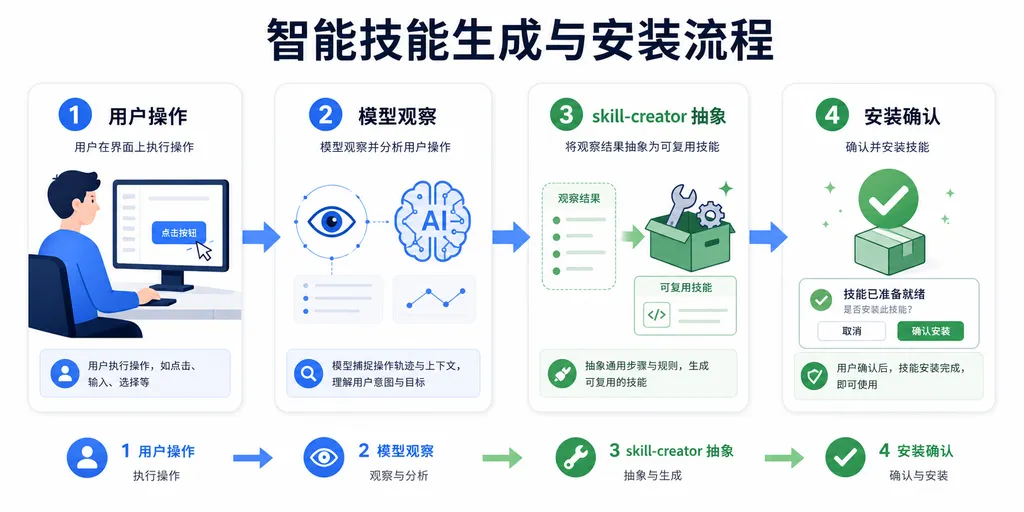
In early June, OpenAI quietly added some new features to ChatGPT. Public attention was mild, but the developer community was already buzzing: the Skills module began entering an “observe—generate” mode. Simply put, you no longer need to manually write out a Markdown telling ChatGPT “for this type of task, do it this way.” Instead, you can set it aside and let it watch you complete a task once; it will then abstract your process into a reusable, shareable Skill.
This is the second major acceleration after last year’s Skills for Codex, marking another step forward in Agent engineering. The feature chain, codenamed Hazelnut, has been partially reverse-engineered by developers; OpenAI’s Help Center quietly updated the Chinese Beta documentation for Skills, covering Business, Enterprise, Edu, Teachers, and Healthcare lines, with Codex and API also supported.
It might look like a small update, but in reality it signals the transition from the era of prompts to the era of skills.
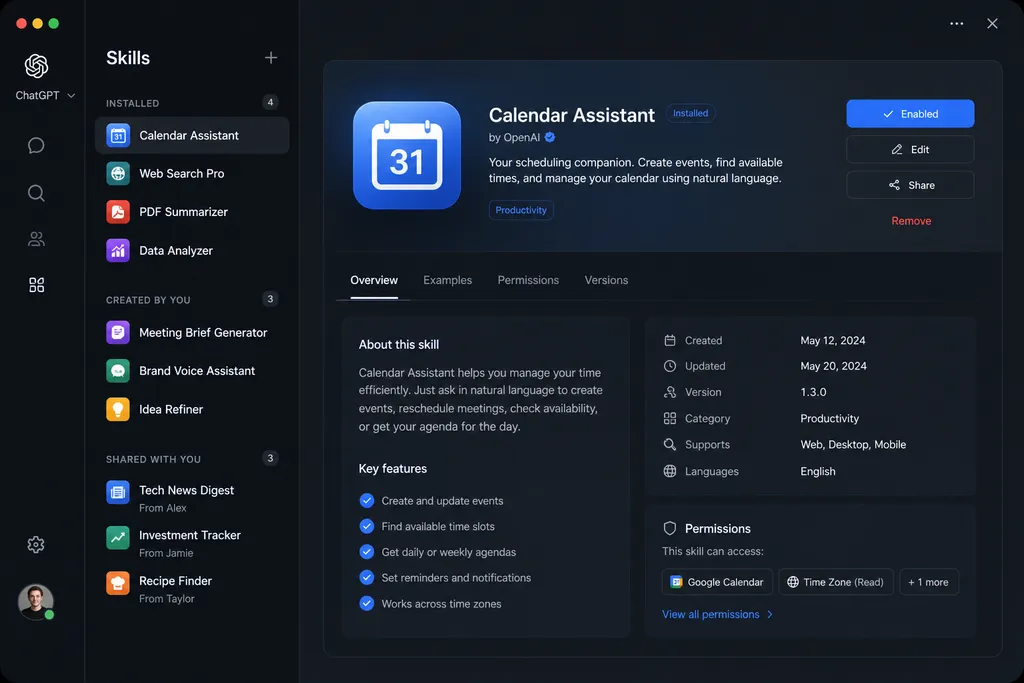
What exactly is a Skill? Stop mixing it up with MCP and Sub-Agent
These terms have been overused in the past half year, so let’s get them straight.
- Skill: A reusable workflow package — essentially a combination of instructions + examples + code/resources. Think of it as an SOP for the model, telling it “for this job, follow this routine.”
- Sub-Agent: Multiple model instances used to split a big job into smaller parts for parallel processing.
- MCP: Model Context Protocol — a connector for the model to interact with external systems, letting it, for example, read Linear tickets or modify GitHub PRs.
Using a cooking analogy: Skills are recipes, Sub-Agents are extra kitchen helpers, and MCP is the gas supply and refrigerator. They tackle different levels of problems, but together they make a fully functional Agent possible.
This upgrade’s core is about how recipes are written. Previously, you had to manually sit down and type out each step. In the new mode, after you complete a task, ChatGPT will proactively ask, “Do you want to save that process as a Skill?” It will then use its built-in skill-creator meta-skill to extract hidden decision points, call sequences, and file structures from your conversation, generating a ready-to-install skill package.
Why this deserves extra attention
The biggest pain point in prompt engineering isn’t writing prompts — it’s inconsistent prompts, poor knowledge sharing, and lack of reusability.
In a team of ten, there are ten prompt styles. For the same report generation task, A uses a 2,000-word “spell,” B uses three casual sentences, and C improvises each time. The result: “model performance is unstable.” In truth, the model is stable — your inputs aren’t.
Skill design aims to transform prompt engineering from “personal craft” into “team engineering assets”:
- Versionable: A Skill is essentially a file — you can review, diff, and roll it back.
- Shareable: Through workspace sharing, everyone in the team uses the same “standard answer.”
- Automatically invoked: Once installed, if ChatGPT detects the task matches a Skill, it applies it automatically — no need to manually
@it each time. - Cross-product migration: Skills follow the Agent Skills open standard, meaning a Skill built in ChatGPT can theoretically be downloaded and run in Codex or API.
The “observe workflow—auto-generate” step removes the last barrier: previously only someone with prompt engineering experience could produce high-quality Skills; now, an ordinary business user can complete a task once and have the system package it for them.
This mirrors Anthropic’s direction with Claude Projects and Skills; OpenAI’s move is more like catching up — and overtaking.
What can it actually do? From CI bug fixing to ticket processing
Developers have showcased typical use cases:
- GitHub CI auto-repair: Observes how you located and fixed CI errors several times, then generates a “CI Doctor” Skill. Next time something fails, it fetches logs, diagnoses, adjusts configuration, and files a PR automatically.
- Linear/Jira ticket workflows: Solidifies the SOP for changing ticket status, adding info, and linking PRs into a Skill. With MCP integration, human oversight is minimal.
- Code review templates: Turns the team’s review checklist into a Skill, automatically applying it to every incoming PR.
- Report generation: For structured outputs like finance or operations weekly reports, the Skill ensures consistency and avoids the model’s “creative improvisations.”
Note: Skills can include code. This means they aren’t just text instructions — they’re executable workflow units. That puts them a notch above traditional prompts, resembling “lightweight functions that can be scheduled by the model.”
Beta pitfalls you should know
Despite the pretty wording in the official docs, Skills currently have clear flaws:
- No cross-product sync: Docs state plainly, “Skills are not yet synced across products.” Moving a Skill from ChatGPT to Codex requires manual download and upload. The open standard is good, but the UX still lags.
- Enterprise/Edu disabled by default: Admins must manually enable permissions. This is for security but slows adoption.
- Security reviews for uploaded Skills: OpenAI scans uploads; suspicious ones get “Needs Review,” high-risk ones are “Blocked.” But they stress that “scans don’t replace your own judgment” — in other words, liability is yours.
- No access for individual Plus/Pro users (yet): Currently limited to enterprise/education/healthcare lines; independent developers must look to Codex and API versions.
Third-party Skill uploads deserve caution. Because Skills can carry code, there’s an opening for supply chain attacks — e.g., a “deployment assistant” Skill hiding malicious scripts could compromise a team once installed. The community is already discussing “Skill audit tools” akin to npm audit.
Compared to Anthropic and Google — where does OpenAI stand?
Looking sideways:
- Anthropic has long pushed the Projects + Skills combo in Claude; the Agent Skills open standard was originally led by them.
- Google’s Gemini Gems takes a “custom assistant” route, leaning toward personal use, with weaker engineering emphasis.
- OpenAI’s distinctive move is auto-generation — abstracting Skills from observed workflows. This kind of productized feature hasn’t been released by others yet.
OpenAI’s disadvantage is clear: the open standard was set by others, and they have to remain compatible — an unusual stance historically, showing a softened attitude toward Agent interoperability. No one wants to build another island.
On a deeper level, Skills pave the way for an Agent Marketplace. Once Skills are standardized, distributable, and billable, the next step is a marketplace — developers create Skills, enterprises pay to install them, and the platform takes a cut. This model was tried with GPTs with modest results, but Skills — as engineering assets for B2B — might tell a stronger story.
Practical tips for developers
If your enterprise account has access, here’s some advice:
- Don’t generate one huge Skill for the whole workflow: Larger Skills are harder to maintain. Split tasks into atomic mini-flows, generate one Skill each, and chain them.
- Value examples: In Skills, examples influence the model far more than bare instructions — include two or three good real-world cases.
- Make code idempotent: Since Skills can auto-trigger without your knowledge, write code assuming it may run repeatedly.
- Establish a Skill review process: Have a human review before team sharing — at least check for hardcoded tokens, internal addresses, or weird dependencies.
One more tip: OpenAI Hub (openai-hub.com) currently supports Skills-related API calls directly. Developers in China can locally test how a Skill runs in API mode with a single key, covering GPT, Claude, Gemini, DeepSeek, etc., without the hassle of VPNs and multi-platform setup.
Final thoughts
In 2024, everyone was focused on model capabilities. In 2025, Agents were the hot competition. By mid-2026, attention has shifted to “engineering Agents” — making Agent capabilities reproducible, shareable, and governable.
Skills are a key puzzle piece on this path. They’re not sexy — no launch events, no benchmark numbers — but every team trying to boost productivity with AI hits the “prompt asset” wall. OpenAI’s “observe-and-generate” lowers that wall so even regular business users can climb over.
The model-level arms race has hit diminishing returns; the engineering-level competition is just starting. Skills are only the first shot in that battle.
References
- OpenAI kicks off GPT’s workflow observation and auto skill generation mode - linux.do — Earliest discussion thread in China’s developer community about this feature, with actual screenshots and user feedback


