
minFLUX Release: Strip FLUX Down to the Basics, So You Can Truly Understand Diffusion Models

Developer Saurabh Purohit has open-sourced the minFLUX project, rewriting the core architectures of FLUX.1 and FLUX.2 with minimalist PyTorch code. Each line corresponds to the diffusers source code, providing researchers who find the official library difficult to digest with a shortcut.
Diffusers Are Too Heavy — Some People Can’t Take It Anymore
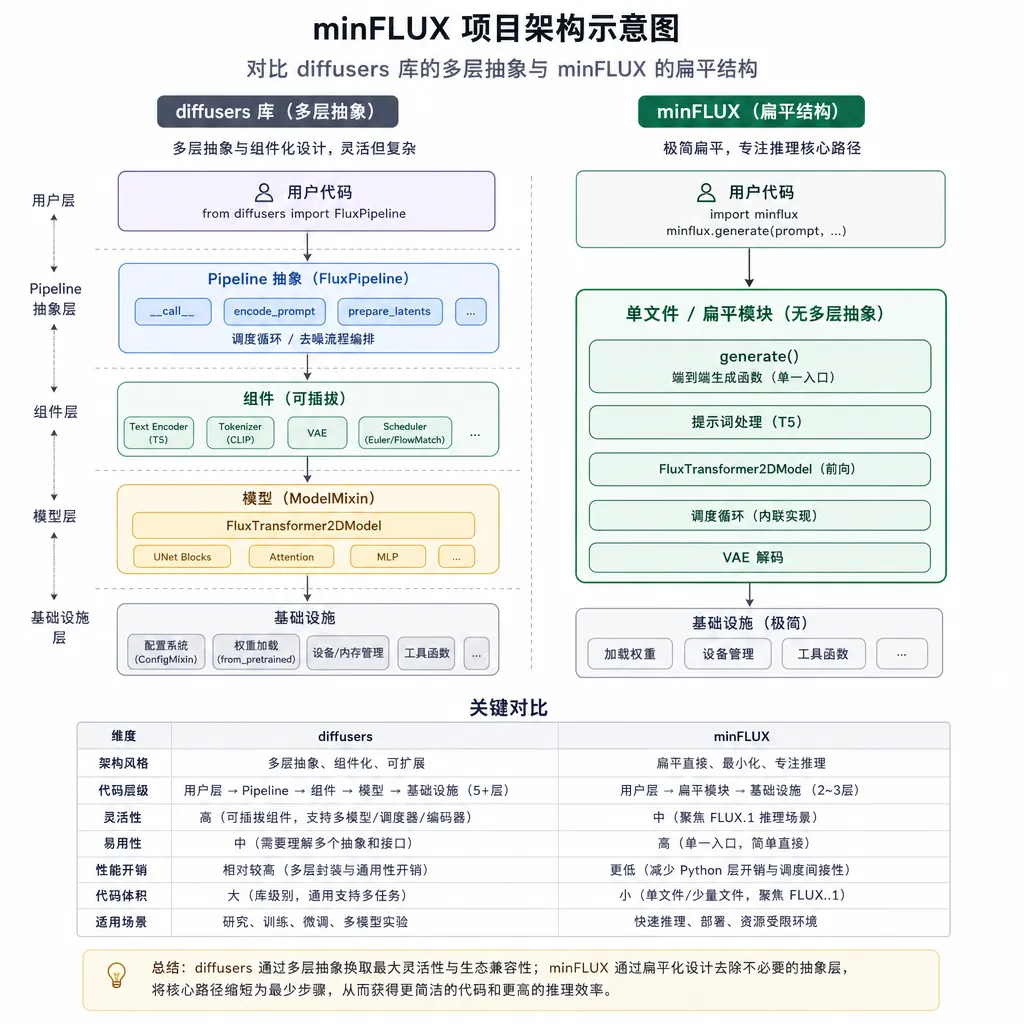
If you’ve been digging into FLUX’s source code recently, chances are you’ve had this experience: you open a FluxTransformer2DModel in the diffusers repo, only to get lost in seven or eight layers of Mixin, Config, PipelineCallback, and PEFT wrappers — clearly you just want to see how modulation is calculated inside a transformer block, but you have to traverse through three files’ inheritance chains first.
On June 19th, a developer named Saurabh Purohit posted his own solution on r/MachineLearning: minFLUX, a stripped-down implementation of FLUX that removes all abstractions and keeps only the core architecture and math. It’s open-sourced on GitHub with a very clear purpose — not for training production models, but for you to read.
The logic here is in the same vein as when Karpathy wrote minGPT back in the day. HuggingFace’s library is comprehensive and impeccable from an engineering standpoint, but for those who want to understand the model itself, the layers of encapsulation are just noise. What minFLUX does is strip away that noise and lay out the skeletons of FLUX.1 and FLUX.2 right in front of you.
What Does It Actually Include
According to the author’s README, minFLUX is quite restrained in what it provides:
- Minimal runnable implementations of FLUX.1 + FLUX.2, including VAE and the transformer backbone
- Every line of code annotated with the corresponding location in HuggingFace diffusers — this is arguably minFLUX’s most valuable feature, letting you read the simplified version while cross-referencing the more complex official implementation
- Training loop: VAE encode → flow matching → velocity MSE
- Inference loop: noise → Euler ODE → VAE decode
- Shared utilities: RoPE positional encoding, timestep embedding, etc.
Note there’s no LoRA adapters here, no ControlNet interface, no pluggable schedulers — even backend selection for attention is removed. This approach is disastrous in production but a luxury in a learning setting — you don’t need to keep a bunch of if/else branches in your head.
Flow Matching: The Training Paradigm of the FLUX Series
The most worthwhile parts in minFLUX to read are actually the paired training and inference loops. Unlike DDPM-style noise prediction, FLUX uses flow matching — directly learning a velocity field from noise to data, with the loss function being the MSE between predicted velocity and true velocity.
In plain terms, traditional diffusion models teach the model “guess how much noise has been added to this image,” while flow matching teaches it “at this moment, which direction should the pixels move.” Mathematically, the two are equivalent, but flow matching’s training is more stable, and at inference you can directly use an ODE solver (like Euler’s method) to step noise back into the image — no complex DDIM scheduling required.
In minFLUX, this whole process is compressed into a few dozen lines of runnable code. For researchers in generative models, this kind of “once you see it, you get it” implementation is hugely valuable — far more intuitive than chewing through formulas in a paper.
FLUX.2 Is Not Just a Scaled-Up Version
The author emphasized a key finding in the post: FLUX.2 is not simply a scaled-up FLUX.1. After rewriting both versions from scratch, he listed FLUX.2’s real changes:
- Transformer block structure adjustments
- Overhaul of modulation mechanism
- FFN layer modifications
- Different VAE normalization method
- Position IDs handling logic changes
This lines up with Black Forest Labs’ statement upon FLUX.2’s release last November — “a brand-new architecture, trained from scratch” — though at the time it was hard for outsiders to judge what exactly was “new.” minFLUX’s side-by-side implementation essentially performs a code-level diff, translating marketing speak into concrete engineering changes.
If you previously fine-tuned or trained LoRA on FLUX.1, those experiences may not directly carry over to FLUX.2. Changes in modulation and position IDs alone are enough to require retuning some hyperparameters. This is the kind of insight minFLUX can provide — you won’t find it in HuggingFace’s model card.
Why There’s Always Someone Making “minXXX” Projects
Looking back: minGPT, nanoGPT, minLLaMA, minSDXL, minDiT, and now minFLUX — whenever a star model appears, someone makes a slimmed-down version. The reason is simple: official implementations are for use, minimal versions are for understanding.
These goals are entirely different. Official code must consider distributed training, mixed precision, inference backend compatibility, features from community contributions — inevitably bloating the code. But when you want to figure out why a model works, all those engineering details are distractions.
For AI systems researchers, minimal versions have another purpose: as a starting point for modifications. Want to change attention? Try a new positional encoding? Swap the VAE? Experimenting on minFLUX costs an order of magnitude less than working inside full diffusers. Even if you eventually port changes back to the official library, validating your idea on the minimal version saves time.
Who It’s For, Who It’s Not For
Let’s be direct:
For:
- Researchers and students wanting to understand modern diffusion model architectures
- Engineers building their own diffusion training frameworks who need a clean reference
- Researchers aiming to make architectural changes to FLUX (not lightweight LoRA tweaks)
- Teachers needing to explain diffusion models thoroughly in AI courses
Not For:
- Users wanting to directly run inference and generate images — just use the official diffusers pipeline, it’s only a few lines
- Teams doing production deployment — the minimal version lacks attention optimization, quantization, and scheduler selection, so performance trails official
- Those planning to do LoRA fine-tuning — the ecosystem is on diffusers; minFLUX doesn’t need to reinvent it
With these boundaries drawn, minFLUX’s value becomes clear: it’s not a replacement for diffusers, it’s the annotated edition.
A Side Note: The Health of the Open Diffusion Ecosystem
Incidentally, since FLUX.2 was released last year, Black Forest Labs’ open-source strategy has been fairly restrained — releasing dev version weights and leaving plenty of room for the community to develop the ecosystem. From ComfyUI nodes to various LoRAs to now this minimal implementation, the FLUX series has built a relatively complete developer community. This contrasts sharply with the semi-open, complaint-heavy early days of Stable Diffusion 3.
Open source isn’t just about dropping weights; it’s also about letting the community read, modify, and teach. Projects like minFLUX essentially act as an “readability supplement” for the official release. If you’re using FLUX APIs via OpenAI Hub for applications, understanding the underlying architecture won’t hurt — at least when tweaking sampling steps or CFG scale, you’ll know what you’re doing rather than adjusting parameters blindly.
How to Get Started
Project address: GitHub purohit10saurabh/minFLUX. Suggested reading order:
- Start with
flow_matching.py(the training objective) - Then read the Euler ODE solver in the inference loop
- Move to the transformer block, cross-referencing the author’s annotated diffusers line numbers
- Finally read the diff between FLUX.1 and FLUX.2 to understand architecture evolution
If you’ve given up halfway through diffusers before, give it another try — but this time, don’t start from from diffusers import FluxPipeline, start from minFLUX’s README.
References
- minFLUX project home - GitHub: Author’s open-source minimal FLUX implementation, including both FLUX.1 and FLUX.2 versions
- Reddit r/MachineLearning announcement thread: Author’s first public post about the project and design motivation, with architecture details discussed in the comments


