
The Atlantic Unveiled the AI Music Training Dataset: 21 Million Songs Searchable

*The Atlantic* journalist Alex Reisner publicly disclosed four datasets used to train AI music models, the largest of which comes from LAION and contains 12.32 million YouTube tracks. Google and Stability AI have confirmed in papers that they have used part of this data.
21 Million Songs, Completely Exposed
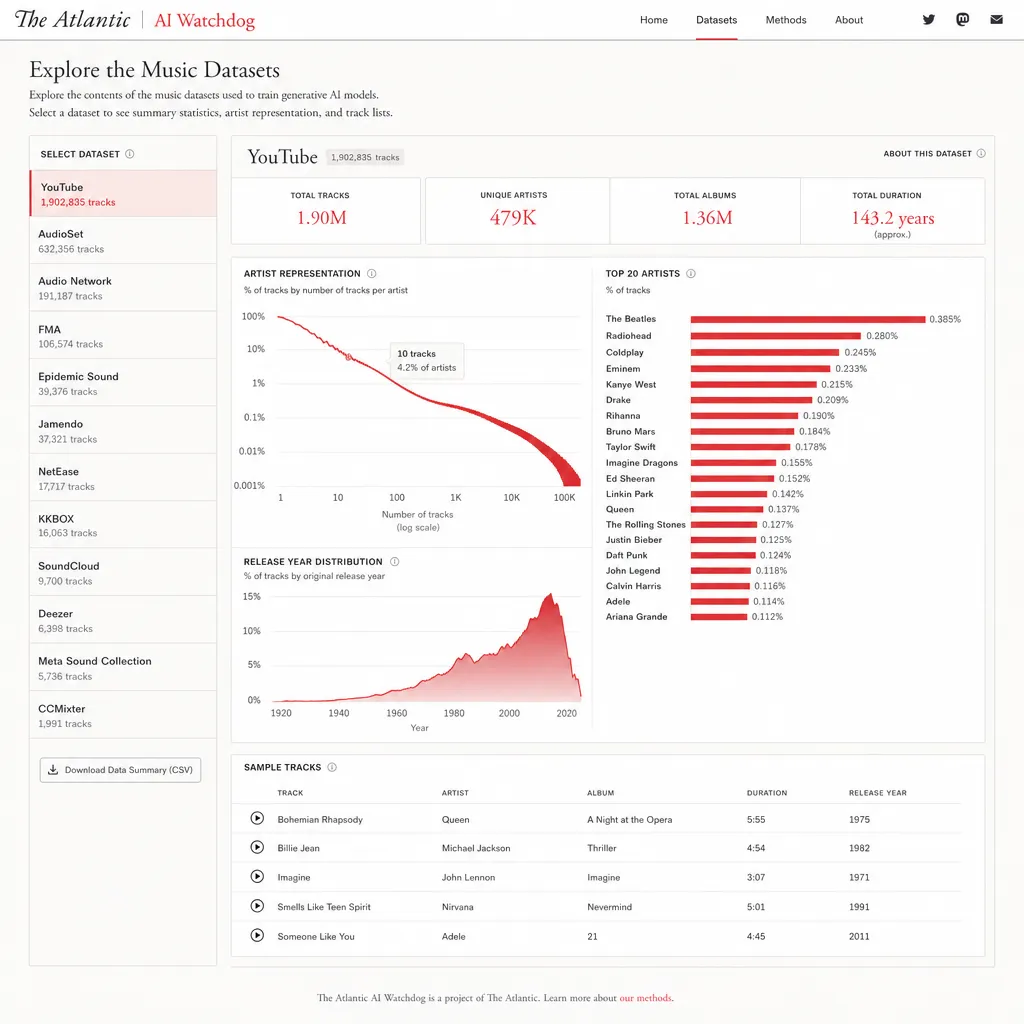
Last week, The Atlantic dropped something the AI music community really didn’t want to see: a searchable database that lays out in public the four music training datasets currently circulating in AI development circles. Anyone can go in and check—whether a particular song of yours is in there.
This was done by journalist Alex Reisner. It’s not the first time he’s done something like this—The Atlantic’s AI Watchdog series previously dug into LibGen, exposing the pirated book library used to train large models, which left Meta embarrassed for a while. This time, it’s music’s turn.
The four datasets combined have a staggering scale:
- LAION-DISCO-12M: 12.32 million YouTube-scraped tracks, total duration 91 years
- A large, unnamed dataset: about 9 million tracks
- Spotify Tracks Dataset: 114,000 tracks pulled from Spotify, anonymously uploaded to Hugging Face, downloaded over 70,000 times as of May 2026
- Free Music Archive Dataset (FMA): 106,574 tracks curated by EPFL in 2016
The FMA’s size might not sound like much—but don’t forget Stability AI used a 13,874-track subset to train a model, and Google admitted in papers to using it too. This isn’t a "gray area"—it’s a publicly acknowledged fact.
Where Did This Data Come From? Is It Legal?
The legality of the four collections varies, but none are clean.
LAION-DISCO-12M comes from German nonprofit LAION—you’ve probably heard the name, they created the LAION-5B text-image dataset used to train Stable Diffusion. LAION has received funding from Hugging Face and former Stability AI CEO Emad Mostaque. How did they get 12.32 million tracks? Scraping YouTube. YouTube’s terms of service explicitly forbid unauthorized downloads, but in academia, this kind of approach in dataset creation has become standard practice in AI circles.
The FMA dataset is a bit more "respectable," with most tracks under Creative Commons licenses—but there’s a detail in CC licensing that many ignore: most CC licenses require attribution and prohibit commercial use. Is training an AI model "commercial use"? Is selling the trained model? No legal precedent exists yet. But when companies like Google and Stability use it, it’s hard to argue it’s non-commercial.
The Spotify Tracks Dataset is the most outrageous. Spotify itself has nothing to do with it—an anonymous developer scraped 114,000 tracks from the platform and uploaded them to Hugging Face. Download count: 70,000+. Hugging Face’s content moderation is mostly reactive—datasets only get taken down when specifically flagged.
As for the remaining 9 million-track dataset, The Atlantic has disclosed no further details—likely to avoid infringement lawsuits. It’s reasonable to assume the provenance isn’t clean.
Why Reveal This Now?
Timing is key.
AI music generation companies Suno and Udio have been sued by the RIAA for over a year now. The central question: where did the training data come from? Suno’s prior response was "training data is a trade secret," while Udio openly admitted to using "publicly available music on the open web"—but refused to specify which.
Reisner’s work essentially provides "corroboration" for what these companies wouldn’t admit. Even if Suno and Udio didn’t directly use these four datasets, the industry’s attitude toward training data sources is now obvious.
The Atlantic report also named specific examples: Suno-generated tracks closely resembling Michael Jackson’s Thriller, Ed Sheeran’s Shape of You, and Chuck Berry’s Johnny B. Goode. This isn’t mere "style inspiration"—it’s a memorization problem. AI systems reproduce fragments of content they’ve seen in training data. This is both a technical and legal issue.
Earlier this year Spotify cleared 75 million "junk" AI-generated songs, and Sony found 135,000 AI-generated tracks under its artists’ names that they hadn’t made. The music industry now faces a double bind: their works are taken for training, and the resulting models flood their own distribution channels with AI content.
What Does a Searchable Database Mean?
Technically speaking, The Atlantic’s tool isn’t complex—metadata indexing plus search interface, essentially integrating scattered dataset cards from Hugging Face into a front end. Its impact lies in lowering the barrier for rights enforcement.
Previously, an indie musician wanting to know if their song had been used in training would have to manually search Hugging Face dataset READMEs, download gigabytes of metadata files, and write scripts to grep them. Now they can just type a song title into a web page.
In the coming months this means:
- A ready-made evidence library for class actions. Law firms just need to organize musicians to search, take screenshots, and build an evidence chain.
- Dataset distribution will go underground. Music datasets on public platforms like Hugging Face will likely be mass-removed, but distribution via BT or IPFS won’t stop.
- "Training data transparency" will become a mandatory label for AI music products. Without clear disclosure of training data, Suno and Udio will be barred from mainstream distribution channels.
For developers, there’s another angle here: dataset governance. LAION is a nonprofit, but effectively serves as a "white glove" service provider for commercial companies—outsourcing the legally risky data collection phase to a nonprofit, so companies can say they only "use public datasets." This tactic has already been challenged in the text-to-image field (Getty Images vs Stability AI), now it’s music’s turn.
Lessons for AI Engineers
If you’re building or planning to build a generative audio model, this incident should remind you of at least three points:
First, make data compliance a precondition. The era of training with third-party datasets like LAION is ending—at least for audio and visual domains. Adobe Firefly’s approach of "all licensed material" is slower and more expensive, but carries minimal legal risk. Sony Music is already negotiating licensing deals with several AI companies; prices will be high, but compliant.
Second, address memorization at the evaluation stage. Suno’s biggest headache isn’t "which data was used," but "outputs can be reverse-matched to training samples." This is a technical problem, not a legal one—better deduplication, data augmentation, and training objective design can significantly reduce memorization. Every audio generation company will eventually need to clear this hurdle.
Third, integrate metadata and attribution systems from the start. The C2PA content provenance standard is gaining traction in imagery, and similar initiatives are moving forward in audio. Early adoption is more cost-effective than being forced to retrofit later.
Platform and Tool Reactions
As of publishing, Hugging Face has not publicly addressed whether it will remove these datasets. Based on past practice, datasets like Spotify Tracks Dataset, which are clearly infringing, will likely be removed first; LAION-DISCO-12M, uploaded by "research institutions," may remain but with warning labels.
Google admitted in research papers it used the FMA dataset to train generative models, but has maintained a stance of "research use" + "no direct model commercialization." Stability AI is in a more awkward position—the company has undergone restructuring, and how to handle the legal legacy after Emad Mostaque’s departure remains unclear.
Chinese AI music products, such as those generating lyrics or accompaniment, are still operating in a regulatory gray area. But given China’s regulatory stance on generative AI training data (Interim Measures for the Management of Generative AI Services explicitly require legal sourcing), the domestic tightening window may arrive sooner than overseas.
Final Thoughts
This isn’t an isolated incident. From the exposure of the LibGen book library, to copyright content issues in Common Crawl, and now music datasets, every link in the AI training data chain is being scrutinized.
Some in the developer community argue: "If all training data needs licensing, AI can’t develop." That’s half right. The text and image domains have proven that licensed data plus synthetic data can produce competitive models—just more expensive and slower. The music domain will likely follow a similar path.
As a side note, OpenAI Hub (openai-hub.com) has integrated mainstream multimodal and audio generation models; Chinese developers can directly call them using the OpenAI-compatible format, avoiding the hassle of compliant self-building—though each company still needs to face the training data issue themselves.
In the short term, AI music generation’s landscape may reshuffle. Aggressive players like Suno and Udio must either obtain licenses or brace for hefty payouts. Conservative players such as Adobe and Stability (if it survives) may use compliance to reclaim market share. For the industry, this revelation is less a crisis and more the inevitable reckoning.
References
- Hugging Face Datasets Platform — hosting platform for implicated datasets Spotify Tracks Dataset and LAION-DISCO-12M, core distribution channel in this incident
- LAION’s Organization Page on Hugging Face — central repository of LAION’s public audio/video datasets, including DISCO series metadata


