
Cloudflare Opened a Backdoor for AI Agents: Instant Deployment Without Registration

Cloudflare launches Temporary Accounts. With just `wrangler deploy --temporary`, an AI Agent can get a temporary account valid for 60 minutes and deploy a Worker, bypassing all registration and OAuth processes designed for humans.
Cloudflare Once Again Removes a Barrier for Agents
On June 19, during Agents Week, Cloudflare dropped what seemed like a small feature but was actually quite radical: Temporary Cloudflare Accounts. In short — AI Agents can now completely skip registration and login, directly deploying a Worker to run on Cloudflare’s edge network.
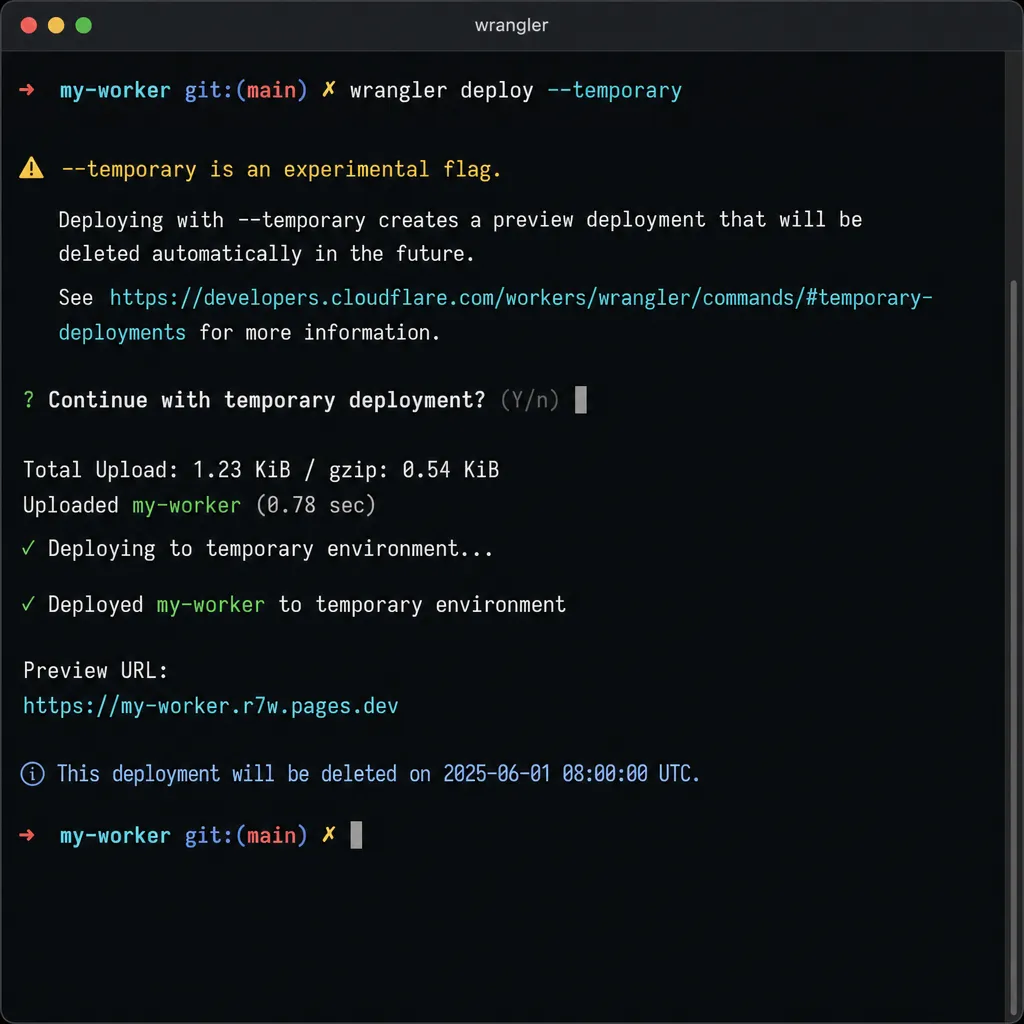
The command is so simple it hardly feels like a product launch from 2026:
wrangler deploy --temporary
Press Enter. Seconds later, the Agent has a publicly accessible Worker URL in hand and can curl the freshly generated code to verify if it’s working. The temporary account lasts 60 minutes, during which human developers can use a Claim URL to “claim” it into their own permanent account; if ignored, it expires automatically — clean and fast.
This is one of the most direct infrastructure moves I’ve seen in the past two years acknowledging “Agents are first-class citizens.”
Why This Is Not a Gimmick
First, let’s clarify the problem.
Nowadays, more and more code-writing is done by Agents: Claude Code, Cursor Agent, Codex CLI, various custom harnesses — under the hood, they’re all running LLMs. If you’ve used these tools, you know that writing the code is smooth; the real bottleneck is always “go live”.
Previously, the workflow looked like this: The Agent writes a Worker, gets ready to wrangler deploy, then Wrangler prompts you to log in. Wrangler tries to open a browser, runs OAuth, jumps to the Cloudflare dashboard, asks you to click “agree,” maybe pass MFA, and only then hands the token back to the CLI.
This process is designed for humans. If you’re sitting at the computer, it’s no big deal. But an Agent isn’t a human — it can’t switch windows, can’t scan a QR code, it can’t even ask you “Boss, can you log me in?” — especially for those running on the cloud, working in the background at night.
The result: the Agent stalls. It either gives up or tries deploying the same Worker somewhere else — Vercel, Deno Deploy, Netlify, etc. What Cloudflare is doing here essentially acknowledges: The race for the Agent deployment entry point has begun — whoever reduces friction to zero first will capture this wave of traffic.
How This Feature Actually Works
The mechanism is pretty clever.
First problem: How does an Agent know there’s a new --temporary flag? It’s not in the Agent’s training data, documentation just came out, so the LLM can’t magically know.
Cloudflare’s solution was to modify Wrangler itself. When an Agent tries wrangler deploy without being logged in, the CLI doesn’t just say “please log in,” but instead injects a message specifically for Agents: Hey, if you’re an AI Agent and can’t go through browser login, you can add the --temporary flag to use a temporary account.
This is classic prompt-in-the-loop design. The CLI’s stderr/stdout now forms part of the Agent’s working memory — Wrangler is essentially “talking” to the Agent. This design aligns with MCP and Codemode — don’t assume Agents learn tools from docs; let tools proactively teach Agents at runtime.
The Agent sees the prompt, reruns the command with --temporary, and the Cloudflare backend does:
- Create a temporary account with assigned resource quota
- Generate a temporary API token and feed it to Wrangler
- Return a Claim URL for the Agent to pass to a human
- Actually deploy the Worker and give it a workers.dev subdomain
Within 60 minutes, the Agent can repeatedly modify, redeploy, and verify code within this temporary account. This is what Cloudflare calls the “write → deploy → verify loop” — Agents’ superpower is “fast trial-and-error,” and the prerequisite is a short feedback loop.
“Cheap, Disposable Deployment Targets”
A quote worth noting from Cloudflare’s official blog:
Agents need cheap, disposable deployment targets so they can curl their own output and determine if they got it right.
On the surface, that’s product description; underneath, it’s a statement of a new development paradigm.
Traditional deployment is a ceremony: confirm the code is fine, set up CI/CD, pass review, deploy to staging, then to prod. Each deployment is heavy because it’s assumed to be “serious.”
Agent deployment logic is the opposite. It doesn’t know if its code is correct; it needs to throw it out and run it to see what the output looks like. This means deployments in the Agent era must be disposable, throwaway, frictionless — similar to Docker containers or Vercel Previews, but even more radical.
The temporary account abstraction is implicitly answering a question: When deployment becomes as cheap as a function call, how should “human protocols” like account, quota, and billing be handled? Cloudflare’s answer: Let the Agent run first; if it works, then have a human claim it. Push the binding of identity and resources to the final step.
A Piece of the Agents Week Puzzle
Looking sideways at Cloudflare’s moves this week makes temporary accounts even more interesting:
- Agent Lee: AI assistant in the dashboard; converts MCP tools to TypeScript APIs with Codemode so models can directly write code to call them
- Project Think: Preview of the next-gen Agents SDK
- Artifacts: Git-compatible versioned storage for Agents
- Cloudflare One stack: Agent-driven deployment
- Agent Cloud × OpenAI: Enterprises can directly call GPT-5.4 within Agent Cloud
Put these together and the intent is clear: Cloudflare isn’t just “adding AI to products,” it’s rebuilding the entire developer platform as an Agent-native execution environment. Temporary accounts solve “the entry moment,” Artifacts solve code persistence, Project Think solves Agent orchestration, Agent Cloud solves model inference.
The upstream-downstream chain is basically closed.
How It Compares to Vercel and Deno
To be fair, Cloudflare isn’t the first to think of “letting Agents deploy directly.”
Vercel’s v0 already does something similar but more productized: interact with v0, it generates a project hosted in Vercel’s sandbox. Deno Deploy also supports Agent-friendly token management. But these still require account binding and SDK use.
Cloudflare’s differentiation is in two points:
- Zero binding: absolutely no prior registration. This is truly “Agent-first principle” — assuming the caller is a process with no credentials.
- Using CLI over SDK: Wrangler is a veteran CLI, with docs everywhere, seen by all major code-writing Agents during training. Cloudflare doesn’t need to train Agents to use a new API — just change Wrangler’s behavior slightly.
The second point is key. In the Agent era, SDK design should prioritize coverage in LLM training data over API elegance. Cloudflare clearly understands this.
Security and Abuse Risks
When you hear “no registration, no authentication, instantly get a machine to run code,” security folks’ ears perk up — isn’t that a perfect abuse tool?
Cloudflare didn’t elaborate on abuse prevention in the blog, but design suggests:
- Strict resource quotas for temporary accounts; expires after 60 minutes
- Workers run in Cloudflare’s isolate sandbox with strong isolation
- Outbound traffic can be monitored by Cloudflare’s own WAF/Bot Management
- Temporary API token can’t be used laterally
That said, without extra rate limits and fingerprinting, the cost for phishing pages, crypto mining, or open proxies could be pushed very low. Likely Cloudflare’s approach is “release it, watch market reaction, then add defenses” — which is consistent with their usual product rhythm.
What It Means for Developers
If you regularly use coding Agents, this feature immediately changes two things:
First, iteration speed goes up a notch. Previously, if you had Cursor Agent write a small tool to test, you had to spin up a local server yourself. Now you can have it deploy directly to Cloudflare, get a real URL, curl it, and verify instantly.
Second, you can seriously consider workflows where Agents autonomously deliver small projects. For example: “Write a service that converts an RSS feed to a webhook,” Agent writes code, deploys, verifies, sends you the Claim URL. You click once and the service is yours — without switching windows.
The implicit meaning: “Letting Agents own cloud resources themselves” is now real. The next step could be temporary databases, temporary object storage, temporary queues. Cloudflare’s D1, R2, Queues suite could follow with similar ephemeral modes.
Some Extended Thoughts
Back to the broader question: The “human-machine interaction boundary” of infrastructure is being redrawn.
Over the past decade, cloud providers competed on how beautiful their console UI was, how thorough their documentation, how handy their CLI — all metrics for humans. AWS, GCP, Azure’s consoles are so complex no one can fully grasp them, but they provide countless tutorials so you can learn.
Agents don’t need tutorials; Agents need predictable, machine-readable, self-describing interfaces at runtime. Temporary accounts, in-CLI hints, Codemode converting MCP to TypeScript — these are different facets of the same idea: Shift cognitive load from “teaching humans” to “teaching models.”
Cloudflare is moving faster than most traditional cloud giants simply because — they don’t have entrenched human user habits to protect, Workers platform is dev-driven, CLI-first. AWS wanting to do similar would have to explain how IAM’s 50 roles can be made temporary — that alone could take half a year of meetings.
For OpenAI Hub developers, temporary accounts combined with GPT-5.4, Claude 4.5, Gemini 3 tool-use capabilities make a smooth combo: Agent calls models via OpenAI Hub to generate Worker code, then deploys via Wrangler --temporary — an end-to-end “idea to production” pipeline with almost no human intervention.
Whether this will become mainstream? My bet is yes, though not necessarily Cloudflare dominating. Once “Agent-native frictionless deployment” proves viable, all cloud providers will follow. Cloudflare’s strengths are first-mover advantage and Workers’ architecture suiting disposable deployment, but Vercel, Fly.io, Render will catch up quickly.
This is a battle worth watching.
References
- linux.do community discussion: Agents can now deploy temporary services using temporary Cloudflare accounts — Chinese translation and discussion of Cloudflare’s official blog
- linux.do community discussion: Cyber Bodhisattva Cloudflare strikes yet again — Domestic developers’ reactions to the temporary account feature


