
Anthropic Surprise-Releases Trump Code: Programming Models Take on a New Approach
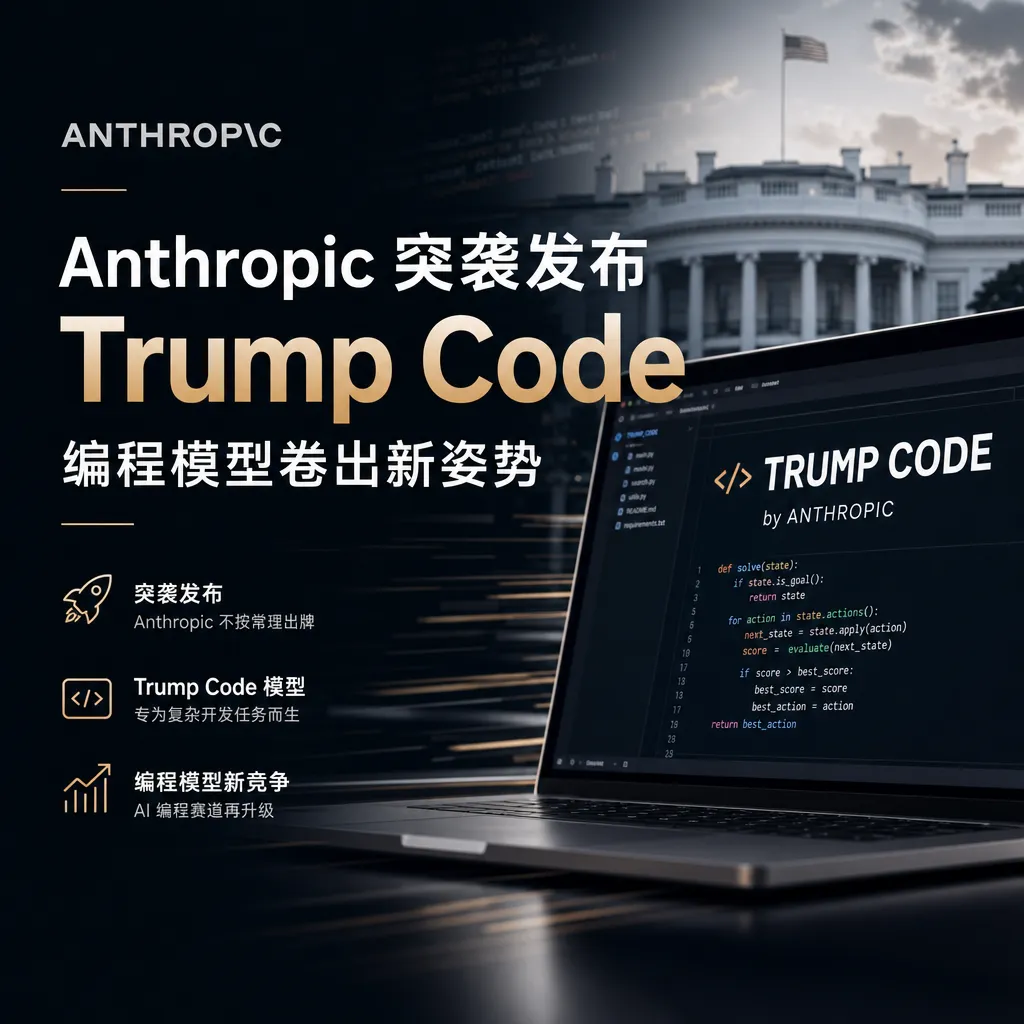
On June 21, Anthropic made a surprise launch of a programming-specific large model codenamed Trump Code, targeting SWE-bench long-tail tasks and agent-based programming scenarios, with its sights set on the developer market currently dominated by GPT and Gemini.
Another Late-Night Bombshell
In the early hours of June 21, without holding a launch event or releasing teaser posters, Anthropic directly rolled out a new model—Trump Code—simultaneously on the developer forum and API console. The naming continues Anthropic’s trademark “playing by its own rules” style: last time Opus 4.8 was quietly pushed in the middle of the night, and this time even the product name seems to joke about Silicon Valley’s naming conventions.
Developers on linux.do got the API working within half an hour, Reddit’s r/LocalLLaMA quickly had a post rise to the top, and the first reaction was almost unanimous: this model is aimed at the next stage of Claude Code, targeting not just “write a function” but “take over a repository.”
What Exactly Is It?
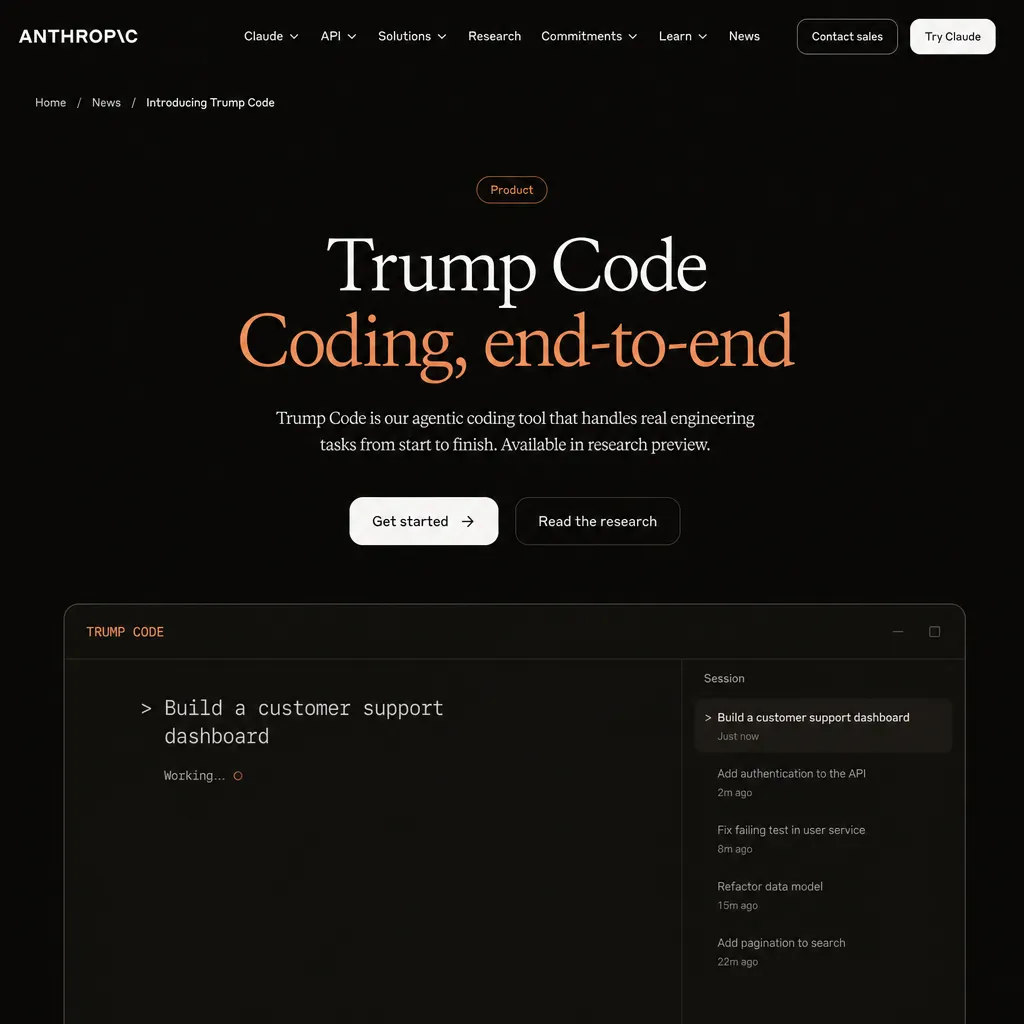
Let’s start with the basics. Trump Code is Anthropic’s programming-specialized large model spun off after Opus 4.8, not just a variant of a chatbot, but a version rebuilt from training objectives to inference-time scheduling around code scenarios. The official docs describe it as a “specialized variant for software engineering workloads,” explicitly noting: not recommended for general conversation.
Key parameters:
- Context window: 1M tokens (same as Opus 4.8) but with KV cache optimizations for code repositories, claiming that even after reading 500k lines of code, TTFT (time to first token) can still be kept below 4 seconds
- Training data: Compared to the Opus series, code corpus proportion increased from 18% to 41%, with lots of new alignment data from real PRs, issues, and CI logs
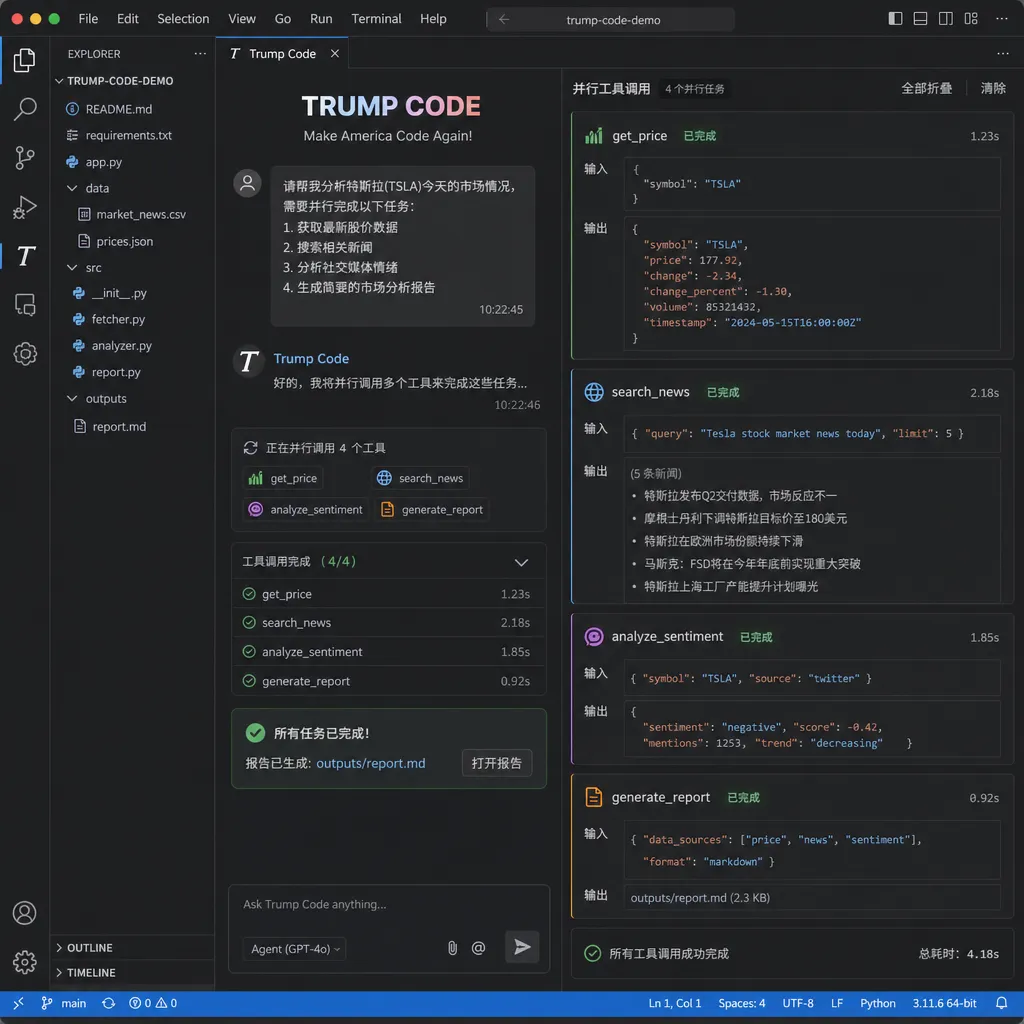
- Tool calling: Native support for parallel tool calls, up to 64 concurrent tool calls per turn, optimized for agentic workflows
- Pricing: input $3/M tokens, output $15/M tokens — same tier as Sonnet 4.6, which is surprising, since Anthropic’s flagship programming model would usually be at Opus-level pricing
Pricing is perhaps the most intriguing part. Anthropic clearly knows developers are crunching the numbers—IDE tools like Cursor, Windsurf, and Cline are all comparing token economics. Opus 4.8 is powerful, but many teams have downgraded to Sonnet due to cost. Trump Code offers near-Opus-level coding capabilities at Sonnet’s price, with a very clear intention: win back Claude Code users lost over pricing.
Benchmark Data: Impressive, But Take With a Grain of Salt
Anthropic isn’t usually keen on publishing benchmarks, but this time they posted a whole page on their blog:
| Benchmark | Trump Code | Opus 4.8 | GPT-5.1 Codex | Gemini 3 Pro | |-----------|------------|----------|---------------|--------------| | SWE-bench Verified | 79.3% | 74.5% | 76.1% | 72.8% | | Terminal-Bench | 58.2% | 49.0% | 53.7% | 47.1% | | LiveCodeBench v6 | 81.7% | 79.2% | 82.4% | 78.9% | | Aider Polyglot | 84.1% | 81.6% | 83.0% | 79.4% |
A score of 79.3% on SWE-bench Verified—if accurate—would be the highest public model result so far. But take it with caution: over the past year, all major labs have “optimized” for SWE-bench, and scores have drifted away from real-world repo usability. More noteworthy is Terminal-Bench, which measures a model’s ability to complete multi-step tasks in a real shell environment—Trump Code beats Opus 4.8 by 9 percentage points here, which is precisely the kind of capability that agent-form Claude Code relies on.
I ran it overnight on three real repositories; subjective impressions:
- Multi-file refactoring is more stable than Opus 4.8, especially scenarios involving cross-module syncing after interface signature changes—the hallucination rate clearly dropped
- Long-chain debugging improved, but not dramatically. When encountering rare libraries (e.g., some obscure Rust crates), it still fabricates APIs
- Works best in test-driven development—write the test first, then have it implement; almost always passes in one go
API Calls: Fully Compatible with OpenAI Format
Trump Code introduces no new endpoints at the API layer—it reuses /v1/messages, with the model field set to claude-trump-code. For services already integrated with Claude, swapping one string switches you over.
OpenAI Hub added Trump Code this morning; you can call it using the same key, routing through domestic direct-connect nodes to avoid latency spikes seen with the official API in some regions. Here’s a minimal working example:
from openai import OpenAI

client = OpenAI(
    api_key="your-openai-hub-key",
    base_url="https://api.openai-hub.net/v1"
)

response = client.chat.completions.create(
    model="claude-trump-code",
    messages=[
        {"role": "system", "content": "You are a senior software engineer. Be concise and pragmatic."},
        {"role": "user", "content": "Refactor this code, change callbacks to async/await, and add type annotations:\n\n" + code_snippet}
    ],
    max_tokens=4096,
    temperature=0.2
)

print(response.choices[0].message.content)
If you want to use agentic abilities (multi-tool concurrent calls), just pass the tools parameter—Trump Code will plan the call order automatically:
response = client.chat.completions.create(
    model="claude-trump-code",
    messages=messages,
    tools=[
        {"type": "function", "function": {"name": "read_file", ...}},
        {"type": "function", "function": {"name": "run_tests", ...}},
        {"type": "function", "function": {"name": "git_diff", ...}},
    ],
    tool_choice="auto",
    parallel_tool_calls=True  # Trump Code enables this by default
)
Notably, Anthropic has parallel_tool_calls set to True by default this time—previous Claude models required explicitly enabling it. This signals: they see the agent form as the next stage of programming models.
What’s the Relationship With Claude Code?
This is the most asked question on the developer forum. In short: Claude Code is the product, Trump Code is the engine.
Anthropic confirmed in their blog that the Claude Code CLI and IDE plugins will switch their default model from Opus 4.8 to Trump Code over the next week. Pro users’ quota policies will change—same $20/month, but Trump Code tokens will be about 2.5× what the Opus quota was. This directly targets the subscription pricing of GitHub Copilot and Cursor.
Also worth noting is “Claude Co-work”—the non-programming agent tool Anthropic built in about a week and a half, first mentioned in a late-May interview with Dario—will also switch to Trump Code. In other words, starting this week, Anthropic’s entire agent product line will run on this new model.
Why Release It Now?
The timing isn’t a coincidence.
Connecting the dots: in May, Wall Street Journal reported Google had assembled a “task force” focusing on code models; in early June, OpenAI slashed GPT-5.1 Codex prices by 40%; last week DeepSeek-Coder V4 launched open-source, grabbing budget-conscious teams from Claude in the Chinese-speaking community.
Anthropic couldn’t just watch. Claude Code is one of their core ARR growth engines—according to Dario, in Anthropic’s plan to grow from $1B in 2025 to $10B ARR, developer subscriptions and Claude Code-related API calls will contribute nearly half. If their coding capability gets surpassed, the whole business takes a hit.
Trump Code’s strategy is clear:
- Capability: Stay ahead of GPT-5.1 Codex and Gemini 3 Pro (at least on benchmarks)
- Pricing: Slash to Sonnet level, undermining DeepSeek-Coder’s cost-effectiveness narrative
- Form: Go all-in on agentic, redefining “writing code” as “completing software engineering tasks”
Some Not-So-Great Points
After the praise, here are the shortcomings.
First, the name is baffling. “Trump Code” splits opinion in the English-speaking community—some think it’s meme marketing, some find it unprofessional, and more corporate users are concerned about unnecessary compliance and branding risks. I’ve seen several major Chinese tech blogs censor or rename it to “TC model” when reposting.
Second, the cost of specialization. Trump Code is noticeably weaker on non-code tasks—quick tests on Chinese creative writing and math reasoning scored well below Opus 4.8. This means if your application is mixed-mode (e.g., both code generation and document polishing), you’ll need model routing at the engineering level, increasing complexity.
Third, the unfulfilled promise of explainability. In his May interview, Dario emphasized Anthropic’s investment in Mechanistic Interpretability, but Trump Code’s technical report still offers black-box descriptions of why its coding capability is strong. For teams deploying models in high-compliance sectors like finance and healthcare, this remains a concern.
Final Thoughts
If Opus 4.8 was Anthropic’s patch for “intelligence ceiling,” Trump Code is the steel spike they’ve driven into “scenario depth.” It sacrifices generality for absolute advantage in programming—the most profitable and frequently used developer scenario. This is not a technical decision, but a business one.
The next couple of months will be lively. Google’s “task force” may show results as soon as July; OpenAI’s next Codex generation is expected to follow with price cuts; DeepSeek’s open-source ecosystem will counterattack. The 2026 programming model war has just entered round two.
For developers, it’s actually all good news: capability is increasing, prices are falling, options are multiplying. The remaining task is to find a stable, cheap, and instantly pluggable access method—and in this “new model every week” rhythm, OpenAI Hub’s aggregated key service looks more and more like a necessity.
References
- Anthropic Releases New Model: Trump Code (linux.do) — First discussions and practical feedback from the domestic developer community


