
All Samsung Employees Using ChatGPT: OpenAI Secures Largest Enterprise Deal in History
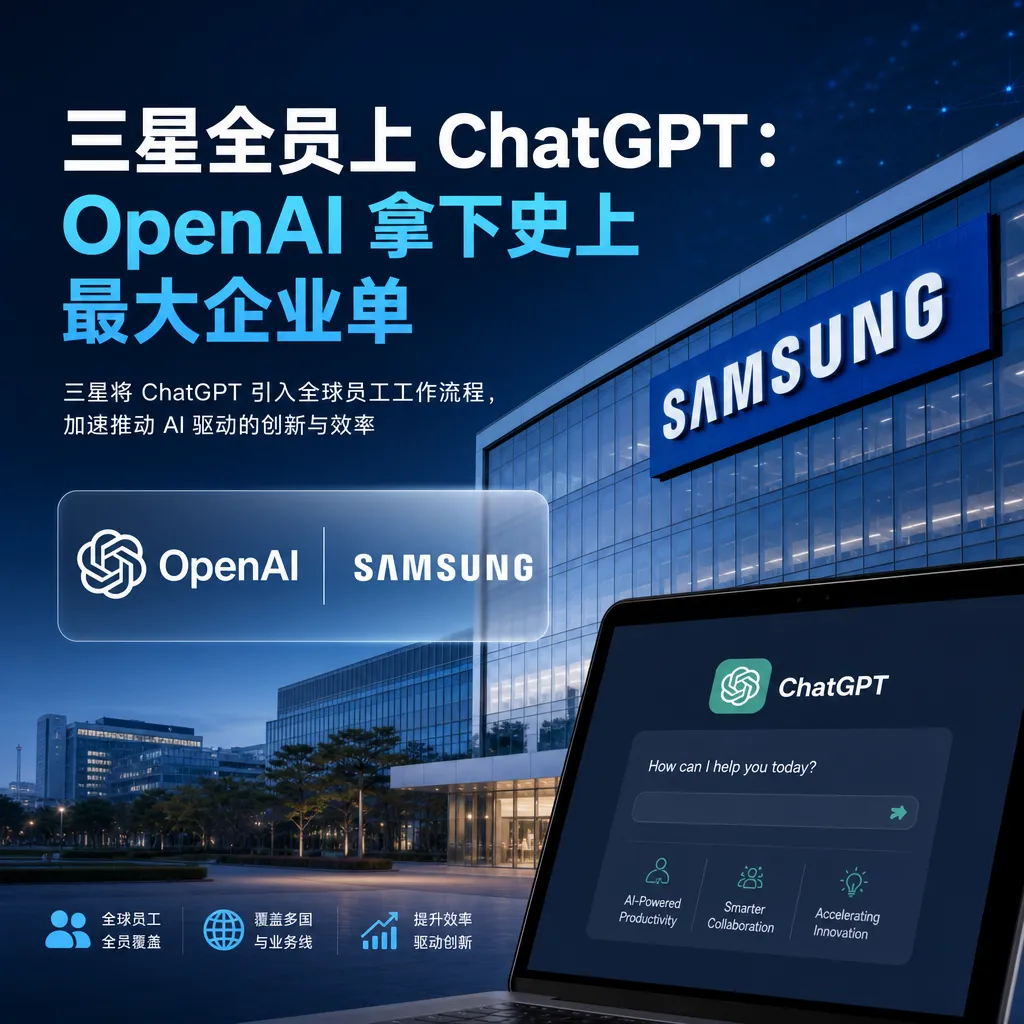
Samsung Electronics announced the global deployment of ChatGPT Enterprise and Codex to its employees, covering all business lines from semiconductors to consumer electronics, making it one of the largest enterprise implementations of OpenAI to date.
Today (June 22), OpenAI posted a short but highly significant announcement on its official website: Samsung Electronics will deploy ChatGPT Enterprise and Codex for employees worldwide. This is one of the largest enterprise-level AI deployments in OpenAI’s history—not a departmental pilot, not a POC for a few thousand people, but a rollout covering all employees at Samsung Electronics.
If you understand the scale of Samsung Electronics’ organization—over 260,000 employees worldwide, with business spanning multiple divisions such as semiconductors (DS), mobile experience (MX), visual display (VD), home appliances (DA), and networks—you’ll recognize the weight of this deal. This is not only a key victory for OpenAI in the Asian enterprise market, but also essentially announces that Korea’s major local players—including Naver and LG AI Research—have retreated to focusing on vertical scenarios in the battle for general-purpose large models.
A “late” but inevitable deal
It’s “late” because Samsung and ChatGPT had a tense relationship back in 2023. At the time, engineers in Samsung’s semiconductor division were reported to have pasted chip design code and meeting minutes directly into ChatGPT for help, sparking concerns over data leaks. Samsung promptly banned the public version of ChatGPT internally, and developed an in-house AI tool called “Samsung Gauss.” Since then, for two years, Samsung pursued a two-pronged approach: self-development and small-scale commercial model pilots.
It’s “inevitable” because the self-development route visibly stalled. Samsung Gauss never achieved significant internal penetration; employees still preferred to use various third-party tools for code writing, translation, and meeting minutes. Over the past year, Samsung SDS (the IT services subsidiary of Samsung Group) became the first official OpenAI reseller in Korea, and in early 2024’s “Enterprise AI Connect 2026” conference, showcased ChatGPT Enterprise as the core component of its enterprise AI transformation plan. Given this supply chain, today’s global rollout was simply the result of natural progression.
Another clue is OpenAI’s Codex Labs initiative launched last month, along with partnerships with global system integrators (GSIs) like Accenture, Capgemini, Cognizant, Infosys, PwC, and TCS. OpenAI admits: “Enterprise demand for Codex continues to rise, but our implementation support capabilities can’t yet keep pace.” This Samsung deal almost certainly follows a GSI + Codex Labs hybrid deployment path.
What exactly did Samsung buy?
Based on the announcement and disclosed information, this rollout includes two core products:
1. ChatGPT Enterprise (for all employees)
A general-purpose productivity tool for all staff, covering:
- GPT-5.5 and reasoning effort control: Admins and Workspace Agent builders can choose reasoning effort based on task complexity, avoiding “overkill” that wastes tokens
- Workspace Agents (GA version): Officially GA this year, these workplace agents can handle full workflows across tools and execute according to team processes, shareable within teams
- Admin controls: Admins can set guardrails for what actions agents can perform in connected apps, and monitor activity and usage
- GPT-5.1 Pro Early Access: Enterprise and Edu customers can apply for access
For a hardware giant like Samsung, real ChatGPT usage scenarios are likely not “writing poetry” but: multilingual meeting minutes (Korean-English-Chinese being common), technical document retrieval, preliminary review of contracts and legal documents, market intelligence summaries, customer support script generation, and cross-division information consolidation. These tasks previously relied on manual labor or scattered internal tools, with mediocre results.
2. Codex (for engineers)
This is arguably the more consequential part of the rollout. How many engineers does Samsung Electronics have? Conservatively, over 70,000 software engineers, plus semiconductor design, firmware, driver, and embedded developers—a sizable scale. Deploying Codex among them means what?
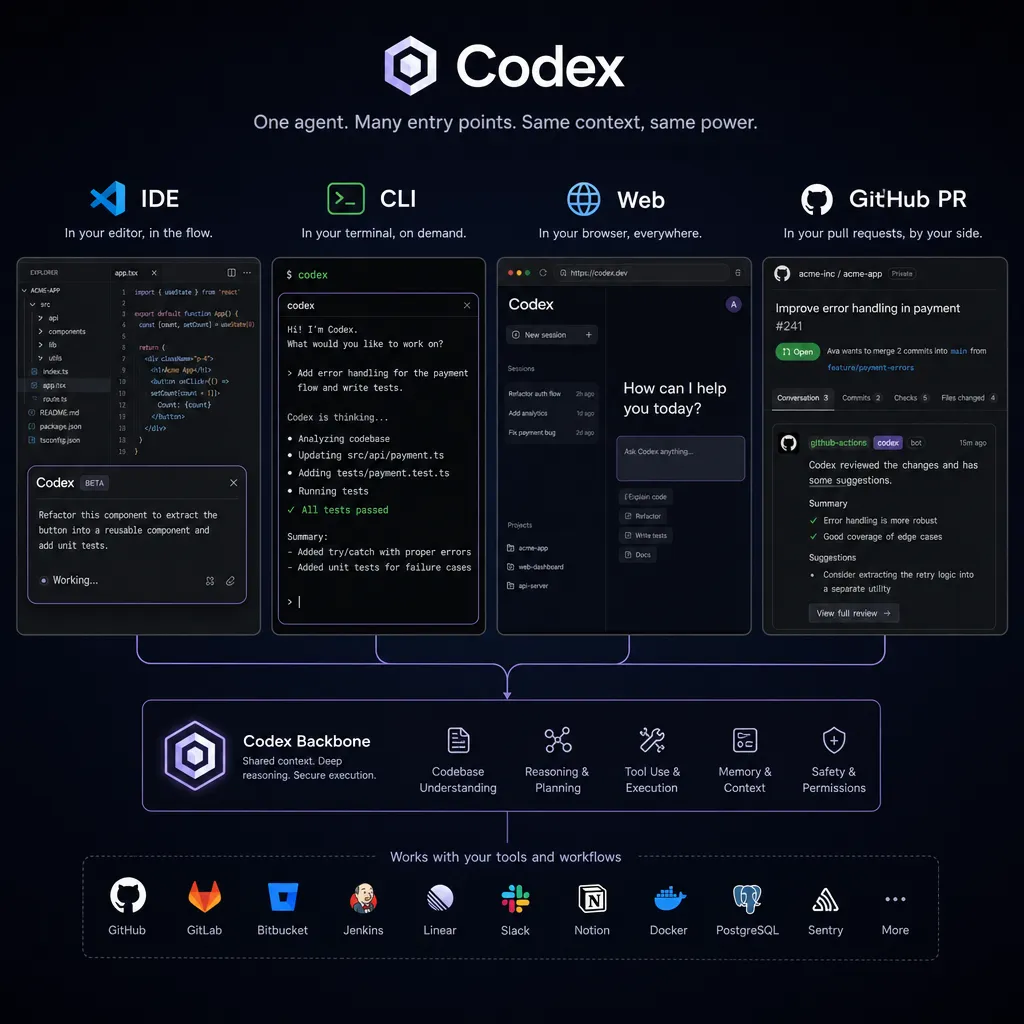
OpenAI data: In early April, over 3 million developers used Codex weekly; two weeks later, that number rose to 4 million. Cisco, Virgin Atlantic, Ramp, Notion, and Rakuten already use it. Codex now is far beyond the 2021 code-completion model—it’s a multi-endpoint agent across IDE, CLI, Web, GitHub PR, and Slack:
- End-to-end feature development: Handles high-management-cost tasks like refactoring and complex migrations
- AI Reviewer in PRs: Reviews PRs, responds to comments, locates and fixes security vulnerabilities
- CI/CD follow-up: Incident investigation, release prep, hotfixes—historically the most painful parts for SRE and on-call engineers
- GPT-5.4-Codex model: Purpose-trained for code tasks, with high/medium/low reasoning tiers
- macOS and Windows OS-level sandbox: Agent actions confined within clear boundaries—a hard requirement for data compliance in companies like Samsung
Why now, and why Codex
From a Samsung CTO’s perspective: In 2026, you’ll face a board question—“Why hasn’t our development efficiency kept pace with the AI revolution?”
There aren’t many options. Build your own coding agent? The past two years prove that without a top-tier base model, fine-tuned code models can’t match Codex/Claude Code in long-context reasoning, cross-repo understanding, or tool invocation chain handling. GitHub Copilot? Samsung and Microsoft collaborate in cloud services but aren’t especially close, and Copilot Enterprise lags behind Codex in agentization and enterprise governance. The remaining rational option is Codex.
The key is that Codex now does far more than “code completion.” OpenAI’s recent messaging repeatedly emphasizes: Codex is not just for engineering teams. In an organization like Samsung, it could be used by product managers to read Google Sheet survey feedback and do classification summaries, by HR to bulk send Slack DMs to employees with incomplete training, or by operations to generate weekly work summaries from calendars, emails, and documents. These scenarios are all in Codex Enterprise’s official use cases.
In other words, Samsung isn’t buying “a tool for engineers”; it’s buying “an agent runtime that performs real business tasks across all roles.”
What this deal means for the Chinese market
Frankly, Samsung Electronics’ China R&D centers, semiconductor foundry division, and display panel division are all included in this rollout. For domestic enterprise AI players, this is a noteworthy reminder:
First, enterprise penetration speed of general-purpose large models is faster than many expected. In January, Samsung SDS announced its reseller partnership with OpenAI; by June, global deployment was done—this pace matches the standard rollout cycle of a SaaS product. Second, the dual-track “in-house model + commercial model” approach is breaking down. Samsung Gauss isn’t dead, but clearly ceded the main role to ChatGPT Enterprise + Codex. This means future negotiations for “purely in-house AI” with large clients will have shrinking leverage. Third, coding agents have moved from efficiency tools to strategic assets. A hardware company pushing Codex to all engineers reflects the logic that gaps in code production efficiency directly impact product iteration speed, thereby determining market share.
Some details not officially stated
A few points worth tracking:
- What are the deployment boundaries in Samsung’s semiconductor (DS) business? DS involves large volumes of IP protected by export controls and trade secrets—data flowing indiscriminately into OpenAI’s training pipeline is impossible. This part likely uses ChatGPT Enterprise’s zero-data-retention mode, and might even employ private deployment—OpenAI just announced Codex hybrid/local deployment with Dell last month, a notably timely move.
- How was Korean domestic compliance addressed? Korea’s Personal Information Protection Act (PIPA), along with finance and semiconductor regulations, tightly restrict cross-border data flow. This global-synchronized rollout implies OpenAI already has the necessary data residency or compliance architecture in Korea.
- Could Samsung become a reverse input source for Codex? Large clients like Cisco and Rakuten already influence Codex’s product iteration. A “hardware + software + semiconductor + display + home appliances” full-stack company like Samsung can provide real-world workflow data whose value to OpenAI is immeasurable.
Practical insights for developers
If you’re an engineering lead or architect responsible for AI tool selection in your enterprise, the takeaways from the Samsung deal are clear:
- The coding agent selection window is closing. This year, products like Codex, Claude Code, and Cursor have already matured in enterprise governance, sandboxing, and observability; waiting longer risks missing the critical 6-month period for organizational capability upgrades.
- Don’t focus only on “writing code”. The real value of tools like Codex increasingly lies in PR review, incident response, document generation, and cross-tool data aggregation—non-pure-coding scenarios.
- Data governance must come first. Samsung’s 2023 pitfalls are lessons: Before full-employee rollout, DLP, audit logging, agent behavioral boundaries, and sensitive data masking infrastructure must be in place.
For individual developers, the Samsung deal is also a signal: In the coming years, enterprise demand for talent who can “use agents to get work done” will significantly outweigh demand for those who can “handwrite boilerplate code.”
As an aside—if you want to compare GPT-5.5, GPT-5.4-Codex, Claude, Gemini, DeepSeek in real coding tasks yourself, OpenAI Hub (openai-hub.com) already fully supports these models. One key lets you switch between them, with direct domestic access, sparing you multiple account management hassles.
In closing
The Samsung Electronics deal completes OpenAI’s enterprise market story. From early clients like Morgan Stanley and Klarna, to Cisco and Rakuten, and now Samsung Electronics, OpenAI achieved in three years what Salesforce took more than a decade to accomplish in enterprise sales—only this time, the product is agents, not CRM.
For all traditional large enterprises still hesitating over “whether to go all-in on AI,” this news essentially says one thing: Don’t wait—your competitors are already fully online.


