
JD Open Source JoyAI-VL-Interaction: Enabling Models to "See and Speak Simultaneously"
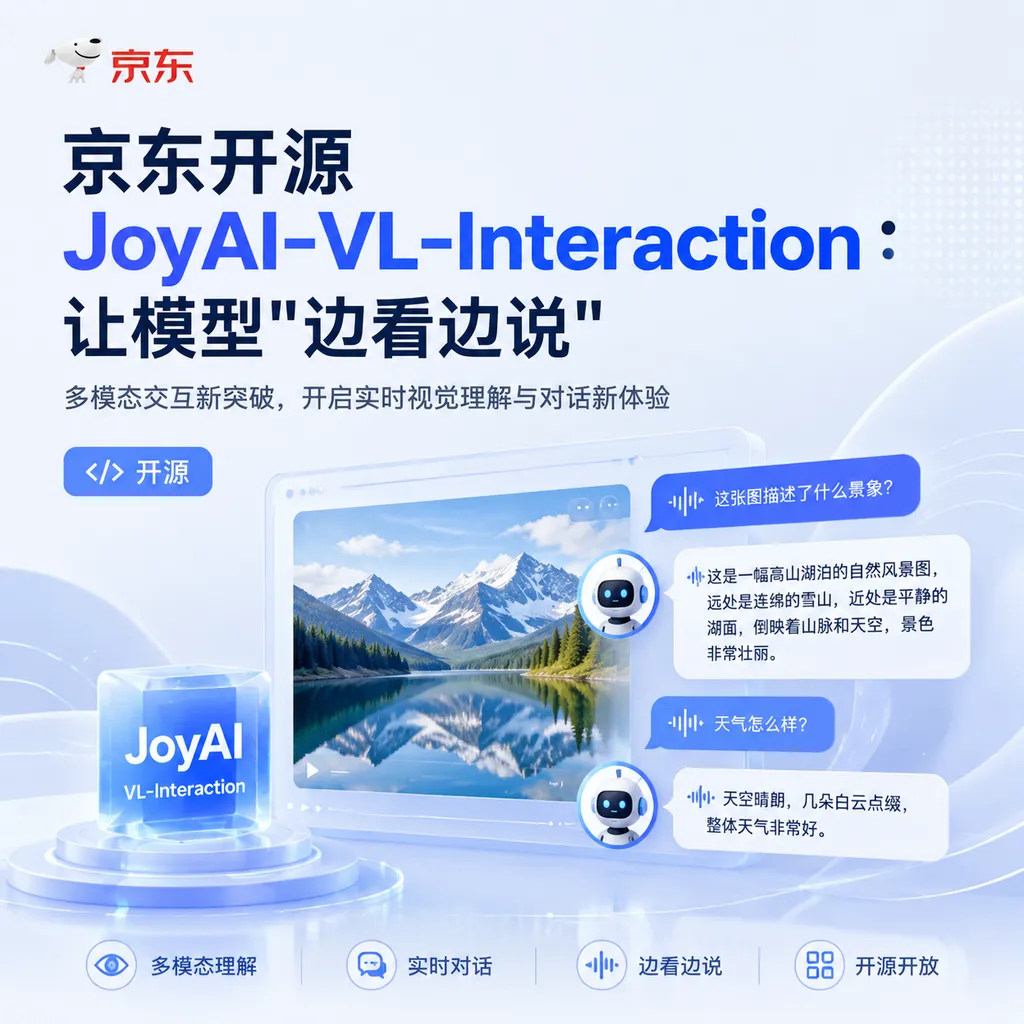
JD.com has open-sourced the world’s first full-stack, open-source real-time video-vision-language interaction model, JoyAI-VL-Interaction, with an 8B parameter scale, featuring streaming interaction for “watching while speaking.” In 58 human blind evaluations, it achieved a 77.6% win rate against Doubao and an 87.9% win rate against Gemini.
JD's latest move is quite interesting.
On June 22, JD officially announced the open-sourcing of its real-time video vision-language interaction model JoyAI-VL-Interaction, claiming it to be "the world’s first fully open-source full-stack interaction model and system", with day-0 native support from vLLM-Omni. The project had actually been leaked early on June 17 by Ke Chuang Ban Daily. The technical report had already been circulating in the open-source community and overseas AI circles for a few days before today’s official confirmation.
With 8B parameters, the scale is not huge. But the problem it aims to solve is one that most multimodal large models have not truly cracked yet: how to turn the model from "Q&A" into "always present".
From Turn-based to Streaming: An Overlooked Gap
First, why this is worth writing about.
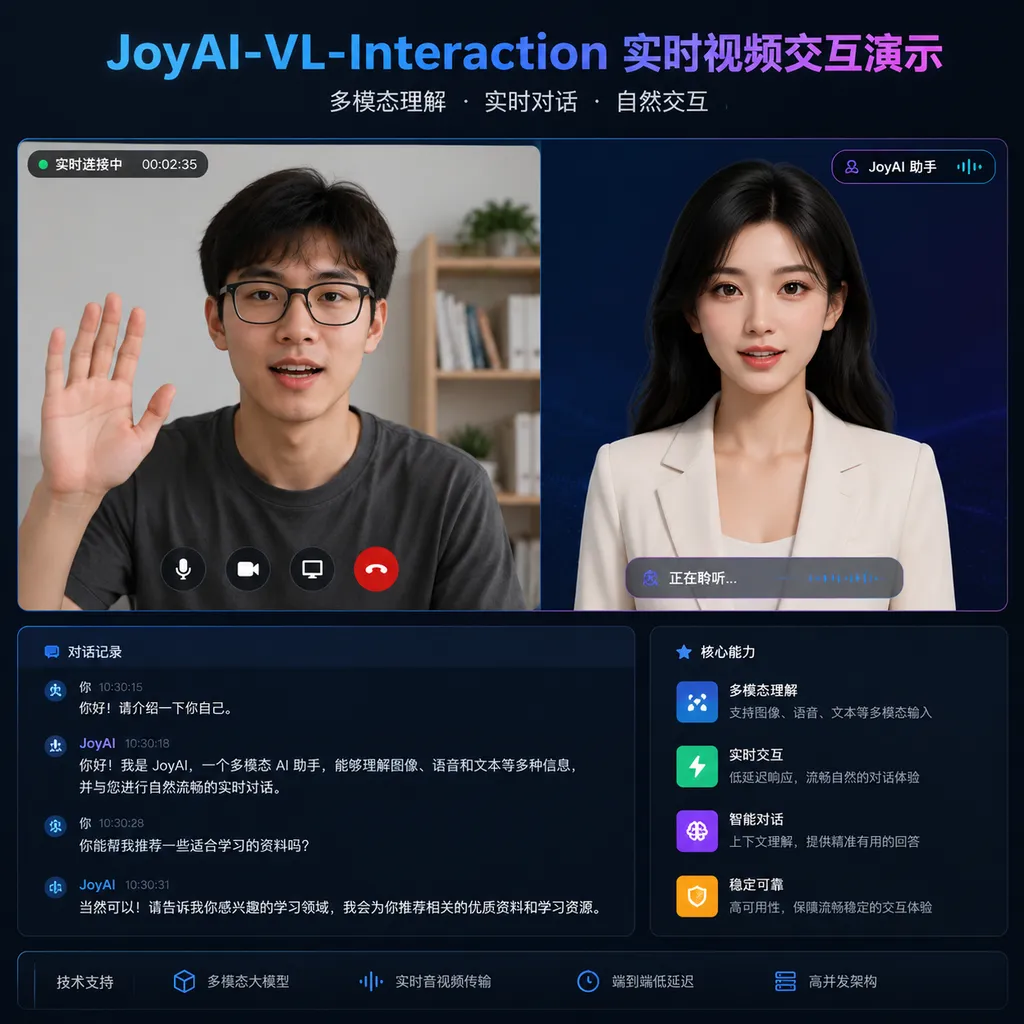
Open the video call feature in Doubao, Gemini, or GPT today — it may look “real-time” — but under the hood it’s still turn-based: you ask a question → it answers. The camera being on is mostly symbolic. The moment the model “sees” the frame is the instant you press the speak button. Whatever happens in between — the kettle boiling over, a child sliding off the couch — the model knows nothing about.
This is a major product shortcoming, but because everyone does it this way, it’s become the industry default.
JoyAI-VL-Interaction aims to break that default. According to the JD team, it makes the model “present” like a human — continuously observing the video stream, deciding on its own when to speak and when to stay silent. This isn’t something that can be solved by simply extending the context window; it involves a whole new training paradigm: training “whether to respond” as an intrinsic model capability.
Other teams abroad are on the same path. Last month, Thinking Machines Lab (Mira Murati’s team) proposed the concept of an “interaction model,” following a very similar line of thinking — that autonomous interactivity should be scaled up as an independent capability. Two teams hitting the same direction almost simultaneously suggests the timing for “from turn-based to interactive” has matured.
The difference: TML has only released a research preview, while JD has fully open-sourced model weights, training data, training methods, and a complete deployable system. In the context of Chinese tech giants, this is quite radical.
Three Key Design Highlights
Going through the technical report, there are three aspects of JoyAI-VL-Interaction worth highlighting.
Active Judgment, Not Passive Answering
Traditional video understanding workflow: user asks → model grabs current frame → inference → answer. All intermediate frames are discarded.
JoyAI-VL-Interaction’s workflow: model keeps watching → constantly makes an internal “should I respond?” decision → only speaks when triggered. This “internal decision” is made by the model itself, not by an external rule engine.
This has huge engineering implications. It means the inference pipeline must be streaming, KV cache must accumulate continuously without blowing up, and response trigger latency must be ultra-low. That’s why day-0 vLLM-Omni support matters — without a foundational inference framework, this model simply wouldn’t run.
Real-time Response, Not Post-event Summary
Most traditional video understanding is “upload full video, then analyze.” This is fine for on-demand, but disastrous for live scenarios.
For security alerts, a 3-second delay might be too late; for real-time translation, latency over 1 second kills the experience; for live commentary, the presenter would have moved on while you’re still analyzing the previous topic. JoyAI-VL-Interaction is built for “in-progress” video streams, triggering responses at the moment the scene changes.
Backend Delegation Mechanism
This might be the smartest part.
Small models face a trade-off: to observe in real time, you can’t pack too many parameters; but for many tasks (code generation, complex reasoning, tool use), small models fall short. JoyAI-VL-Interaction’s solution is frontend-backend separation:
- Frontend 8B model stays online, watching, listening, judging, conversing
- Complex tasks are delegated to a backend large model or agent
- While the backend processes, frontend keeps observing and interacting
- When results return, the conversation resumes naturally
This effectively decouples “always present” from “complex capabilities.” In analogy: frontend is a quick-reacting assistant, backend is the expert team, and the assistant never leaves your side with “I need to think about it.”
Benchmark: 77.6% Win Rate vs Doubao, 87.9% vs Gemini
JD’s published evaluation results are impressive — but should be viewed objectively.
They chose 58 blind-reviewed real-person cases across six scenarios:
- Surveillance & Alerting (fires, falls, abnormal behaviors)
- Real-time Counting
- Real-time Translation
- Time Awareness
- Live Commentary & Guidance
- Long-term Memory
Results:
| Competitor | Overall Win Rate | |------------|-----------------| | Doubao Video Call Assistant | 77.6% | | Gemini Video Call Assistant | 87.9% |
In surveillance/alerting, JoyAI-VL-Interaction scored 100% win rate against both baselines.
How to interpret this? My view is: in the niche track of “vision-triggered active response,” JoyAI-VL-Interaction indeed has an edge, but it doesn’t mean it surpasses Doubao and Gemini overall.
The report itself honestly acknowledges limitations — the 8B model still lags behind Doubao and Gemini’s larger models in general knowledge, long-tail scenarios, richness of expression, and stability. The 58-case sample size is also small, far from a large-scale systematic evaluation.
But the interesting part is: training interactivity as an independent capability is highly data-efficient. At the same 8B scale, specialized interaction training can beat bigger general models in certain scenarios. This mirrors the path taken by reasoning models — emergent specialist capability doesn’t always require parameter bloat.
What Does “Full-stack Open-source” Mean?
This is where JoyAI-VL-Interaction differs from typical “open source” releases.
JD released a complete system:
- Model weights
- Interaction datasets (for training)
- Training methodology (recipes in technical report)
- Fully deployable system, including:
- ASR/TTS modules (replaceable)
- Visualization interface
- Long-term memory module
- Backend model interface
- vLLM deployment plan
- External tool integration
Developers can plug in their own speech service, agents, APIs, business systems, frontends — the stack is fully swappable. This is far more generous than simply releasing weights — you’re getting a working car, plus a complete modification manual.
Officially listed application scenarios:
- Security monitoring (fire/fall/abnormal behavior alerts)
- Elderly and child care
- Live explanation, e-commerce guidance
- Operational instruction (appliance repair, cooking, etc.)
- AI glasses
- Accessibility assistance
The common thread: AI needs to stay present, not appear only when summoned. JD’s own e-commerce and logistics businesses have plenty of such needs. By open-sourcing, JD can build ecosystem momentum through the community while boosting intelligence in its own operations.
Points Worth Watching
Some directions I’ll be watching:
First — community adoption speed. Full-stack open source makes getting started easy, but the contribution threshold is high — you have to modify both model and system. In 6 months, GitHub forks and secondary development numbers will tell if developers are on board.
Second — long-duration stability. The report didn’t say much about “will the model start making nonsense after running for 8 hours straight?” For monitoring and care use cases, this is life-or-death.
Third — edge deployment. 8B isn’t huge in the cloud, but still too large for AI glasses. If smaller 1B–3B versions come later, coupled with edge-cloud collaboration, they could actually reach consumer devices.
Fourth — domestic video stream chip synergy. Real-time video interaction demands high codec performance and memory bandwidth — cost can only be constrained with hardware-software co-design.
Final Thoughts
The dominant trends in large models over the last two years have been scale, knowledge, and reasoning. But when an AI assistant really enters real-world scenarios, what decides its usefulness is often not how much it knows, but whether it appears at the right time.
JoyAI-VL-Interaction takes a less flashy but very pragmatic route. It doesn’t aim to be the smartest model, but the most “present” one. This kind of product-first perspective is rare in open-source work from major Chinese tech firms.
Whether it can kickstart the interaction model track — the technical direction is right, the open-sourcing is thorough, and now it’s up to the community and market adoption.
OpenAI Hub (openai-hub.com) will continue following JoyAI’s progress. For developers already using various closed-source VL models for real-time interaction, the platform also supports unified invocation of mainstream multimodal models such as GPT, Claude, and Gemini, allowing direct cross-comparison with open-source solutions.
References
- ITHome: JD Open Sources Real-Time Video Vision-Language Interaction Model JoyAI-VL-Interaction — Official open-source announcement from JD and explanation of three major technical breakthroughs
- GitHub: JD Open Source Code Repository — JoyAI-VL-Interaction code, weights, and deployment solutions


