
Vidu Q3 by Vidu launches on Huawei Cloud: The world’s first video large model “born for films” is here
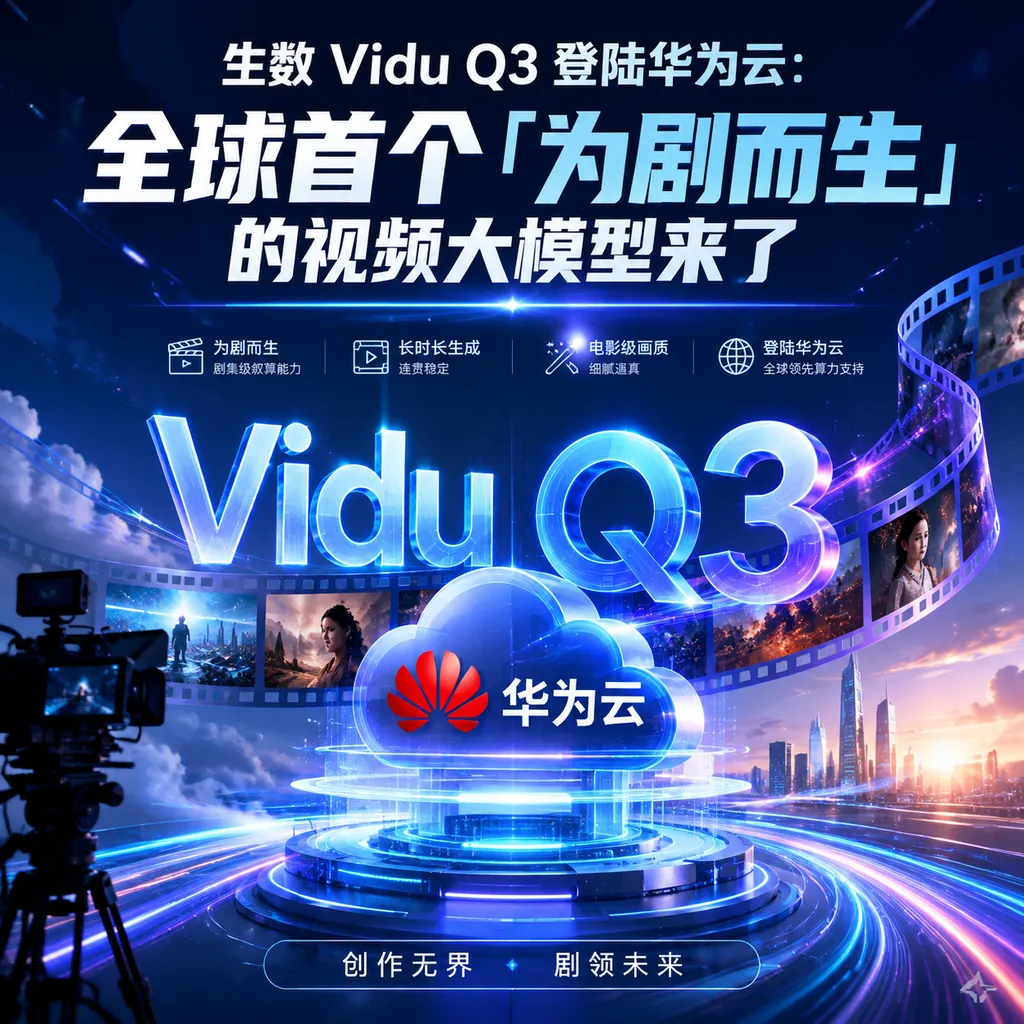
Shengshu Technology has brought its latest multimodal video generation model, Vidu Q3, to Huawei Cloud MaaS. The Turbo and Pro versions are launched simultaneously, featuring 16 seconds of synchronized audio and visuals, multi-camera storytelling, and 4K output, targeting the increasingly competitive business of animated series and short dramas.
Shengshu Vidu Q3 Lands on Huawei Cloud: The World’s First “Born for Drama” Video Foundation Model is Here
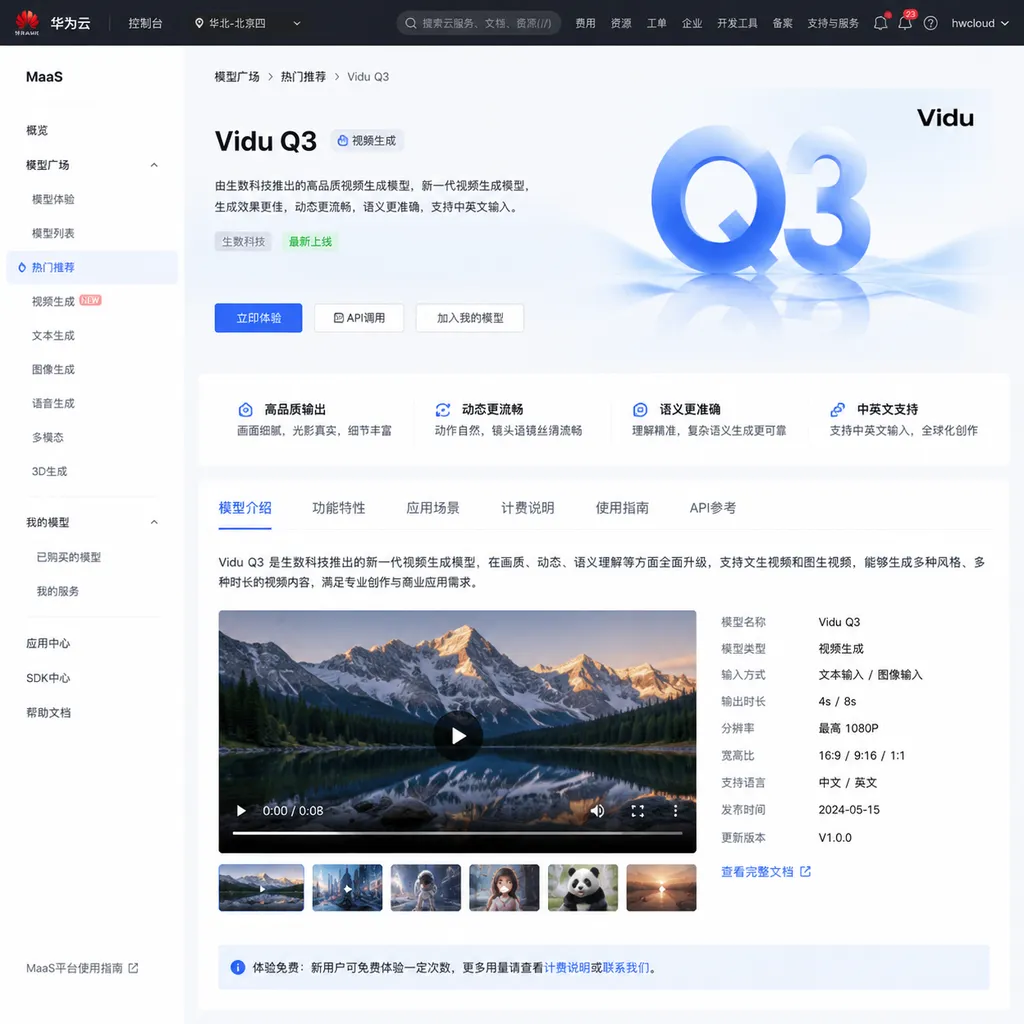
On June 22, Huawei Cloud officially announced that Shengshu Technology’s new generation multimodal video generation foundation model Vidu Q3 has been launched on the Huawei Cloud MaaS (Model-as-a-Service) platform. This time both the Turbo speed edition and Pro professional edition come packaged together, covering four main capabilities: text-to-video, image-to-video, first-and-last-frame-to-video, and reference-to-video.
What deserves to be singled out is the positioning — Shengshu has branded Vidu Q3 as the “world’s first video foundation model born for drama.” This label isn’t just slapped on. Over the past year, video models have been competing on parameters, duration, resolution; anyone can produce a few flashy demos, but when it comes to creating usable drama-level content, most choke on old problems like “you can’t connect to the next shot” or “character deforms when viewed from another angle.” Q3 directly addresses this.
Not Just Another Show-off Demo, But Aiming for “Finished Production”
Let’s lay out the core specs:
- Duration: max 16 seconds per segment
- Quality: Turbo edition 1080P, Pro edition supports up to 4K
- Audio-video: sound and picture generated together, no more silent film + post-dubbing jumble
- Narrative: stable multi-shot switching, precise shot transitions
- Text: supports multilingual text rendering and multilingual output
Sixteen seconds may not seem long at first glance. Sora 2 already touts minute-level videos, and domestic models like Kelin and Jimeng have long-video options. But if you’ve actually worked in short drama or comic drama workflows you’ll know — production units for dramas are never “the longer the better.” An effective shot is usually 3–8 seconds; being able to stably cut 2–3 shots within 16 seconds with consistent characters and continuous action is more useful than a blurry 60-second clip. This is Q3’s pragmatic logic when choosing duration.
The simultaneous audio-video output is even more noteworthy. AI video has long been “silent images,” with dubbing and lip-syncing requiring secondary processing using tools like ElevenLabs or Sync.so. When the chain gets too long, mass production of dramas collapses. Q3 integrates this step directly into end-to-end generation, meaning the original “prompt → video → dubbing → lip-sync” four-step process can be compressed to one. For short drama producers, this is not “icing on the cake” but saving half a post-production team.
Turbo vs Pro: One for Volume, One for Craft
Shengshu smartly split the product line into two tiers, with clear pricing and scenario boundaries.
Vidu Q3 Turbo Speed Edition
All four sub-capabilities are included:
ViduQ3-Turbo T2Vtext-to-videoViduQ3-Turbo I2Vimage-to-videoViduQ3-Turbo H2Vfirst-and-last-frame-to-videoViduQ3-Turbo R2Vreference-to-video
Turbo’s positioning is essentially “high-volume output.” Lightweight, significantly faster inference, lower costs — suitable for scenarios like mass production of social media short videos, concept prototyping, and iteration of asset materials. In other words — if you’re running TikTok matrix accounts, cross-border e-commerce materials, or short drama storyboard validation, this edition suffices, with the key being controllable per-video cost.
Vidu Q3 Pro Professional Edition
Three sub-capabilities:
ViduQ3-Pro T2VViduQ3-Pro I2VViduQ3-Pro H2V
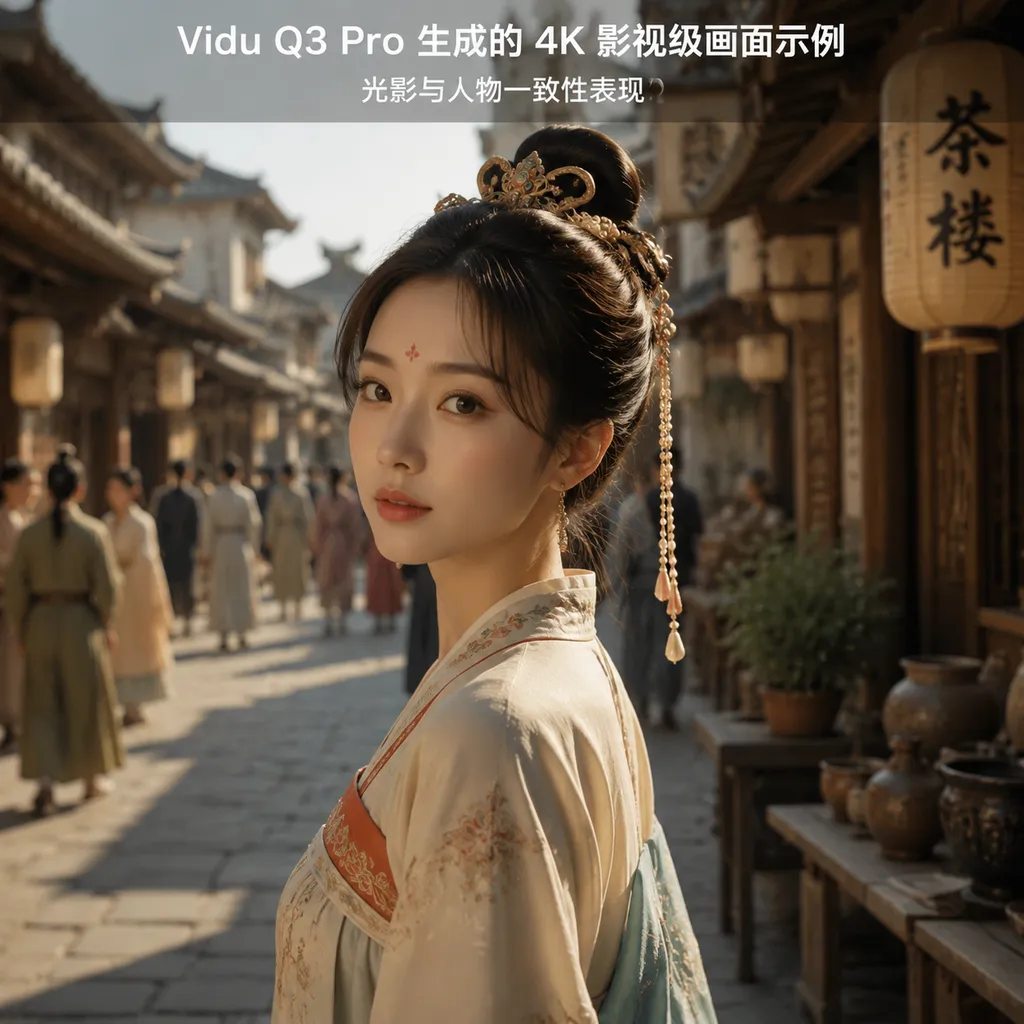
Pro removes R2V reference-to-video (notable, more on that later) but adds 4K, cinematic lighting, character consistency, and camera movement performance. It targets commercials, brand TVCs, and premium productions — projects with budgets from tens of thousands to hundreds of thousands per clip, where clients tolerate zero flaws in any frame.
My speculation on why Pro lacks R2V: reference-to-video, when chasing extreme image quality, still involves precision trade-offs. R2V essentially feeds a “reference image” to the model to maintain that subject/style consistency in the video. This works well in Turbo’s fast-iteration scenarios, but in 4K cinematic output, the balance between control signals and generation freedom hasn’t yet been perfected. Shengshu keeping R2V in Turbo for now is a pragmatic decision.
What Does “Born for Drama” Mean in Practice
Shengshu’s “born for drama” slogan boils down to three things:
First: multi-shot narrative. The biggest difference between dramas and short clips is shot language. A scene needs switching between long shots, medium shots, and closeups; the camera position changes but not the characters, and lighting consistency must be maintained. This is something Sora and Kelin aren’t stable at yet. Q3 puts effort into “stable multi-shot storytelling + precise shot transitions,” likely with explicit modeling of scene graphs and shot sequences inside the model.
Second: character consistency. In comic dramas and short dramas, the main character needs to appear in over 50 shots. Traditionally, you’d first generate a set of reference images and then use LoRA fine-tuning or reference-based control. Q3 offers native support via R2V (Turbo) and I2V, freeing users from manually tinkering with ComfyUI workflows.
Third: multilingual text rendering. Often overlooked, but crucial for comic dramas and overseas short drama export. AI models generating on-screen Chinese, English, Japanese, Korean text have long been poor at it — especially non-Latin scripts. Q3 adds this, meaning dialogue cards, title text, subtitles in dramas can be directly generated, without needing to add text in After Effects afterward.
Why Choose Huawei Cloud? The Compute Logic Behind It
Shengshu and Huawei Cloud have been collaborating for some time. In 2024 Shengshu joined Huawei Cloud’s startup program, training with Ascend Cloud services and using SFS Turbo high-performance file systems for storage. Launching Q3 on Huawei Cloud MaaS essentially puts both training and inference into the same ecosystem.
There are two layers of logic here:
- Compute autonomy and controllability. Video models demand far higher compute throughput than text models; even a single H100 card struggles, let alone large-scale concurrent inference. Ascend offers stable domestic supply; for companies like Shengshu that need continuous iteration, supply interruption risk is more critical than performance differences.
- Ecosystem integration. Huawei Cloud MaaS’s clientele includes many state-owned enterprises, cultural tourism companies, broadcasters, and brand owners — precisely the B-end market Vidu aims to capture. Having a single key to access Vidu’s capabilities is much smoother for these clients than connecting via Shengshu’s own API.
Video Model Track to Differentiate in 2026
If 2024 was the year of “Can we generate video?”, 2025 is “Can we generate long video?”, then 2026’s keyword will be “Can we generate usable content?” This may sound trivial, but it signals the track’s complete differentiation:
- General show-off camp: Sora, Veo — keep chasing longer duration, physics consistency, using demos for branding
- Industrial pipeline camp: Runway, Pika — integrate into NLE tools, friendly for editors
- Vertical content camp: Vidu Q3, Kelin 2.0, Jimeng 4.0 — locked onto specific content categories (short dramas, comic dramas, ads) for a closed loop
Shengshu chose the third route — hardest to market but easiest to monetize. China’s short drama market will surpass 70 billion RMB in 2025, with domestic hits produced from concept to release in just two weeks. AI’s ROI here is crystal clear: one Vidu Q3 + one editor can replace the workload of a 5-person drama crew over three weeks.
A Few Judgments for Developers
If you are evaluating integrating a video generation API, here are some practical tips:
- For C-end creative tools, Turbo edition is basically sufficient; focus on testing cost-speed balance points for T2V and I2V. R2V is the killer feature — enables a “upload one protagonist picture, generate series drama” product model.
- For B-end commercial productions, Pro edition’s 4K and character consistency are core selling points, but budget accordingly — per-video costs are significantly higher than Turbo.
- First-and-last-frame-to-video (H2V) is underrated — for companies producing beat-synced videos, transition materials, and camera movement templates, it’s far more controllable than pure T2V.
- Test multilingual text rendering — stability varies among languages, especially for non-Latin scripts like Japanese, Korean, Thai, Vietnamese.
By the way, OpenAI Hub (openai-hub.com) is also integrating mainstream video generation models; developers can use one key to call GPT, Claude, Gemini, DeepSeek, compatible with OpenAI format for direct domestic connections — handy for teams doing multi-model comparison tests.
Final Thoughts
Vidu Q3’s launch on Huawei Cloud isn’t simply “just another cloud model.” It actually signals two things: first, domestic video foundation models are quickly approaching commercial usability thresholds; second, Shengshu clearly has no plans to go head-to-head with Sora in the general domain, but has cut into the short drama/comic drama niche with real-paying capability.
Two things worth watching next: how low Pro edition’s actual generation cost can go (this determines if it can enter mainstream ad production workflows), and when R2V will be added to Pro edition (this is the true key to mass drama production capability).
The tipping point for AI-driven short dramas may arrive in the second half of this year.
References
- Born for drama: Shengshu Vidu Q3 multimodal foundation model launched on Huawei Cloud, focusing on integrated text/image-to-video finished production capability - IT Home: official information source for this launch, with detailed capability matrix for Turbo and Pro editions
- Shengshu Vidu Q3 multimodal foundation model launched on Huawei Cloud - IT Home: IT Home mobile version report
- Partnering with Vidu AI to make multimodal foundation models within reach - Zhihu Column: extended interpretation of Vidu platform capabilities and application scenarios


