
NVIDIA has made robot safety a full-stack solution: Halos for Robotics released
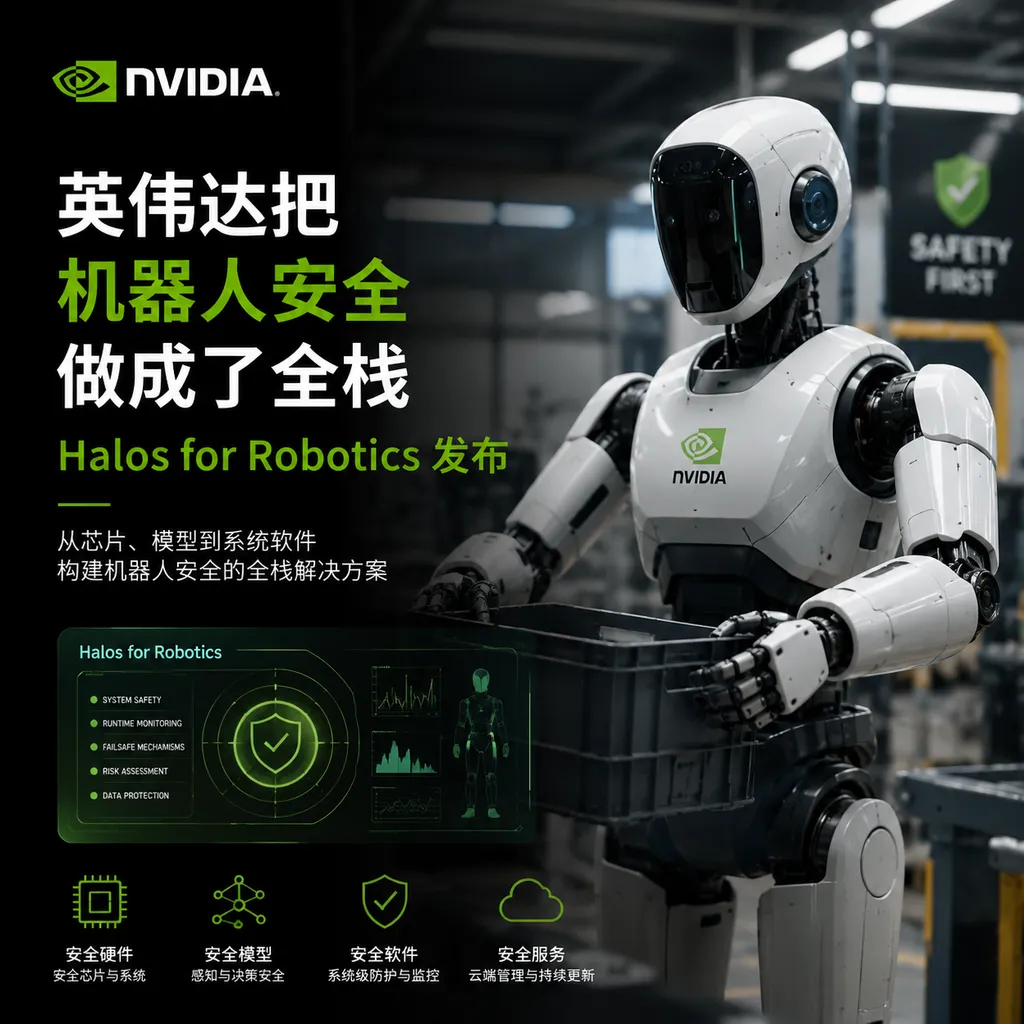
NVIDIA today released Halos for Robotics, claiming it to be the industry's first full-stack physical AI safety system that integrates AI computing power, system software, sensors, safety applications, and certification processes. Agility Robotics becomes the first launch customer.
NVIDIA Makes Robot Safety Full Stack: Halos for Robotics Released
On June 22, NVIDIA officially launched NVIDIA Halos for Robotics, describing it externally as “the industry’s first full-stack physical AI safety system.” In short: they’ve bundled together five things that used to be scattered across different vendors—AI compute, system software, sensor integration, safety applications, and third-party certification preparation—into a unified architecture, providing turnkey solutions for robotics and physical AI manufacturers.
Humanoid robotics company Agility Robotics is among the first customers, planning to integrate Halos capabilities into its proprietary safety system for industrial humanoid robots used in factories, warehouses, and logistics scenarios.
This is not a simple SDK release. What Halos for Robotics truly aims to solve is the most awkward problem faced by the humanoid robot and embodied intelligence industries over the past two years—demos look impressive, but when it comes to actually entering factories and working alongside humans, how do you pass safety certification? Nobody could give a complete answer.
Why Now
The timing is quite subtle. Between 2025 and 2026, humanoid robots are transitioning from the stage of endless demo videos to real-world deployment. Companies like Figure, Agility, Apptronik, UBTECH, and Unitree are doing industrial pilots, but scaling up immediately runs into two walls:
- The first wall is safety standards. Standards like ISO 10218 (industrial robots), ISO 13482 (personal care robots), and IEC 61508 (functional safety) were originally written for traditional industrial robots and limited automation scenarios, and are unfriendly to embodied intelligence systems that rely on large-model decision-making and have behavior that’s not entirely predictable.
- The second wall is responsibility allocation. Chip vendors handle silicon, OS vendors handle the OS, robot companies handle the hardware, integrators handle on-site work, and certification agencies looking at such a stack are overwhelmed—nobody can sign for the whole chain.
What NVIDIA has done here is essentially upgrade itself from “Jetson and Isaac SDK compute supplier” to “safety architecture definer.” This is a very typical NVIDIA strategy—secure a key ecosystem position, then guide partners to run along its standards.
The Three-Layer Architecture
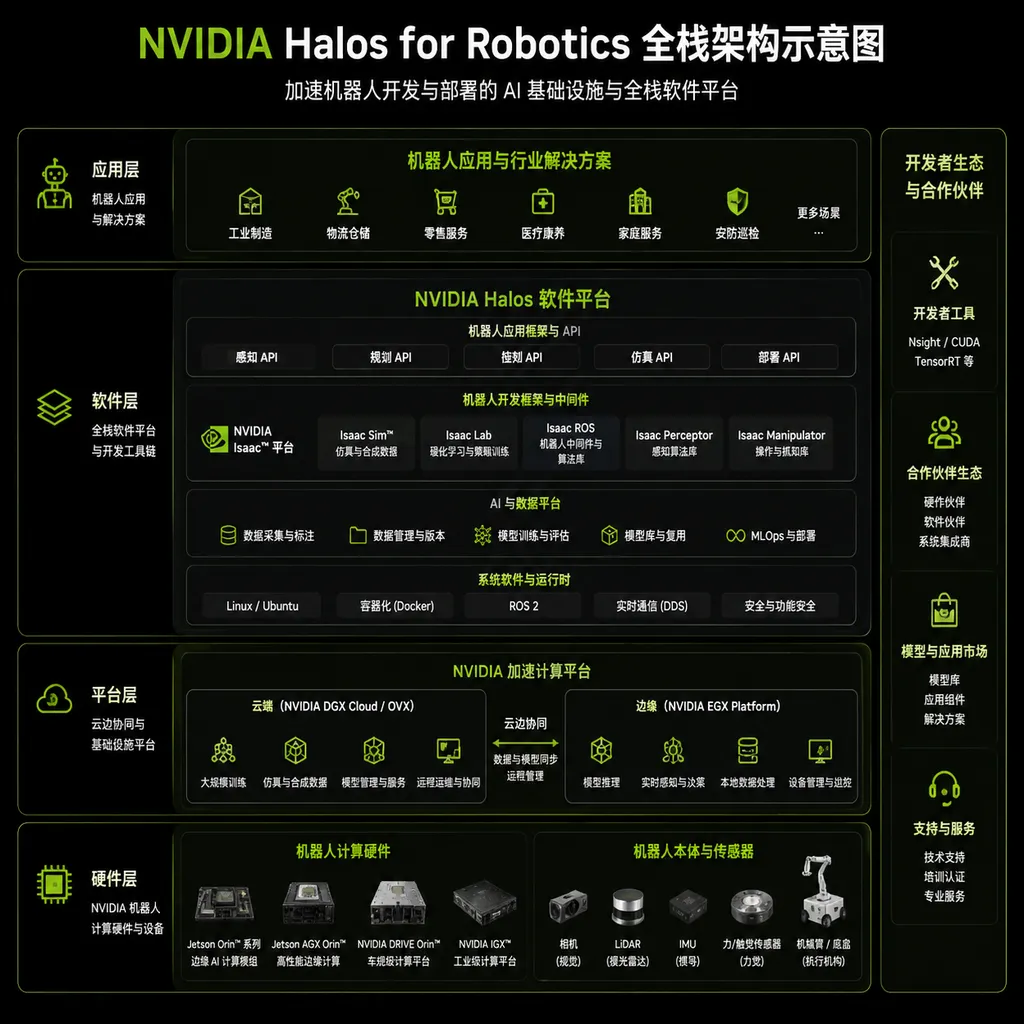
Halos for Robotics consists of three main parts, corresponding to hardware, software, and certification layers.
Hardware Layer: IGX Thor + Holoscan Sensor Bridge
The hardware core is NVIDIA IGX Thor. Thor was previously promoted mainly for autonomous driving; now an industrial-grade safety mechanism version is brought to robotics—meaning that the existing ASIL-D level functional safety design can be directly reused.
The accompanying Holoscan Sensor Bridge handles sensor integration. Simply put, robots have a bunch of LiDARs, depth cameras, torque sensors, IMUs—previously requiring robot manufacturers to write lots of drivers and time synchronization code. Holoscan abstracts this layer, providing a low-latency, deterministic timing integration channel.
For developers, the key point here is: real-time control and AI inference can run on the same SoC, without needing one MCU for safety control and one GPU for AI inference, then linking them via CAN bus. One less connection means one less certification hassle.
Software Layer: Halos OS
The software layer is Halos OS, with two key components:
- Halos Core: Handles safety-related runtime functions, available for early access to registered developers. Supports two configurations—a pure Linux setup and Linux + QNX OS for Safety 8.0 dual-system setup. The latter is clearly for industrial scenarios needing strict functional safety certification, and QNX’s reputation is solid in automotive and medical.
- External Perception Safety Blueprint: An interesting design. Robot sensors always have blind spots; the blueprint allows external cameras and AI agents to serve as supplementary perception sources, dynamically adjusting robot behavior based on changes in the factory environment. In other words, the robot is no longer “an isolated intelligent agent” but works cooperatively with the factory’s monitoring system. This blueprint has been open-sourced on GitHub for early access.
This “robot + environmental perception” cooperation is similar to V2X in autonomous driving—no matter how strong standalone intelligence is, adding roadside/environmental perception boosts overall safety margins.
Certification Layer: Halos AI Systems Inspection Lab
This layer is the most easily overlooked but actually the most crucial part of the release.
NVIDIA Halos AI Systems Inspection Lab is the world’s first ANAB-accredited lab project covering both physical AI functional safety and AI safety. Its role is not to directly issue certifications but to help partners prepare for certifications from TÜV Rheinland, UL Solutions, TÜV SÜD, exida, SGS, CertX, etc.
In plain terms: previously, after building a robot, you’d take it to TÜV for certification; they’d want to see your entire safety evidence chain, which you’d have to organize and explain yourself, revise after rejection. Now NVIDIA says: follow my architecture, I’ll preprocess the certification evidence for you, making approval much faster.
For small and medium robotics companies, this saves real money—an industrial-grade functional safety certification’s cost and timeline could wipe out a startup’s cash flow for a year.
How It Compares to Competitors
Looking across the market:
Traditional industrial robot makers like ABB, KUKA, FANUC build safety systems themselves, closed, expensive, and not open to third-party developers.
The ROS 2 + micro-ROS open-source route has SROS2 providing safety mechanisms, but functional safety certification still requires robot companies to liaise with certifiers; there’s no unified “bundle solution.”
Intel has also promoted Edge AI safety solutions but lacks an industrial-grade AI SoC to anchor it.
NVIDIA’s killer move this time is: It simultaneously holds the SoC (IGX Thor), OS partner (QNX), AI frameworks (Isaac, Holoscan), sensor abstraction layer, safety runtime, and lab pre-certification. One vendor signs the full chain—something rarely achieved in industrial automation history.
Of course, the trade-off is clear—you’ll be locked into the NVIDIA stack. But for many startups wanting to get humanoid robots into factories within 18 months, this trade-off may be worth it.
Why Agility is the Launch Customer
Agility’s Digit robot began industrial pilot runs last year in Amazon and GXO warehouses—one of the few humanoids truly operating in commercial contexts. Its pain point is specific: warehouses have many human workers working alongside robots; if a robot hits a person or misplaces items, who’s liable?
Launching with Halos for Agility essentially upgrades “our safety system” to “our safety system + NVIDIA endorsement + third-party certification prep.” This combo directly helps with expanding from Amazon’s small-scale pilots to larger deployments.
How Developers Can Get Started
Currently, Halos Core for NVIDIA IGX is available for early access to registered developers, supporting two configurations:
- Single Linux system
- Linux + QNX OS for Safety 8.0 dual system
The External Perception Safety Blueprint, part of the Halos OS application layer, is open for early access on GitHub, where developers can directly pull the code for secondary development.
For Chinese embodied intelligence teams, two things need special attention:
- IGX Thor supply and compliance issues. This chip uses an industrial-grade SKU, not in the same export control category as data center GPUs, but whether it can be obtained and used in localized products requires supply chain evaluation.
- Localized certification path. The Halos Lab aligns with European certifiers like TÜV; China’s CR and CCC systems do not directly recognize these. Local deployment still requires mapping to domestic safety certification standards.
A Few Thoughts
NVIDIA’s pace in robotics and physical AI has noticeably accelerated over the past two years—from Isaac, GR00T, Cosmos to today’s Halos—it is doing one thing: positioning itself as the “Intel Inside” of the embodied intelligence era, but going deeper than Intel did, pulling safety and certification into its ecosystem.
This move impacts the industry in two ways. Short term, it lowers safety compliance barriers for startups building industrial humanoids, helping speed the transition from demo to production line. Long term, the robotics industry may resemble autonomous driving—few companies build underlying platforms and reference architectures, while many focus on applications and scenarios.
Whether NVIDIA can actually make this architecture a de facto standard will depend on how many top robotic manufacturers it can sign up in the next year besides Agility. How Figure, Apptronik, 1X, and Unitree choose sides will be key indicators to watch.
References
- Industry’s First Full-Stack Physical AI Safety System: NVIDIA Halos for Robotics Officially Released - IT Home - IT Home’s first report on the release, including full product composition and partner info
- NVIDIA Halos External Perception Safety Blueprint Open Source Repository - GitHub - NVIDIA’s official GitHub organization, where the early access code for the External Perception Safety Blueprint is hosted


