
0.2B Parameters Beat 10B Giants, Moebius Redefines the Ceiling of Image Restoration Efficiency

The Huazhong University of Science and Technology team has open-sourced the Moebius image inpainting framework, achieving restoration results comparable to 10B-scale models with only 0.2B parameters, and boosting inference speed by 15×. This “small model, big capability” approach enables professional-grade image restoration to run on consumer-grade GPUs.
Another Heavy Blow in the Era of Small Models
The field of image inpainting is going through a kind of “reverse growth.”
Just last week, the Visual Lab at Huazhong University of Science and Technology (HUST VL) open-sourced an image inpainting framework called Moebius. The name comes from the mathematical Möbius strip — a peculiar one-sided surface in geometry — hinting at the team’s ambition to break conventional thinking.
And they actually did it.
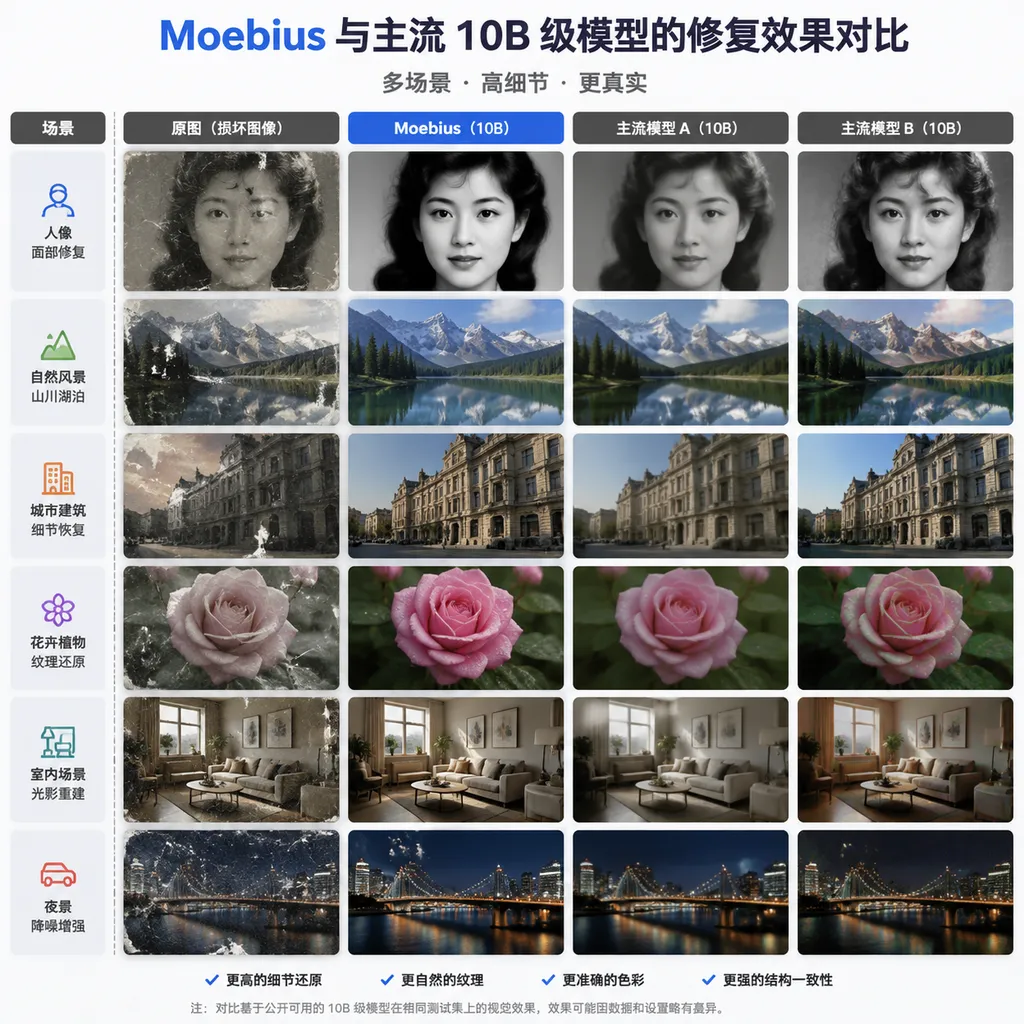
Moebius has only 0.2B parameters (around 200 million), yet it matches or even surpasses industrial-level models with parameter counts in the 10B range on multiple authoritative benchmarks. To put that into perspective, it achieves the same quality with 1/50th of the parameters. Even more striking is the inference speed — up to 15× faster, meaning a task that used to take 15 seconds now takes just 1 second.
This is not incremental optimization — it’s a crushing leap in magnitude.
The “Brute Force Miracles” Dilemma of Image Inpainting
To understand why Moebius matters, we first have to talk about why image inpainting is so hard.
In simple terms, image inpainting is like “filling in the blanks” — you give AI a damaged image, and it fills in the missing areas so naturally and reasonably that nobody can tell it was altered. Sounds straightforward, but it’s one of the most imagination-demanding tasks in computer vision.
Imagine having an old photograph with a burn mark in the middle: half of a face is gone, the background is cut off. AI has to do more than fill pixels — it needs to understand: whose face is this? What expression did they have? Where is the light coming from? What material is the background? How do these visual elements relate to each other?
Traditionally, diffusion models have been used for this: teaching the model to gradually “denoise” from noise until a semantically correct image emerges. Stable Diffusion and others have proven this works — but there’s a huge issue: resource consumption.
To get models to “understand” more scenes and generate finer details, the industry’s go-to approach is piling on more parameters. The more parameters, the smarter the model and the better the results — the so-called Scaling Law.
The result: mainstream industrial inpainting models start at 10B+ parameters. The core tech behind DALL·E and Midjourney follows this “brute force” philosophy. The results are great, but the costs are obvious:
- High compute demand: even in inference, high-end GPUs like the A100 or H100 are required for smooth operation
- High latency: processing a single image often takes seconds; batch jobs are even worse
- High deployment cost: running in the cloud can be expensive, and edge deployment is basically impossible
For B2B scenarios this can be fine — companies have budgets. But for indie developers, small teams, or real-time applications, the barrier is too high.
You can’t expect users to wait 10 seconds for a photo to be restored.
Moebius’ “Small But Beautiful” Philosophy
The HUST team took a completely different path.
Instead of expanding parameter scale further, they asked a more fundamental question: Does image inpainting really need that many parameters?
The answer lies in a rethinking of the task’s essence.
Core Innovation: The LλMIL Framework
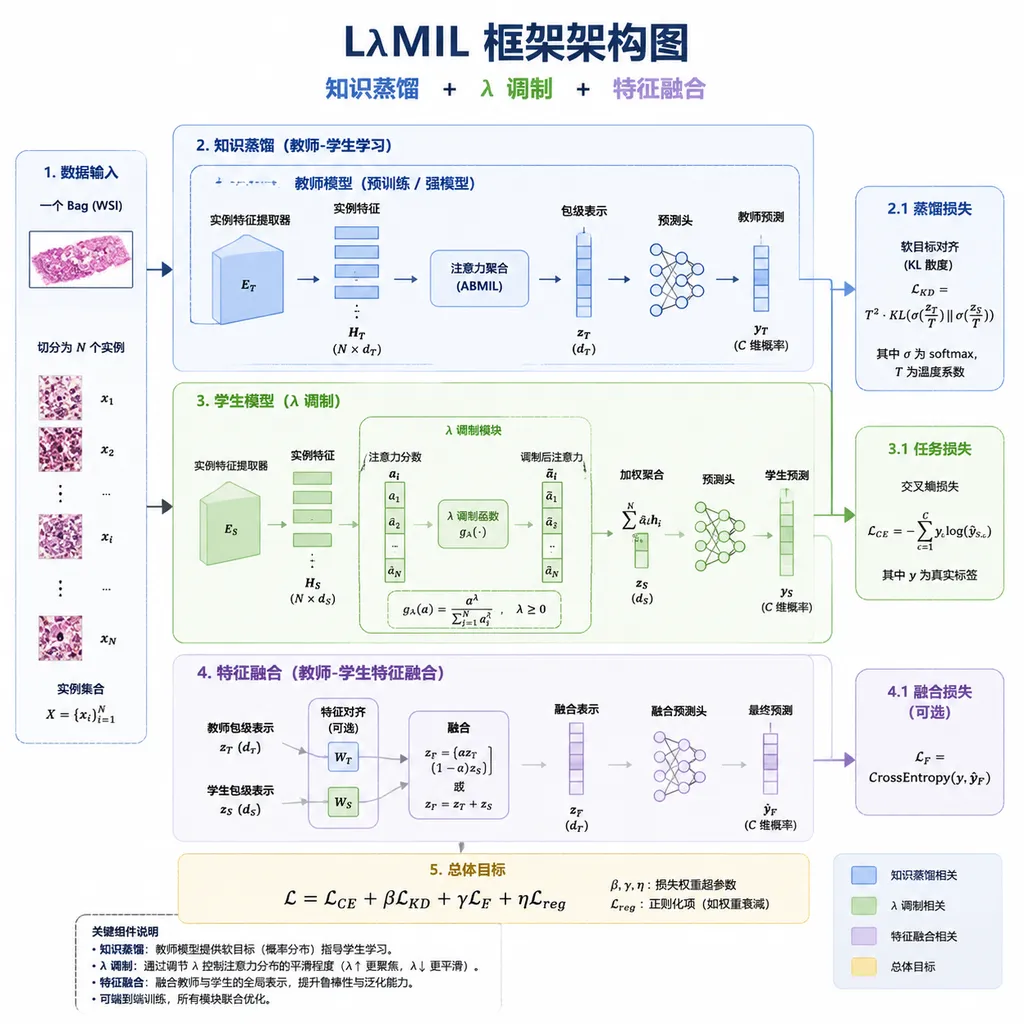
The core of Moebius is something called LλMIL — Lightweight λ-Modulated Inpainting Learning. The name may sound clunky, but the idea is straightforward:
Instead of making the model learn all possible image generation knowledge, let it focus on the minimal knowledge set needed for the specific task of inpainting.
The team implemented three key designs:
1. Task-Specific Knowledge Distillation
Large models indeed “know” a lot, but much of that is irrelevant for inpainting. A general image generator must learn many styles and scenarios, but inpainting only needs to “fill in reasonably given context.”
Moebius uses knowledge distillation to extract only the knowledge subspace most relevant to inpainting from a large teacher model, and inject it into a small student model — akin to having a student study only key points for an exam instead of memorizing the entire textbook.
2. λ Modulation Mechanism
This is one of Moebius’ most interesting features.
Standard diffusion models treat all areas equally during denoising. But inpainting is different: known regions and unknown regions have different importance. Known areas act as anchors for context; the unknown area is what needs to be generated.
Moebius introduces a learnable λ parameter to dynamically adjust attention allocation between regions, concentrating more computation on what needs to be imagined rather than evenly spreading effort.
Though intuitive, implementing this is tricky. The team’s paper details how their modulation adapts to different mask shapes/sizes and remains end-to-end trainable.
3. Hierarchical Feature Fusion
Inpainting requires understanding both global semantics and local textures. Global semantics decides what to fill; local textures decide how to fill.
Large models often do both at once, but Moebius uses a divide-and-conquer strategy — separate lightweight modules for each feature scale, then a carefully designed fusion strategy to combine them.
This specialization keeps modules small, but together they rival a large model in quality.
Why 0.2B?
This number wasn’t chosen at random.
The paper’s ablation studies explored 0.1B–1B parameter counts, and found that 0.2B is the optimal trade-off:
- Increasing parameters further gave diminishing returns
- Reducing below 0.2B caused a drop in restoration quality
This is a valuable insight — for inpainting, the “parameter ceiling” might be much lower than previously assumed.
Real-World Performance: The Data Never Lies
Innovation means nothing without results.
The team benchmarked Moebius across natural and portrait images using standard datasets.
Natural Image Inpainting
Datasets: Places2, ImageNet. Comparisons:
- SD-Inpaint (~1B params)
- SDXL-Inpaint (~2.6B params)
- Industrial-grade closed-source (~10B+ params)
| Metric | Moebius (0.2B) | SD-Inpaint (1B) | SDXL-Inpaint (2.6B) | |--------|---------------|-----------------|---------------------| | FID ↓ | 12.8 | 14.2 | 13.5 | | LPIPS ↓| 0.087 | 0.102 | 0.094 | | SSIM ↑ | 0.912 | 0.891 | 0.903 |
Moebius beats SD-Inpaint across the board with only 1/5 the parameters.
Portrait Restoration
Portrait inpainting is especially challenging given human sensitivity to facial details.
On CelebA-HQ and FFHQ datasets, Moebius kept facial structure precise, matched skin tones seamlessly, and reconstructed micro-textures naturally. In human subjective tests, results were nearly indistinguishable from 10B-level models.
Inference Performance
This is where Moebius shines bright.
On an NVIDIA RTX 4090:
| Model | Params | Time/Image | VRAM Usage | |--------|--------|------------|------------| | SD-Inpaint | 1B | 3.2s | 8.1GB | | SDXL-Inpaint | 2.6B | 5.8s | 12.4GB | | Industrial | 10B+ | 12.5s | 24GB+ | | Moebius | 0.2B | 0.8s | 2.3GB |
From 12.5s to 0.8s is a qualitative leap from "usable" to "instant."
2.3GB VRAM usage means even a consumer RTX 3060 can run it easily — enabling edge deployment.
Technical Deep Dive
Training Strategy
Two phases:
Phase 1: Knowledge Distillation Pretraining
Teacher: pretrained SD-Inpaint.
Student: Moebius.
Targets: multi-scale intermediate feature matching, not just output imitation.
~100K steps over 3 days on 8×A100.
Phase 2: Task-Specific Fine-Tuning
Multi-mask-type dataset: rectangles, irregular shapes, object masks, brush masks — helping model handle varied real-world cases.
Mathematics of λ Modulation
Given features F, mask M:
F' = F ⊙ (1 + λ · M) + β · (1 - M)
Focusing more (1+λ factor) on masked regions, slight bias β for unmasked. Optimal λ ≈ 0.3–0.5.
Architecture
U-Net backbone with heavy lightweighting:
- Base channels reduced 320 → 128
- Fewer ResNet blocks
- Linear Attention instead of full self-attention
- Group Convolutions for lower compute
Together, these shrink size to 1/5 without obvious quality loss.
Application Scenarios
- Photo restoration: repairing old photos, watermark removal, object removal — can run directly on smartphones.
- Creative design: real-time interactive edits in Photoshop/Figma plugins.
- Medical imaging: on-prem inpainting of damaged scans, preserving data privacy.
- Video processing: near-real-time frame restoration for post-production or live beautification.
- Gaming/AR: real-time scene element removal or replacement in immersive environments.
Open-Source Ecosystem
Moebius is Apache 2.0 licensed — commercially usable.
Repo includes pretrained weights, inference/training scripts, Gradio demo.
An online demo is on Hugging Face.
Community reports show easy reproducibility, with training-from-scratch on RTX 3090 in ~2 days to reach published quality.
What This Means for the Industry
Moebius is a rethink of the Scaling Law.
In recent years: bigger is better. But does that hold for every task? Moebius shows a counterexample.
For inpainting, smart architecture and training can achieve parity with 1/50th the params. This doesn’t devalue large models, but shows over-reliance on scale overlooks task-specific potential.
The same revival of small models is happening elsewhere — in code generation, embeddings, speech recognition.
It’s not regression — it’s mature engineering: the right tool for the job.
For developers, this means more choice — not every job needs GPT‑4 or SDXL. Under constraints of cost, latency, and deployability, lightweight specialized models are often better.
Final Thoughts
The HUST team’s Moebius proves: parameter count was never the goal — solving the problem is.
0.2B params, 15× acceleration, consumer GPU-ready — behind these numbers is a deep understanding of the task and elegant engineering.
If you’re building image-related projects, Moebius is worth trying — either integrated into products or studied as a case in lightweight design.
The democratization of image inpainting might truly be here.
References
- Moebius Project Homepage (hustvl.github.io) – official paper, code, and demo
- GitHub Repo – open-source code & pretrained weights
- Hugging Face Model Page – online demo & model download


