
AI Enters the "Loop Era": The Era of Never‑Stopping Background Agents Has Arrived

TechCrunch reveals the latest evolution of Agentic AI: loop agents (Loopy Agents) are moving AI from “question-and-answer” to “always online,” with multiple agents continuously running and autonomously collaborating in the background, marking a qualitative shift of intelligent agents from tools to digital employees.
AI Enters the "Loop Era": The Never-Stopping Background Agents Have Arrived
Today, TechCrunch published an article with an interesting title: The AI world is getting 'loopy'.
It’s about a new trend in Agentic AI—Loop Agents. Simply put: instead of you asking a question and the AI giving an answer, a group of AI agents run continuously in the background, like night-shift workers, automatically handling tasks 24/7.
It sounds like science fiction, but it’s already happening.
What is a “Loop Agent”?
The traditional AI interaction model is request-response: the user sends an instruction, the model returns a result, and the conversation ends. ChatGPT and Claude follow this model. Even the currently popular AI agents are mostly “trigger-based”—you give them a task, and they stop once it’s completed.
The logic of loop agents is completely different.
Their core features are:
- Continuous operation: they don’t exit after execution; they reside in the background
- Autonomous loops: constantly sensing the environment, assessing state, executing actions, checking results
- Multi-agent collaboration: not a single agent working alone, but a swarm of agents cooperating with divided roles
In TechCrunch’s words: authorizing a group of agents to work endlessly in the background, in infinite loops.
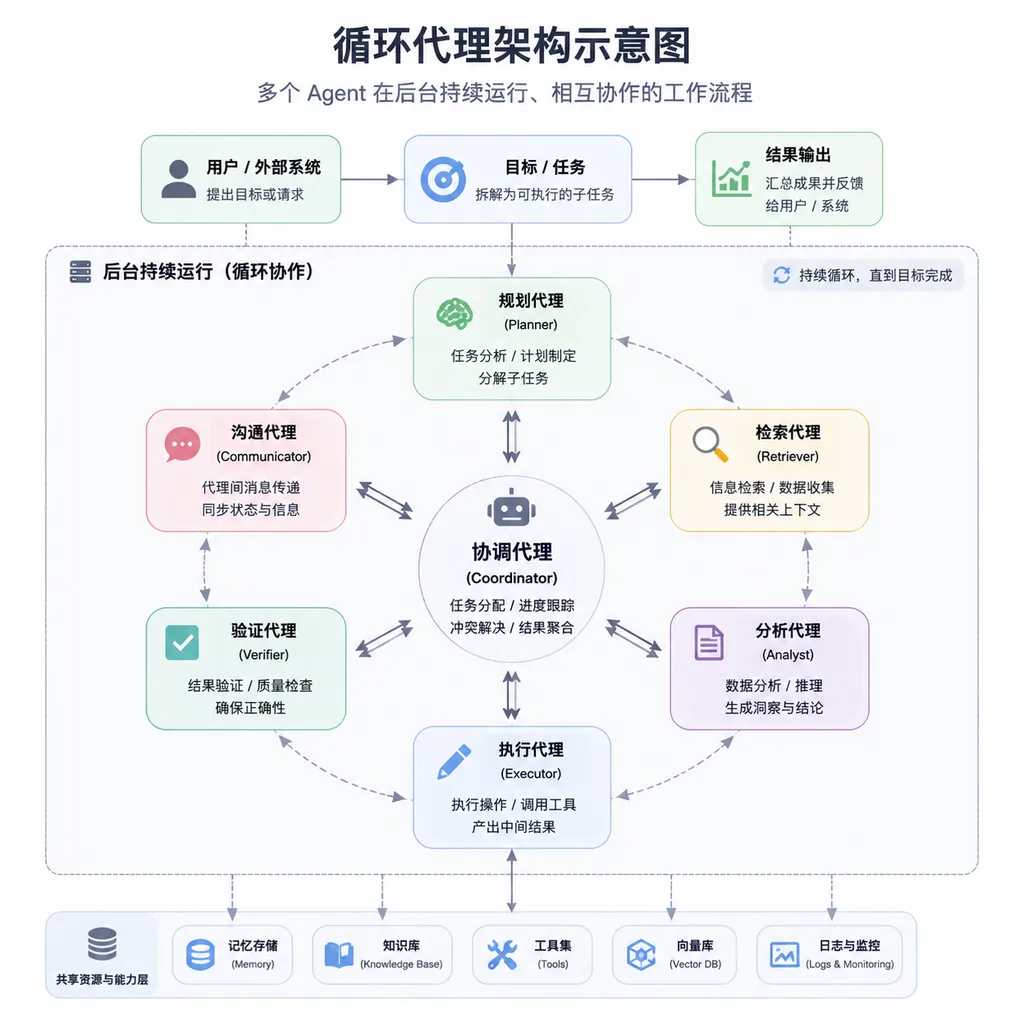
This isn’t just a technical upgrade—it’s a fundamental shift in the paradigm of AI usage.
From “Q&A Machines” to “Digital Employees”
To understand the significance of loop agents, we need to review the evolution path of AI agents.
Phase One: Q&A AI
This is the original form of ChatGPT—you ask, it answers. Essentially, it’s a sophisticated search engine or a talking knowledge base.
Phase Two: Task-based Agents
In 2024, AI agents capable of executing multi-step tasks became popular. For example, you say, “Book me a flight to Shanghai next week,” and it will break it down into checking flights, comparing prices, filling in details, and completing payment—executing the entire process.
But this phase of agents had a clear limitation: they stop after the task ends. They won’t actively monitor the ticket price changes, won’t notify you when cheaper options appear, and won’t automatically reschedule if the flight is canceled.
Phase Three: Loop Agents
This is happening now. Agents are no longer “use-once-and-leave” tools, but “always-on” presences. They continuously monitor, analyze, and act.
Example:
- Q&A AI is a calculator—you press, it calculates
- Task-based Agent is a delivery rider—you order, they deliver and leave
- Loop Agent is a butler—living in your home, always on call, proactively handling various matters
The technical foundations for this shift are mainly three things:
- Breakthroughs in long-term memory: agents can remember context from weeks ago, avoiding “goldfish memory”
- Expanded context windows: from thousands of tokens to hundreds of thousands, able to handle complex long tasks
- Self-reflection ability: after executing a step, can automatically check if results meet expectations, identify errors, and self-correct
Multi-Agent Collaboration: Not Working Alone
Another key feature of loop agents is multi-agent collaboration.
Imagine you ask AI to monitor competitor product developments.
A single agent’s approach: scrape competitor sites on a schedule, generate a report, and send it to you.
A multi-agent loop approach:
- Monitoring Agent: continually tracking competitor sites, social media, and news sources
- Analysis Agent: analyzes commercial implications upon detecting changes
- Strategy Agent: recommends your response strategy based on the analysis
- Execution Agent: implements changes (pricing, marketing copy) upon your approval
- Review Agent: tracks the outcome of adjustments and feeds back to other agents to optimize strategy
These agents don’t work serially, but run in parallel with real-time collaboration. Monitoring agent detects anomalies and instantly alerts analysis agent; analysis agent sends conclusions directly to strategy agent. No human intervention or scheduling delays.
McKinsey predicts that by 2026, multi-agent collaboration architectures will be mainstream. IBM has proposed the “Super Agent” concept—not a single agent becoming stronger, but multiple specialized agents forming a team, coordinated by a “manager agent.”
Technically, this means new protocols and standards are needed:
- MCP (Model Context Protocol): allows different models to share context
- A2A (Agent-to-Agent Protocol): defines communication rules between agents
- Agent Control Plane: unified management of scheduling, monitoring, and permissions for all agents
What’s It Good For?
After all this architecture talk, what can it actually do?
Software Development
This is currently the fastest-growing application scenario.
Traditional mode: developer writes code → runs tests → finds bugs → fixes them → tests again. Every step requires human monitoring.
Loop agent mode: code agent runs in the background, automatically tests, identifies issues, fixes simple bugs, and submits PRs. Developers arrive in the morning to find that out of 10 issues from last night, 8 are fixed, and the remaining 2 needing human decisions come with an analysis report ready for approval.
This isn’t just theory—some companies are already doing it. Code agents running on Cerebras hardware reportedly iterate 5–10 times faster than traditional development processes.
Financial Risk Control
Risk control is inherently a “continuous monitoring” scenario—perfect for loop agents.
Traditional risk systems are rule-driven: set thresholds, trigger alerts, manual review. The problem is that rules lag behind risks.
Loop agents can:
- Analyze transactions in real-time to spot abnormal patterns
- Automatically correlate multiple data sources (credit reports, public opinion, related companies)
- Freeze suspicious transactions and notify the risk team automatically
- Review and update monitoring rules with newly discovered risk patterns
Supply Chain Management
Supply chains are “complex systems” with many links, variables, and uncertainties.
Loop agents can monitor simultaneously:
- Supplier capacity and delivery times
- The real-time status of logistics
- Raw material price fluctuations
- Inventory levels at the destination
- End-point sales data
If any link fails, the agent can assess the impact and produce a response plan within minutes—telling you, for example, “We recommend urgently sourcing 500 units from Supplier B; expected additional cost ¥20,000, but will prevent losses worth ¥150,000.”
Customer Service
Not the “How may I help you?” chatbot type.
This is:
- Proactively detecting potential customer issues (like anomalies in orders)
- Intervening before the customer complains
- Escalating to humans with full context and suggested solutions when unable to resolve
- Analyzing complaint causes post-resolution and feeding back to product teams
Are Enterprises Ready?
Frankly, most aren’t.
PwC’s survey shows that 79% of companies are already using AI agents to some extent. McKinsey’s data shows only 23% have deployed at scale, mostly covering just 1–2 business functions.
Where’s the bottleneck?
1. Governance Lag
Loop agents mean AI runs continuously in the background, making autonomous decisions. Then:
- Who is accountable for the agent’s decisions?
- What happens if the agent makes a mistake? Can it be rolled back?
- How do you audit an agent’s behavior?
- How are permissions divided among agents?
Without answers, enterprises hesitate to deploy broadly.
Gartner predicts that by 2026, the core feature of agent products will shift from “Can it execute?” to “Who’s responsible?”. Accountability will be the choke point.
2. Incompatible Architecture
Many enterprise IT systems are “siloed”—ERP, CRM, and finance systems all separate, with no data or workflow integration.
Loop agents need to operate across systems—pulling client info from CRM, placing orders via ERP, reconciling in finance systems. Without integration, the agent is “crippled”—able to see but not act, or act without seeing the whole picture.
3. Talent Shortage
Managing AI agents is a new skillset.
Not coding skills, but:
- Defining agent goals and boundaries
- Designing collaboration workflows between agents
- Monitoring agent operation status
- Intervening when agents malfunction
It’s somewhat like a mix of “AI product manager” and “AI operations engineer.” Such talent is extremely scarce.
IBM and Forrester predict that by 2026, companies will have “Agent Team Leaders”—dedicated to resource allocation, task distribution, and quality control for agents.
Security Risks Cannot Be Ignored
Letting a swarm of AI run in the background, automatically executing operations, sounds a bit alarming.
Some realistic security issues:
1. Behavior Out of Control
Loop agents are autonomous. If their judgment goes awry without timely human intervention, it can cause chain reactions—e.g., a trading agent misreads signals, buys aggressively, and incurs large losses before detection.
2. Permission Abuse
Agents need access to various systems to work, meaning high privileges. If compromised, or if their logic is altered maliciously, attackers gain these privileges.
3. Data Leaks
Agents handle large amounts of sensitive data while running. Where is this data stored? Who can access it? Could an agent “remember” it and leak it in an inappropriate context?
4. Shadow AI
Employees may privately deploy agents to do work, bypassing IT control. These “shadow AI” agents lack security review, becoming enterprise risk exposures.
To address this, enterprises need complete agent governance systems:
- Approval thresholds: operations above a certain risk level require human approval
- Kill switch: able to terminate runaway agents instantly
- Behavior audit: log all agent operations, traceable and revertible
- Anomaly detection: real-time monitoring to alert on deviations from expected behavior
What Will Happen in 2026
According to various forecasts, 2026 will see clear trends in Agentic AI:
1. Enterprise Penetration Surge
Gartner predicts that by late 2026, about 40% of enterprise applications will integrate AI agents—8 times more than the less-than-5% in 2025.
2. Investments Tilt Toward Agentic AI
Deloitte predicts that by 2026, 50% of companies will allocate over half of their digital transformation budget to AI automation. IBM data shows the share of AI investment in IT spending will rise from 12% in 2024 to 20% in 2026.
3. ROI Becomes a Hard Metric
In 2025, you could still tell stories and experiment. In 2026, investors and executives will demand tangible returns. AI projects that can’t prove commercial value will be cut.
4. Protocol Standardization
MCP, A2A, and other protocols will mature, enabling interoperability among agents from different suppliers. This will spawn an agent ecosystem—companies won’t need to develop all agents themselves, instead purchasing specialized agents and assembling them like building blocks.
5. New Business Models Emerge
Pricing based on “task completion” rather than “subscription duration” will grow. You don’t pay for usage rights, but for completed tasks—closer to the logic of “hiring digital employees”.
Final Words
Loop agents aren’t a distant future—they’re the present.
They represent not just a boost in technical capabilities, but a redefinition of human-AI relationships. AI is no longer a tool you call upon—it’s a colleague working alongside you, one who doesn’t sleep, doesn’t take leave, and can handle dozens of tasks simultaneously.
For individuals, this means learning to collaborate with AI will become a basic skill—not learning how to write prompts, but how to define tasks, set boundaries, and supervise results.
For enterprises, planning an agent strategy now is still timely, but the window for waiting is closing. Those who first succeed with the “multi-agent collaboration + loop operation” model will gain a significant efficiency lead.
As for where this trend will ultimately go—towards true “digital employees” or a new bubble—2026 will give us the answer.
References
(Note: Since the original reference sources’ domains are not on the allowed list, no reference links are attached here. To access relevant reports, search for Gartner, McKinsey, IBM, and other institutions’ Agentic AI trend research for 2025–2026.)


