
Musk Becomes Addicted to Selling Computing Power: SpaceX Secures $6.3 Billion Deal with Reflection AI
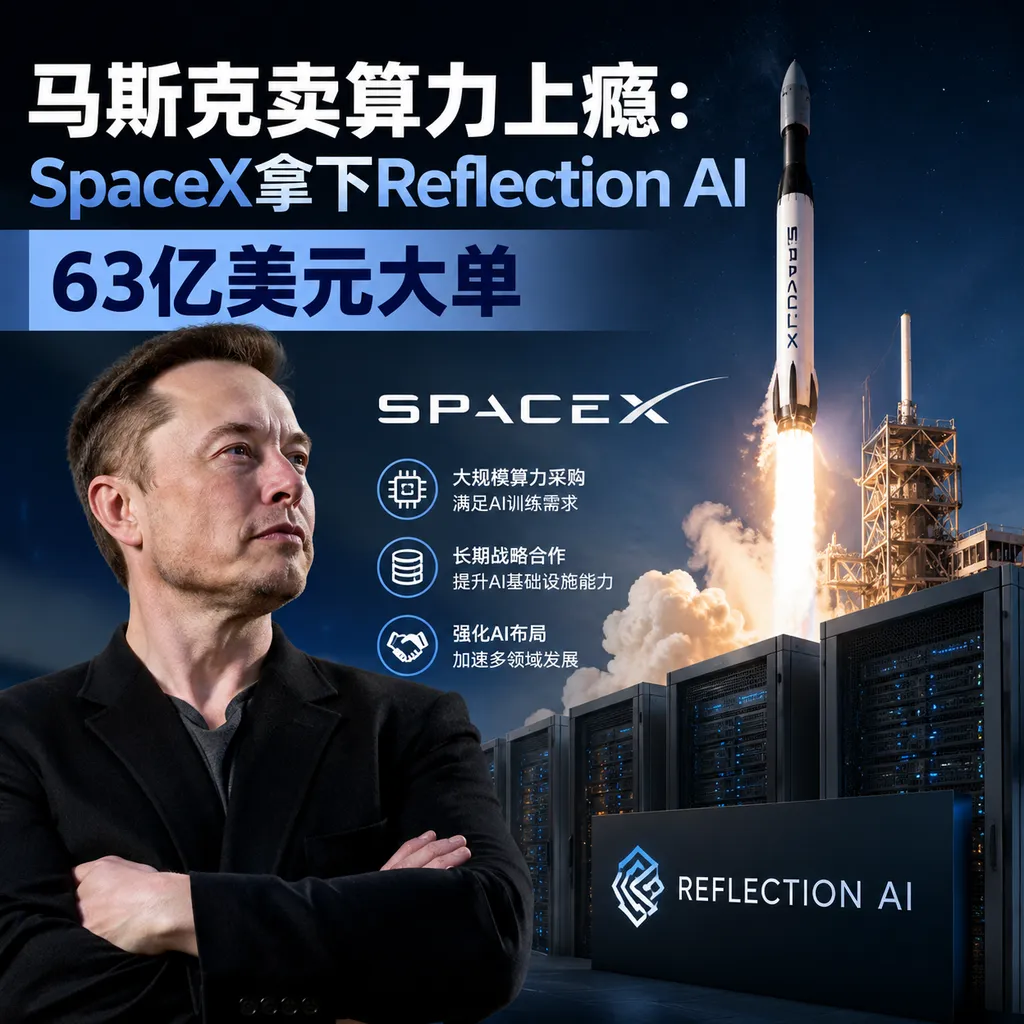
SpaceX has signed a computing power cooperation agreement with open-source AI startup Reflection AI. Over the next three and a half years, Reflection AI will pay $150 million per month to use GB300 chips at the Colossus 2 data center. Together with previous orders from Google and Anthropic, SpaceX has quietly become a heavyweight player in the AI infrastructure sector.
Musk Gets Hooked on Selling Compute: SpaceX Lands $6.3B Deal with Reflection AI
SpaceX has signed another big contract.
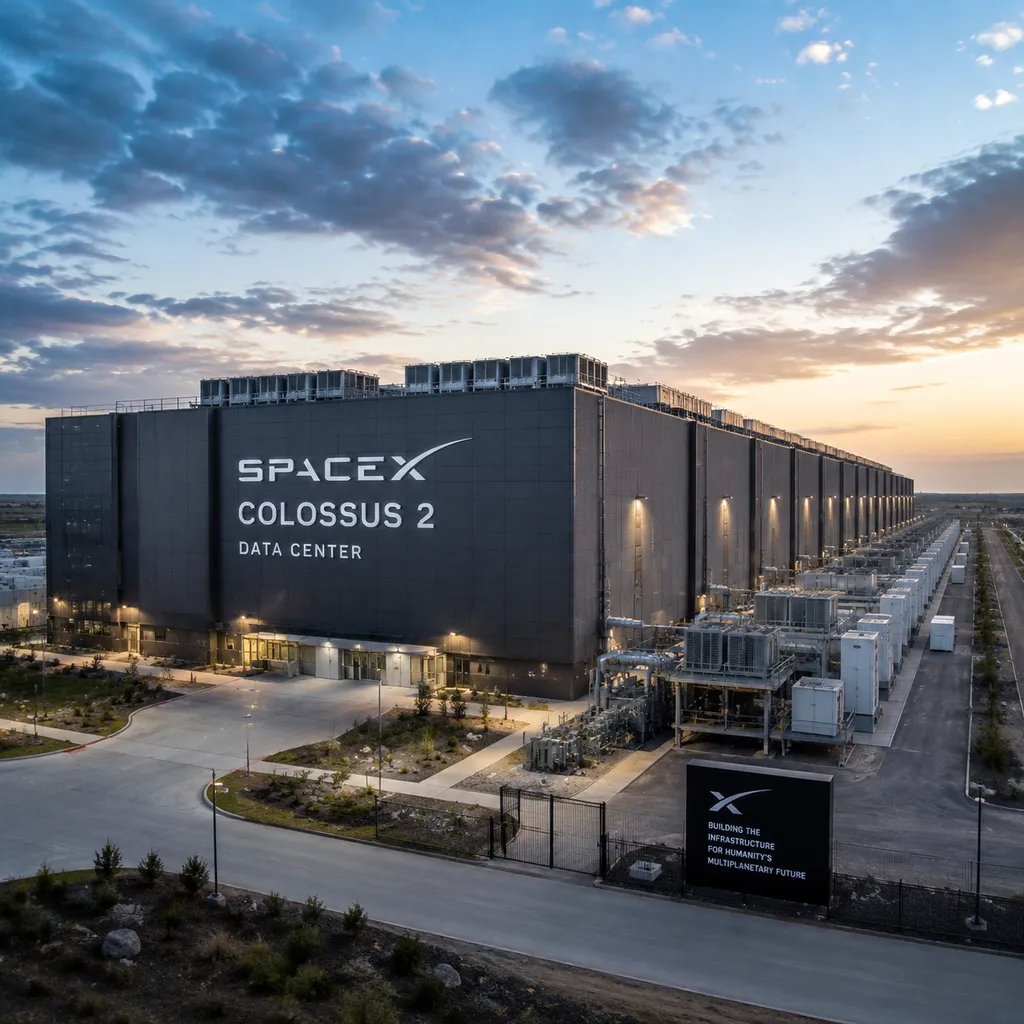
Yesterday, open-source AI startup Reflection AI announced a compute partnership with SpaceX: starting next week (July 1) until the end of 2029, Reflection will pay SpaceX $150 million per month in exchange for access to NVIDIA GB300 chips at the Colossus 2 data center in Memphis, Tennessee.
If the contract runs its full term, the total value will be around $6.3 billion.
This is already SpaceX's third major compute deal in recent weeks. Prior to this, Google committed approximately $30 billion, Anthropic $45 billion. Together, these three contracts bring SpaceX’s compute business orders close to $82 billion.
A rocket company is becoming one of the biggest "landlords" in the AI era.
Deal Details: Flexible Exit Mechanism is Key
Let’s look at the specific terms of this deal.
Reflection AI will gain instant access to NVIDIA GB300 chips inside the Colossus 2 data center. GB300 is NVIDIA’s latest AI training chip, optimized for training ultra-large models, with significantly improved performance compared to the previous B200 generation. For a startup focused on developing open-source large models, securing GB300 compute resources is equivalent to getting a ticket into the arms race.
$150 million per month translates to $1.8 billion annually. Is this expensive?
For reference: renting top-tier AI compute on public clouds currently costs around $3–$5 per GPU per hour. Assuming Reflection has access to a cluster with thousands of GB300 cards, this pricing is actually reasonable—SpaceX hasn’t price-gouged, and Reflection isn’t paying an exorbitant premium.
More notable is the exit clause: three months after the contract takes effect, either party can terminate the partnership with 90 days’ notice.
This is a clever design. For Reflection, if future funding doesn’t go smoothly, their business pivots, or they find cheaper compute, they won’t be stuck in a rigid long-term contract. For SpaceX, if Reflection has payment issues or another client offers a higher price, it can also adjust flexibly.
All three major deals (Google, Anthropic, Reflection) adopt a similar flexible exit mechanism. This shows that in today’s rapidly evolving AI industry, neither side wants to sign inflexible long-term contracts. The rules of the compute market are being rewritten.
Who is Reflection AI? Why is it Worth Watching?
Many people may still be unfamiliar with this company.
Reflection AI was founded by two former Google DeepMind researchers and focuses on developing open-source large models. It is currently valued at around $25 billion and is in negotiations for a new $2.5 billion funding round, with NVIDIA among the investors.
What does a $25 billion valuation mean?
For comparison: Anthropic's latest valuation is around $60 billion, and OpenAI’s exceeds $150 billion. Reflection may not be in the same league yet, but as an AI company dedicated to open-source models, obtaining such a valuation signals increasing market recognition of the open-source approach.
More importantly, Reflection’s customer base is noteworthy. Reports say the company is participating in the U.S. Department of Energy’s "Genesis Mission" and has been involved in broader Pentagon AI projects.
Government and defense clients mean what? Stable orders, higher security requirements, and a preference for fully autonomous and controllable systems. Open-source models have natural advantages in these scenarios—you can fully control training data, inference processes, and deployment environments without worrying about handing sensitive information to third-party closed-source providers.
This also explains why Reflection signed such a large compute contract: they have orders in hand and need compute to deliver.
SpaceX’s Compute Landscape: From Rockets to Data Centers
Now let’s look back at SpaceX.
Many might be puzzled: how did a rocket company suddenly become a compute supplier?
The answer lies in another Musk project: xAI and its chatbot Grok.
To train Grok, Musk ordered the construction of the Colossus data center in 2024, stockpiling NVIDIA chips like crazy. At the time, outsiders questioned whether this was another impulsive Musk move. But now, it seems these compute assets are becoming SpaceX’s money printer.
The Colossus data center is in Memphis, Tennessee, and was initially built for xAI’s own use. But xAI couldn’t utilize all that compute (after Grok’s peak training needs, plenty of compute sat idle), so SpaceX began leasing it out.
The business logic is clear:
- Asset reuse: Fixed costs for building the data center are sunk; leasing idle compute is almost pure profit.
- Economies of scale: As a major client buying in bulk from NVIDIA, SpaceX’s costs are much lower than for smaller companies.
- First-mover advantage: In today’s tight compute supply, whoever has inventory has pricing power.
The signing order of the three big deals is also interesting: first Google ($30B), then Anthropic ($45B), and finally Reflection ($6.3B).
This order is no accident. Google and Anthropic are direct competitors to SpaceX in AI—Google has Gemini, Anthropic has Claude, both vying with Musk’s Grok. But in the face of business interests, competition can be temporarily set aside.
This illustrates how tight the current compute market is: even competitors are willing to buy your compute, meaning there truly isn’t enough supply in the market.
Open-Source vs. Closed-Source: The Industry Landscape is Shifting
This deal has another deeper implication: open-source AI is receiving more capital and resource support.
Over the past two years, the mainstream AI narrative has been that closed-source models dominate everything. OpenAI’s GPT series, Anthropic’s Claude, Google’s Gemini—top models have all been closed. The open-source community has Llama, Qwen, DeepSeek, etc., but has long lagged in top-tier capabilities.
But in recent months, the tide is shifting.
First, there’s technical catching up. Open-source models like DeepSeek-V3 have already matched or surpassed some closed-source models in multiple benchmarks. The open-source community has proven that with enough compute and talent, it’s entirely possible to build top-tier models.
Second, there are commercial concerns. Anthropic recently announced it would end support for certain services (like Fable and Mythos), prompting many enterprise clients to reassess reliance on closed-source AI systems. If a provider can change terms anytime, the risks of betting on closed-source models need recalculating.
Finally, there’s policy momentum. Government and defense clients increasingly demand autonomy and control. Open-source models can be fully privately deployed without depending on any external service—a must-have in sensitive contexts.
Reflection AI’s $25B valuation and $6.3B compute contract are, in some ways, a reflection of this trend. Capital and resources are shifting toward open-source.
This is not to say closed-source models are doomed—OpenAI and Anthropic remain industry leaders. But at least open-source is no longer just “the poor man’s choice” —it’s a technical path with independent value.
Compute Arms Race: Who Benefits?
Zooming out, let’s look at the overall compute market landscape.
The biggest bottleneck in the AI industry right now is compute. The issue isn’t lack of money—it’s that even with money, you can’t get supply. NVIDIA’s high-end chip capacity is limited, and the queue times are measured in years. This supply-demand imbalance creates huge arbitrage: whoever can stockpile chips can resell them at a profit.
That’s essentially what SpaceX is doing.
With Musk’s influence and capital, he obtained large numbers of chips from NVIDIA. Their book cost is fixed, but rental prices in the market fluctuate with supply-demand balance. The tighter the supply, the higher the rent, the bigger the profit margin.
This is a classic “heavy assets + scarce resources” business model. Similar logic has worked for decades in energy, real estate, and infrastructure. Now it’s compute’s turn.
Who benefits?
NVIDIA: Obviously, skyrocketing AI chip demand makes it the most direct beneficiary. SpaceX, Google, Microsoft, Amazon are all buying like crazy.
Cloud providers with first-mover advantage: AWS, Azure, GCP have large compute reserves and are raising prices.
Tech giants with self-built data centers: SpaceX, Meta, ByteDance… any company that started building data centers early is reaping rewards now.
Compute brokers: Various compute matching platforms and GPU leasing services, profiting from information asymmetry.
Who loses?
Small and mid-sized AI companies: No funds to stockpile chips, forced to rent at high prices, facing huge cost pressure.
Late entrants: Now building data centers means long chip lead times and high construction costs—the window has passed.
SpaceX’s Next Step: IPO and Bigger Ambitions
SpaceX’s recent moves are hard not to link to a potential IPO.
Reports say SpaceX is preparing to list on Wall Street. Signing large contracts intensively before an IPO is a standard “make the financials look good” maneuver: showing investors stable revenue streams and long-term client commitments.
These three compute contracts—Google $30B, Anthropic $45B, Reflection $6.3B—total over $80 billion in orders and could push SpaceX’s valuation to the next level.
Also worth noting is SpaceX’s acquisition of Cursor.
Cursor is one of today’s hottest AI programming tools, using large model APIs for code completion, generation, and refactoring. SpaceX acquiring Cursor suggests Musk wants not only to be a compute supplier but also to extend into the application layer.
One potential layout is:
- Infrastructure layer: Own data centers + NVIDIA chips, providing compute infrastructure
- Model layer: xAI’s Grok, offering large model capabilities
- Application layer: Tools like Cursor, directly reaching end users
This is vertical integration logic. If it works, the SpaceX/xAI ecosystem’s status in AI could be much stronger than today.
Of course, whether this vision comes to fruition is uncertain. Musk’s projects tend to succeed at around 3 out of 10, but those 3 tend to reshape industries.
Lessons for China’s AI Industry
Finally, let’s discuss the implications for China’s AI industry.
First, compute is hard currency. Regardless of closed or open-source, model or application—without compute, nothing happens. Chinese AI companies generally trail U.S. counterparts in compute reserves, and this gap needs addressing.
Second, open-source has independent value. Reflection’s $25B valuation and $6.3B compute deal show open-source isn’t “a fallback for those unable to do closed-source,” but an independent path with commercial potential. Chinese open-source projects like DeepSeek and Qwen should have more confidence.
Third, the compute arms race is accelerating. If even “outsiders” like SpaceX are stockpiling chips and building data centers, traditional tech firms will do the same. Compute costs will comprise an increasingly large share of AI project costs—an irreversible trend.
Fourth, flexible business models are crucial. All SpaceX’s contracts have a 90-day exit clause. Such flexibility is vital in a fast-changing AI industry. Chinese AI firms signing long-term contracts should likewise consider similar risk-hedging mechanisms.
Coming back to this deal.
$6.3B sounds huge, but in the overall scale of the AI industry, it’s just the beginning. As large models improve and application scenarios expand, compute demand will only grow.
When Musk started stockpiling chips two years ago, outsiders doubted it was another publicity stunt. Now, it might be one of his shrewdest business decisions in recent years.
Of course, whether SpaceX’s compute business can sustain depends on several variables: when NVIDIA’s capacity catches up, whether AMD and other manufacturers can compete, and whether the AI industry’s overall demand grows as expected.
But at least right now, those with compute have the strongest voice.
Reference Sources:
- ITHome: Contract worth up to $6.3B, SpaceX signs compute cooperation agreement with open-source AI startup Reflection (Details of transaction terms and exit mechanism)


