
Samsung launches UFS 5.0: 10.8 GB/s, the loading time for on-device large models is about to end
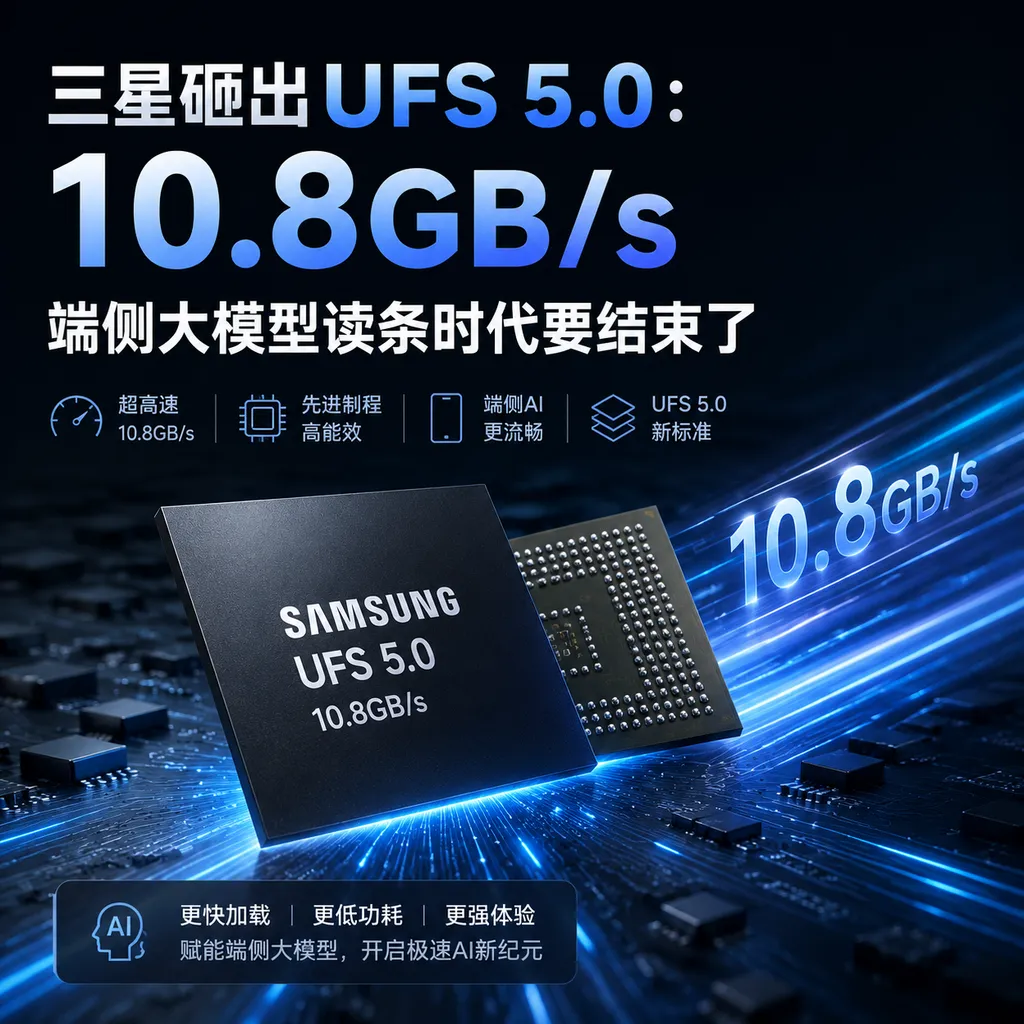
Samsung today released the industry’s first UFS 5.0 storage solution, with sequential read speeds soaring to 10.8 GB/s—more than double that of the previous UFS 4.1 generation—and over 40% improvement in energy efficiency. Designed specifically for on-device large model inference, it will enter mass production in Q4.
Samsung Launches UFS 5.0: 10.8GB/s, Signaling the End of Load Times for On-Device Large Models
On June 23, Samsung Electronics announced it had secured the first launch of UFS 5.0, claiming it to be the fastest mobile storage solution in the industry. With a maximum bandwidth of 10.8GB/s, it’s more than twice as fast as the current flagship standard UFS 4.1 (4.64GB/s). Mass production will start in Q4, with capacities up to 1TB. Target customers include next-generation flagship smartphones, XR headsets, and AI wearables.
This marks the first commercial product release since JEDEC finalized the UFS 5.0 specification in October last year. Although Kioxia had hinted at its plans in EE Times Japan back in February, Samsung was the first to deliver a mass-producible product, gaining the early advantage.
No Longer Just a Data Warehouse — Storage Becomes the Bottleneck for AI Inference
Why is a flash memory chip worth a dedicated write-up this time? Because on-device large models have forced storage from a supporting role into a starring one.
In the past, phone storage mainly served as a place for photos and app installations; as long as performance was adequate, it was hardly worth a mention at product launches. But generative AI has changed the rules — running a 3B or 4B parameter LLM locally means 3–4GB of weight files. Every cold start requires moving all of these from UFS to DRAM before the SoC can compute the first token.
This is the industry’s oft-cited Time to First Token (TTFT). For cloud APIs, the blocker is network latency; for on-device AI, it’s flash bandwidth. With UFS 4.1, reading 3–4GB takes about 1 second — tolerable for users. But if on-device models grow to 7B–10B (7–10GB even with INT8 quantization), the bottleneck is exposed — you can’t have users tap “AI Assistant” and then stare at a loading bar for three seconds.
Samsung’s 10.8GB/s read speed means models around 10GB can also load in roughly a second. According to Kioxia, UFS 5.0 raises the practical capacity limit for on-device LLMs from 3–4GB to around 10GB. This isn’t a numbers game — it’s the dividing line between whether a phone can run a genuinely useful large model locally.
Specs Breakdown: Full Upgrade in Physical and Protocol Layers
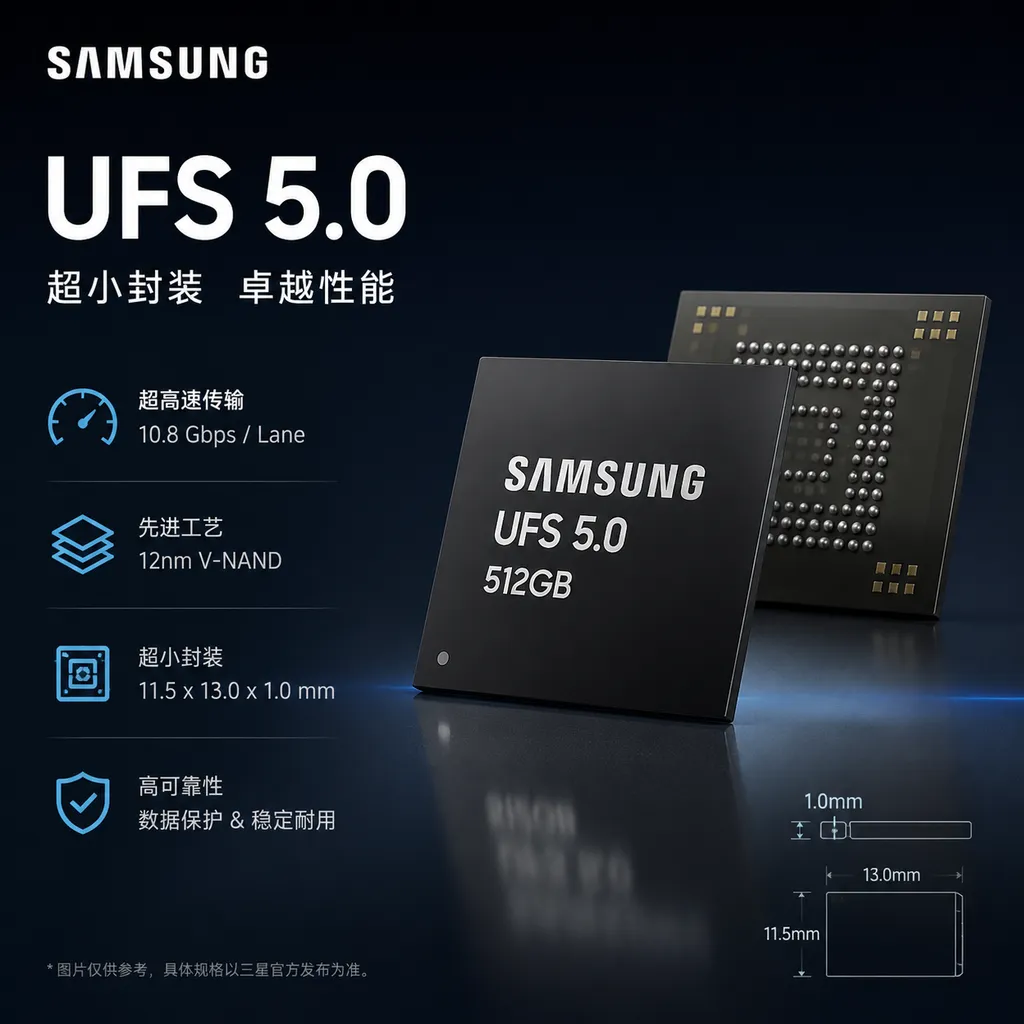
Samsung’s product parameters this time:
- Sequential Read: Up to 10.8GB/s
- Sequential Write: Up to 9.5GB/s
- Power Efficiency: Over 40% improvement versus UFS 4.1
- Package Size: 7.5 × 13 × 0.9 mm, 16.7% smaller than the previous generation
- Capacity: Up to 1TB, multiple versions available
- Mass Production: Q4 2026
UFS 5.0 gets a full under-the-hood refresh. The physical layer uses MIPI Alliance’s M-PHY v6.0, and the protocol layer is UniPro v3.0 — the foundation for doubling bandwidth. Samsung has also worked on efficiency: clock gating, multi-voltage domain design — in simple terms, turning off the clock to idle modules and powering modules on demand. Power consumption is significantly reduced for the same data throughput, which matters for flagship devices already cramped for battery budget while housing NPUs and large DRAM.
A 16.7% reduction in package size might not sound sexy, but it matters for XR headsets — where every cubic millimeter counts. Every bit saved in storage space means more room for optical modules and thermal management.
RAG Moves to Mobile: A New Role for Flash
The truly interesting part of UFS 5.0 is that it enables a new architectural approach for on-device AI.
Traditionally, model weights are stored in UFS, then loaded entirely into DRAM at runtime, and the SoC reads parameters from DRAM to compute. But mobile DRAM tops out at a few tens of GB at most — and much of it is reserved for the OS and apps — so model size ceilings are low.
Kioxia proposes a different approach — separating “thinking” from “knowledge.” The LLM handles inference on GPU/NPU, but the vector database for RAG (retrieval-augmented generation) stays in UFS, accessed on-demand without occupying DRAM. Kioxia’s open-source AiSAQ software does exactly this — originally for data centers, but now validated on mobile.
For this architecture to work, flash must read fast enough. In the UFS 4.1 era, real-time vector retrieval from storage was barely feasible — latency would kill the UX. But at 10.8GB/s, this barrier is lowered — installing a personal RAG database of tens of gigabytes (chat history, documents, photo metadata) to power personalized answers from an on-device large model becomes technically viable.
That’s why I say UFS 5.0 isn’t just another routine upgrade. It redefines mobile storage from “app drive” to “part of the AI inference pipeline.”
How It Stacks Against Competitors
Looking horizontally, Kioxia also has UFS 5.0 — based on its 8th-gen BiCS FLASH plus CBA bonding technology, with an in-house controller, and similarly claiming 10.8GB/s. SK Hynix and Micron have not yet unveiled products of the same class. Samsung’s “fastest in the industry” claim is essentially a launch-first boast; the real performance gap will be clear after Q4 mass production and third-party testing.
Samsung does hold an advantage Kioxia lacks: it makes its own phones. The Galaxy S series and foldables can absorb early production runs, and the Galaxy AI ecosystem will want to leverage the new hardware. The Galaxy S27 series, expected in 2027, will likely be the first flagship platform with UFS 5.0, followed by Chinese flagships.
In XR, adoption might be even faster. Samsung’s XR headset — the Project Moohan series co-developed with Google and Qualcomm — will reach its second generation this year. On-device large model inference is a core selling point, and UFS 5.0’s compact size and high bandwidth are a natural fit.
Key Points for Developers
For those building on-device AI apps, now is the time to factor these variables into 2027 product plans:
- Model size limits will increase — 4B parameters was the on-device comfort zone; with UFS 5.0, 7B–10B becomes a standard flagship option. Prepare corresponding quantization and distillation strategies.
- Cold start latency will no longer be an excuse — With TTFT dropping from ~1s to 300–500ms, interaction design for on-device AI should be reworked; those “Please wait, thinking…” animations can go.
- Local RAG will truly arrive — The hardware is ready for placing personal knowledge bases on phones; whether to do it and how to handle privacy will be key product decisions in the next 1–2 years.
- Hybrid architectures are transitional — Cloud large models + on-device small models will remain for a while, but on-device capability will keep expanding. Dynamic switching strategies will be a core skill.
On a side note, for those doing cloud–edge collaboration still worrying about integrating multiple model APIs, aggregation platforms like OpenAI Hub are a convenient choice — one key to access GPT, Claude, Gemini, DeepSeek in OpenAI-compatible format, usable in China, and easy to pair with an on-device model as fallback.
In Closing
Over the past two years, the storage industry has followed a similar script: HBM sucking up capacity, QLC eSSDs booming in data centers, consumer products being squeezed. At MemoryS 2026, all major manufacturers forecast “tight supply until at least 2027.” In this context, the rollout of UFS 5.0 is being pulled forward by AI demand — as Kioxia’s Takumi Watanabe put it: “In the past, standard setting came first, with transmission speeds doubling roughly every four years. But in recent years, with the evolution of on-device technology, smartphone makers’ demand for higher speeds has become increasingly urgent.”
Standards are being accelerated by demand, manufacturers are being pushed by flagship devices to mass-produce, and developers are driven by new hardware to redo products. Once this chain starts rolling, the hardware ceiling for on-device AI will be raised year by year. Today’s UFS 5.0 is just one point on that curve.
References
- Samsung launches industry’s fastest UFS 5.0 solution: 10.8GB/s bandwidth for on-device AI - ITHome — Samsung’s official release and product specification details


