
7B small model as a foreman — on what grounds does Sakana Fugu challenge Fable 5?
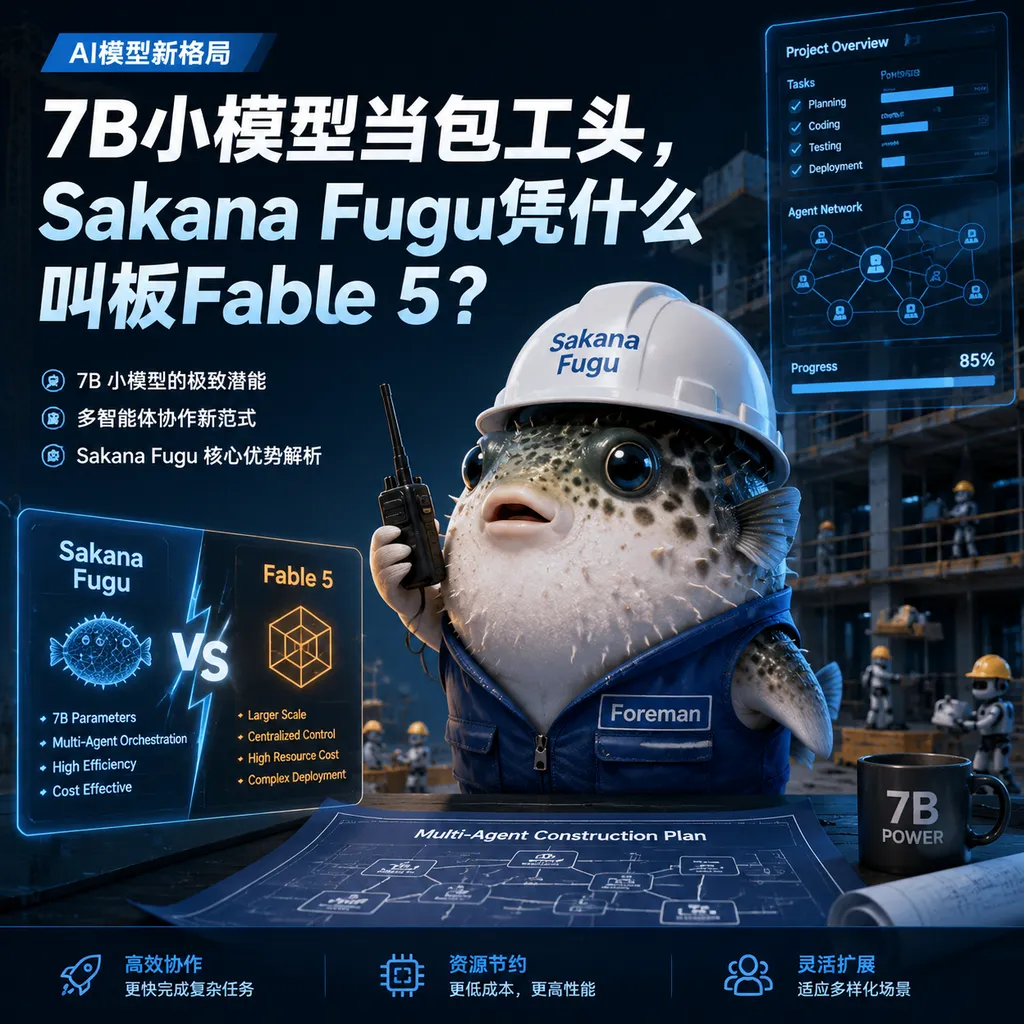
Japanese AI startup Sakana AI has released Fugu, a multi-agent orchestration system that uses a 7B-parameter "dispatcher" model to dynamically call top global large models such as GPT, Claude, and Gemini. On engineering benchmarks such as SWE-Bench Pro, it surpasses GPT-5.5 and Claude Opus 4.8, with the company claiming performance on par with the export-controlled Fable 5.
Not a Bigger Model, but a Smarter Orchestration
Japanese AI startup Sakana AI yesterday (June 22) released something that caught the industry's attention: the multi-agent orchestration system Fugu.
This is not another hundred-billion-parameter behemoth. Quite the opposite — the core of Fugu is a small model with only 7B parameters. It doesn’t do the work itself; it specializes in directing others to do the work — dynamically orchestrating top-tier global models like GPT-5, Claude Opus 4.8, and Gemini 3.1 Pro, assigning subtasks to the most suitable “expert” based on the type of task.
The result? On the SWE-Bench Pro software engineering benchmark, Fugu Ultra scored 73.7, surpassing Claude Opus 4.8’s 69.2 and GPT-5.5’s 58.6. On the TerminalBench 2.1 system operations test, it scored 82.1, again taking the lead.
Even more interesting is Sakana AI’s marketing posture: in the official statement, they boldly promoted “cutting-edge capabilities without export control risk” as a selling point, clearly mocking Anthropic’s Fable 5, which cannot be used in some regions due to regulatory restrictions.
What Can 7B Parameters Do? Be a Competent Foreman
To understand Fugu’s design logic, you first need to look at Sakana AI’s situation.
The company was founded in Tokyo in 2023 by Transformer paper co-author Llion Jones and former Google researcher David Ha. In 2025, they secured investment from giants like NVIDIA and Google, reaching a valuation of over $2.5 billion. But Japan lacks the compute infrastructure and data scale of the US or China, making it impractical to go head-to-head with hundred-billion-parameter large models.
Sakana AI chose another path: instead of building the strongest monolithic model, build the smartest orchestration system.
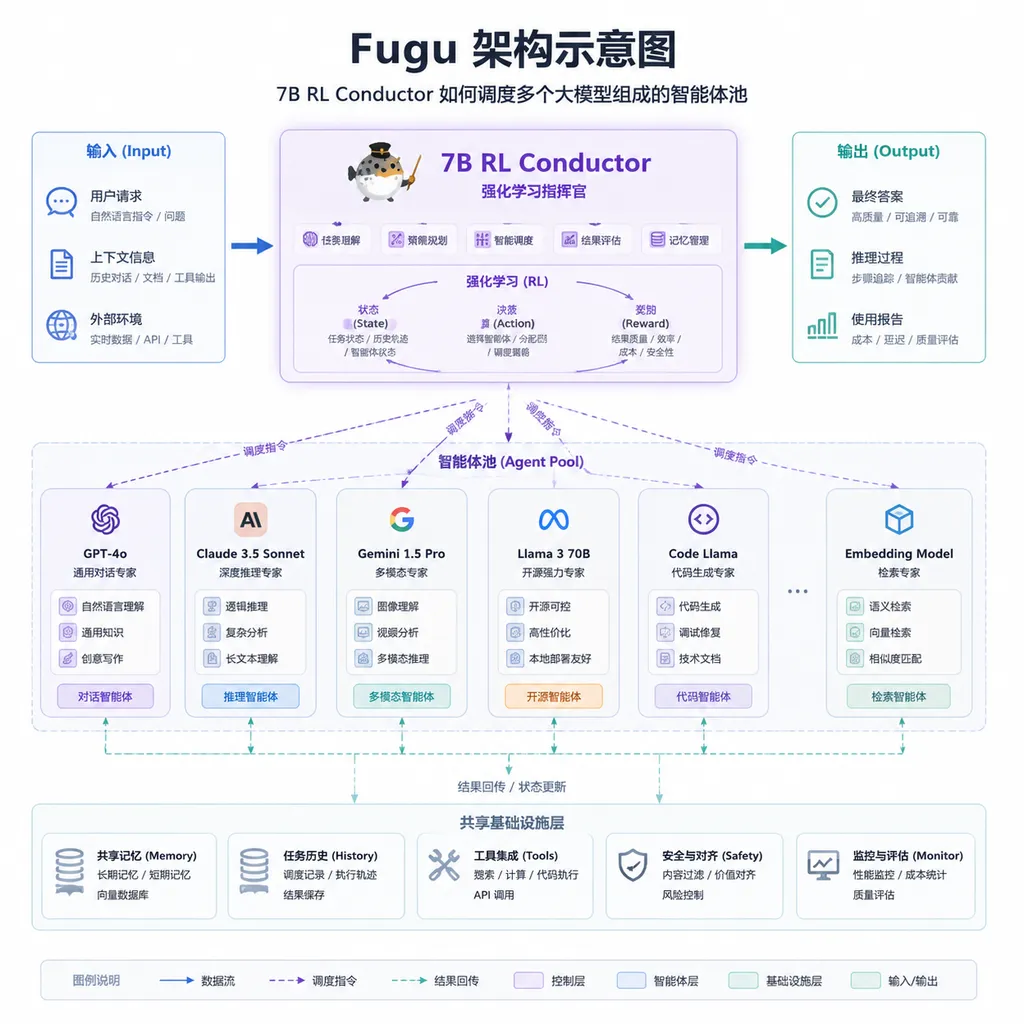
Fugu’s architecture can be understood like this:
- RL Conductor: a 7B-parameter model trained via reinforcement learning; responsible for analyzing tasks, decomposing them into subtasks, selecting execution models, and validating results.
- Agent Pool: GPT-5, Claude Opus 4.8, Gemini 3.1 Pro, etc., standing by as an “expert team.”
- Single API: exposed externally as an OpenAI-compatible interface, with users unaware of the orchestration process behind the scenes.
Traditional large models are “all-in-one” monoliths — a prompt goes in, computation proceeds layer by layer, and output comes out. This works very efficiently for simple problems, but for complex, multi-step engineering tasks it can lead to hallucinations or broken logic.
Fugu’s approach is different: let professionals do professional work. When a code review task comes in, it may simultaneously call a model specialized in static analysis, one with strong logical reasoning, and another great at security audits — verifying from multiple angles. This “expert panel” approach naturally detects more issues than solo work.
There’s academic backing for this. Two papers at ICLR 2026 — TRINITY: An Evolved LLM Coordinator and Learning to Orchestrate Agents in Natural Language with the Conductor — detail how to use small-parameter models with reinforcement learning to “command” large models. The core insight: Test-time Scaling compute doesn’t have to be spent on deep internal reasoning; it can be spent on external orchestration, verification, and synthesis.
Benchmark Scores: Surpassing GPT-5.5 and Opus 4.8, Claiming to Rival Fable 5
Fugu currently offers two versions:
- Fugu (balanced): suited for everyday development tasks.
- Fugu Ultra: aimed at complex problems, calling deeper into the expert agent pool.
Official published benchmark results:
| Benchmark | Fugu Ultra | Claude Opus 4.8 | GPT-5.5 | Gemini 3.1 Pro | |-----------|------------|-----------------|---------|----------------| | SWE-Bench Pro | 73.7 | 69.2 | 58.6 | 54.2 | | TerminalBench 2.1 | 82.1 | 74.6 | 78.2 | - |
SWE-Bench Pro measures software engineering capability, requiring locating and fixing bugs in real codebases. TerminalBench 2.1 tests system operations capability. Both are “hard bones” leaning toward real engineering environments, not easy multiple-choice-style benchmarks that can be gamed.
Fugu Ultra’s lead on these shows that it is less likely than monolithic models to crash mid-task or drift off-target when tackling complex engineering problems.
But here’s the controversy: Sakana AI claims Fugu Ultra “matches” Anthropic’s Fable 5 and Mythos Preview on engineering and scientific benchmarks. The problem is, Fable 5 and Mythos Preview aren’t part of Fugu’s agent pool, due to export controls or non-public releases. This comparison is based on publicly reported scores, not same-pool, same-condition testing.
The developer community is skeptical: testing conditions vary between systems and environments — is directly comparing scores fair? Some point out that referencing vendor-reported data is standard practice when unified testing isn’t possible.
Regardless of the Fable/Mythos debate, Fugu’s surpassing GPT-5.5 and Opus 4.8 is an apples-to-apples comparison. And the edge comes not from Fugu’s base model being more intelligent — Fugu doesn’t generate answers itself — but from the RL Conductor’s precision in task decomposition and expert orchestration.
Real-World Experience: Code Review, Long-Conversation Stability, Penetration Testing
Fugu underwent Beta testing with nearly 500 early users before launch, revealing some interesting traits.
Depth in Code Review
Traditional monolithic models often only catch surface-level syntax errors or common logic flaws. Testers found Fugu could identify deep architectural bugs that other tools missed entirely.
The reason is clear: the RL Conductor can simultaneously call several models with different specialties to cross-check the same code — static analysis, logical reasoning, security audit — each doing its own job.
Stability in Long Conversations
One of the biggest headaches in building AI Agent products is “persona drift” in long conversations — as dialog rounds increase, the model forgets its initial instructions or deviates from directives.
Corporate testers reported Fugu’s persona remains exceptionally stable even in long conversations, with virtually no drift.
This comes from the architecture: the RL Conductor itself isn’t responsible for maintaining long text memory; it simply chooses the most suitable base model for each conversational turn based on current context. Separating control from generation avoids the degradation monolithic models show in long-context scenarios.
End-to-End Cybersecurity Capability
In security tests, Fugu could independently perform the full process — from reconnaissance to XSS/SQLi vulnerability detection to authentication review — generating complete penetration testing reports while strictly adhering to safe instructions.
Completing such complex tasks depends on the RL Conductor precisely orchestrating security toolchains and different large models’ abilities. A monolithic model would struggle to cover so many specialized domains in one reasoning pass.
Token Efficiency
Monolithic models tackling complex problems often produce excessively long chains-of-thought, consuming many tokens. Fugu’s RL Conductor avoids meaningless long CoT costs via precise routing.
For developers billed per token, this means lower costs and faster responses.
Risks: Living on Other People’s Infrastructure
After all those advantages, time to pour some cold water.
Fragility of Base Dependencies
Fugu’s agent pool relies heavily on APIs from US giants like GPT, Claude, and Gemini. While the RL Conductor can switch models if one fails or throttles, this only mitigates single-vendor risk — it doesn’t escape the broader US AI infrastructure ecosystem.
If these base models collectively raise prices, impose large-scale throttling, or change API terms, Fugu’s cost structure and stability would be hit directly. This “tenant” model is inherently fragile for commercialization and long-term reliability.
Ironically, Sakana AI touts “no export control risk” as a selling point, but if the US broadens API restrictions on base models, Fugu’s core capability sources could be cut off.
Latency and Cost Trade-offs
Multi-agent orchestration inevitably involves multiple API calls and inter-model communication. For ultra-low-latency real-time scenarios — like live voice dialog or high-frequency trading support — Fugu Ultra’s “deep thinking and orchestration” time may exceed direct monolithic model calls.
In such speed-critical cases, Fugu’s architecture advantage might become a drawback.
Capability Ceiling Limited by Base Models
The 7B RL Conductor proves that a small model can be a great commander, but it can’t create capabilities the base models lack.
If GPT-5 and Claude Opus 4.8 can’t solve a certain problem, Fugu won’t solve it by shuffling task assignments. An orchestration system’s ultimate capability ceiling is determined by its base models.
Japan’s Asymmetric Breakthrough
Zooming out from the product itself, Fugu’s emergence has deeper implications for Japan’s large model ecosystem.
Japan faces an awkward spot in the global AI race: no cutting-edge compute power and algorithm accumulation like the US, no massive data pool and fierce market competition like China, and exposure to US model export control risks.
Japan does have large model vendors — NTT launched tsuzumi; ELYZA, Rinna, and LLM-jp are training domestic models. But these follow the traditional “train from scratch” route, making it hard to match top US/China models in parameter scale and general capability.
Sakana AI is the only lab focused on “asymmetric architecture.”
Fugu’s dynamic routing ability essentially helps Japanese businesses build “AI usage sovereignty.” In a compute-limited environment, instead of spending huge sums to train a hundred-billion-parameter model that’s inferior to GPT-5.5, train a clever 7B foreman. This foreman can flexibly tap into the world’s best models according to task needs. If a US model suddenly stops supply, the RL Conductor can quickly route tasks to other available models — even connect to specialized domestic Japanese models.
Such an architecture gives Japan a degree of autonomy and risk resilience in AI capability usage.
But this path has a ceiling. As long as core base model technology is controlled by a few giants, orchestration systems’ maximum capability will be limited. For Japan’s large models to truly break through, they must invest in base compute, core algorithms, and high-quality data alongside orchestration innovation.
Fugu is a smart systems-level innovation, but it’s not a cure-all.
What It Means for Developers
If you’re a developer, Fugu offers an interesting new option:
- Complex Engineering Tasks: scenarios requiring multi-step reasoning and long execution chains — Fugu’s multi-agent orchestration may be more stable than monolithic models.
- Vendor Risk Hedging: if you don’t want to be locked into one vendor, Fugu’s dynamic routing offers a buffer.
- Token Cost Optimization: precise routing avoids wasteful token consumption, making it cost-effective for high-frequency calls.
But stay clear-eyed:
- Base reliance on US APIs — this risk remains.
- Real-time interaction scenarios may suffer latency.
- Comparisons to Fable 5 lack same-pool testing — choose carefully.
Large model capabilities are flattening out; the competitive battleground is shifting from pure parameter stacking to toolchains and real-world applications. Fugu represents a potential direction: the future isn’t about who has the biggest model, but who can orchestrate models better.
This little 7B foreman may be changing the rules of the game.
References
- IT Home: Japan’s Sakana AI launches Fugu — Official release and basic feature introduction
- Zhihu Column: Has an AI model surpassed Claude Mythos? — Technical architecture and benchmark analysis


