
Mistral OCR-4 is here, scan 2,000 pages for $1
French AI unicorn Mistral has released the OCR-4 model, claiming the world’s most powerful document recognition capability, with 97% accuracy in Chinese, processing 2,000 pages per minute, API pricing at $1 per 1,000 pages, and outperforming Google and Azure in multiple benchmark tests.
Mistral OCR-4 is Here: $1 for 2,000 Pages
Mistral AI has just released the OCR-4 model, directly targeting Google Document AI and Azure OCR. Officially described as “the world’s best OCR model,” it may sound exaggerated, but the data backs it up: 97% accuracy for Chinese recognition, 2,000 document pages processed per minute per node, and API pricing at $1 per thousand pages. This price undercuts traditional OCR services dramatically, and the speed is off the charts.
For developers, what’s worth paying attention to isn’t just the low cost and high speed, but that Mistral has pushed document understanding a step forward. In the past, OCR merely extracted characters from images, failing with complex tables, mathematical formulas, and multilingual mixed layouts. OCR-4 natively supports these scenarios and can structure output as JSON, eliminating the need for post-processing.
Crushing Performance — But Not Without Costs
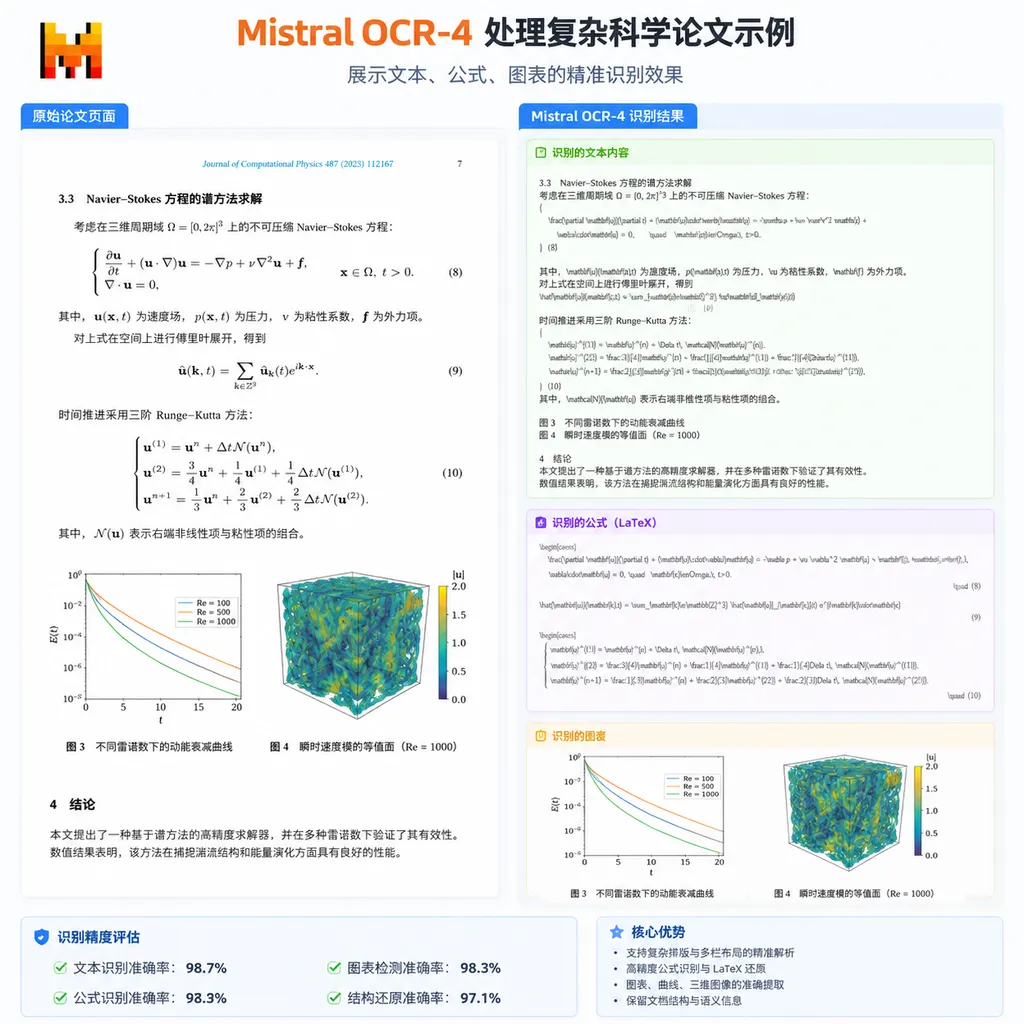
Mistral’s blog showcases numerous benchmarks where OCR-4 leads across multilingual recognition, complex document parsing, and processing speed. For Chinese, accuracy hits 97%, notably higher than Gemini 2.0 Flash. Multilingual support is even more impressive, recognizing thousands of scripts, fonts, and handwriting styles — a must-have for multinational companies and niche-language markets.
However, real-world tests reveal some issues. The Pulse AI team ran it on real commercial documents and concluded it’s “very good, but not yet enterprise-grade.” Complex tables in financial documents had a 17% column misalignment rate, precision deviations of ±1.5%, and sometimes lost critical negative-number parentheses — fatal for finance and legal scenarios.
To be fair, OCR-4 has just launched, and Mistral is iterating quickly based on feedback. Compared with other models, it’s already one of the strongest OCR solutions available. And Mistral has made it extremely open: free trials in Le Chat, direct API access, and even private deployment support.
Documents as Prompts — A New Take on RAG
The most interesting feature in OCR-4 is “Doc-as-prompt.” Previously, you had to run OCR to extract text, then feed it to an LLM, with intermediate cleaning and formatting steps. Now, you can directly throw in a PDF or image, and the model will understand the document’s structure and output JSON according to your instructions.
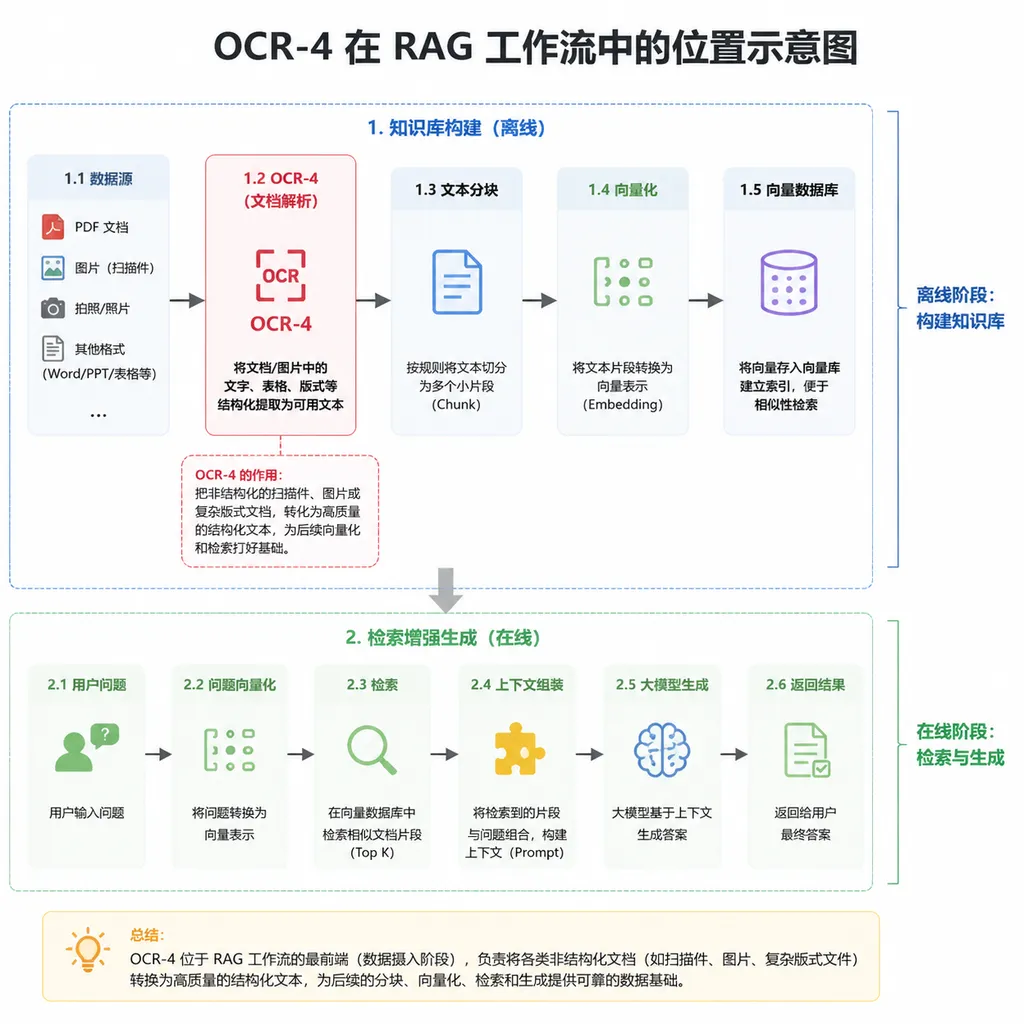
This is a qualitative upgrade for RAG (Retrieval-Augmented Generation) systems. For example, extracting key clauses from hundreds of contracts traditionally required OCR → text cleaning → vectorization → retrieval → LLM generation. Now, OCR-4 can directly understand contract paragraphs, tables, and attachments, and produce structured fields you need. It saves multiple steps and improves accuracy.
# Typical Use Cases

- **Scientific Literature Processing**: Accurate extraction of text, charts, and formulas from papers, with LaTeX output support
- **Multilingual Document Archiving**: Batch recognition and classification of contracts, invoices, and reports for multinational corporations
- **Knowledge Base Construction**: Extracting information from scans, PDFs, and images, and automatically structuring it into databases
- **Automated Workflows**: Using Function Calling to pass OCR results directly to downstream systems
Truly Fast and Genuinely Low-Cost
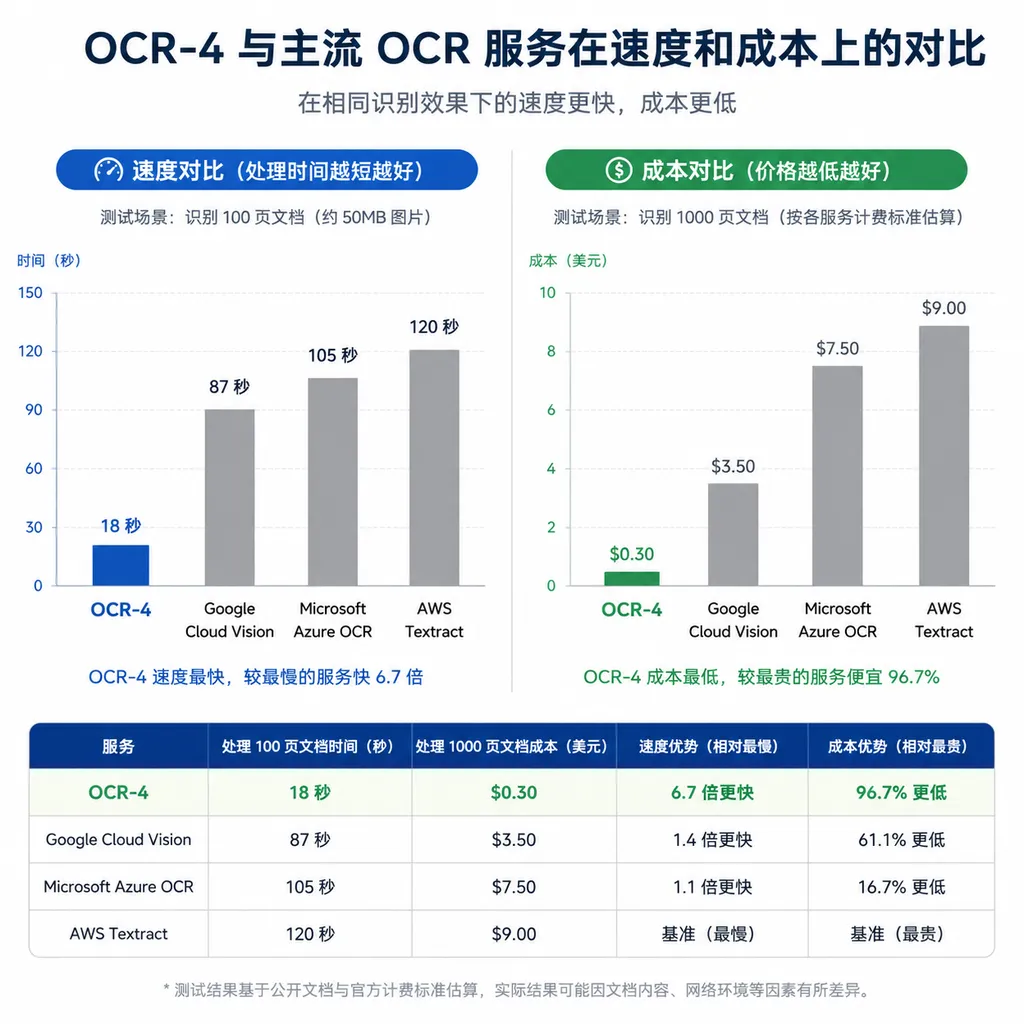
What does 2,000 pages per minute per node mean? If you have 100,000 pages of historical documents to digitize, traditional OCR might take days; OCR-4 can do it in under an hour. And at $1 per thousand pages, 100,000 pages costs just $100. Compared with Google Document AI and Azure OCR, which often cost several cents per page, this is a massive price disruption.
This pricing move is very Mistral-like. Last year, they launched reasoning and multimodal models with a value-for-money strategy, and OCR is now following the same path. For small and medium-sized teams, this means that document intelligence, once the domain of big companies, is now accessible for just a few hundred dollars.
There’s also a hidden advantage to high speed: real-time document processing for user uploads. When OCR was slow, asynchronous queues were necessary. Now, a user can upload a PDF and get structured results in seconds, transforming the experience. This is essential for customer service bots, online approvals, and real-time translation scenarios.
Unmatched Multilingual Support, Chinese Performance Exceeds Expectations
Mistral has always emphasized multilingual capabilities, and OCR-4 pushes this to the limit. Official tests show that in the “Fuzzy Match in Generation” metric, OCR-4 outperforms Azure OCR and Google Doc AI. With 97% Chinese accuracy, the number has sparked significant discussion in the developer community.
In practical tests, OCR-4 handled Chinese tables and mixed-layout documents well. Some developers noted that its layout detection is strong, but recognition rates drop for obscure characters or handwriting. By contrast, Gemini 2.0 Pro was slightly more consistent for Chinese. But given the speed and price difference, this flaw is quite tolerable.
More importantly, OCR-4 supports far more than major languages like Chinese and English. With thousands of scripts, fonts, and handwriting styles supported, you can process documents worldwide with the same model — no need to swap services for different languages. This is genuine cost and efficiency improvement for global operations.
Private Deployment — A Boon for Compliance-Heavy Scenarios
In addition to its cloud API, OCR-4 supports private deployment — essential for sensitive industries like finance, healthcare, and government. Before, you either used cloud services and risked compliance breaches, or trained your own OCR models at great expense and time. Now, you can deploy OCR-4 on your own servers, keeping data inside your network while enjoying advanced recognition.
Mistral hasn’t published private-deployment prices, but based on past strategies, it shouldn’t be prohibitive. Private deployment also allows customization for specific business scenarios, which is especially attractive for vertical fields.
Compared to Gemini and GPT-4V — A Different Focus
Some developers may ask: how does OCR-4 compare with Gemini 2.0 or GPT-4V? It’s not a direct comparison, as the focus differs.
Gemini and GPT-4V are general-purpose multimodal models that can handle images, video, and documents — OCR is just one branch of their abilities. OCR-4 is specialized for document understanding, with advantages in extraction accuracy, processing speed, and cost. If your needs are mass document recognition and structured data extraction, OCR-4 is the better choice.
But if you need deep document reasoning — such as answering legal questions after reading a contract or deriving business trends from a financial report — then GPT-4 or Claude would still be the go-to. OCR-4 functions more like the front-end component of a RAG workflow, handling the heavy lifting before any LLM takes over.
How Can Developers Use It?
Mistral has made its API straightforward. The model ID is mistral-ocr-latest, supporting image and PDF input, with output in Markdown text and images. You can specify the output format in the prompt — for example, requesting JSON structure.
The default rate limit is 30 requests per minute, with a maximum of 30 pages per request. That’s enough for most applications, and high-concurrency needs can be discussed with Mistral for enterprise solutions.
OCR-4 is now free to try in Le Chat; you can upload documents directly to test results. API use requires a key from the Mistral website. Developers in China who face connectivity issues can use aggregator platforms like OpenAI Hub for proxy calls, compatible with the OpenAI API format.
What Are the Pitfalls?
Despite OCR-4’s overall strength, some scenarios require caution:
- Financial Documents: Complex table alignment and numeric precision aren’t fully stable; critical workflows should use manual review
- Handwriting: Recognition is significantly worse than for printed text, especially for messy notes
- Scan Quality: Low-resolution or blurry scans noticeably impact results
- API Stability: As a new release, expect possible queuing and throttling — production use should have a fallback plan
Mistral says they’re iterating with user feedback, and updates should arrive in the coming weeks. For businesses requiring extreme accuracy, start with small-scale, real-data tests.
What Does This Mean for the Industry?
OCR has long been a mature market, with established solutions from Google, Microsoft, and AWS. Mistral has entered with a massive disruption in price — $1 per thousand pages — and much higher speed, posing a real challenge to incumbents.
More importantly, OCR-4 bridges document understanding and LLM workflows. OCR and AI apps used to be separate processes; now they integrate seamlessly. This is a genuine infrastructure upgrade for AI agents, RAG applications, and knowledge management.
Judging by Mistral’s product rollout, they are quickly filling in all AI application gaps: reasoning models, multimodal capabilities, embeddings, and now OCR. With this toolset, developers can build complete AI applications entirely within the Mistral ecosystem.
For developers in China, OCR-4 adds another option. Domestic OCR services excel in Chinese, but multilingual and international scenarios still rely on overseas models. Now that Mistral has driven prices down and sped things up, it’s worth a try. OpenAI Hub already supports Mistral OCR-4 for direct calls.
References
No reference links meeting the specified criteria (all original sources are from non-designated domains).


