
66,000 people rushed to use it, Xiaomi's 1000 TPS inference was delayed.
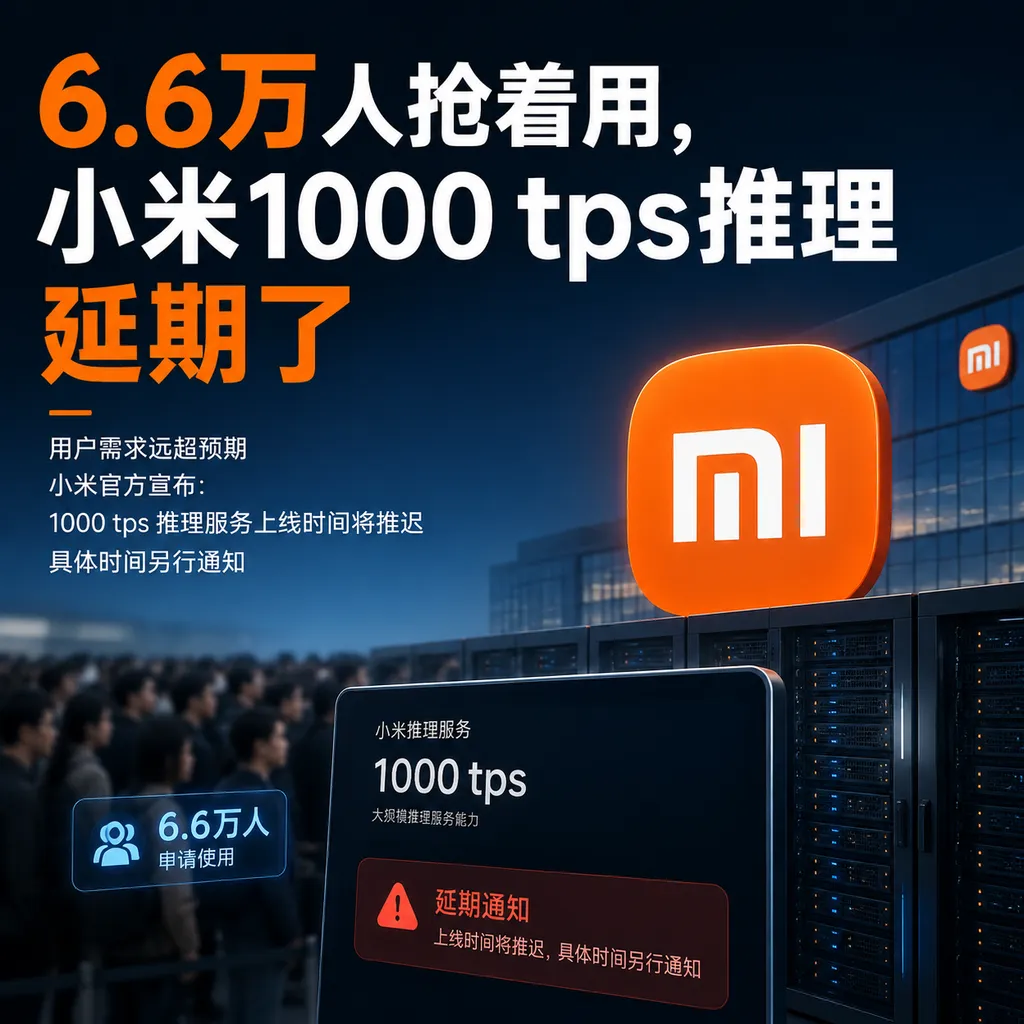
Xiaomi MiMo-V2.5-Pro-UltraSpeed was originally scheduled to go offline tonight, but due to application demand far exceeding expectations, the official team announced an indefinite extension of the trial window. This is currently the only trillion-parameter model that can reach 1000 tokens/s on general-purpose GPUs.
66,000 People Scramble to Use It — Xiaomi’s 1000 TPS Inference Extension
Today, Xiaomi issued a notice: the limited-time trial for MiMo-V2.5-Pro-UltraSpeed will not be taken offline — at least not for now.
According to the original plan, this “1000 tokens/s” ultra-high-speed inference mode was supposed to end its two-week trial at 23:59 tonight. But Xiaomi says the number of applications far exceeded expectations — as of today, they’ve received over 66,000 usage applications, from Fortune 500 companies, leading enterprises in various industries, and individual developers, covering law, finance, communications, logistics, automobile manufacturing, media, academia, and more.
So the trial will stay open, with the offline date “to be arranged based on resource conditions.” Translation: We haven’t figured it out yet — let’s wait and see.
What Does 1000 tokens/s Mean?
First, here’s an intuitive comparison.
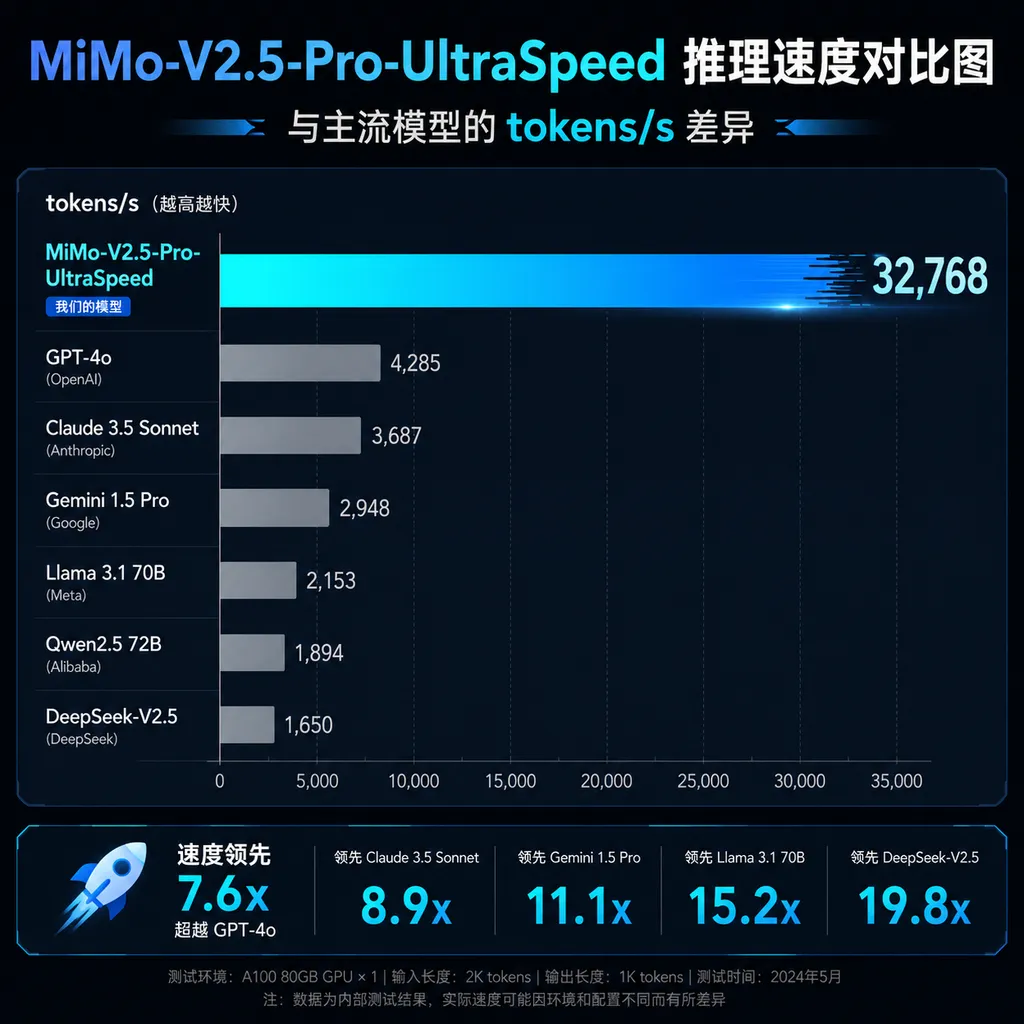
Currently, mainstream large model APIs output at around 50–150 tokens/s. Claude 3.5 Sonnet, tested on OpenAI Hub, runs about 80–100 TPS; GPT-4o is roughly on par. Domestic models tend to be slightly faster — DeepSeek-V3 can reach 150 TPS — but that’s about the limit.
1000 tokens/s — what’s the significance?
A medium-length technical document is roughly 3,000–5,000 tokens. At 100 TPS, it would take 30–50 seconds to generate. At 1000 TPS, it comes out in 3–5 seconds.
A more extreme example: in Xiaomi’s official demo, they use UltraSpeed mode to “replicate a macOS system in one minute” — of course, it’s just the front-end UI, not the OS itself — but the speed indeed supports interaction patterns that were previously infeasible.
How Is It Achieved Technically?
Xiaomi and the TileRT team explained their core approach clearly in a joint technical blog. In short, two key techniques:
FP4 Mixed Quantization
Traditionally, large model inference uses FP16 or FP8/INT8 quantization. The lower the bit width, the smaller the VRAM usage, and the lower the bandwidth load — resulting in faster speeds. But over-aggressive quantization can degrade model capability.
Xiaomi’s approach is “targeted optimization”: MiMo-V2.5-Pro is an MoE (Mixture of Experts) architecture, where Expert modules hold most parameters but are most tolerant of quantization. So they only apply FP4 quantization to Experts, keeping original precision for other modules.
This trick isn’t new, but they executed it thoroughly. Officially, benchmark results are “basically on par with the original model” — no specific numbers given, but with 66,000 applications, at least the real-world experience hasn’t tanked.
DFlash Speculative Decoding
Speculative decoding is a hot acceleration method in recent years: a small model first “guesses” a batch of tokens, then the large model validates them in bulk — correct guesses are directly used, incorrect ones regenerated.
Xiaomi’s DFlash is a customized version for trillion-parameter MoE and long-context scenarios, utilizing a Muon second-order optimizer and self-distillation to greatly reduce draft-stage overhead.
The technical blog goes into detail, but here’s the takeaway: with these two methods, they ran a 1T-parameter model at 1000 TPS on a standard 8-card general-purpose GPU node.
The phrase “general-purpose GPU” is important — not custom chips or special hardware, just commercially available GPUs. This means other companies could theoretically replicate it — it’s just a matter of engineering effort.
Pricing and Usage Restrictions
Now for the commercial side.
UltraSpeed mode is priced at 3x that of standard MiMo-V2.5-Pro:
| Billing Item | MiMo-V2.5-Pro | UltraSpeed | |--------------|---------------|------------| | Input (cache hit) | ¥0.025 / million tokens | ¥0.075 / million tokens | | Input (cache miss) | ¥3 / million tokens | ¥9 / million tokens | | Output | ¥6 / million tokens | ¥18 / million tokens |
Three times the price for ten times the speed — the cost-per-unit-time efficiency actually improves. But it’s not that simple — in most scenarios, the bottleneck lies in model ability, not inference speed. Will you pay 3x more for “fast”?
Current trial rules:
- Application-based — not everyone gets in
- Approved users can use Chat for free
- Each account can queue at most 10 times/day
- Single session limit of 30 minutes
- Inactive for 5 minutes — auto kick
Clearly, Xiaomi is controlling resource consumption. 1000 TPS pushes GPU utilization to the max, and server costs are high. With 66,000 applications, not everyone can be admitted.
They say priority goes to enterprises and professional developers with genuine business needs. If you’re an individual developer, write your use case clearly in the application — don’t just say “want to try.”
The Demand Behind 66,000 Applications
This figure is worth breaking down.
Two weeks, 66,000 applications — nearly 5000/day. For a “limited-time trial” of a new feature, that’s not bad.
More interesting is the applicant makeup: Fortune 500, law, finance, communications, logistics, automobile manufacturing, media, academia… this isn’t just indie devs experimenting — it’s companies seriously evaluating.
Why are these industries so sensitive to “speed”?
Some guesses:
Law & Finance: Contract review, due diligence, report generation — characterized by large document volumes and tight deadlines. A multi-page contract may take minutes at traditional speeds — UltraSpeed cuts that to tens of seconds. In industries billing by time, this directly impacts margins.
Communications & Logistics: Customer service scenarios. Cutting wait times from 5 seconds to 0.5 seconds changes the experience entirely. Also, these industries have high concurrency — demanding high throughput.
Automobile Manufacturing: In-car interaction. If the car assistant takes 3 seconds to respond, the experience breaks. 1000 TPS enables near-real-time dialogue.
Media & Content: Content creation — short video scripts, press releases, marketing copy — output speed directly impacts productivity.
Academia: Research scenarios — large-scale experiments requiring frequent model calls, where inference speed determines experimental cycle.
These needs have always existed — but previously no product could meet them. Xiaomi may be the first to bring “1000 TPS” from paper into production.
Competitive Landscape: What Is Xiaomi Trying to Capture?
From a broader perspective, Xiaomi’s strategic intent here is clear: use inference speed to differentiate.
In China’s large-model market, competition is intense.
On capability: top models are close in benchmarks — DeepSeek, Qwen, ERNIE, MiMo — it’s hard for users to perceive differences.
On price: already driven to the floor — millions of tokens costing a few RMB or even cents — margins are thin.
Now, “speed” becomes the new competitive dimension.
Xiaomi’s strategy: don’t go all the way in price wars — create generational gap in speed instead. Triple the price, tenfold the speed — targeting high-value clients willing to pay for speed.
This positioning is interesting — the market is splitting:
- Low-end: compete on price, free tiers, targeting indie devs and small teams
- High-end: compete on capability and speed, targeting enterprise clients
Xiaomi wants both — standard MiMo-V2.5-Pro for volume, UltraSpeed for premium margins.
Success hinges on two factors:
- Whether UltraSpeed’s capability is notably degraded (official says “basically on par” — needs independent testing)
- The size of genuine 1000 TPS demand (66,000 applicants suggest it’s sizable)
Real Impact on Developers
Some practical advice:
If you’re building latency-sensitive apps — real-time chat, streaming generation, interactive agents — UltraSpeed merits serious evaluation. 1000 TPS can turn “functional but clumsy” features into “good enough to launch.”
If your scenario is batch processing — doc analysis, data cleaning, offline generation — speed improvement may matter less. If users aren’t waiting live, 10x vs 2x speed isn’t huge — but cost is 3x.
If you’re still in tech selection — apply for the trial and run benchmarks on real use cases. Xiaomi’s “basically on par” claim may differ from your needs.
Application portal: platform.xiaomimimo.com/ultraspeed
Chat trial portal: ultraspeed.xiaomimimo.com
For large-scale commercial needs: contact business-mimo@xiaomi.com
The Bigger Significance
Lastly, on the macro scale:
“1000 tokens/s” would have been unimaginable a year ago — back then, discussions were about whether “100 TPS is fast enough.”
Inference speed boosts are redefining large model application boundaries.
Previously, the question was “Can we use a large model for X” — considering capability and cost. Now add: Is it fast enough?
Many scenarios aren’t “impossible” — just “bad experience.” When speed jumps an order of magnitude, these scenarios revive.
Xiaomi’s technical path — FP4 mixed quantization + speculative decoding — isn’t a secret. Others could replicate it with sufficient engineering.
The question is whether it’s worth the investment. Xiaomi has proven demand exists with 66,000 applications — now we’ll see if others follow.
If they do, inference speed will be a new battlefield; if not, Xiaomi may pull ahead in high-speed inference.
Either way, developers benefit — faster models, lower latency, more options.
Extension is good — more time for more people to try.
References
- Xiaomi MiMo-V2.5-Pro-UltraSpeed limited trial officially extended; offline date to be arranged based on resources – IT Home: First report on official extension notice, including 66,000 application count.


