
Anthropic Launches Claude Tag: Let AI Dive into Slack to Learn from Your Company
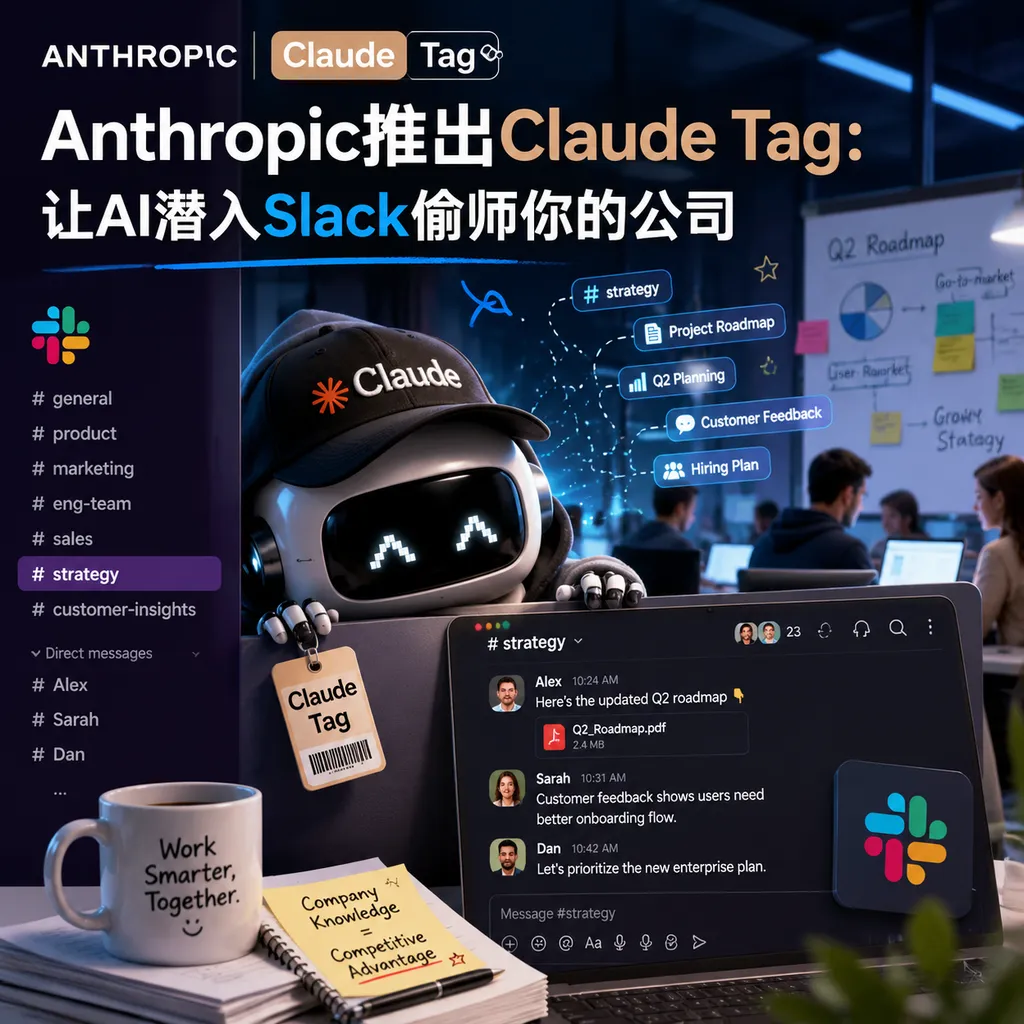
Anthropic launched the Claude Tag feature today, deeply embedding the AI assistant into Slack workflows. This is not just another chatbot—it can continuously learn from corporate conversations, accumulate organizational knowledge, and is essentially a strategic positioning move around enterprise data assets.
Anthropic launched Claude Tag today, an AI feature deeply integrated into Slack.
Simply put, you can now @Claude in any Slack channel, and it will read the context, understand what you’re talking about, and respond. Sounds unremarkable? But think about it: an AI that can be in your company’s Slack 24/7, watching all public channel conversations, learning your terminology, processes, and decision logic—this has far more potential than “just another chatbot.”
What it can do
Let’s start with the basic functions. The core interaction in Claude Tag is very simple: @Claude in Slack, and it will respond.
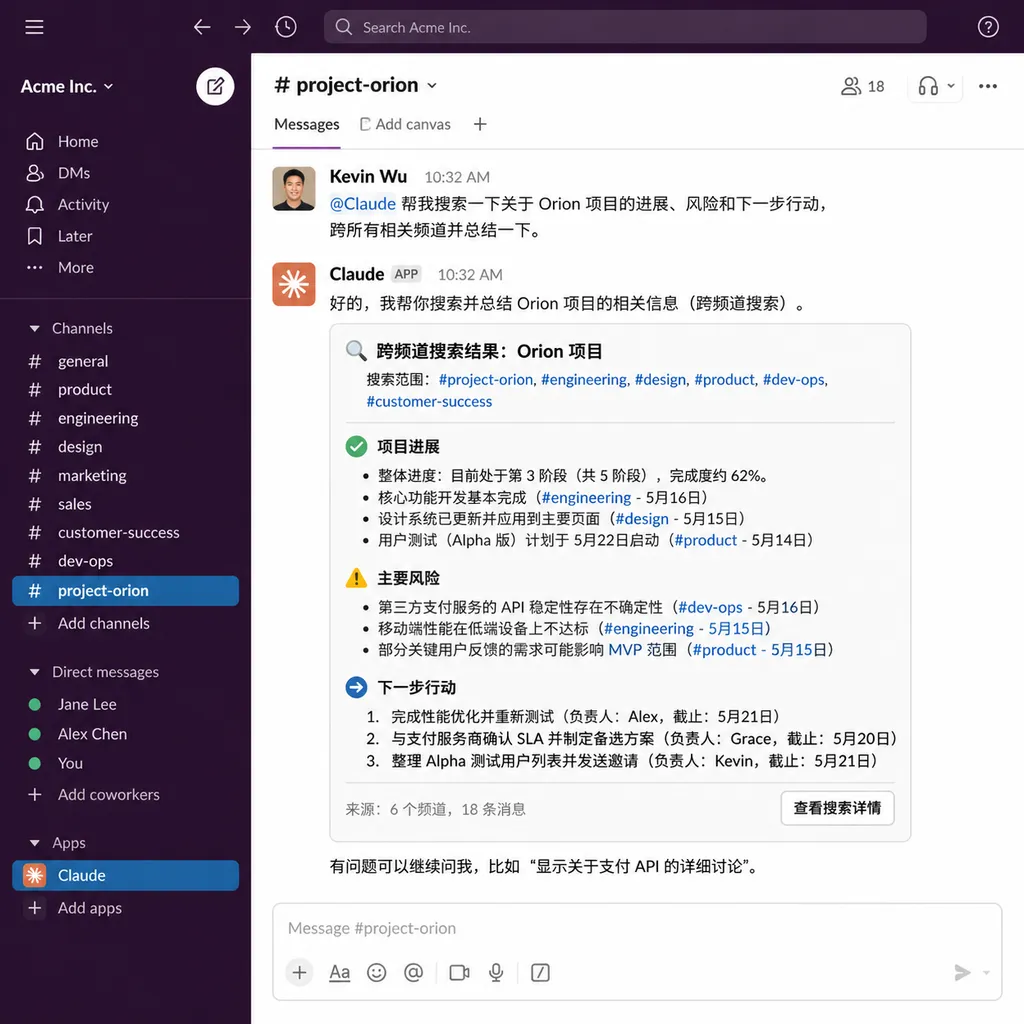
But unlike ordinary Slack bots, Claude Tag has cross-channel awareness. It’s not just looking at your current message—it’s able to:
- Search historical conversations: “Did the product team discuss this requirement last month?”
- Summarize long threads: For a 200-message discussion, it can extract the key points
- Link related context: You might ask a question in #engineering, and it could reference related discussions in the #product channel
- Understand company jargon: If you internally refer to a certain system as “Bumblebee,” it’ll learn that after a few uses
For developers, there’s an extra perk: Claude Code capabilities are included.
Back in December, Anthropic began testing Claude Code’s Slack integration, allowing developers to assign coding tasks to AI directly in Slack. Now this capability has been integrated into Claude Tag. If you’re discussing a bug in a tech channel and @Claude says “Help me check this issue,” it will determine if it’s a coding task and, if so, automatically invoke Claude Code—able to comprehend the entire code repository, not just snippets in the chat window.
This means developers no longer have to switch repeatedly between Slack, IDEs, and Claude’s web app. Wherever the discussion goes, the code can follow.
Why this is called a “strategic-level” feature
On the surface, Claude Tag is a productivity tool. But Anthropic’s real intention is clearly more than that.
Let’s look at this from another angle: What is the most valuable data asset in a business?
It’s not structured data in databases—those CRM and ERP systems have already been mined countless times by various SaaS solutions. The most difficult to obtain, yet highly valuable, is unstructured knowledge embedded in daily communication:
- Why was this architecture decision made at the time?
- How did we negotiate a particular client’s special request?
- Who in the team is most familiar with this tech stack?
- What was the experience from handling a similar failure last time?
This knowledge is scattered across thousands of Slack channels and hundreds of thousands of messages. In the past, only “long-term employees” held it in their minds, and newcomers would need months to figure things out.
Now Claude Tag can continuously “immerse” in these conversations, gradually building an organization-level knowledge graph.
This is the core point in today’s TechCrunch report: Claude Tag is not just a productivity tool—it’s Anthropic’s strategic move to capture enterprise context, institutionalize knowledge, and workflows.
An analogy: If previous ChatGPT/Claude versions were “external consultants” that required you to prepare and feed them materials, then Claude Tag is more like a “full-time employee” who absorbs the company’s information stream daily, becoming more familiar over time.
Technical implementation: where are the limits of continuous learning?
Of course, “AI continuously learning from company data” immediately raises concerns: what about privacy? Security?
Anthropic has not yet disclosed Claude Tag’s full technical architecture, but based on available information, a few points can be inferred:
1. Permissions follow Slack’s native settings
Claude can only access channels it’s invited into. Private channels and DMs remain invisible unless you explicitly add it. This works just like other Slack bots.
2. Enterprise admins have control
Slack Enterprise Grid customers can configure Claude’s permission boundaries via the admin console, such as prohibiting access to certain sensitive channels and controlling data retention policies.
3. Context window vs persistent memory
It’s unclear whether Claude Tag retrieves historical messages dynamically on each call or builds a persistent knowledge index. If the latter, this raises sensitive “training data” questions—will your company conversations be used to improve Claude’s model itself?
Anthropic has consistently emphasized in its enterprise products, “We don’t train our models using customer data.” Still, such deep integrations will inevitably prompt enterprise clients to demand more details.
Comparing to competitors: Anthropic’s differentiation
Integrating AI into Slack is nothing new. Salesforce’s Einstein GPT, Microsoft’s Copilot (via Teams rather than Slack), and even Slack’s own AI features all offer similar functionalities.
But Anthropic has a few differences:
Model capability advantage
Claude 3.5 Sonnet performs at a top-tier level in long-context understanding. Its 200K token context window means it can “comprehend” an ultra-long Slack thread in one go, not just the last few messages. For scenarios like “summarizing a three-day architecture discussion,” this is a qualitative leap.
Integrated coding abilities
Claude Code is widely acknowledged as one of the most powerful AI coding tools currently available. Bringing it straight into Slack allows developers to seamlessly invoke code generation, code review, and bug fixing in conversation—something Salesforce can’t do and Microsoft hasn’t integrated yet (Copilot’s coding abilities live in VS Code, not Teams).
Neutral third-party positioning
Anthropic does not sell CRM, cloud services, or office suites. For companies worried about being locked into Microsoft’s ecosystem by using Microsoft AI, Claude represents a relatively neutral choice.
Of course, Anthropic’s weaknesses are also obvious: it lacks Salesforce’s customer relationships, Microsoft’s distribution channels, and Google’s search and email entry points. Whether Claude Tag can secure a foothold in the enterprise market will depend on sales and ecosystem capabilities down the line.
What this means for developers
If you write code in an enterprise setting, there are several points worth noting about Claude Tag:
1. Context switching costs may truly drop
Old workflow: See an issue in Slack → copy the context → open Claude/ChatGPT → paste → get an answer → switch back to Slack.
Now: Just @Claude—done.
This small reduction in steps can add up significantly.
2. Code reviews can be more immediate
If someone posts a snippet in Slack asking “Is it okay to write it this way?” you previously had to wait for a colleague to reply. Now Claude can instantly provide an initial review, helping to unblock tasks.
3. Faster onboarding for new hires
The hardest part for newcomers is “not knowing who to ask or where to find historical discussions.” If Claude can effectively index and retrieve channel history, newcomers can directly ask “Why was this system designed this way?”—and the AI can dig up the relevant records.
4. But beware ‘AI dependency’
When AI can quickly give you answers, you might stop reading the code, consulting documentation, or engaging in deep discussions with colleagues. Short-term productivity gains could harm knowledge transfer and personal growth in the long run. It’s a trade-off.
Practical use: quick start guide
If your company is already a Claude Enterprise customer, enabling Claude Tag roughly works like this:
- Slack admin authorization: Install the Claude app via Slack admin console and configure permissions
- Invite Claude to channels: In the desired channel, run
/invite @Claude - Start using it: Directly @Claude to ask questions or assign tasks
Usage tips:
- Provide ample context: Even though Claude can see channel history, explicitly referencing relevant messages will improve accuracy
- Make use of threads: In long discussions, stay in the same thread when @Claude so it can better maintain context
- Be specific with coding tasks: @Claude “Write me a function” is less effective than specifying “Write a Python function that takes a user ID list as input and returns their latest login time, using Redis for caching”
Bigger picture: the battle for enterprise AI entry points
Zooming out.
In 2024, AI large model companies competed on “whose model is smarter.” Starting in 2025, the battlefield will shift to “who can get closest to the user.”
OpenAI leveraged ChatGPT’s consumer user base to gain brand and distribution advantage. But in the B2B market, especially for large enterprises—what’s the entry point?
- Microsoft bets on Office 365 + Teams
- Google bets on Workspace + Gmail
- Salesforce bets on CRM + Slack
- Anthropic is now betting on Slack
Slack is an interesting battleground. It’s not as tightly controlled by Microsoft or Google as Office/Workspace, nor as deep-water as CRM (even Salesforce isn’t an absolute monopoly). Slack’s high penetration, developer density, and open API ecosystem make it an entry point for “pure AI companies” like Anthropic.
And Slack’s data really is a goldmine of enterprise knowledge. Whoever can turn this unstructured conversation into usable intelligence will gain an edge in the next phase of enterprise AI competition.
Risks and concerns
Finally, here are a few risks to watch:
Trust issues around data security
Exposing all company Slack conversations to an external AI service will require security audits in many enterprises. Is Anthropic’s security endorsement strong enough? SOC 2, ISO 27001 compliance certifications are just the basics—highly sensitive industries (finance, healthcare, government) may need much more reassurance.
Responsibility for information accuracy
If Claude answers based on historical Slack messages that were wrong to begin with, who is responsible? If someone makes a wrong decision due to an AI’s erroneous summary, how is responsibility assigned? In enterprise settings, this is a serious issue.
Employee psychological acceptance
“An AI is always watching our chats”—even with permission controls, some people won’t be comfortable with the idea. Enterprises deploying Claude need clear internal communication explaining what Claude can see, can’t see, and how data is processed.
Impact on ‘long-term employee value’
Previously, being in the company for a long time and knowing various historical anecdotes was rare and valuable. Now AI can quickly index such knowledge, possibly reducing the “long-term employee premium.” The cultural impact is worth watching.
Final remarks
Claude Tag marks an important move for Anthropic in the enterprise market.
From a product standpoint, it shifts AI from an “external tool” into an “internal member”—a qualitative change. Strategically, it’s about capturing the enterprise knowledge entry point—once established, it will have strong stickiness and barriers.
But challenges remain: concerns over data security, competitive pressure, and the complexity of enterprise procurement decisions are all hurdles Anthropic must overcome.
For developers, it’s worth letting the team try it out. An AI assistant that can “understand the company” delivers tangible efficiency benefits.
As for deeper questions—AI is getting to know your company better and better. Is that ultimately a good or bad thing? It may take much longer to answer.
References
(Note: This article primarily references foreign media reports. Due to access restrictions, domestic-accessible links could not be provided.)


