
GPT-5 Pro Solves Three-Year Immunology Puzzle, AI Research Paradigm Has Changed
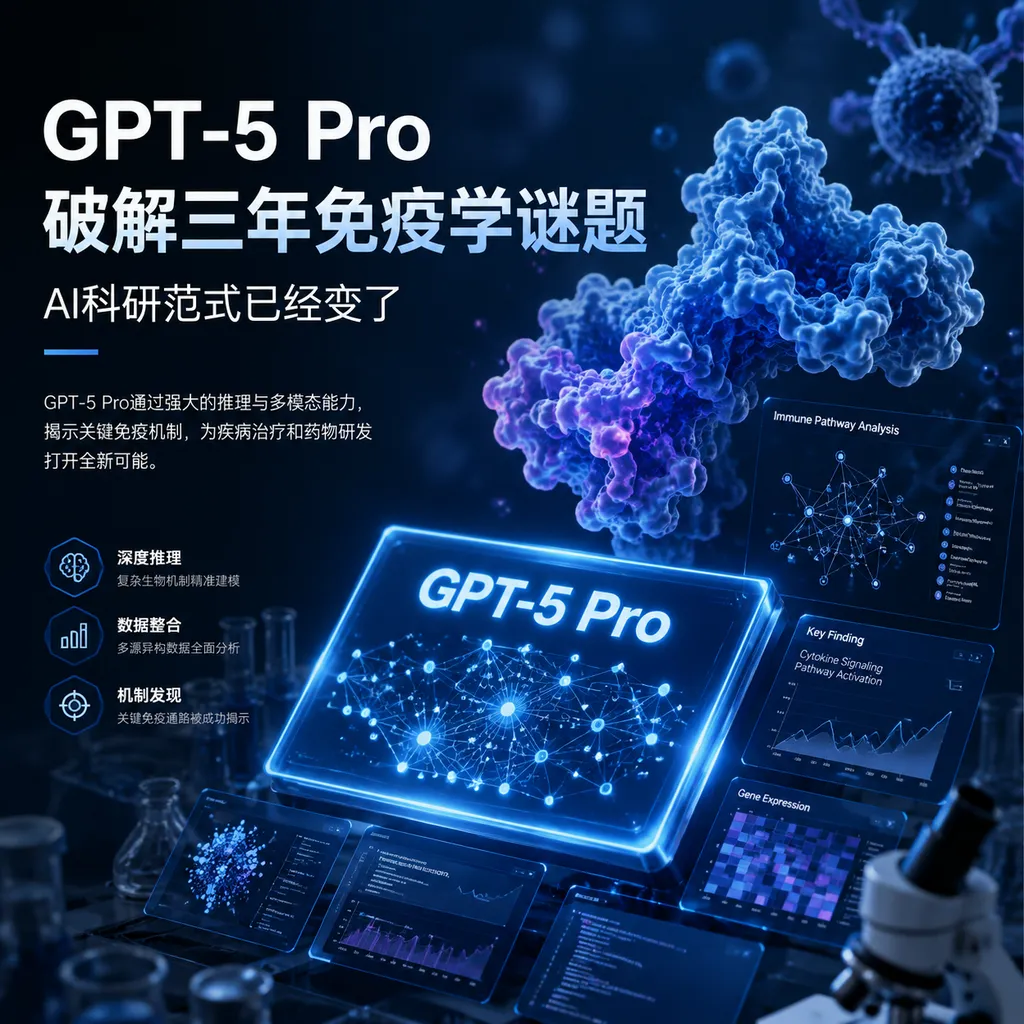
OpenAI Announces Latest Application of GPT-5 Pro in Immunology: Assisting Vanderbilt University immunologist Derya Unutmaz in solving a T-cell behavior mystery that had puzzled his team for three years. The predictions matched unpublished laboratory data exactly, holding significant value for cancer immunotherapy and autoimmune disease research.
GPT-5 Pro Solves Three-Year Immunology Mystery, AI Research Paradigm Has Changed
Immunologist Derya Unutmaz stared at the same set of data for three years without finding the answer—until GPT-5 Pro stepped in, offering a hypothesis within minutes that later was experimentally verified to be entirely correct.
This isn’t science fiction—it’s a real case just disclosed by OpenAI.
Three-Year Mystery, AI Breaks Through in Minutes
The story begins in Unutmaz’s lab at Vanderbilt University.
This team studies T cells—the core combat units of the human immune system. Specifically, they were exploring a seemingly simple but extremely tricky question: What happens to CD8+ T cells’ behavior after a brief treatment with 2-deoxyglucose (2DG)?
2DG is a glucose analog that can temporarily disrupt cells’ energy metabolism. The immunology community has long known it affects T cells, but its exact mechanism remained debated. The Unutmaz team had amassed a large amount of experimental data but couldn’t piece the whole picture together.
The data was there, yet the answer lay hidden in the fog.
GPT-5 Pro’s approach was straightforward: analyze this unpublished experimental dataset and propose a mechanism hypothesis.
The result surprised everyone.
The model not only deduced a “non-obvious but valuable mechanism hypothesis,” it precisely identified which T cell subgroups were involved and proposed follow-up experimental plans. More critically, it made a specific prediction: briefly exposing CAR-T cells to 2DG during preparation would enhance their killing efficiency against targeted cancer cell lines.
This prediction was subsequently verified by unpublished data from Unutmaz’s lab—perfectly consistent.
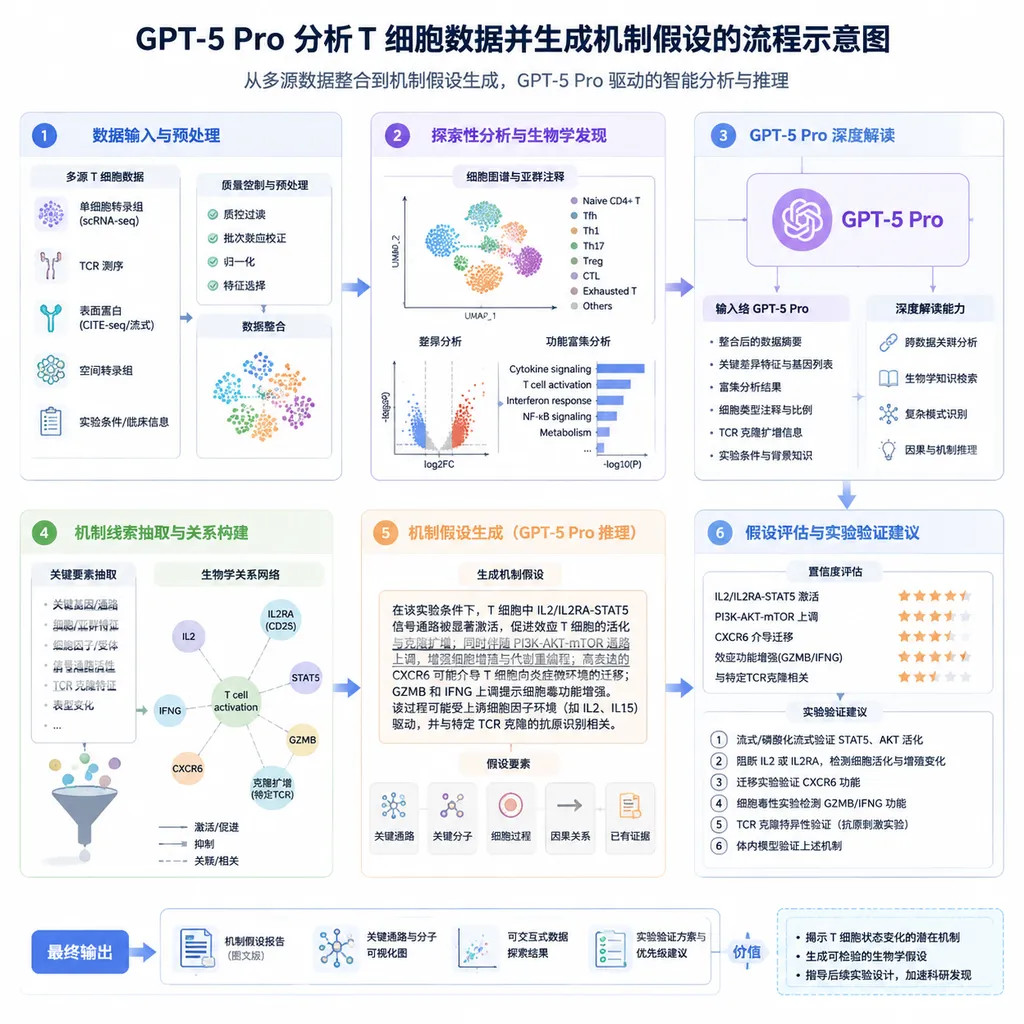
A mystery unsolved for three years was cracked by AI in minutes through a perspective human researchers hadn’t considered.
What Does This Mean? CAR-T Therapy May Change
Let’s explain the background so the significance becomes clear.
CAR-T therapy is one of the most important breakthroughs in cancer immunotherapy in recent years. Simply put, T cells are extracted from the patient, genetically modified in vitro so they can recognize and attack cancer cells, and then reinfused into the patient.
This therapy is stunningly effective for certain blood cancers, but it has a persistent problem: CAR-T cells’ killing power varies. Sometimes a batch is highly effective, sometimes much less so. Scientists have been searching for ways to boost CAR-T cells’ combat power.
Now, GPT-5 Pro points to a new approach: add a brief 2DG treatment step during preparation.
If this finding is validated in larger experiments, it could materially improve CAR-T therapy’s efficacy. For patients fighting cancer, this isn’t an abstract scientific advance—it’s tangible hope.
Of course, there’s still a long way from lab findings to clinical application. But if the direction is right, the journey won’t be in vain.
Beyond Immunology: GPT-5’s Scientific Scorecard
Unutmaz’s case is not alone.
OpenAI’s simultaneous report shows that the GPT-5 series has demonstrated similar capabilities across multiple scientific fields. The report was co-authored by OpenAI along with Vanderbilt University, UC Berkeley, Columbia University, Oxford University, Cambridge University, Lawrence Livermore National Laboratory, and The Jackson Laboratory.
Some illustrative cases:
Mathematics: Cracking an Erdős Legacy Puzzle
Paul Erdős, one of the greatest mathematicians of the 20th century, posed over a thousand problems, many still unsolved. One number theory problem, No. 848, stumped mathematicians for decades.
Mathematicians Mehtaab Sawhney and Mark Sellke had advanced far but were stuck at the final step.
GPT-5 provided a key insight: an idea about “how a single number constrains all other numbers.” This idea wasn’t a complete proof, but it pointed in the right direction. The two mathematicians refined and extended it to eventually complete the full proof.
This wasn’t AI solving the problem alone but a classic case of human-AI collaboration—AI offering a spark where humans were stuck.
Physics: Reconstructing Hidden Symmetry in Black Hole Equations
Physicist Lupsasca was studying the wave equations of Kerr black holes. Such equations often hide certain symmetry structures that are vital for understanding black hole physics.
After being given appropriate “warm-up” problems, GPT-5 Pro successfully reconstructed the hidden SL(2,ℝ) symmetry algebra of the equation. Lupsasca independently verified this result.
Algorithm Optimization: Challenging Classic Conclusions
Researchers Sébastien Bubeck and Christian Coester were testing a commonly used decision method in robot path planning. GPT-5 not only found new examples where this method could fail but also improved a classic conclusion in optimization theory.
Christian Coester used GPT-5’s suggested geometric construction to find a stronger lower bound for a certain online algorithm problem.
Literature Search: Finding Overlooked Solutions
GPT-5 was also used as a “literature search assistant.” For problems marked “unsolved” in the Erdős problem database, GPT-5 searched existing literature and found several problems that actually had solutions—published in obscure journals or non-English papers that hadn’t gained attention.
It even pointed out a printing error in one problem statement.
What AI Did—and Didn’t Do
After reading these cases, it’s easy to think: AI is replacing scientists.
But the report’s wording is clear: “GPT-5 cannot autonomously execute projects or solve scientific problems.”
So what did it do?
1. Integrate known results in novel ways. One core challenge in scientific research is information overload. With thousands of papers in a field, no one can read them all. GPT-5 can help researchers discover cross-field links—for example, telling a mathematician that their theorem also has deep connections to learning theory and multi-objective optimization.
2. Compile in-depth literature reviews. This is often a dreaded task for researchers. GPT-5 can quickly locate relevant literature, including material unfamiliar to the researcher.
3. Accelerate complex calculations. Research involves tedious but necessary calculations. GPT-5 can help check derivations, suggest equivalent expressions, and even point out matching results in literature.
4. Generate new proof ideas for unsolved problems. This is the most exciting part—but note, it’s “generate ideas,” not “provide proofs.” Verification and refinement still require human experts.
The report candidly records GPT-5’s limitations. For example, it doesn’t always proactively provide relevant published papers, sometimes needing explicit prompts. This reminds us that verifying AI output remains crucial.
Fields Medalist Tim Gowers described GPT-5 aptly: it’s like an “inexhaustible sparring partner and critic,” quickly pointing out flaws, missing cases, and simpler alternatives.
But the final judgment and responsibility remain with humans.
From “Years” to “Days”: Research Pace Is Changing
Looking at these cases together, a trend emerges: the pace of scientific discovery is accelerating.
Traditionally, a scientific problem from proposal to solution might take years or decades, involving literature surveys, hypothesis building, experimental design, data analysis, peer review, and each step could be lengthy.
AI is compressing some of these steps:
- Literature survey: from weeks to hours
- Hypothesis generation: from lengthy trial-and-error to rapid screening
- Cross-field connections: from accidental to systematic searches
Unutmaz’s case says it all—three years without understanding the mechanism, AI provided the hypothesis in minutes, and lab validation matched. Humans still handled the questioning, experiment design, result verification, and interpretation—but AI removed the bottleneck of “spark of inspiration.”
Some liken it to a telescope: the telescope can’t comprehend the stars or automatically discover Jupiter’s moons, but when Galileo looked through it, human vision instantly extended.
GPT-5’s role in research is much like that telescope.
Implications for Developers
What does this mean for developers?
A lot.
First, these cases show the boundaries of large language models’ abilities in “non-everyday dialogue” scenarios. Many still think “ChatGPT is just a chatbot,” but GPT-5 Pro’s performance in professional research tasks shows that its reasoning abilities can handle highly specialized problems.
Second, it offers ideas for vertical-domain applications. If GPT-5 Pro can analyze immunology data and produce valuable mechanism hypotheses, it’s likely similarly potent in other fields—financial modeling, materials science, drug design.
Finally, it reminds us to watch model iteration direction. From GPT-4 to GPT-5, improvement is not just “smoother conversation” or “faster generation,” but a qualitative leap in complex reasoning tasks. This is an important evaluation reference for developers using large models in projects.
Developers wishing to try GPT-5 series models can directly call them via OpenAI Hub. One API Key allows access to GPT, Claude, Gemini, DeepSeek, and other mainstream models, with direct usage even in domestic network environments.
Here’s a simple call example:
from openai import OpenAI

client = OpenAI(
    api_key="Get from OpenAI Hub",
    base_url="https://api.openai-hub.net/v1"
)

response = client.chat.completions.create(
    model="gpt-5",  # or gpt-5-pro
    messages=[
        {
            "role": "system",
            "content": "You are a professional research assistant skilled at analyzing biomedical data and proposing mechanism hypotheses."
        },
        {
            "role": "user",
            "content": "Please analyze the following T cell experimental data and infer possible mechanisms..."
        }
    ],
    temperature=0.7
)

print(response.choices[0].message.content)
// Node.js example
import OpenAI from 'openai';

const client = new OpenAI({
    apiKey: 'Get from OpenAI Hub',
    baseURL: 'https://api.openai-hub.net/v1'
});

const response = await client.chat.completions.create({
    model: 'gpt-5-pro',
    messages: [
        {
            role: 'system',
            content: 'You are a professional interdisciplinary research assistant.'
        },
        {
            role: 'user',
            content: 'Help me analyze possible solution ideas for this math problem...'
        }
    ]
});

console.log(response.choices[0].message.content);
Stay Cool: Where Are AI4S’s Boundaries?
The AI for Science (AI4S) concept has been around for years, but solid case studies are rare. This report is arguably the most substantial answer yet.
But we must stay calm.
First, these are curated cases. The report shows GPT-5’s best performances—we don’t know about cases where it didn’t help or gave wrong suggestions. Early application reports always have “survivor bias.”
Second, human experts remain central. Every success involved top researchers. Unutmaz is a seasoned immunologist, Sawhney and Sellke are top mathematicians, Gowers is a Fields Medalist. They can judge AI output quality and know which advice to follow or ignore. With less experienced researchers, results might differ entirely.
Third, verification costs still exist. AI generates hypotheses quickly, but testing them requires real experiments, which can’t be accelerated much. Unutmaz’s lab had existing data for comparison—ideal. Often, verifying a hypothesis may require months or years of extra work.
Fourth, reproducibility needs time to test. The gold standard in science is reproducibility. These early cases need more independent verification to confirm whether AI-assisted research is truly reliable and scalable.
Conclusion
Back to the opening question: a three-year unsolved immunology mystery answered by AI in minutes—what does it mean?
It means research methodology is changing—not AI replacing humans, but a more effective division of labor in human-AI collaboration: humans ask good questions, design good experiments, make final judgments; AI finds patterns in massive information, generates hypotheses, points to overlooked directions.
This division of labor is vividly shown in Unutmaz’s case: three years of puzzlement, minutes for hypothesis, lab verification, ultimately pointing to practical applications that could improve cancer treatment.
Scientific research has never been a solo fight. From Galileo’s telescope to modern particle colliders, tool advances have always expanded humanity’s cognitive boundaries. GPT-5 Pro might join that lineup—not replacing scientists, but becoming a more powerful cognitive tool in scientists’ hands.
How far this tool can go remains to be seen—but at least from this batch of early cases, the direction is right.
References
Note: The primary information in this article comes from OpenAI’s official GPT-5 science application report and related case introductions. Since the original links are restricted domestically, they are not listed here. Interested readers can access the complete report Early experiments in accelerating science with GPT-5 from OpenAI’s website via technical means.


