
Modal launches Auto Endpoints: Developer self-hosted inference magic

Modal, having just completed a $355 million Series C funding round, has unveiled a new move: Auto Endpoints allow developers to enjoy the convenience of hosted inference while retaining full code control and customization capabilities, aiming to carve out a third path in the serverless inference market.
Modal Launches Auto Endpoints: Developer Self-Hosted Inference Magic
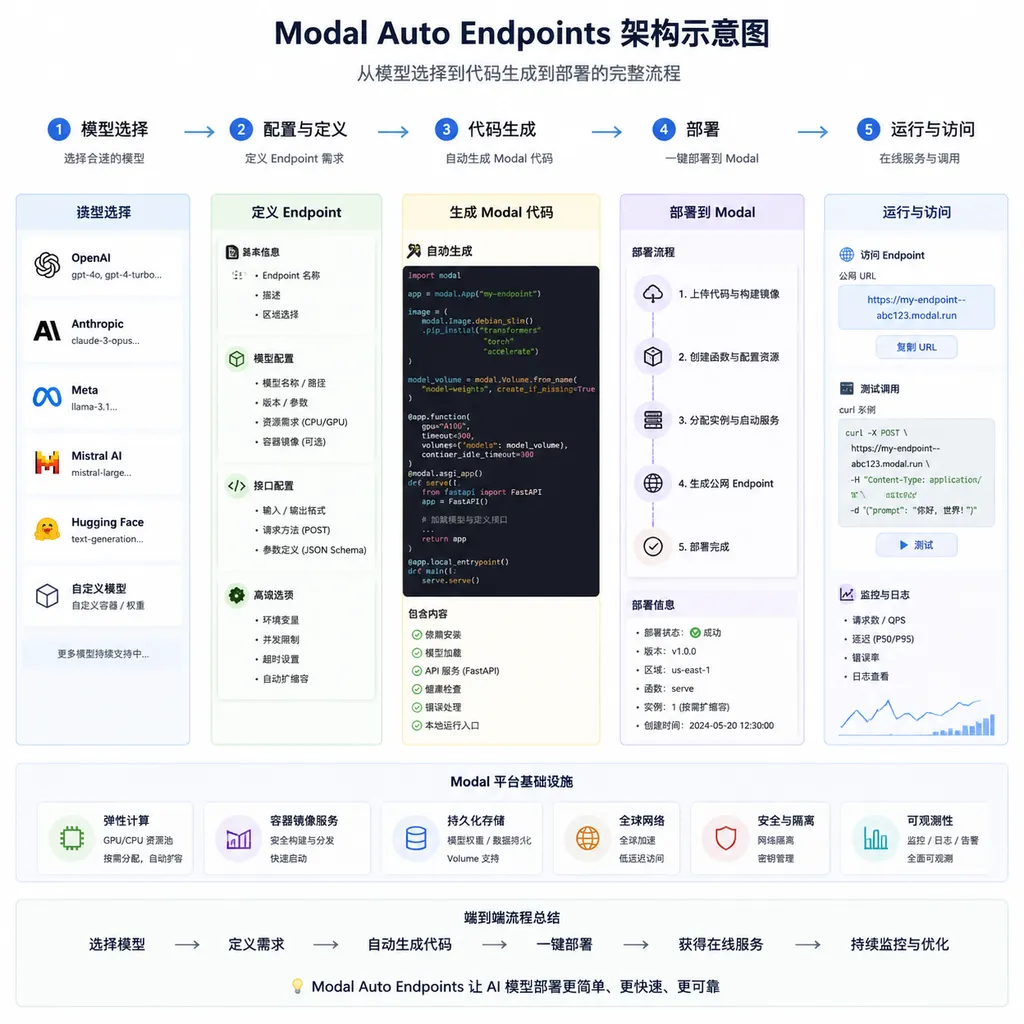
Modal has just released Auto Endpoints, a new feature that lets developers enjoy the convenience of hosted inference while retaining full control of their code. This is the first major product move from the $4.65 billion AI infrastructure company since completing its Series C funding round.
Simply put, Modal aims to solve a long-standing developer problem: Using third-party hosted inference services is convenient but unmodifiable; building from scratch is flexible but exhausting. Auto Endpoints attempts to find a balance between the two.
Core Selling Point: Optimized Code, Ready for You
Traditional hosted inference services are black boxes—you call an API, it returns results, and you don’t know what happens in between, nor can you change it. Modal’s approach is different: Auto Endpoints generates real runnable code, directly deployed into your Modal account.
What does this mean?
First, complete transparency. You can see every line of inference code, including model loading logic, batch processing strategies, and GPU allocation methods. It’s not “trust our optimization,” but “here’s exactly how we optimized it, see for yourself.”
Second, modifiable. Want to change a sampling parameter? Change it. Want to add a preprocessing step? Add it. Want to integrate it into your existing data pipeline? Go ahead. The code is yours—you call the shots.
Third, lock-in immunity. If you ever want to migrate to another platform, or even set up your own K8s cluster, you can just take the code and run it. No vendor lock-in anxiety.
Technical Details: What Modal Has Optimized
It’s not enough to just give you code—the key is that the code should be better than what you’d write yourself. Modal has packed plenty of optimizations into Auto Endpoints:
Inference Engine Selection
Modal automatically selects the most suitable inference backend based on the model’s characteristics. For most LLMs, it defaults to vLLM—currently one of the highest-performing LLM inference engines in the open-source community. vLLM’s PagedAttention mechanism significantly improves KV cache memory efficiency, especially advantageous in high-concurrency scenarios.
For certain specific model architectures, Modal may choose TensorRT-LLM or other optimized backends. This decision logic itself is worth learning—many developers make mistakes here, selecting the wrong engine and losing 30%-50% performance.
Quantization Strategy
Large models can easily reach tens of GB, and running FP16 directly is too expensive. Auto Endpoints automatically applies suitable quantization schemes based on model and hardware configurations:
- FP8 quantization: Used preferentially on supported GPUs (H100, L40S, etc.), with minimal precision loss but halving memory usage.
- INT8/INT4 quantization: Used in older GPUs or memory-constrained scenarios, requiring a balance between precision and performance.
- Mixed precision: Keeping critical layers at high precision while aggressively quantizing others.
These strategies aren’t hardcoded parameters—they’re specific implementations generated in the code. You can see how Modal configured the quantization parameters and then fine-tune them to your precision needs.
GPU Configuration and Scaling
Auto Endpoints-generated code includes complete GPU allocation logic:
# This is an example snippet generated by Modal Auto Endpoints
import modal

app = modal.App("llama-endpoint")

@app.cls(
    gpu=modal.gpu.A100(count=2, memory=80),  # Automatically selected based on model size
    container_idle_timeout=300,  # Auto-scale down after 5 minutes of no requests
    allow_concurrent_inputs=32,  # Concurrent request count
)
class LlamaEndpoint:
    @modal.enter()
    def load_model(self):
        # Model loading logic, including optimized weight sharding
        pass

    @modal.method()
    def generate(self, prompt: str, max_tokens: int = 512):
        # Inference logic, including dynamic batching and streaming output
        pass
Note the container_idle_timeout parameter—one of Modal’s killer features is sub-second cold start. Containers are destroyed after 5 minutes of inactivity and spun back up when the next request arrives, with no charges in between. In scenarios with fluctuating traffic, this can save a lot of money.
Dynamic Batching
Processing single requests one by one wastes GPU compute. Auto Endpoints automatically implements dynamic batching: collecting multiple requests within a short window and bundling them into one batch for inference.
This optimization has dramatic effects in high-concurrency scenarios. Suppose your model inference takes 100ms—processing one request and processing a batch (say, 8 requests) takes about the same time. Dynamic batching can multiply throughput severalfold.
But batching has its nuances: a window too large increases latency; too small, and batches aren’t full. Modal’s generated code adjusts this parameter automatically based on actual traffic patterns, and you can also override it manually.
Comparing with Competitors: Where Modal Differs
The cloud inference space is crowded. Where does Modal Auto Endpoints fit?
Compared with Pure Hosted Services (Replicate, Banana, Baseten)
The experience with these services is: select a model → call an API → pay. Simple, but you have no control over intermediates.
Want to change inference parameters? File a ticket. Want a different quantization scheme? Depends if they support it. Want to integrate a private model? Complex and expensive.
Modal’s advantage is transparency and flexibility. The code is in your hands—change it however you like. The tradeoff is you need to know Python and basic ML deployment concepts.
Compared with Cloud Provider Solutions (AWS SageMaker, GCP Vertex AI)
Big provider solutions are feature-rich but complex. Deploying a model requires configuring IAM, VPC, ECR, Endpoint Config, and lots more.
Modal’s philosophy is “everything in code”—one Python file handles all configurations. For small and medium teams, this difference in development experience is decisive.
Of course, big providers have advantages in compliance, enterprise support, and integration with existing cloud resources. If your company is all-in on AWS, SageMaker might be the more natural choice.
Compared with Self-Built (Bare Metal + K8s + vLLM)
Self-hosting is the most flexible but most work-intensive. Just getting vLLM to run stably on K8s requires wrestling with GPU operators, device plugins, resource scheduling, and more. Not to mention monitoring, logging, auto-scaling, and other operational burdens.
Modal Auto Endpoints can be seen as “semi self-built”—you get optimized code running on Modal’s infrastructure. You skip the low-level ops but retain code-level control.
For most teams, this is a pragmatic compromise.
Use Case Analysis
Auto Endpoints isn’t a magic bullet. It’s best suited for certain scenarios:
Scenario 1: Quick Validation and Gradual Customization
You have a new model to launch and test, uncertain about traffic volume or final inference configuration.
Auto Endpoints lets you start quickly and see actual performance. Once traffic stabilizes and requirements are clear, you can deeply customize the generated code. This saves time compared to starting from scratch.
Scenario 2: Parallel Iteration of Multiple Models
Your product needs to support multiple models—main, backup, experimental. Optimal configs may differ.
Auto Endpoints can quickly generate optimized configs for each model, saving you from manual parameter tuning.
Scenario 3: Cost-Sensitive Medium-Scale Traffic
Daily requests in the tens of thousands to millions range. Pure hosted services are costly at this scale; self-building isn’t cost-effective.
Modal’s per-second billing + auto-scaling is competitive here. Auto Endpoints-generated code already includes cost optimization logic, like aggressive scaling down and suitable GPU selection.
Less Suitable Scenarios
Ultra large-scale traffic: If your QPS reaches tens of thousands or higher, you may still need to self-build clusters to minimize cost. Modal’s abstraction layer adds some overhead.
Extreme latency requirements: If you need single-digit millisecond latency, Modal’s cold start mechanism may not suit you. You’d have to keep a warm pool, losing the pay-as-you-go advantage.
Highly regulated industries: Finance, healthcare, etc., require strict data residency and audit logs. Modal’s compliance certifications may not be comprehensive enough.
The Bigger Picture for Modal
Auto Endpoints isn’t an isolated feature—it’s part of Modal’s overall strategy.
Earlier this year, the company completed a $355 million Series C round, with a valuation of $4.65 billion. Some numbers mentioned in the funding news are notable: over 1 billion AI agent sandbox environments have already run on their platform.
1 billion sandboxes—this shows Modal’s positioning isn’t just “GPU cloud,” but “AI-native infrastructure.” From inference, training, to agent execution environments, Modal aims to cover it all.
Auto Endpoints can be seen as one piece of this puzzle: lowering the barrier to inference deployment to get more developers running workloads on Modal. Once inference is running, training, data processing, and agent needs will naturally follow.
This strategy is similar to AWS’s launch of Lambda—start with a killer feature to draw users in, then retain them with the ecosystem.
Hands-On Experience
So, how is it in practice?
Modal’s CLI and SDK are designed to be quite intuitive. After installing the modal package, it’s basically write Python code, then modal deploy.
# Install Modal
pip install modal

# Login authentication
modal setup

# Deploy code
modal deploy your_endpoint.py
For Auto Endpoints, the process is even simpler: select a model → click generate → get the code → deploy. The whole process can be completed in minutes.
The generated code is of good quality, with clear comments and a reasonable structure. Even if you’re unfamiliar with vLLM or Modal’s API, reading it once lets you understand what’s going on. This is far better than some “low-code” platforms’ spaghetti code.
Of course, the real test is in production. Modal claims sub-second cold starts and millisecond-level latency, but actual performance depends on specific models and traffic patterns. Their website lists cases, such as Physical Intelligence using Modal for robot control, achieving 10–15ms latency. This is impressive, but robot control and LLM inference differ and can’t be directly compared.
Industry Perspective: The Inference Arms Race
Modal’s move, seen in the larger industry context, is a snapshot of intensifying competition in AI inference infrastructure.
NVIDIA is pushing TensorRT-LLM AutoDeploy, aiming to turn optimization from manual work into compiler automation. Cloud providers are massively scaling GPU clusters. Startups are seeking differentiation in various niches.
The core logic of this competition is: Inference cost is one of the biggest bottlenecks for large-scale AI application deployment.
Training a model is a one-time expense, but inference is ongoing. An AI app with a million DAU may have daily inference costs exceeding the expense of training the entire model. Whoever can cut inference costs unlocks more application scenarios.
Modal’s path is “let developers optimize themselves”—democratizing expert-level optimization techniques with Auto Endpoints while providing flexible underlying infrastructure. Whether this works depends on whether developers are willing to invest time understanding and customizing the code.
The other path is “fully hosted black box”—you don’t worry about anything, I handle it all. The problem is inflexibility, and differing needs across scenarios make universal solutions hard.
Ultimately, both paths may coexist, serving different types of users. Modal has chosen the “transparent and controllable” end, with clear positioning.
In Conclusion
The launch of Modal Auto Endpoints adds new meaning to “self-hosted inference”: it’s not about building everything from scratch, but giving you an optimized starting point, and letting you decide whether and how to modify it.
This “generate code instead of provide API” model may become a trend in AI infrastructure. It acknowledges a reality: AI application needs are too diverse for any black box solution to satisfy everyone. Instead of trying to make a universal hosted service, it’s better to output optimization capabilities as code and let developers assemble it themselves.
For teams choosing inference solutions, Modal Auto Endpoints deserves a spot on the shortlist—especially if you value flexibility, want to avoid vendor lock-in, and don’t want to build everything from scratch. This positioning might suit you well.
Of course, tech decisions should always be based on specific scenarios. It’s recommended to try Modal’s free credits first, run some real benchmarks, and then decide.
References
(Note: This article refers to Modal’s official blog and related technical documents. Since the original links are overseas sites, they are not listed here. Readers can search for “Modal Auto Endpoints” to find more technical details.)


