
Aiide integrates Bailian and Volcano, kicking off the domestic model aggregation battle.
AI aggregation platform Aiide announced simultaneous integration with Alibaba Cloud’s Bailian and ByteDance’s Volcano Engine, breaking the previous situation where each platform operated independently. Behind this move is the fierce tussle between Alibaba and ByteDance at the MaaS layer—one aiming to be number one in token call volume, the other striving to be number one in full-stack revenue—while developers have finally gained genuine freedom of choice.
Aiide Integrates Bailian and Volcano Engine — The Battle of Domestic Model Aggregation Begins
The competitive landscape of domestic AI aggregation platforms is being reshaped by a key move.
Recently, model aggregation platform Aiide AI announced the simultaneous integration of Alibaba Cloud Bailian and ByteDance Volcano Engine, two major MaaS platforms. Developers can now use a single API entry point to call the Qwen series from Tongyi, the Doubao large model, as well as third-party models hosted on both platforms. In the past, aggregation platforms typically integrated only one or two major cloud providers. Aiide’s approach of connecting both Alibaba and ByteDance at the same time is relatively rare.
This is more than just a product update — it reflects that the bipolar structure of the domestic MaaS market has already taken shape, and aggregation platforms in the middle layer are becoming a new battlefield.
Two “Number Ones,” Two Accounting Systems
To understand the background, you first need to clarify the narratives of Alibaba Cloud and Volcano Engine.
In May this year, Volcano Engine disclosed a set of numbers: According to IDC, in the enterprise MaaS market in China for 2025, Volcano Engine's token call volume share reached 49.5%, Alibaba Cloud 28%, and Baidu 10%. In other words, one out of every two tokens generated domestically is routed through Volcano’s infrastructure.
Alibaba Cloud, however, tells a different story. According to Omdia's statistics of overall AI cloud revenue (including IaaS, PaaS, MaaS), Alibaba Cloud ranks first with 35.8%, while Volcano Engine holds 14.8%.
Two leaderboards, two number ones, two narratives.
This split is not about conflicting data but about differing business logic. Volcano Engine’s approach is extreme low pricing for scale — last year it was the first to bring enterprise market pricing down to ¥0.0008 per thousand tokens, ushering in the "cent" era. This year it halved fees for certain bulk inference services. The massive user data accumulated by the Doubao App on the consumer side has fed back into faster model iteration; ByteDance’s internal products such as Douyin, Feishu, and Jianying are themselves huge token-consuming pools.
Alibaba Cloud’s path is different — it bets on the “full AI stack,” from foundational computing power (self-developed Yitian chips, Panjiu servers), to the model layer (Qwen open-source ecosystem), to the platform layer (Bailian), and finally the application layer (Tongyi product series), aiming to build a complete loop from hardware to software. Wu Yongming’s statement at the Yunqi Conference was straightforward: Tongyi Qwen aims to be the “Android of the AI era.”
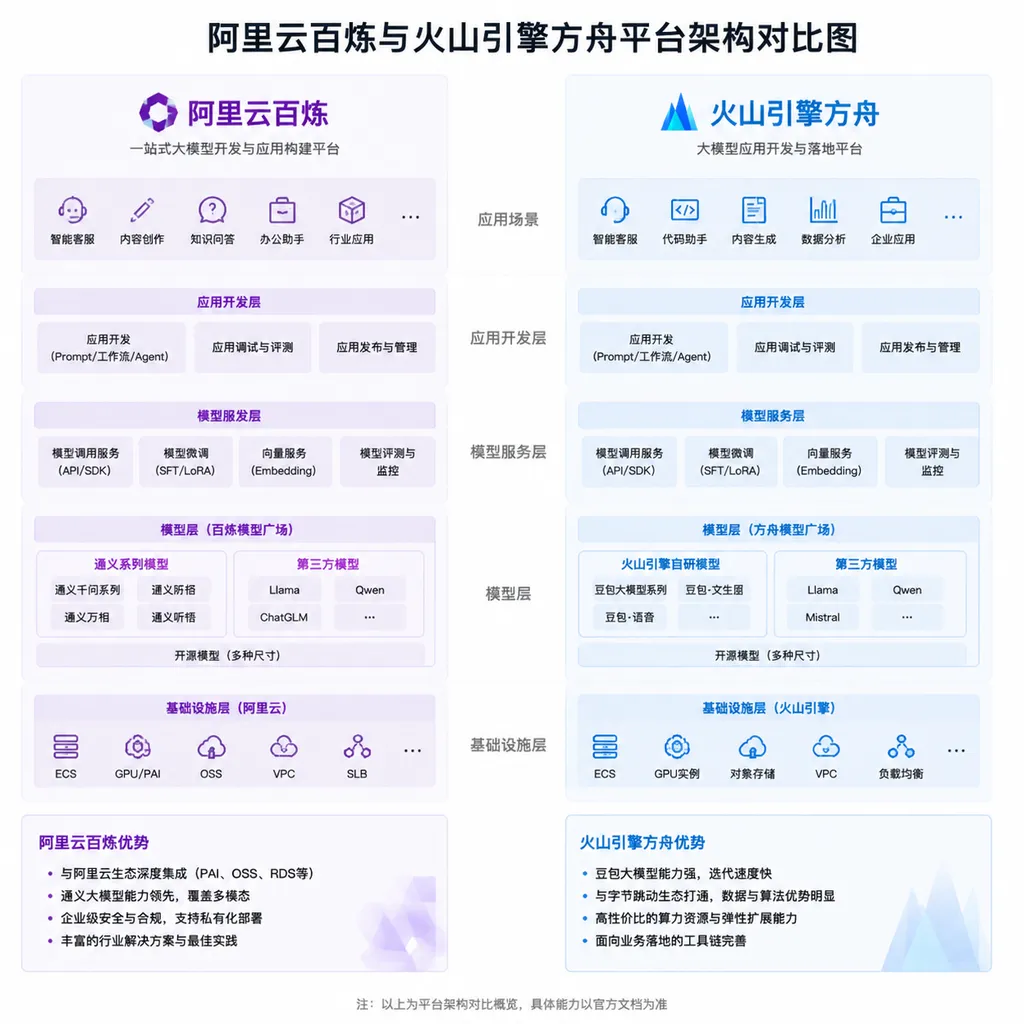
Both paths are logical but have their weaknesses.
Volcano’s problem: being first in token call volume does not mean being first in revenue quality. Data shows that MaaS services billed by token currently account for less than 1% of the entire AI cloud market scale. Call volume growth is dramatic, but much of it comes from low-priced or even free trial traffic. The client structure is shallow, and switching cost is low if cheaper competitors emerge.
Alibaba's problem: full-stack means maintaining competitiveness in every segment. Resource consumption is enormous, and with a long chain and many nodes, any link failing impacts the whole. More critically, consumer mindshare has already been captured by Doubao, making it increasingly difficult for Tongyi to catch up.
Why Aggregation Platforms Are Becoming Important
In this landscape, the value of aggregation platforms is becoming more apparent.
For developers, directly connecting to multiple cloud providers’ APIs means maintaining multiple SDKs, handling different authentication mechanisms, and dealing with occasional API changes from each provider. The more practical issue is: you don’t know which model performs best on a given task, nor whether a provider might suddenly raise prices or discontinue a version.
The role of an aggregation platform is essentially to insert a buffer layer between the model layer and application layer. It offers a unified API format (often compatible with OpenAI specs), a unified billing entry, and the ability to quickly switch between multiple models.
Currently, mainstream domestic aggregation platforms include Qiniu Cloud AI, SiliconFlow, and some smaller vertical-focused platforms, each with their emphasis:
| Platform | Main Features | Free Quota | |----------|---------------|------------| | Qiniu Cloud AI | Broad domestic model coverage; GLM 4.5 Air permanently free | 3 million tokens | | SiliconFlow | Cost-effective open-source models; Qwen2.5-7B etc. free | To be confirmed | | Alibaba Cloud Bailian | Complete Qwen ecosystem; Agent workflow support | Tens of millions of tokens | | Volcano Engine Ark | Doubao series + deep integration with ByteDance ecosystem | Video/image model trials |
Aiide’s integration with both Bailian and Volcano essentially adds a new option: you can access both Alibaba and ByteDance models via the same entry point. This has real value for teams needing to compare models or flexibly switch vendors based on task type.
What Developers Really Care About
But to truly establish itself, an aggregation platform needs more than just “multiple integrations.”
Conversations with several developers using various aggregation platforms revealed surprisingly consistent priorities:
First, stability. Model API availability directly impacts live services. Some developers report certain platforms seeing sudden response latency spikes or timeouts during peak hours — unacceptable in production.
Second, price transparency. Billing methods vary wildly — by input tokens, output tokens, request count, context length. Some platforms have hidden “context window overage” charges. Developers want clear, instant price comparisons, not half a day of calculations to figure out the cost.
Third, migration cost. Once your business runs on a platform, how expensive is switching? If the platform uses OpenAI-compatible format, in theory switching just means changing the base_url. In practice, compatibility varies for function calling, streaming, multimodal support, etc.
Fourth, compliance & data security. Many enterprise clients require clarity: Does data cross borders? How long are logs retained? Are there security certifications? Small platforms often can’t answer, while enterprise-grade services from big providers cost significantly more.
Whether Aiide can differentiate itself in these dimensions after integrating Bailian and Volcano will determine if this is just a flash in the pan or a genuine market-shaping move.
What Bailian and Volcano Are Focused On
It’s worth noting the current directions of Alibaba Cloud Bailian and Volcano Engine Ark themselves.
Alibaba Cloud Bailian is focusing on Agent capabilities. The Qwen3.7-Max released in May is positioned as “a new-generation flagship model for the agent era,” emphasizing evaluations like SWE-Pro and MCP-Mark rather than traditional MMLU or HumanEval. Bailian also launched “Agent Workflow,” letting users visually orchestrate nodes to chain multi-step tasks into reproducible execution flows.
Alibaba Cloud stresses compatibility with third-party dev tools — Qwen3.7-Max claims support for mainstream Agent frameworks like Claude Code and OpenClaw. The intent is clear: let Anthropic build the ecosystem, replace the model with Qwen. But Anthropic is increasingly tying Claude and Claude Code together, with certain features only fully activated in Claude; third-party models may be “runnable” but not “highly usable.”
Volcano Engine Ark takes another path. Its core advantage is deep ByteDance ecosystem integration — ArkClaw is tied closely to Feishu, supporting one-click installs from the Feishu App Marketplace; in chat windows, @ an agent to book meeting rooms, bulk-generate documents, manage tables. For teams already using Feishu, this native integration experience is hard to replicate elsewhere.
Volcano is also pushing its Coze platform, a low-barrier Agent building tool claiming “develop and launch an industry application in 7 days.” Public data shows Coze already offers templates for 29 industries, covering e-commerce, medical, education, etc. This “lower barrier to scale users” tactic mirrors Volcano’s low-price MaaS strategy.
Strong Models ≠ Strong Platforms
One often-overlooked point: the capability gap between Qwen and Doubao large models is rapidly narrowing.
In most mainstream evaluations, both providers’ flagship models are now in the same tier. Qwen3.7-Max shines in Agent tasks, but Doubao has unique strengths in multimodal and real-time interaction. For developers, choice is often not about “who’s stronger” but “who’s cheaper” or “whose toolchain is smoother.”
This raises a deeper question: when model capabilities converge, where will competition focus?
The answer may be execution reliability and ecosystem stickiness.
Execution reliability means: Can the model consistently perform tasks? Can it self-correct errors? Can costs be clearly calculated? These don’t show in leaderboard metrics — only real-world usage reveals them.
Ecosystem stickiness means: Once users have accumulated enough workflows, data, and plugins on a platform, migration costs rise exponentially. Alibaba Cloud’s strategy is open-source models + full-stack cloud services; Volcano’s is Feishu + Coze application ecosystem.
The awkwardness for aggregation platforms: they are inherently “low-stickiness” middle layers. Users choose them for flexibility, which also means they can easily be replaced. How to build a moat while offering flexibility is a question all aggregation platforms must answer.
The Real Highlights of This War
Coming back to Aiide’s integration with Bailian and Volcano.
In the short term, this is a smart positioning move. As Alibaba and ByteDance battle fiercely for developers, securing both providers’ resources lets Aiide matchmake, arbitrage, and offer value-added services.
In the medium to long term, aggregation platforms’ fate depends on upstream providers’ attitudes. If Alibaba and ByteDance want developers to use their own platforms directly (Bailian, Ark), they can squeeze the middle layer through pricing, features, or interface restrictions. In fact, both are moving this way — Bailian is improving its developer experience, Ark is deepening Feishu integration.
An interesting variable is DeepSeek. Recent job postings indicate it is building a dedicated “Harness” team aimed at a desktop Agent product, directly competing with Claude Code. If DeepSeek shifts from “just models” to “also upper-layer products,” China’s AI toolchain landscape will be reshuffled again.
For developers, the most pragmatic strategy now may be: keep technical choices flexible, don’t put all eggs in one basket. Use aggregation platforms for early validation and cost control, then decide whether to connect directly to a provider once the business stabilizes.
The struggle between Alibaba Cloud and Volcano Engine will not yield a winner in the short term. But it has already given China’s AI developers more options — and that is inherently a good thing.
References
(Note: In accordance with requirements, only links accessible domestically are retained. This article’s references are mainly derived from enterprise official releases and industry media reports. Related platforms can be accessed directly via their official websites.)


