
NVIDIA Releases BioNeMo Agent: AI Agents Officially Enter Drug Discovery Laboratories
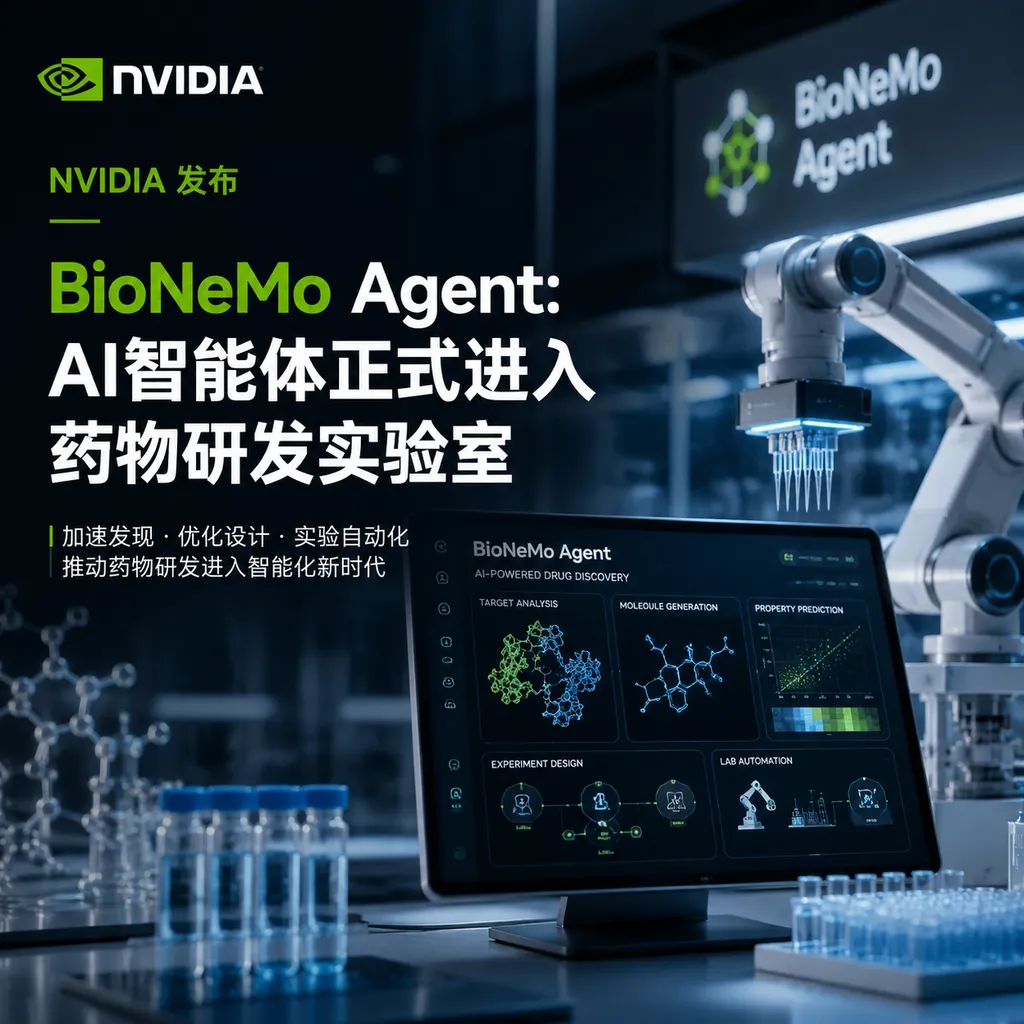
NVIDIA has launched the BioNeMo Agent Toolkit, encapsulating over a decade of life science expertise into a toolset that can be invoked by AI agents. This enables large models to directly perform specialized computations such as protein prediction and molecular docking, marking a new stage in the application of AI agents in vertical domains.
NVIDIA Releases BioNeMo Agent: AI Agents Officially Enter Drug Discovery Labs
On June 23, NVIDIA officially released the NVIDIA BioNeMo Agent Toolkit. This is not just another life sciences AI model, but a toolkit that enables AI agents to actually "conduct experiments."
In simple terms: previously, AI in drug discovery could only answer questions; now it can run computations, analyze results, and provide the next step recommendations on its own.
What’s at the Core of This Release
Not a New Model, but a “Toolbox”
BioNeMo itself is not new. NVIDIA has been developing this life sciences AI platform since 2022, gradually integrating capabilities like protein structure prediction, molecular generation, and genome analysis.
Previously, BioNeMo was more like a “model repository”—you had a question, you would call the corresponding model, and get a result. The whole process was human-driven.
The new Agent Toolkit changes this logic.
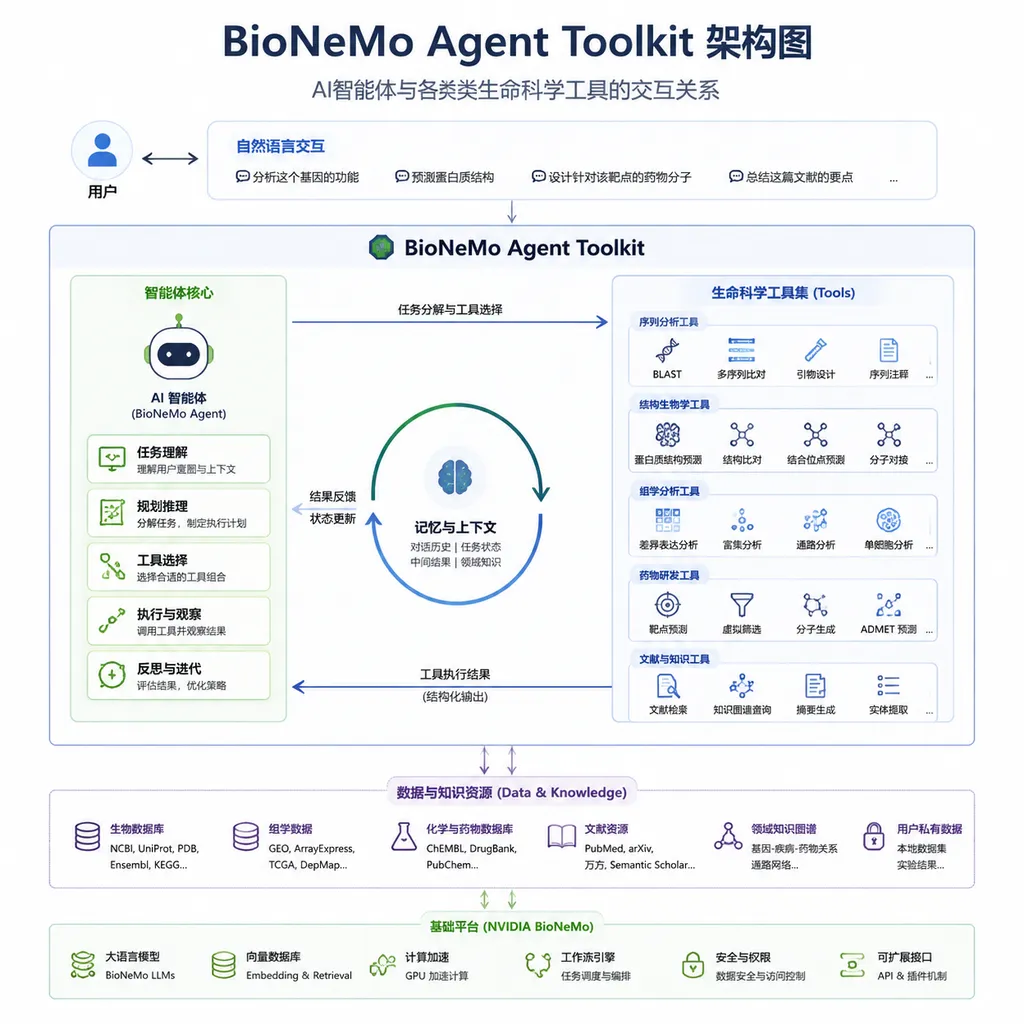
NVIDIA has repackaged over a decade of accumulated life sciences libraries, tools, and open models into a set of APIs that AI agents can call. In other words, now a large language model can use these specialized tools much like a calculator:
- Need to predict protein structure? Call AlphaFold2 or ESMFold
- Want to perform molecular docking? Call DiffDock
- Generate new candidate molecules? Call MolMIM
- Analyze genome data? Call the relevant analysis tool
The key change is: the decisions about what to call, when to call it, and how to interpret the results can now be made by the AI agent.
From “Humans Use Tools” to “AI Uses Tools”
The traditional drug discovery process roughly looks like this:
- Scientist proposes a hypothesis
- Designs an experiment
- Performs computation (possibly using various AI models)
- Analyzes results
- Adjusts the hypothesis based on results, returns to Step 1
Each step needs human judgment and decision-making. An experienced computational chemist might run dozens of experiments at once, but their time and energy are the bottleneck.
The BioNeMo Agent Toolkit aims to have AI agents handle most of steps 2–4.
If a scientist says “I want to find a small molecule that binds this target,” the AI agent can:
- Analyze the target structure
- Generate a batch of candidate molecules
- Perform docking simulations for each candidate
- Evaluate binding affinity
- Screen out the most promising ones
- Provide reasons and recommendations
The whole process runs automatically; the scientist only needs to review the final results.
Technical Architecture: How to Make AI Agents “Understand” Life Sciences
Tool Invocation Layer
At the base of this toolkit are NVIDIA’s accumulated NIM (NVIDIA Inference Microservices) services. Each specialized capability is encapsulated into a separate service:
Protein Structure Prediction
- AlphaFold2: DeepMind’s flagship model for predicting protein 3D structures
- ESMFold: Meta’s protein language model, faster
- OpenFold: Open-source implementation, easier to customize
Molecule Generation & Optimization
- MolMIM: NVIDIA’s own molecular generation model
- REINVENT: Molecule optimization via reinforcement learning
- Supports SMILES, molecular graph representations
Molecular Docking
- DiffDock: Diffusion model-based docking prediction
- AutoDock-GPU: GPU-accelerated version of classic docking tool
Genome Analysis
- Single-cell RNA sequencing analysis
- Variant detection
- Biomarker discovery
Each service has standardized API interfaces with unified input/output formats—this is the foundation for AI agents to call them.
Agent Orchestration Layer
Having tools is not enough; AI agents must know how to use them.
The BioNeMo Agent Toolkit provides an orchestration framework, with core components including:
Task Planner
Receives high-level research goals and breaks them down into specific computational tasks. For instance, “evaluate this compound’s drug-likeness” would be broken down into:
- Predict solubility
- Predict metabolic stability
- Predict toxicity
- Predict synthetic feasibility
Tool Selector
Chooses appropriate tools based on task type. Some tasks have multiple possible tools; the selector chooses based on accuracy requirements, computing resources, time constraints, etc.
Result Interpreter
Transforms outputs from specialized tools into understandable analysis. What does a docking score of -8.5 kcal/mol imply? Where does this affinity rank among known drugs? The interpreter provides such context.
Decision Engine
Decides the next action based on current results. If docking score isn’t good, should it adjust the molecule structure and regenerate, or switch to another binding pocket? This logic can be rule-based or delegated to a large language model.
Integration with LLMs
The system is designed to be LLM-agnostic, meaning you can integrate various large language models as the “brains” of the agent.
Official NVIDIA-supported integrations include:
- NVIDIA’s own BioNeMo LLM (fine-tuned for life sciences)
- Llama series (via NIM deployment)
- Mainstream commercial model APIs
In practice, the LLM handles:
- Understanding user natural language instructions
- Creating experiment plans
- Calling tools to get results
- Synthesizing analysis and generating reports
Specialized tools handle:
- Precise scientific computation
- Domain-specific predictions
- Numerical simulation
This division of labor is clear: LLMs excel at understanding, reasoning, and expression, but are unreliable for precise computation; specialized models compute accurately but don’t “think.” Combining them is what works.
“Lab-in-the-Loop”: What’s the Concept?
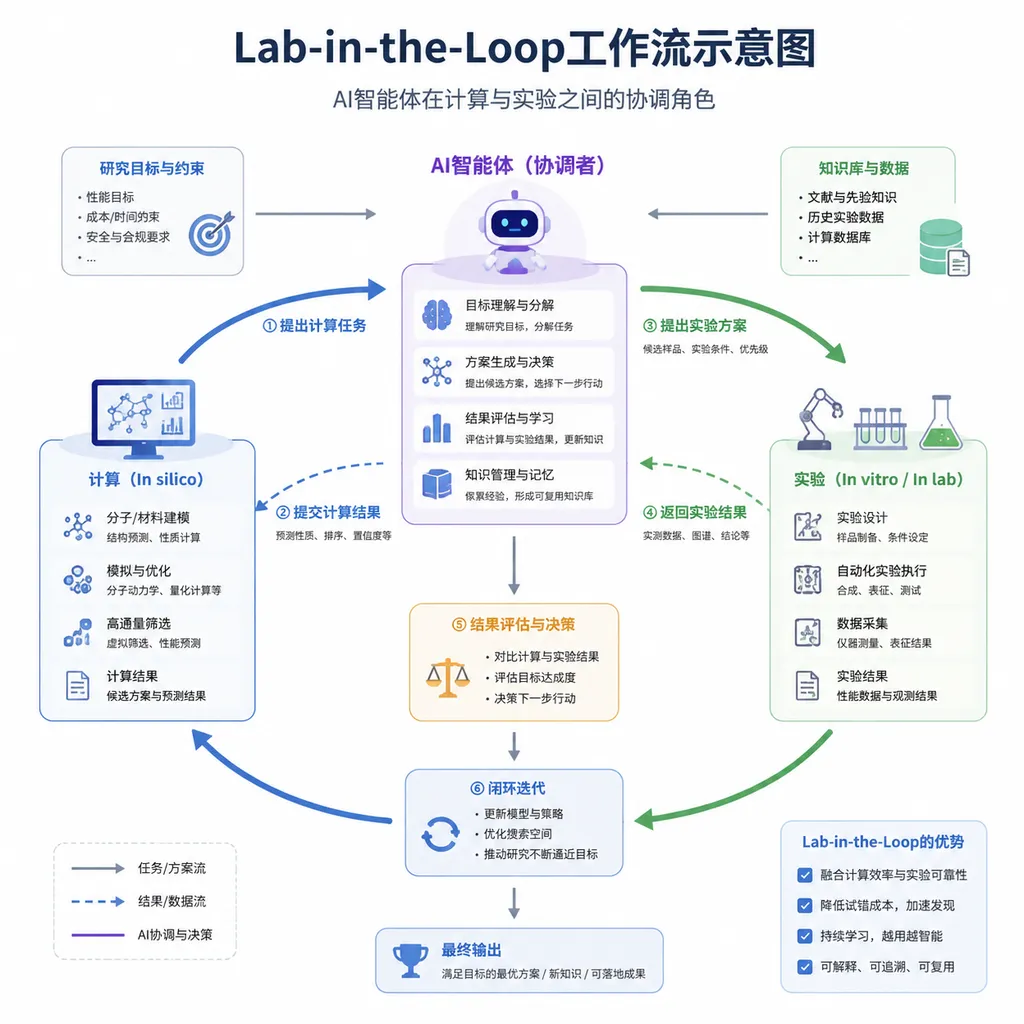
NVIDIA previously introduced the “Lab-in-the-Loop” concept in BioNeMo updates; this Agent Toolkit is a further implementation of it.
Traditional AI-assisted drug discovery looks like:
Computational prediction → Manual screening → Experimental validation → Manual analysis → Model adjustment
Each arrow needs human bridging; cycles are measured in weeks or months.
Lab-in-the-Loop aims for:
Computational prediction ←→ Automated screening ←→ Experimental validation ←→ Automated analysis ←→ Model update
        ↑_____________________________________________↓
The loop runs automatically, with the AI agent as coordinator between computation and experiment.
Fully automated operation is still far off. Currently, a more realistic scenario is:
- AI agent automates the computational side
- Generates experimental plans for human scientists
- Scientists review, then execute experiments
- Experiment results fed back to AI agent
- AI agent analyzes results, updates strategy
This “semi-automated” mode already boosts efficiency significantly. NVIDIA cites cases where partners shortened drug discovery cycles by 30–50%.
Who’s Using It and What’s the Impact
Feedback from Early Partners
The BioNeMo platform is already in use by many life sciences companies. According to info shared at the JPM Healthcare Conference earlier this year, partners include:
Recursion
AI-driven drug discovery, with a massive cell image database. Uses BioNeMo to:
- Predict chemical compounds’ cell phenotype effects
- Screen lead compounds
- Optimize molecule structures
Reportedly tripled their virtual screening hit rate with BioNeMo.
Insilico Medicine
Has AI-designed drugs already in clinical trials. Uses BioNeMo for:
- Novel target discovery
- Molecule generation
- ADMET prediction (absorption, distribution, metabolism, excretion, toxicity)
Evozyne
Focused on protein engineering. Uses BioNeMo’s protein structure prediction and sequence design capabilities to develop novel enzymes.
New Players for This Agent Toolkit
Exact company names adopting the Agent Toolkit haven’t been disclosed yet, but NVIDIA targets:
- Large pharma computational chemistry teams
- Biotech startups
- Academic research institutions
- CROs (Contract Research Organizations)
It’s expected that existing BioNeMo users will be among the first to try the Agent Toolkit.
Comparing BioNeMo Agent Toolkit with Competitors
The Life Sciences AI Platform Track
Main players include:
Schrödinger
Established computational chemistry firm with over 30 years’ history. Highly respected in pharma, more traditional molecular simulation focus; AI capability strengthened recently, no agent orchestration concept.
Atomwise
Specializes in AI drug discovery using deep learning for molecule screening. Strong model capabilities, but less tool coverage than BioNeMo, and no agent framework.
Google DeepMind
Owns AlphaFold—unmatched in protein prediction. But not a complete drug discovery platform, more like a single-point capability.
Isomorphic Labs
DeepMind’s spin-off for AI pharma; still somewhat secretive, products not publicly released.
BioNeMo’s Differentiation
Compared with these competitors, BioNeMo Agent Toolkit stands out with:
1. Broad Coverage
Protein, small molecules, genome—covers major life sciences computation directions. Not strongest in any one point, but comprehensive.
2. Unified Interface
All tools exposed through NIM microservices with standard APIs, lowering integration cost. Competitors tend to have siloed tools, requiring user integration.
3. Agent-Native
This is the biggest difference. Others still make “tools for humans,” BioNeMo is already making “tools for AI.” If this bet pays off, it’s a generational leap.
4. Compute Advantage
Backed by NVIDIA, with natural edge in GPU resources and optimization. BioNeMo can be deployed directly on DGX Cloud, without infrastructure worries.
Potential Issues
Concerns include:
Pricing
BioNeMo pricing is opaque; large pharma may not care, but small biotech might find it expensive. Agent Toolkit as a value-added service will only cost more.
Lock-in Risk
Heavy reliance on BioNeMo makes migration costly. NVIDIA certainly wants users locked into its ecosystem, but users must weigh the risk.
Agent Reliability
If AI agents make automatic decisions and errors occur, who’s responsible? In high-risk drug discovery, this is critical. Currently positioned as “assist” not “replace,” but boundaries might blur in practice.
Industry Impact: AI Agents as a Vertical Test Case
The significance isn’t just for life sciences—it’s a demonstration of AI agents deployed in vertical domains.
Why Life Sciences Suit Agents
Reasons for choosing life sciences include:
1. High Degree of Tool API-ization
Lots of mature computation tools already exist in life sciences, many with APIs or CLI. Wrapping them for agent use is relatively easy.
2. Clear Task Decomposition
Drug discovery is fairly standardized: target validation → lead compound discovery → lead optimization → preclinical research. Each stage has clear objectives and success criteria.
3. Error Tolerance
Mistakes in computational experiments just mean rerunning; unlike autonomous driving where errors cost lives. This gives agents room to trial and learn.
4. Specialist Scarcity
Experienced computational chemists are scarce; clear manpower bottleneck. Using agents to augment expert capacity shows clear ROI.
Potential Demonstration Effect
If BioNeMo Agent Toolkit proves successful, similar products can be expected in other verticals:
- Materials Science: Similar logic to drug discovery—compute screening + experimental validation
- Chip Design: EDA tools are becoming AI-enabled; agent orchestration is a natural next step
- Chemical Processes: Process optimization, formula design—tool API-ization rising
NVIDIA is likely considering these. BioNeMo shows the Agent + vertical tools model works, making expansion into other fields inevitable.
What Technologists Should Watch
If you’re a developer or tech manager, notable points include:
1. Engineering Practices in Agent Orchestration
How NVIDIA packages specialized tools for agent use, how tool selection and task planning logic is designed—these engineering details are worth studying. Code isn’t open-sourced, but architectural ideas can be referenced.
2. Combining Domain Knowledge and General Capabilities
BioNeMo Agent Toolkit shows a model: general LLM for understanding/planning, specialized models for precise computation. This applies to other verticals.
3. Trend Toward Tool Standardization
To let AI agents use your tool, it must have standardized interfaces. This will drive more tools toward API/microservice architectures. If you make B2B tools, watch this trend.
4. Reliability and Explainability
When agents make decisions automatically, how do you ensure reliability? How do you help users understand the decision process? BioNeMo’s practices can serve as reference.
Summary
NVIDIA’s BioNeMo Agent Toolkit transforms life sciences tools from “human-use” to “AI-use.”
Technically, it’s more engineering integration and productization than breakthrough innovation. But the direction is right: in vertical domains, the value of AI agents is not to replace human experts, but to extend their capacity.
For life sciences, this might catalyze faster AI adoption. For the AI industry as a whole, it’s an important case of agents deployed in a vertical domain.
Worth watching closely.
References
No domestic reference links accessible under current conditions.
This article draws on NVIDIA’s official press release and public reports. For more technical details, visit the NVIDIA Developer official documentation.


