
Doubao Audio Model 1.0: Generate film-level audio directly from a single prompt
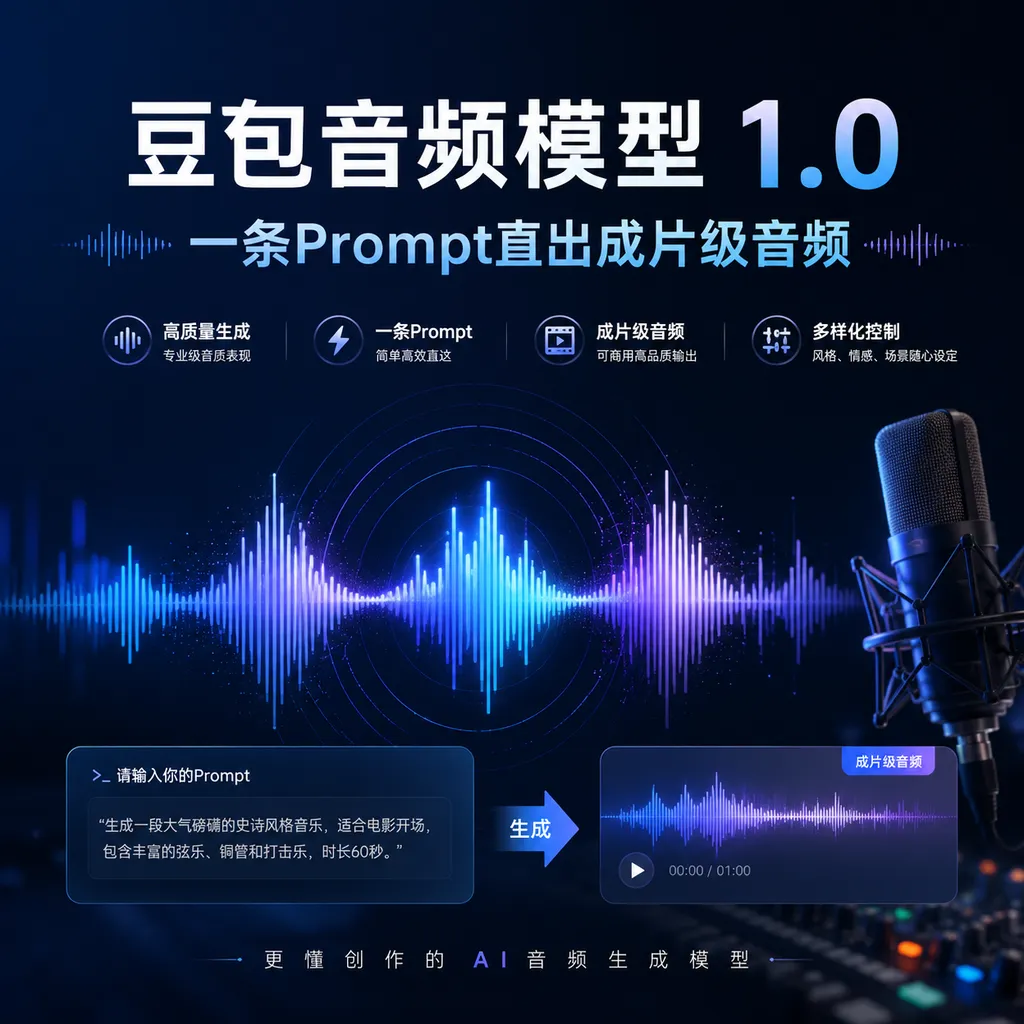
Volcengine releases Doubao Audio Generation Model 1.0, achieving for the first time end-to-end generation of dialogue, background music, and sound effects in a single pass. It supports long-duration timbre consistency and zero-shot voice creation, directly transforming the traditional multi-track editing workflow in audio production.
Doubao Audio Model 1.0: Film-Quality Audio in One Prompt
Yesterday, Volcano Engine released the Doubao Audio Generation Model 1.0 (Doubao-Seed-Audio 1.0) at the FORCE Motivation Conference. This is an end-to-end audio generation model whose core selling point is: a single inference simultaneously outputs character dialogue, background music, and environmental sound effects, without needing to generate them separately and manually merge them.
What does this mean? In traditional audio production workflows, voice actors record dialogue, composers provide music, sound designers do foley, and mixing engineers put everything together — at least four steps and four different tools. Seed-Audio 1.0 aims to replace several steps in that chain with a single prompt.
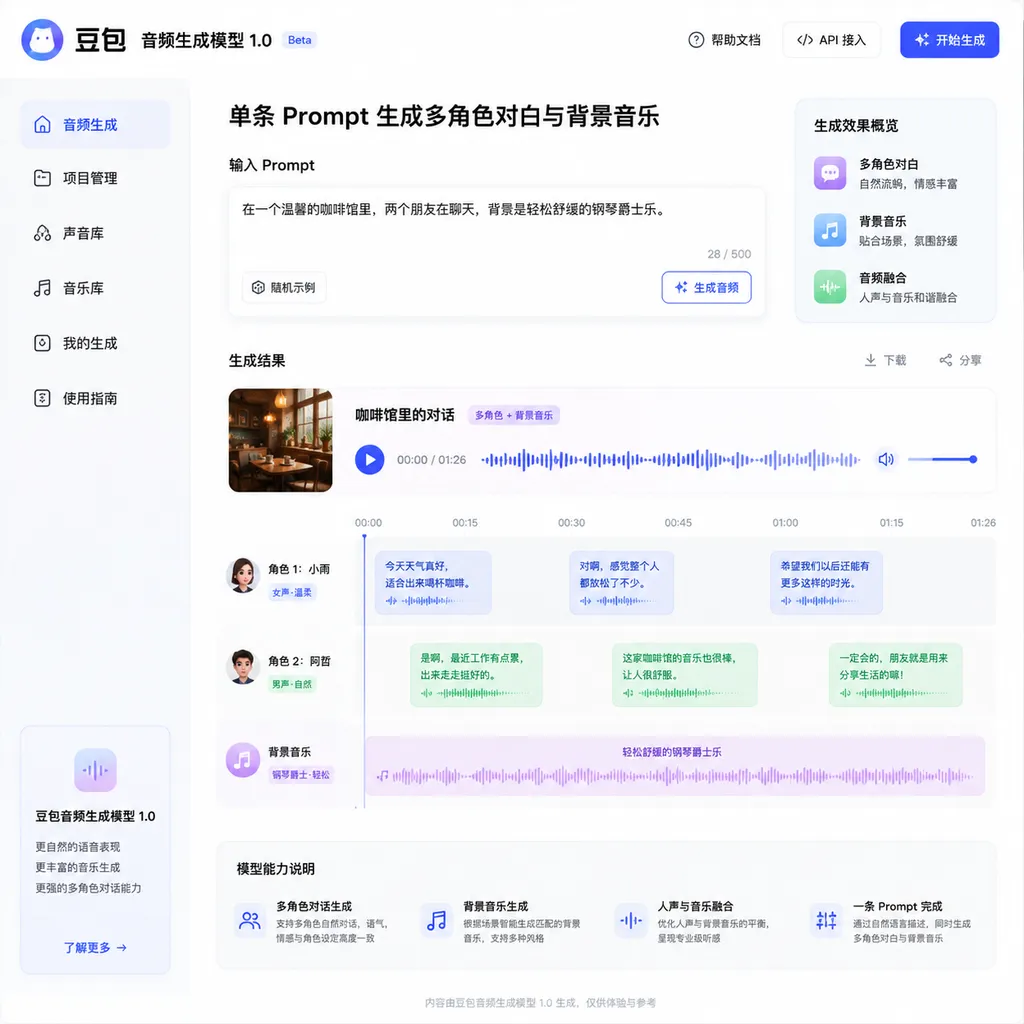
Three Core Capabilities, Addressing Three Real Pain Points
Film-Level Audio in One Shot
The most straightforward capability is “complete element generation.” In a single prompt, you can simultaneously define:
- Multi-character dialogue: including line content, emotional rhythm, tone changes
- Non-verbal expressions: laughter, sighs, pauses, dialect accents
- Background music: style, tempo, emotional tone
- Environmental sound effects: scene ambience, foley effects
The model arranges these elements in sync during generation, outputting mixed, finished audio rather than multiple tracks you have to manually align on the timeline.
A concrete example: you want to create an opening scene for a suspense radio drama. The traditional process — write the dialogue script, have voice actors record individually, pick background music from a library, let a sound designer add footsteps, door sounds, rain, then have the mixing engineer align and combine everything — might take days.
With Seed-Audio 1.0, you write a description:
“Late night, heavy rain. The male lead (30 years old, deep and weary voice) pushes open the door, footsteps heavy. The female lead (25 years old, with a sobbing tone): ‘You’ve finally come back…’ Background is constant rain and occasional thunder, music is deep strings creating a tense atmosphere.”
The model directly outputs a complete audio segment with dialogue, rain, thunder, footsteps, and background music.
This is not just about being faster — it’s about restructuring the workflow.
Consistent Voice Tone Over Long Durations
Anyone who’s done audiobooks or podcasts knows: single-line quality is never the biggest challenge. The real nightmare is when the protagonist in chapter one doesn’t sound like the same person in chapter ten.
Traditional TTS tools often suffer from “voice tone drift” in long audio scenarios — the same character’s voice changes subtly between different segments, requiring lots of post-processing or outright re-generation.
Seed-Audio 1.0’s solution is deep linking between text-to-audio and reference audio. Specifically:
- The model can generate up to 2 minutes of audio in one go
- You can feed previously generated audio as a reference to extend content
- The model locks onto established voice characteristics across extensions
This delivers direct value in scenarios like audiobooks, long podcasts, multi-episode radio dramas. For a 20-episode radio drama, each 30 minutes long, the traditional workflow demands consistent performance from voice actors or heavy post-processing — now the model ensures tonal consistency at the generation level.
However, there’s a question to verify: is the “2 minutes per run, multiple extensions” mechanism stable in real use? After 10 or 20 extensions, will voice drift accumulate? The official data for long-range generation isn’t provided — this needs testing.
Zero-Shot Multi-Modal Reference
The third capability is “zero-shot voice creation.” Traditional voice cloning requires you to provide reference audio — record a sample of the target voice for the model to learn.
Seed-Audio 1.0 supports pure text-based voice definition:
“Middle-aged male, slightly hoarse, southern accent, slow speech”
The model infers matching voice characteristics from the description, directly using them for generation — without needing real human reference audio.
This is significant for small teams — not every podcaster has access to a recording studio or voice actors. Text-only voice definition lowers the barrier substantially.
But here too, there’s a control issue: “middle-aged male, slightly hoarse” could match countless specific timbres. Can you precisely control a specific voice style via text, or must you “draw cards” until satisfied? This directly affects practical use in commercial contexts.
ElevenLabs addresses precision by offering voice cloning and preset voice libraries. Whether Seed-Audio 1.0’s zero-shot approach can match accuracy requires more case studies.
Differences Compared to ElevenLabs
Talking about Seed-Audio 1.0 requires mentioning ElevenLabs, a global benchmark in audio generation, with a product matrix including:
- Eleven v3: TTS model supporting 70+ languages
- ElevenMusic: music generation at Suno-level quality
- Sound Effects: sound effect generation
- Text-to-Dialogue: multi-character dialogue
- Studio 3.0: timeline editor combining the above elements
The product line is very complete. But ElevenLabs’ architecture is “generate separately, manual assembly” — TTS, music, sound effects are three separate APIs/models, requiring users to add and align tracks in Studio.
Seed-Audio 1.0 differs with “single end-to-end generation” — dialogue, music, and effects are output together in one inference, no manual alignment needed.
| Comparison Dimension | Seed-Audio 1.0 | ElevenLabs | |----------------------|----------------|------------| | Generation Method | Single end-to-end output | Separate generation, manual assembly | | Language Support | Unannounced (likely Chinese & English) | 70+ languages | | Music Generation | Built into end-to-end process | Separate ElevenMusic model | | Enterprise Compliance| Unannounced | SOC 2/HIPAA Certified | | API Maturity | Invitation testing | Mature pricing | | Major Clients | ByteDance ecosystem internal testing | Meta and other top clients |
If the “single output” capability of Seed-Audio 1.0 proves stable in practice, its efficiency advantage is structural — eliminating not just minutes of operation but the whole “multi-track alignment” stage.
But ElevenLabs’ ecosystem advantage is also structural: language coverage, API maturity, enterprise compliance, major client endorsements — these are not easily offset by functional parameters. Seed-Audio 1.0, as a v1.0, needs time to catch up in these dimensions.
Domestic competition: Alibaba and Tencent have TTS product lines but no public release of end-to-end “dialogue + music + sound effects in one shot” models. Kuaishou’s audio capabilities in its Coling framework are mainly TTS. Seed-Audio 1.0 currently has no direct functional equivalent in China.
Within the Doubao Multi-Modal Matrix
Seed-Audio 1.0 isn’t an isolated launch. At the same conference, Volcano Engine also released Seedance 2.5 (video model) and Seedream 5.0 Pro (image model).
Zooming out:
- Feb: Seedance 2.0 launch — audio-video joint generation architecture
- Apr: Seedance API opened
- May: Seedance 1.0 lite — balancing efficiency and cost
- Jun: Seedance 2.5, Seedream 5.0 Pro, Seed-Audio 1.0 released together
In four months, ByteDance’s Seed team achieved full modality coverage in visual and auditory generation — unmatched domestically.
Combination logic:
Seedream (image) → Seedance (video with sound) → Seed-Audio (pure audio)
These three models cover major AIGC content forms. Seedance 2.0 already used a joint generation architecture — video and audio produced together in one inference. Seed-Audio 1.0 fills the “pure audio” use cases — audiobooks, podcasts, radio dramas without visuals.
Coverage doesn’t equal maturity. Seedance 2.0 took two months from launch to full API availability, and another two months to large-scale enterprise adoption. As a new model line, Seed-Audio 1.0 likely won’t see a short timeline from launch to stable availability.
Current Usability: What Can You Experience Now?
Current availability:
- API: Volcano Ark invitation testing, requires application
- Personal Experience: Volcano Ark Experience Center offers 30 free minutes of creation time
- Product Integration: Upcoming for Jianying, Jimeng, Tomato, and other ByteDance ecosystem products
For eager developers, 30 minutes free is enough to run several test scenarios. Recommended: start with simple multi-character dialogue, gradually add music and effects, observe model performance at increasing complexity.
For content creators, integration into Jianying and Jimeng is notable — their large user bases could quickly produce new content forms if Seed-Audio 1.0’s capabilities are wrapped into easy feature entry points.
Three Questions Pending Verification
As a v1.0, Seed-Audio needs real-world use to answer:
First, stability in long audio scenarios. Official demos are short clips, but audiobooks/podcasts often run dozens of minutes or hours. Will “2 minutes per run, multiple extensions” accumulate voice drift, timing errors, or quality degradation over prolonged use? Needs long-run testing.
Second, controllability in zero-shot voice generation. Text-based voice feature descriptions are coarse — “middle-aged male, slightly hoarse” could match countless timbres. Can users precisely control desired styles via text or must they “draw cards” for satisfaction? This determines commercial practicality.
Third, API availability and pricing. No timeline or pricing announced. For long audio scenarios such as audiobooks/podcasts, how will billing be structured, and can costs undercut traditional voice + music licensing + sound effect library combos? This is key to commercial adoption speed.
What Does This Mean for the Audio Content Industry?
If Seed-Audio 1.0 proves stable enough in practice, it may shift competition in some niche markets:
Audiobook Market
Traditional audiobooks are costly and slow to produce mainly due to voice actor and post-production labor. AI voice has already penetrated this market, but the prior approach was “AI dialogue generation + manual music/effects,” leaving substantial post-work.
If Seed-Audio 1.0 truly achieves “one prompt, finished product,” marginal production cost for audiobooks could drop further — directly encouraging audio versions of long-tail books that previously weren’t worth the investment.
Podcasts and Short Audio
Podcast creators’ pain point has been “low barrier, high ceiling.” Entry is easy (just a mic), but making a polished show is hard — requiring good editing, music, and effects.
Seed-Audio 1.0 may spawn “AI-native” podcast formats: not human-hosted recordings with AI-assisted editing, but fully AI-generated shows from the start. Virtual host podcasts, AI-generated news briefs, automated audio dailies — these may arrive quickly.
Games and Interactive Content
NPC dialogue and interactive story audio traditionally require lots of voice resources — especially costly for multi-language games.
If end-to-end audio generation delivers quality and control, it could change game audio production — replacing “pre-record all dialogue” with “real-time generation fitting the situation,” directly supporting open-world games and AI NPC design.
Overall, Doubao Audio Generation Model 1.0’s “single end-to-end generation” is an interesting technological direction. It aims to solve a very concrete problem — compressing multi-track production into a single generation. If successful, audio content creation efficiency could see structural improvement.
But as a v1.0, it may still be far from “stable commercial use.” The API is in invitation testing, pricing unannounced, long audio stability unverified. Developers with relevant needs should try it at Volcano Ark’s Experience Center to see performance in their scenarios before deciding to move into production.
References
- IT Home: Volcano Engine Releases Doubao Audio Generation Model 1.0 — First report with official feature introduction


