
Qianwen Releases First Native Language World Model, Ushering AI Agent Training into a New Stage

Today, Alibaba Qwen released Qwen-AgentWorld, the first language world model that begins environment modeling from the pre-training stage. A single model covers seven major domains of agent interaction, providing a brand-new paradigm for AI agent training and deployment.
Qwen Releases First Native Language World Model, Ushering AI Agent Training into a New Stage
Today, Alibaba’s Qwen officially released Qwen-AgentWorld, which it positions as “the first native language world model.” This is not just another generic large model chasing leaderboard scores, but an attempt to answer a more fundamental question: For AI agents to work in real environments, can they first learn how to operate in a simulated world?
The answer is yes — and the results are quite promising.
What is a “Language World Model”?
Let’s break down the concept first. Traditional agent training faces an awkward issue: if you want an AI to learn how to operate a computer, browse websites, execute terminal commands, you have to let it learn through trial and error in the real environment. But real environments are costly, risky, and hard to scale — you can’t possibly run 10,000 real machines for AI to experiment on all at once.
The idea behind a language world model is: use a language model to simulate environmental responses. When an AI agent performs an action (e.g., clicking a button, entering a command), the world model predicts what result the environment would return. The whole training process can take place entirely in a “virtual world,” without needing real environment involvement.
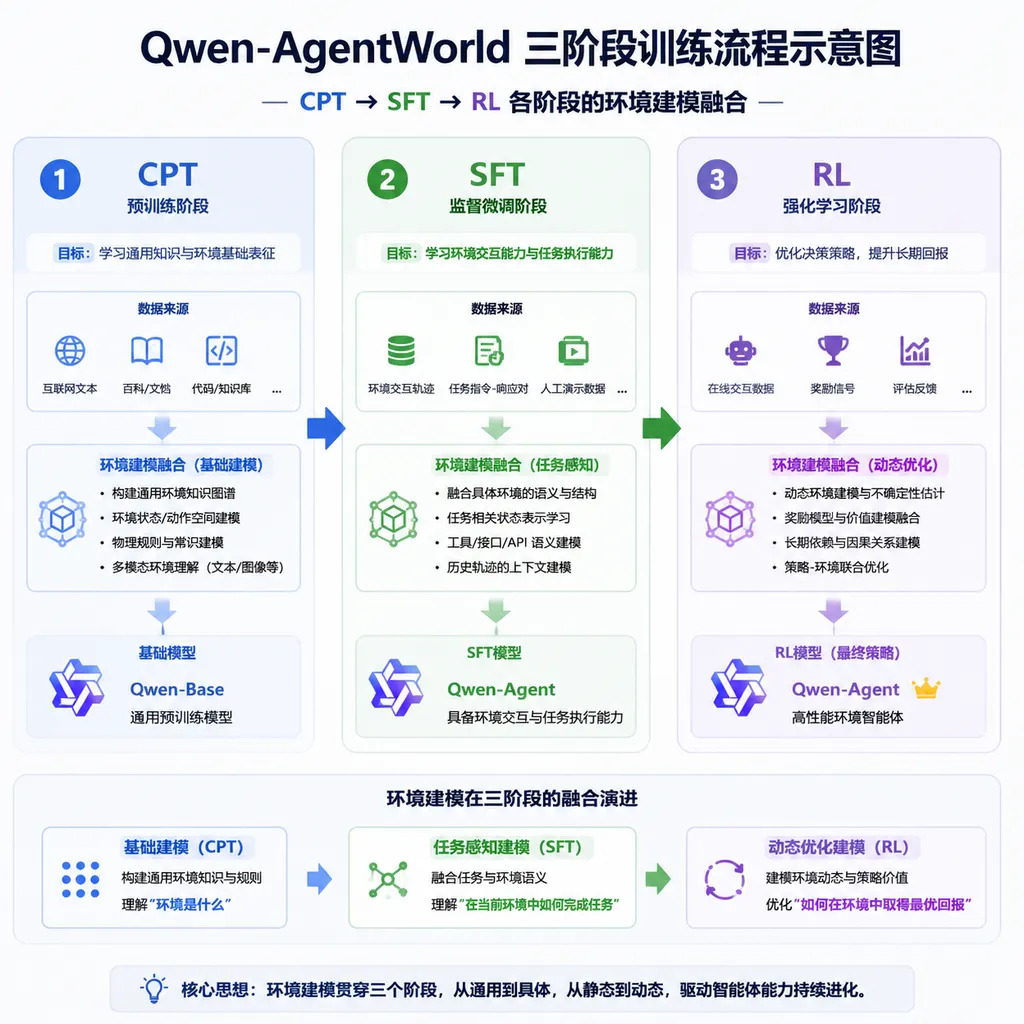
This idea isn’t brand new, but previous implementations typically followed this path: first train a generic large model, then fine-tune it for a specific environment. Qwen-AgentWorld takes a different approach — environment modeling starts from the continued pre-training (CPT) stage and runs through the entire CPT → SFT → RL pipeline. That’s what “native” means.
To illustrate: previous approaches are like giving an adult crash courses in a specific domain, whereas Qwen-AgentWorld is like a “native-born” who grew up immersed in that environment from the start.
One Model, Seven Domains
The range of coverage is even more interesting: Qwen-AgentWorld uses a single model to simultaneously support interaction across seven agent domains:
Text-based environments:
- MCP: Model Context Protocol — standard protocol for AI to call external tools
- Search: Search engine interactions
- Terminal: Command-line operations
- SWE: Software engineering environments — repository-level code operations
GUI-based environments:
- Web: Web browsing and operation
- OS: Desktop operating systems
- Android: Mobile applications
Why pack all this into one model? Because these domains share a lot of transferable knowledge. Concepts learned for directory operations in the terminal can be applied in GUI file managers; form-filling logic learned on web pages is similar on mobile apps. A single model enables cross-domain knowledge transfer instead of training a separate specialist model for each domain.
Technically, this is a bold choice. Many teams prefer the “small and specialized” route — optimizing deeply for a specific domain. Qwen instead opted for “big and universal,” leveraging larger model capacity for generality.
Two Sizes, Matching Flagship Performance
Qwen-AgentWorld comes in two specs:
| Spec | Total Parameters | Activated Parameters | Positioning | |------|------------------|----------------------|-------------| | 35B-A3B | 35 billion | 3 billion | Lightweight deployment | | 397B-A17B | 397 billion | 17 billion | Flagship performance |
From the naming, this is an MoE (mixture of experts) architecture — the “A” number indicates activated parameters. 397B-A17B means that although the total parameters are close to 400 billion, each inference only activates 17 billion parameters, balancing performance and efficiency.
According to official comparison data: in their own AgentWorldBench evaluation, Qwen-AgentWorld-397B-A17B’s overall simulation quality surpasses GPT-5.4, Claude Opus 4.8, and Gemini 3.1 Pro.
This comparison should be viewed with caution — it's based on Qwen’s own benchmark; also, “simulation quality” is a composite metric whose calculation details will be in the technical report. Nevertheless, it suggests the model is already at top-tier performance for environment simulation tasks.
Training Data: Over 10 Million Real Interaction Trajectories
The quality of a language world model largely depends on the quality and scale of training data. Qwen-AgentWorld is trained on over 10 million real environment interaction trajectories.
This is substantial. Each trajectory contains: the agent’s action sequence, the environment’s state changes, and the final execution result. Collecting this requires running many agent tasks in real environments and logging the entire interaction.
Possible data sources include:
- Internal agent system logs
- Public agent evaluation datasets
- Synthetic-generated interaction trajectories
The exact proportions are undisclosed, but given the coverage of seven domains, diversity was clearly a major focus.
AgentWorldBench: Complementary Benchmark
Qwen also released AgentWorldBench, a benchmark covering all seven domains for language world model evaluation.
A key feature: each test sample includes observed data from real environment execution. In other words, evaluation isn’t about having a model imagine responses — it’s comparing the model’s prediction to real environment responses, measuring closeness.
This evaluation method is more objective and better reflects real-world performance.
Both the model and benchmark are available on Hugging Face and ModelScope, enabling other researchers to reproduce results and conduct comparative studies.
Two Application Paradigms
In its technical documentation, Qwen outlines two ways to use Qwen-AgentWorld:
Paradigm One: Decoupled Environment Simulator
Use Qwen-AgentWorld as an independent environment simulator for training other agent models.
Traditional agent reinforcement learning samples from the real environment, which causes:
- High cost: real environment compute resources and API calls cost money
- Slow speed: limited by real environment response times
- Lack of control: hard to construct specific edge cases for testing
Replacing the real environment with a language world model alleviates these issues. Moreover, a simulated environment can do things the real one cannot — for example, controlled scenario construction. You can have the simulator deliberately return various abnormalities, forcing agents to learn to handle edge cases.
Official experiments showed: agents trained in the simulated environment significantly outperformed agents trained only in the real environment — validating the value of “controllable simulation.”
Paradigm Two: Unified Agent Base Model
A more imaginative application: use Qwen-AgentWorld itself as the base model for agents.
The logic: a model that can precisely predict environment responses must have deep understanding of the environment. This understanding transfers to agent tasks — without extra reinforcement learning fine-tuning, directly using the world model for task execution.
Official verification: after world model pre-training, the model effectively transferred to multi-turn agent tasks covering all seven benchmarks, with three benchmarks absent from the training set. This shows the model learns general environment interaction capabilities rather than memorizing specific solutions.
If this path works, future agent development may shift to: large-scale pre-training on a world model to gain general environment understanding, then lightweight adaptation for specific tasks.
In the Industry Context
Language world models aren’t unique to Qwen; OpenAI, DeepMind, and Meta have related work. Qwen-AgentWorld’s distinguishing features:
- Native modeling: integrating environment modeling from pre-training stage, not retrofitting later
- Multi-domain unification: one model covering both text and GUI types, across seven domains
- Open-source release: both model and benchmark openly available
The third point is particularly valuable: agents are a key direction for large model applications, but high-quality environment simulators are scarce resources. Qwen-AgentWorld’s open-sourcing could accelerate research progress in this area.
Qwen’s Ambition for Agents
Looking at this release in Qwen’s product line makes the strategy clearer.
In January, Qwen App launched the “Task Assistant” feature, connecting Taobao, Alipay, Fliggy, and Amap, enabling AI to directly place orders, book tickets, call rides — C-end agent deployment.
In April, Qwen3.6-Plus enhanced programming and agent capabilities, excelling in benchmarks like SWE-bench — developer scenario deployment.
Now, Qwen-AgentWorld represents agent training infrastructure layout.
Put together, Qwen isn’t just aiming to build a competent agent — it’s building a complete agent R&D and deployment system, covering base models, training methods, and application rollout.
This strategic thinking puts it in direct competition with OpenAI’s Operator and Anthropic’s Computer Use — with the difference that Qwen has chosen an open-source route, seeking competitive edge through ecosystem building.
Real-world Applications: Who Will Use This Model?
The target users for Qwen-AgentWorld are mainly:
1. Agent development teams
If you’re developing AI agent products, Qwen-AgentWorld can serve as a training environment substitute, reducing data collection costs and speeding iteration.
2. Academic researchers
Agents and reinforcement learning are research hotspots, but real environment experimentation is costly. A high-quality open-source world model can enable broader participation.
3. Enterprise automation scenarios
For enterprises deploying large-scale RPA (robotic process automation), Qwen-AgentWorld can pre-train automation scripts to improve task success rates.
Of course, these applications need time to verify. The model is newly released, and actual performance will depend on community feedback.
Some Technical Speculations
The official technical documentation is not yet fully open, but based on existing info:
Architecture: likely based on Qwen series MoE architecture, with 397B-A17B specs consistent with earlier Qwen models. Possibly optimized attention mechanisms for sequence prediction.
Training: CPT stage might use “action–observation” sequences for training, letting the model learn the conditional probability P(observation | action, context). SFT and RL stages optimize for simulation quality and consistency.
Inference: as an environment simulator, needs to support autoregressive multi-turn interactions, which requires strong context management and consistency maintenance.
Details will be confirmed in the technical report.
Points to Watch Going Forward
This release is just the beginning; key points to watch:
- Detailed technical report: training methods, data construction, evaluation specifics
- Community replication and comparison: other teams’ performance on AgentWorldBench
- Downstream application rollout: any teams building actual products on Qwen-AgentWorld
- Comparisons with other world models: e.g., DeepMind’s Genie, Meta’s work
Language world models are developing rapidly. Qwen’s release at least proves the feasibility of this path. How far it can go depends on subsequent research and application validation.
References
- Alibaba Qwen Releases First Native Language World Model Qwen-AgentWorld — IT Home’s detailed coverage of the release


