
Grok lands on Google Cloud — former rival becomes its landlord
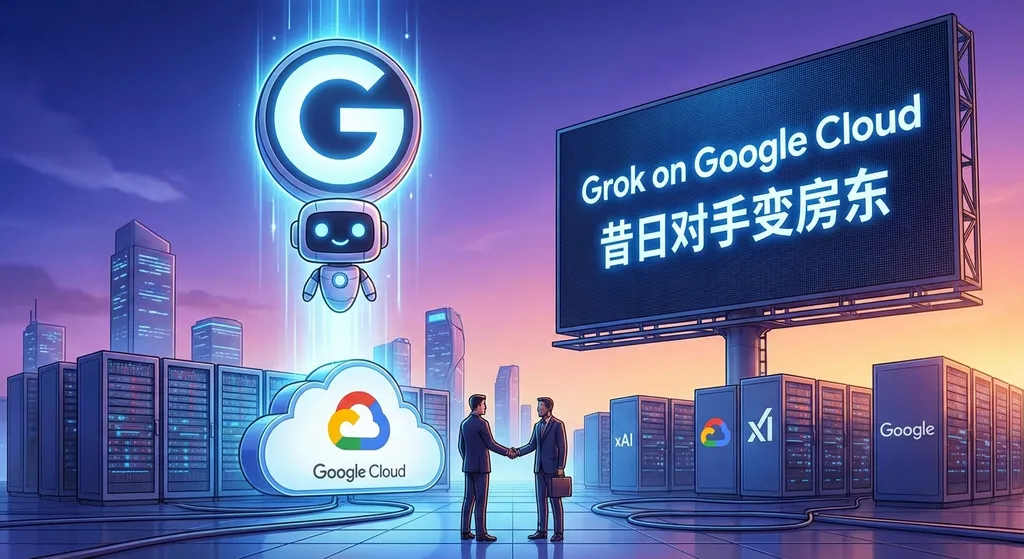
Google Cloud Vertex AI recently launched three models from xAI — Grok 4.1 Fast and Grok 4.20. This marks the first time AI models from Musk’s xAI have been made available on the Google Cloud platform. Developers can call them directly via the Vertex API.
Musk’s Model Moves into Google’s Territory
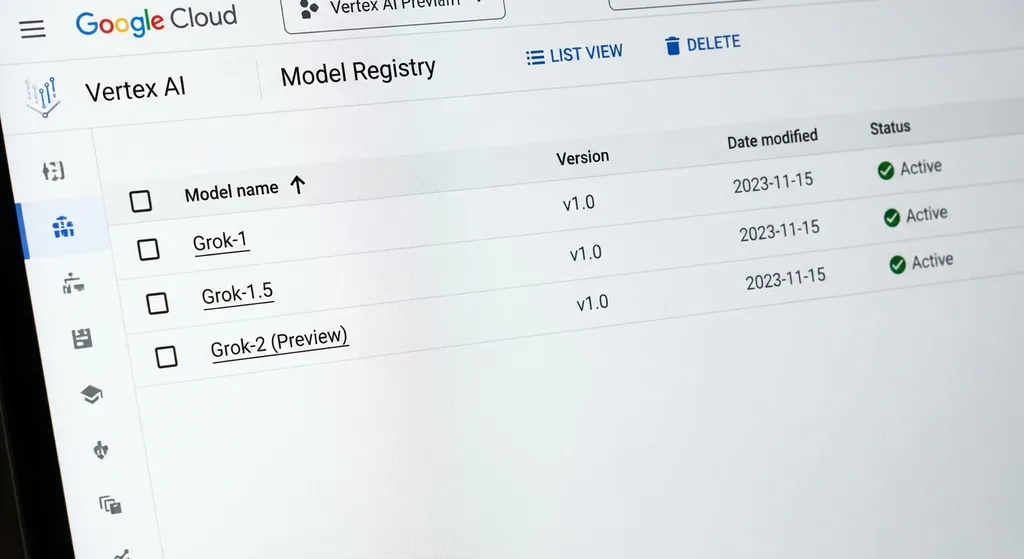
Google Cloud Vertex AI has quietly added three Grok models from xAI to its marketplace: Grok 4.1 Fast (Reasoning), Grok 4.1 Fast (Non-Reasoning), and Grok 4.20 (Non-Reasoning).
No press release, no blog post — they simply appeared on the Vertex model list. But the symbolic significance of this move is far greater than the listing itself — this marks the first time an xAI model under Musk’s company has officially landed on Google’s cloud infrastructure.
To put it mildly, the relationship between Musk and Google in the AI field has always been “delicate.” From co-founding OpenAI in the early days to later falling out, from publicly criticizing Google’s AI safety stance to creating xAI as a challenger, the two have rarely coexisted peacefully in public discourse. But business is business: models need distribution channels, and cloud platforms need a rich model ecosystem. Listing Grok on Vertex essentially fulfills both sides’ needs.
What Models Were Listed, and What Are Their Roles?
The three models listed this time serve different purposes, worth unpacking separately:
- Grok 4.1 Fast (Reasoning): A fast version with reasoning capability. It can be understood as a lightweight deployment of Grok 4.1 Thinking — retaining chain-of-thought reasoning while optimizing reasoning latency. Suitable for scenarios requiring logical inference with performance constraints.
- Grok 4.1 Fast (Non-Reasoning): A fast version without reasoning chains. It outputs answers directly without showing its thought process, making it the fastest model. Suitable for dialogue, content generation, and information extraction tasks that do not require complex reasoning.
- Grok 4.20 (Non-Reasoning): The latest iteration from xAI, previewed by Musk on X in February as a “major improvement” over 4.1. It is currently listed on Vertex in Non-Reasoning mode.
An interesting detail: Vertex lists the “Fast” variants rather than the full Grok 4.1 or Grok 4.1 Thinking versions. This indicates a deliberate tradeoff in xAI’s cloud distribution strategy — prioritizing faster, lower-cost variants for third-party platforms while keeping the full versions for its own API and Grok client.
This is a smart move. For enterprise developers using Vertex, the Fast variants are sufficient for most production scenarios, with better control over cost and latency.
A Quick Review: How Powerful Is Grok 4.1?
To understand the weight of this launch, we must revisit Grok 4.1’s capabilities.
On November 17, 2025, xAI released Grok 4.1, achieving a “double crown” on the LMArena text leaderboard: Grok 4.1 Thinking topped the list with an Elo of 1483, and the non-reasoning Grok 4.1 ranked second with 1465 Elo — 31 points higher than Gemini 2.5 Pro.
This was explosive in the competitive landscape at the time. Models like O3, Claude Sonnet 4.5, and Kimi K2 were all left behind, forming a clear performance gap.
Some key stats:
- Hallucination Rate: Dropped from 12.09% in the previous version to 4.22%, a nearly threefold reduction — a qualitative leap in information retrieval and factual Q&A.
- User Preference: In a two-week double-blind A/B test, 64.78% of users preferred Grok 4.1’s responses without knowing the source — a strong indicator of perceptible improvements.
- Emotional Intelligence: In EQ-Bench3 tests, Grok 4.1’s reasoning and non-reasoning modes took the top two spots across emotion understanding, empathy, and interpersonal communication metrics.
Technically, xAI retained Grok 4’s large-scale reinforcement learning infrastructure but introduced a key innovation: using frontier reasoning models as reward models. Traditional RLHF relies on human feedback, while xAI’s method lets AI models judge themselves — autonomously evaluating output quality at scale and iterating rapidly. This led to more consistent output styles and lower hallucination rates.
As Grok 4.20 follows 4.1, Musk’s “major improvement” claim suggests upgrades have been validated internally and reached external distribution readiness — consistent with its Vertex rollout.
Why Does This Matter?
Model listings on cloud platforms aren’t new. Anthropic’s Claude exists on both AWS Bedrock and Google Vertex; Meta’s Llama is ubiquitous. But Grok on Vertex carries different implications.
First, it redefines competitive relationships.
Google already has Gemini, and Gemini 2.5 Pro is Vertex’s flagship model. Listing Grok — a direct competitor — shows Google’s cloud strategy shifting toward platform neutrality, transforming Vertex into a “model marketplace.” AWS Bedrock has done this for a while; now Google is catching up.
For developers, this is a win. You no longer need to integrate with xAI’s API just to use Grok or open an AWS account for Claude. One Vertex project now gives access to all major models.
Second, xAI’s distribution strategy is evolving.
Early on, xAI was a closed ecosystem — Grok mainly reached users via X and xAI’s API. By launching on Vertex, xAI is formally targeting enterprise distribution. After all, many enterprise infrastructures are built on GCP, and expecting clients to reconfigure for a single model poses high friction costs.
Third, the model market is becoming “de-factionalized.”
A year ago, many predicted an AI ecosystem split resembling the mobile era — Google, OpenAI, Meta operating in separate camps. Yet, trends now show model commoditization and cloud platform neutrality. Musk’s model running on Google GPUs would have been unthinkable two years ago, but in 2026, it feels almost natural.
How Can Developers Use It?
If you already use Vertex AI, integrating Grok models works the same as any other model — Vertex’s unified API layer handles routing.
For developers in regions with network or account restrictions to Vertex AI, using OpenAI-compatible aggregation services is a practical alternative. Platforms like OpenAI Hub support calling Grok and other models using the familiar OpenAI API format, with local access and no infrastructure hassle.
Example of calling a Grok model via an OpenAI-compatible API:
import openai

client = openai.OpenAI(
    api_key="your-api-key",
    base_url="https://api.openai-hub.net/v1"
)

# Call Grok 4.1 Fast (Non-Reasoning)
response = client.chat.completions.create(
    model="grok-4.1-fast",
    messages=[
        {"role": "system", "content": "You are a helpful assistant."},
        {"role": "user", "content": "Explain briefly what RLHF means in large language models."}
    ],
    temperature=0.7,
    max_tokens=1024
)

print(response.choices[0].message.content)
# Call Grok 4.1 Fast (Reasoning)
response = client.chat.completions.create(
    model="grok-4.1-fast-reasoning",
    messages=[
        {"role": "user", "content": "A pool has two inlet pipes and one outlet pipe. Pipe A fills the pool in 6 hours, Pipe B in 8 hours, and the outlet empties it in 12 hours. If all pipes are opened together, how long will it take to fill the pool?"}
    ],
    temperature=0.0
)

print(response.choices[0].message.content)
# Call Grok 4.20 (Non-Reasoning)
response = client.chat.completions.create(
    model="grok-4.20",
    messages=[
        {"role": "user", "content": "Write a Python program that implements a simple LRU cache."}
    ],
    temperature=0.3,
    max_tokens=2048
)

print(response.choices[0].message.content)
Suggested use cases:
| Model | Best Suited For | Features | |--------|----------------|-----------| | Grok 4.1 Fast (Reasoning) | Math reasoning, logic analysis, debugging | With chain-of-thoughts, high accuracy, slightly higher latency | | Grok 4.1 Fast (Non-Reasoning) | Dialogue, content generation, info extraction | Fastest response, low cost, ideal for high concurrency | | Grok 4.20 (Non-Reasoning) | General tasks, creative writing, complex dialogue | Latest iteration, strongest overall performance |
Grok 4.1 vs 4.20: What’s Upgraded?
While detailed technical reports on Grok 4.20 haven’t been released, we can infer some improvements from clues and prior limitations in 4.1:
- Long-context capability: 4.1 had room to improve in long-text handling; 4.20 likely expands context length or boosts long-range information accuracy.
- Multimodal enhancement: 4.1 already generated decent images; 4.20 may further unify multimodal understanding and generation.
- Consistency in instruction following: A universal direction of improvement, particularly for complex multi-step instructions.
The fact that Vertex currently lists only the Non-Reasoning version of 4.20 may mean either its reasoning version is still being tuned, or xAI believes the base capability is strong enough to handle most tasks without explicit reasoning chains.
If the latter is true, that’s an interesting technical direction — boosting a model’s base competence to reduce reliance on explicit reasoning. This parallels OpenAI’s evolution with the GPT series.
The New Landscape of Cloud Model Competition
Zooming out, Grok’s listing on Vertex is a microcosm of the cloud platform model ecosystem competition.
Current leading lineups roughly look like this:
- AWS Bedrock: Claude (Anthropic), Llama (Meta), Mistral, Cohere, Stability AI, etc.
- Google Vertex AI: Gemini (Google), Claude (Anthropic), Llama (Meta), Mistral, and now Grok (xAI).
- Azure: GPT series (OpenAI), Llama (Meta), Mistral, etc.
Google made a clever move here. Vertex has trailed Bedrock in third-party model diversity, but securing Grok (which Bedrock doesn’t yet have) fills that gap. Given Grok’s strong LMArena ranking, this provides enterprise customers with an attractive, high-quality option.
For xAI, Vertex offers a ready-made channel to enterprise customers. While xAI’s own API platform is operational, it still lags behind cloud giants like GCP in enterprise sales, compliance, and SLA guarantees. Leveraging established infrastructure is the pragmatic move.
Final Thoughts
Musk’s AI model running on Google Cloud — two years ago, that would’ve sounded like a joke. But in 2026’s AI industry, pragmatism is replacing partisanship.
Model vendors need distribution. Cloud platforms need ecosystems. Developers need choices. When those incentives align, no amount of “bad blood” can override business logic.
For developers, this is good news. Whether you call Grok directly via Vertex on GCP or use an aggregation platform like OpenAI Hub with a single API key, your options are expanding and integration costs are shrinking.
As for Grok 4.20’s full performance, we’ll know soon enough once developers begin real-world testing.
References
- Vertex Lists Three Grok Models — Linux.do community thread revealing Vertex’s Grok model listing.


