
Musk Moves Data Centers to the Sky: An AI Computing Network Composed of Millions of Satellites
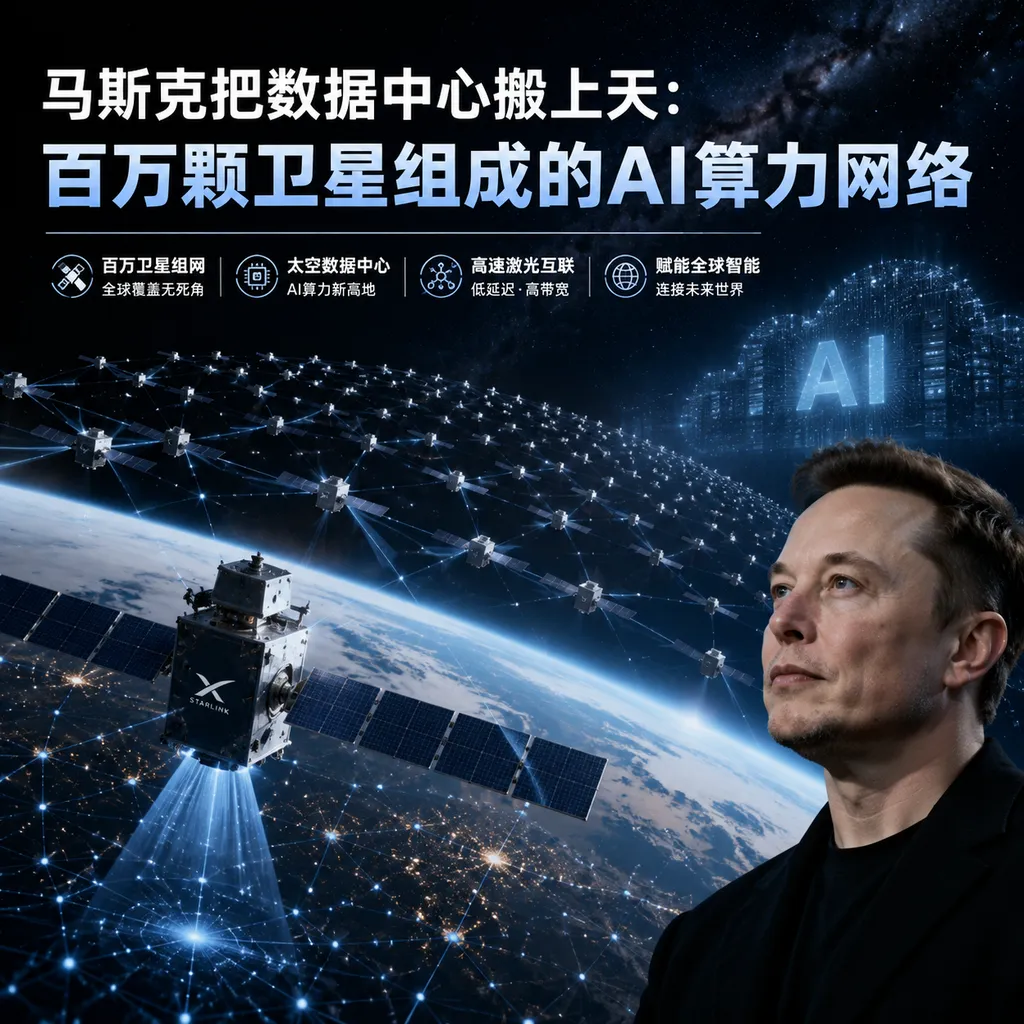
SpaceX officially announced the name of its space AI computing power project — Starmind — and plans to deploy up to 1 million computing satellites in low Earth orbit, with each satellite’s computing power equivalent to that of a ground-based server rack. This marks another major gamble by Musk in the field of space infrastructure, following Starlink.
Musk Moves Data Centers to Space: An AI Computing Network Made of a Million Satellites
Today, Musk confirmed on the X platform that SpaceX’s planned orbital AI data center project is officially named Starmind.
The name was first discovered by netizens. xAI registered the trademark Starmind, and someone asked Musk on X whether it was the name of the space computing project. His reply was just one word: Yes.
Simple, direct, very Musk.
But behind this “Yes” lies an ambitious application SpaceX submitted to the U.S. Federal Communications Commission (FCC) in January this year — a plan to launch up to 1 million compute satellites to build a distributed AI computing network in low-Earth orbit.
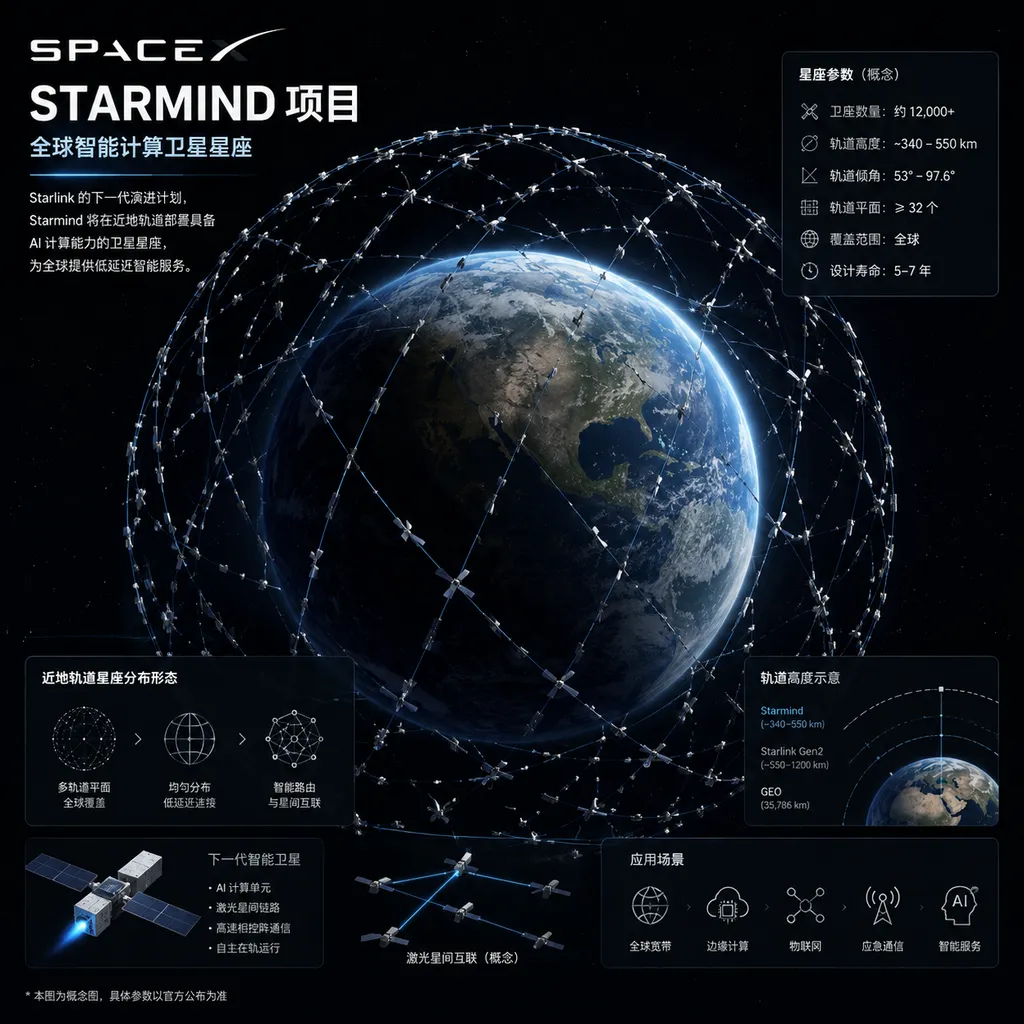
One Satellite, One Rack
Let’s start with the hardware.
On June 8, SpaceX released specifications for its first-generation hardware AI1:
- Height: 20 meters
- Wingspan when deployed: 70 meters
- Width: greater than Boeing 747-8
- Average computing power: 120 kW
- Peak computing power: 150 kW
The size is quite staggering. A 70-meter wingspan means it is wider than a Boeing 747 when deployed. These massive solar panels are meant to power the computing unit.
What does 120 kW of average computing power mean?
A modern AI server rack consumes about 40–100 kW depending on configuration. NVIDIA’s latest GB200 NVL72 rack can reach 120 kW. In other words, the computing power of one AI1 satellite is roughly equivalent to a high-end AI server rack on the ground.
This analogy is important. It means SpaceX is not doing a symbolic space computing experiment, but is seriously trying to move the basic unit of a data center into orbit.
If 1 million such satellites were deployed, it could theoretically create a computing network close to 1 terawatt (1000 megawatts) in total. For reference, the total power consumption of current AI data centers worldwide is in the hundreds of terawatts, but growing extremely rapidly.
Why Move Data Centers to Space?
The answer is not complicated: heat dissipation.
One of the biggest bottlenecks in AI training and inference is heat. GPUs generate a lot of heat during operation, and data centers consume huge amounts of energy for cooling. On Earth, this means massive electricity bills, complex cooling systems, and heavy consumption of water resources.
Microsoft has submerged servers underwater to cool them. Google built a data center in Finland to take advantage of the cold climate.
Space offers a natural solution: radiative cooling in a vacuum.
In orbit, there is no air; heat can only be dissipated via infrared radiation into space. The background temperature of space is close to absolute zero (about -270°C), which makes heat dissipation highly efficient. Of course, when exposed to direct sunlight, a satellite’s surface temperature can rise sharply, but with proper orbit designs and thermal control systems, computing units can be kept within acceptable operating temperatures.
Besides cooling, space data centers have other potential advantages:
- Abundant energy: Solar power in orbit is almost available 24 hours (depending on orbit altitude), unaffected by weather.
- No land usage: Ground data centers require large amounts of land and infrastructure.
- Global coverage: They could theoretically provide computing services to any region.
Of course, challenges are equally significant.
Network Architecture: Starlink Is a Key Link
Starmind is not an isolated project; it is deeply tied to Starlink.
According to publicly available information, Starmind satellites will connect to the Starlink network via high-speed optical links, and Starlink will relay the data to ground stations. The whole architecture can be simplified into three layers:
┌─────────────────────────────────────────────────────────┐
│                  Starmind Computing Layer               │
│     (AI1 satellite clusters performing AI training/inference) │
└────────────────────────┬────────────────────────────────┘
                         │ Optical link
                         ▼
┌─────────────────────────────────────────────────────────┐
│                     Starlink Communication Layer        │
│      (Existing Starlink network responsible for data relay)     │
└────────────────────────┬────────────────────────────────┘
                         │ Satellite-to-ground link
                         ▼
┌─────────────────────────────────────────────────────────┐
│                     Ground Access Layer                 │
│        (Ground stations, user terminals, enterprise clients)    │
└─────────────────────────────────────────────────────────┘
The smart part of this architecture is that SpaceX doesn’t need to build a communication network from scratch; Starlink already has over 6,000 satellites in orbit covering most of the globe. Starmind only needs to focus on computation, leaving communications to Starlink.
But this also brings a problem: latency.
Data uploaded from Earth to Starlink, then forwarded to a Starmind compute satellite, processed, and returned via the same route — even at light speed, round-trip latency in low-Earth orbit (~550 km altitude) is in the tens of milliseconds. Adding multiple hops and processing time, end-to-end latency could be 100–200 ms or higher.
This latency is too long for real-time inference applications (like autonomous driving or online conversations), but is perfectly acceptable for AI training, batch inference, and offline data processing.
Business Logic: Compute as a Service
From a business perspective, Starmind is SpaceX’s second growth curve after Starlink.
Starlink is already profitable, but it is essentially a telecom business with a clear ceiling. The global internet access market is finite; even with Starlink dominance, revenue growth will eventually slow.
The AI compute market is entirely different.
In the past two years, global AI compute demand has been doubling annually. OpenAI, Anthropic, Google, and Meta are all frantically expanding data centers, but supply still falls far short of demand. NVIDIA’s GPUs are constantly in shortage; each generation — H100, H200, B100, B200 — is a hot commodity.
If SpaceX can provide a new form of compute supply, even as a supplement rather than a replacement, the market potential is huge.
According to materials SpaceX showed to investors, the company is currently raising a new round with a $1.75 trillion valuation target and plans to raise $75 billion. The orbital computing project is one of the core parts of its long-term growth strategy.
This valuation already surpasses Meta and approaches Alphabet. For a private company, that’s astounding.
Technical Challenges: Far More Complex Than Imagined
The vision is grand, but reality is harsh. Moving a data center into space involves technological challenges far more complicated than on the ground.
1. Radiation Environment
Low-Earth orbit’s radiation environment is unfriendly to electronics. High-energy particles cause single-event upsets (SEUs), flipping bits in memory and processors randomly, sometimes crashing systems.
Ground data centers don’t need to deal with this, but it’s a fundamental problem in orbit.
Solutions include using radiation-hardened chips, deploying redundant compute nodes, and implementing error detection and correction. These add cost and complexity.
2. Hardware Reliability
When a server fails on Earth, you just replace it. When a satellite fails in orbit, it’s basically scrap.
This means Starmind satellites need extremely high reliability, or SpaceX must accept higher failure rates and maintain overall compute stability via mass deployment.
Given SpaceX’s greatly reduced rocket launch costs (Falcon 9 reuse now exceeds 20 times), mass deployment may be more realistic.
3. Thermal Control Systems
Although space cooling efficiency is high, designing thermal control systems is still very complex.
In sunlight, a satellite’s surface temperature can exceed 100°C, while in Earth’s shadow it may drop below -150°C. Such extremes challenge electronics.
Compute chips typically operate in the range 0–85°C (industrial grade) or -40–105°C (automotive grade). Maintaining this range in space requires precise thermal design.
4. Power Consumption and Energy Management
An average 120 kW power draw demands large solar arrays — hence AI1’s 70-meter wingspan.
But solar panel efficiency declines over time, and atomic oxygen and micrometeoroid impacts damage panels. Maintaining sufficient power generation throughout a satellite’s lifespan is another challenge.
5. Spectrum and Regulation
You can’t just launch a million satellites.
First, spectrum resources are limited. Satellite communications use assigned frequency bands requiring FCC (U.S.) and ITU (International Telecommunication Union) approval. SpaceX filed its application with the FCC in January, but approval could take years.
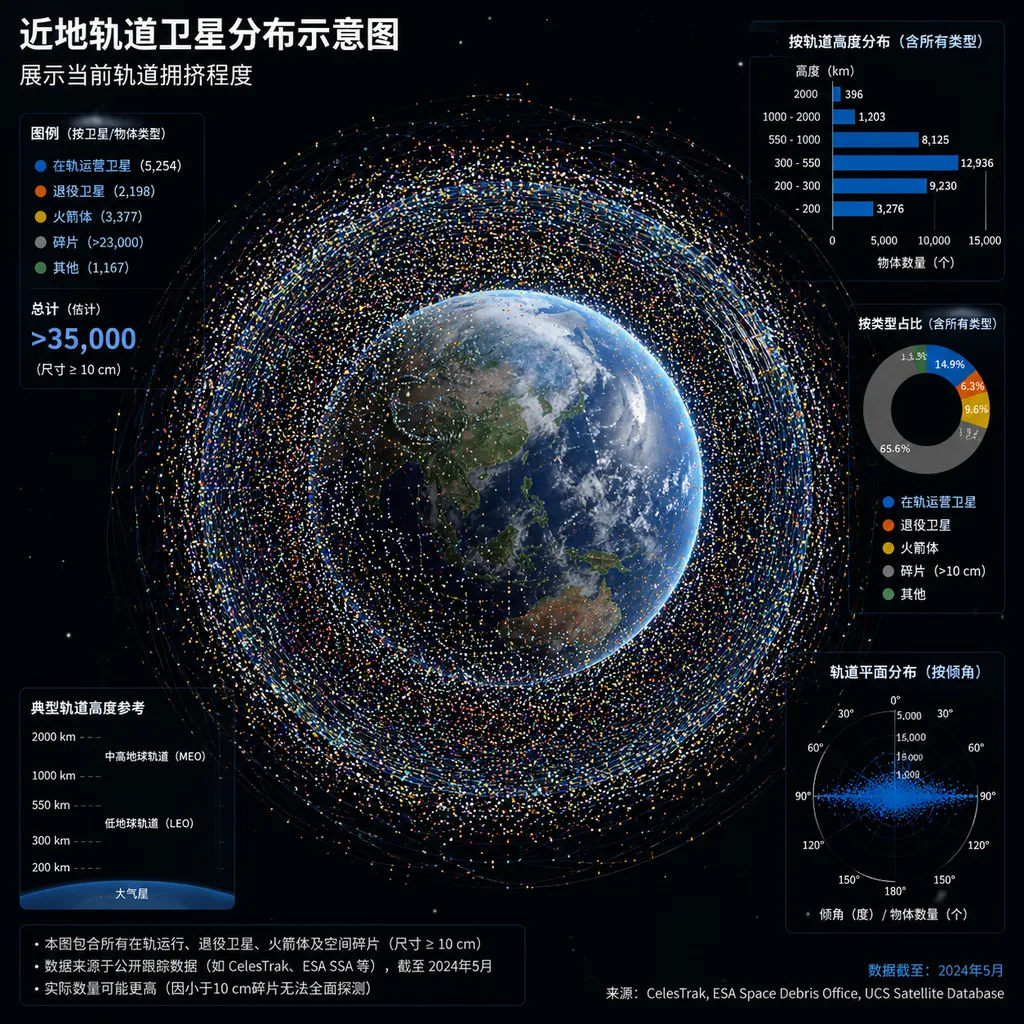
Second, space traffic management — low-Earth orbit is already crowded, with Starlink alone over 6,000 satellites. Adding a million compute satellites raises issues of collision avoidance and debris management.
In 2021, China’s space station had to make two emergency maneuvers to avoid Starlink satellites. Such incidents will become more frequent as satellite numbers rise.
Timeline: Technology Demonstration by End of 2027
According to media reports, SpaceX plans to start its space AI compute technology demonstration by the end of 2027.
This timetable is earlier than what was disclosed in IPO documents. Given SpaceX’s typical “Musk time” (usually 1–2 years later than planned), seeing the first verification satellites in orbit around 2028–2029 is more realistic.
But there’s a long way from verification to mass commercialization. Even with SpaceX’s launch capacity (~200 launches/year), deploying 1 million satellites would take decades.
Of course, once Starship matures, launch capability will increase by orders of magnitude. Each launch could carry more satellites, and costs will drop further. This is the confidence behind SpaceX’s grand planning.
Competitive Landscape: No Current Rivals
In space-based AI compute, SpaceX currently has no real competition.
Amazon’s Kuiper project is still focused on communications and has no public compute satellite plans. OneWeb has fallen behind Starlink. China’s satellite internet initiatives also mainly focus on communications.
Such a first-mover advantage could become a long-term competitive moat. Space infrastructure has long deployment cycles; once SpaceX establishes a complete orbital computing network, it will be hard for newcomers to catch up.
But there’s another possibility: space computing may ultimately prove commercially unviable, unable to compete with ground data centers in cost. In that case, SpaceX’s resources would be wasted.
That’s why Musk wants a technology demonstration first — to validate technical feasibility and business models before going all-in.
What Could This Mean for the AI Industry?
If Starmind succeeds, the impact on AI could be profound.
In the short term, it’s mainly a supply-side story. More compute supply means more choices for AI companies, and possibly lower costs.
In the medium term, space compute could enable new applications — tasks insensitive to latency but demanding immense compute: large-scale model training, scientific computing, climate simulation.
In the long term, if space compute scales, it could change the layout of AI infrastructure entirely. Data centers would extend beyond Earth. This would be a paradigm shift in compute infrastructure, akin to the shift brought by cloud computing.
Of course, all of this depends on Starmind’s success. Given the technical difficulty and timeframe, cautious optimism is reasonable.
Conclusion
Musk has once again proposed something that sounds crazy: launch 1 million compute satellites into space to build a distributed AI computing network.
Crazy? Absolutely. Feasible? Maybe.
Ten years ago, nobody believed rockets could be reused. Five years ago, nobody believed satellite internet could be profitable. Today, Falcon 9 has been reused more than 20 times, and Starlink is making money.
Musk’s greatest talent isn’t predicting the future — it’s executing to turn the impossible into possible. Will Starmind be the next Starlink or the next Twitter? Only time will tell.
But one thing is certain: if anyone can move a data center into space, that person is probably Musk.
References
- ITHome: Musk confirms Starmind space AI compute project name, plans to launch 1 million satellites into orbit – Musk confirms project name and basic information
- Zhihu column: SpaceX (AI edition) building a 1 terawatt space compute empire – Deep analysis of SpaceX’s space compute strategy


