
Douyin "World Creation" unveiled: What tricks can multi-agent driven 3D UGC pull off?
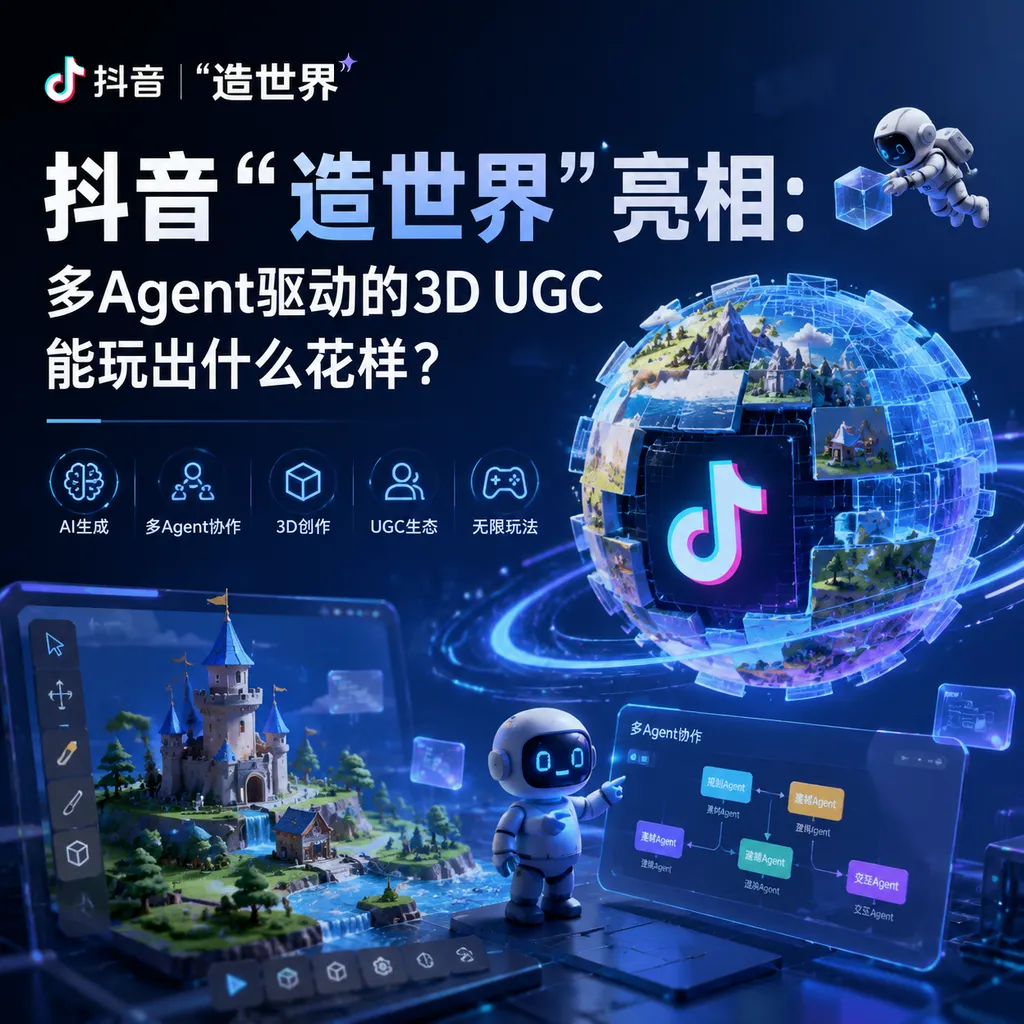
At the Volcano Engine FORCE Conference, TikTok released the 3D creation tool **"World Builder"**, which focuses on multi-Agent collaboration to generate playable virtual worlds, serving the **"Duoshan Zaizai World"** ecosystem. This marks the official entry of major companies into the competition for the AI + 3D UGC track.
Douyin Steps In
On June 24, at the Volcano Engine FORCE Conference, Douyin unveiled a new creation — "Build the World".
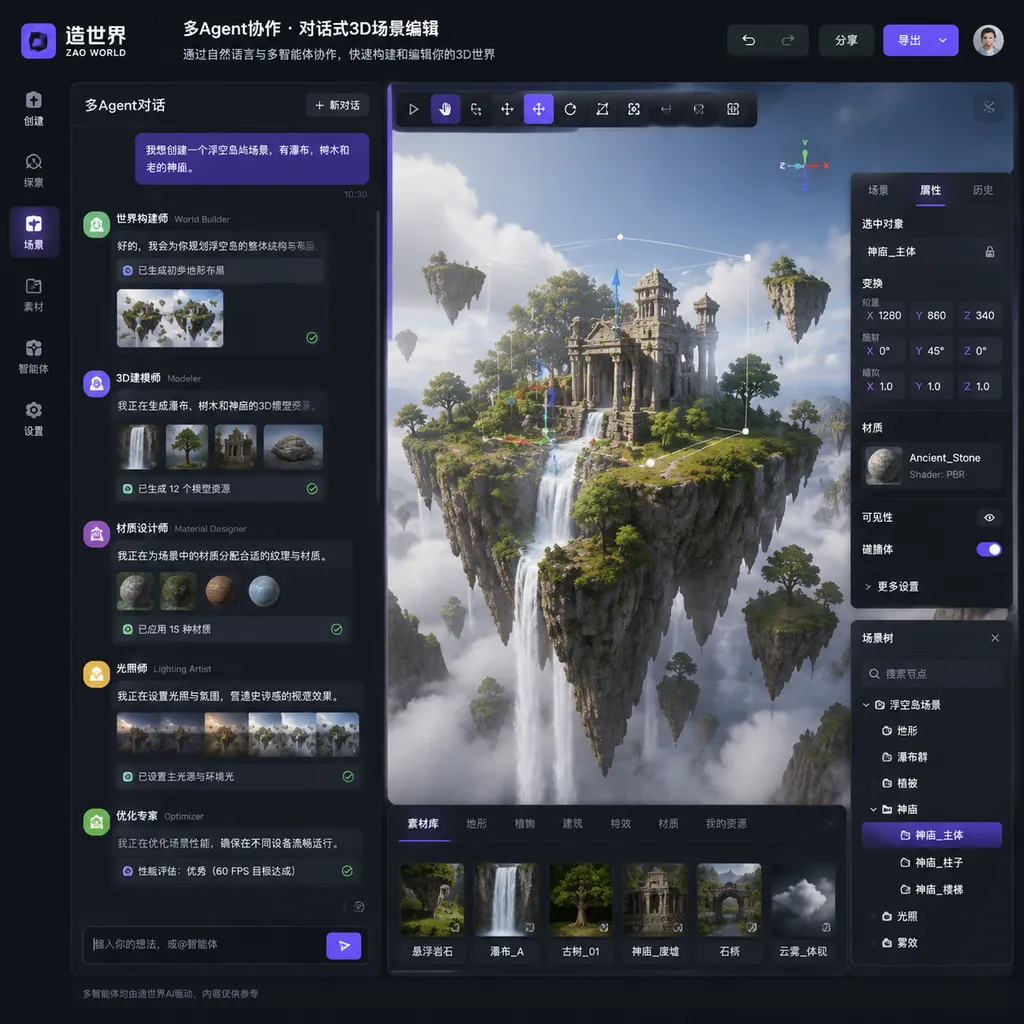
This is an integrated multi-Agent 3D world creation tool. Simply put, creators can, through multi-round dialogues, asset assembly, and scene editing, generate virtual worlds that can be published and played. It’s not just rendering an image, not just generating a video, but a 3D space that others can enter, explore, and play in.
Currently, "Build the World" mainly serves Douyin’s "Duoshan Zizai World" — a 3D UGC interactive scene. Once a creation is completed, it can directly join Douyin and Duoshan’s social and recommendation distribution system. Creators can now apply for beta access on the official "Douyin Virtual Creation Platform" website.
The news itself isn’t explosive, but the signal is clear: the big players are officially entering the race for the AI + 3D UGC track.
Why Multi-Agent?
The most noteworthy technical feature of "Build the World" is "multi-Agent integration".
Traditional AI generation tools basically operate in a single-task mode: you input a prompt, it outputs a result. Text-to-image works this way, and so does text-to-video. But the complexity of 3D world creation far exceeds a single medium — you need scenes, characters, props, interaction logic, and physics rules, which cannot be accomplished by a single model in one go.
The multi-Agent approach breaks down tasks: one Agent is responsible for understanding your natural language description, another for generating scene layout, another for character modeling, another for coordinating interaction logic… They collaborate via certain protocols to ultimately assemble a complete interactive world.
This architecture isn’t new. When Manus went viral last year, the industry began discussing the possibilities of Agent collaboration. But "Build the World" may be the first product in China to implement multi-Agent architecture in a consumer-grade 3D creation scenario.
Judging by the product design, Douyin’s approach is quite pragmatic. It doesn’t aim for the sci-fi level goal of “generate an entire game with one sentence,” but instead makes human-machine collaboration the core process: multi-round dialogue gradually refines intentions, asset assembly gives creators controllable editing space, and scene editing preserves final adjustment rights.
This “AI lays the groundwork, humans finish the job” mode may be the most realistic path under current technological conditions.
The Past and Present of the 3D UGC Track
To understand the significance of "Build the World", you need to grasp the current state of the track.
AI + 3D UGC is not a new concept. Over the past two years, teams in both domestic and overseas markets have been exploring this direction:
Overseas market — Roblox has always been the benchmark for 3D UGC. Its creation tool, Roblox Studio, while traditional, has a mature ecosystem, with millions of creators building countless playable worlds on it. Last year, Roblox also began introducing AI-assisted features, but overall it still relies on traditional editors.
3D generation model field — VAST’s Tripo series, several 3D companies invested in by OpenAI, and some domestic startups are working on underlying 3D generation capabilities. Tripo 3.0 can already produce models directly ready for 3D printing, without further modification. But these tools mainly target professional users and B2B scenarios, still far from consumer-grade UGC.
Character-driven communities — Perhaps the most interesting example is Nie Ta. This 20-person team’s product essentially uses AI to eliminate the barrier to drawing, enabling ordinary people to create and nurture virtual characters. It has already achieved commercialization: users pay for image generation of characters, and monthly active users have reached the millions.
Nie Ta’s founder, Hu Xiuhan, has an intriguing take: building worlds should start with creating characters, not the world itself. Characters carry users’ emotional projection, while worlds are merely stages for their activities. Talking about worlds without characters results in a “spherical chicken in a vacuum.”
This viewpoint offers insight into "Build the World". Douyin’s choice to integrate it into Duoshan Zizai World rather than making it a standalone creation tool may stem from similar logic: establish a character ecosystem first, then grow worlds.
Where Are the Technical Barriers?
Creating a usable 3D world creation tool is more complex than it seems.
First layer: 3D asset generation — Current advanced 3D generation models can produce usable quality for a single object, but consistency in complex scenes remains an issue. Ask AI to generate a café and you might get great tables, chairs, and bar counters individually — but together their styles may clash, and proportions may be off.
Second layer: interaction logic — The difference between a static 3D scene and a playable world lies in a full set of interaction systems: how characters move, how objects collide, how players trigger events. Traditional game engines (Unity, Unreal) have spent decades refining these capabilities, and replicating them with AI in the short term is extremely difficult.
Third layer: multimodal coordination — Maintaining consistency across text, images, 3D models, animations, and sound effects is the hardest part. Describe “a gloomy castle” and you want the scene, background music, NPC dialogue style all in the same tone. This requires deep alignment between multiple models, not simple chaining.
Douyin’s choice of multi-Agent architecture may precisely aim to address this complexity. Assigning different tasks to specialized Agents is more controllable than asking one general model to handle all problems. But the trade-off is increased system complexity, as coordination among Agents becomes its own challenge.
From disclosed information, "Build the World" has opted for a relatively conservative strategy: it doesn’t strive for end-to-end automatic generation, but instead allows humans to participate in the creation loop. This lowers AI capability requirements but also limits tool convenience.
Douyin’s Ecosystem Advantage
Beyond technology, Douyin’s greatest strength here is its ecosystem.
Whether a 3D UGC platform can thrive depends less on how powerful its tools are, and more on whether creators want to come and whether audiences want to play. This is a classic two-sided market cold start problem.
Douyin’s solution is straightforward: integrate "Build the World" content into Douyin and Duoshan’s recommendation distribution. Worlds created aren’t left in some corner unnoticed — they have a chance to be pushed to users.
This is an advantage startups struggle to replicate.
Nie Ta grows content like “Huai’an Apartment” through community operations and creator incentives, slowly cultivated over time. But this requires patience and deep understanding of niche cultures.
Douyin has traffic — but also inertia. Big companies running UGC communities often make the mistake of applying PGC thinking: official templates, official events, official tonality. Creators feel restricted, and users perceive content as homogeneous.
Whether "Build the World" can avoid this pitfall depends on the product team’s understanding of the essence of UGC. Genuine UGC ecosystems aren’t planned by officials — they’re played into existence by users. Nie Ta’s “Huai’an Apartment” is one example: it wasn’t designed by the official team, but spontaneously assembled by players using AI characters, stories, and templates.
Content Production in the Agent Era
The release of "Build the World" prompts a bigger question: how will AI Agents change content production?
Hu Xiuhan from Nie Ta notes an interesting phenomenon: users have already started using Agents to play with their product. For example, using OpenClaw (a locally deployed AI Agent) inside Nie Ta, it will explore on its own, learn how to play, and act naturally.
What does this mean? In the future, content may not only be produced by humans for humans, but also by Agents for humans — and even humans for Agents.
Imagine: you have a virtual character, you set their persona and preferences. Then you place them in a virtual world generated by "Build the World". They explore, socialize, and create stories on their own. As the "owner," you just occasionally check snapshots of their experiences — like watching a pet’s daily life.
This isn’t sci-fi — it’s already technically feasible. Constraints are computational cost and experience design.
Hu Xiuhan believes building products around Agents will become a major trend. Agents solve problems like complex operations and steep initial learning curves. The future focus is on building environments — whether for humans, pets, or Agents, the demand is essentially the same: enabling a better version of themselves to gain new experiences within an environment.
If this prediction holds, "Build the World"’s competitors may not be other 3D creation tools, but all products building “virtual environments.” Games, social platforms, and metaverses — their boundaries will blur.
The Long-Term Vision for World Models
Talking about 3D generation inevitably involves the concept of “world models.”
Simply put, world models are engines that let AI understand and generate worlds. Google’s Genie series can already generate interactive game scenes directly — though the graphics are still rough, the direction is clear: in the future, traditional game engines may not be needed, and AI will directly “imagine” a world you can enter and play.
What does this mean for products like "Build the World"?
In the short term, world models are still immature, and human-machine collaboration modes like "Build the World" remain mainstream. In the long term, if world model quality improves, many intermediate processes could be skipped.
Nie Ta’s strategy: accumulate not heavy assets like 3D models, but lightweight protocols — character settings, tags, and prompts. If world models can interpret these protocols, they can render the content.
This is a smart hedge. Regardless of how underlying technology evolves, user-created characters and stories can migrate. As they say: “This world has always been here, the fog has just finally lifted.”
Will Douyin adopt a similar approach? From current information, it’s unclear. But one thing is certain: whoever can keep their assets portable during rapid AI iteration will be more likely to survive long-term competition.
Big Players vs Startups
Finally, let’s talk competitive landscape.
Douyin’s entry — what does it mean for startups in the track?
Hu Xiuhan from Nie Ta thinks the biggest issue for big companies is inertia. Heavy processes, slow decisions, and teams that still think in traditional development modes — AI is, to them, an auxiliary tool rather than a core productivity source.
This makes sense, but we shouldn’t underestimate big companies’ execution. Douyin’s recommendation system, distribution capabilities, and user base are resources startups can hardly match.
The key question is: how big is the AI + 3D UGC market?
At present, the core user groups are OC (original character) enthusiasts, anime/manga/game fans — users with strong expression needs who will play with products first. But this is relatively niche.
To break out, broader demand scenarios need to be found — possibly social (parties, gatherings in virtual spaces), education (allowing kids to create their own game worlds), or e-commerce (interactive 3D brand experiences).
Integrating "Build the World" into Douyin’s ecosystem is, to some extent, testing these possibilities. Whether it can succeed remains to be seen.
One thing is certain: AI + 3D is still in a very early stage. Language models may have plateaued, but 3D large models are just beginning. The coming years will bring many exciting developments.
Douyin’s entry is just the beginning.
References
(Note: The original sources referenced are mostly domestic media reports; below are sources that meet domain requirements)
- None available for inclusion at this time. Information in this article is compiled from official Volcano Engine FORCE Conference releases and domestic tech media reports such as 36Kr.


