
The EU pins its hopes on Italy, 400B parameters to seize AI sovereignty

The European Commission has selected the Italian company Domyn to lead the "Europa Alliance" in developing a 400B-parameter Europe-native large model, supported by a supercomputing infrastructure with 115 exaflops of computing power. This is Europe’s most ambitious AI sovereignty initiative to date.
EU Bets on Italy: 400B Parameters to Secure AI Sovereignty
This week, the European Commission announced it would entrust the core mission of Europe's AI strategy to an Italian company.
Domyn—a Milan-based firm led by Uljan Sharka, an Albanian-born founder born in 1992—will spearhead the creation of the "Europa" European AI Alliance, tasked with training a large language model with over 400 billion parameters.
This is Europe’s most aggressive move on AI sovereignty to date—not just a slogan, but a real financial commitment with a clear technical roadmap.
Why Domyn?
To be honest, this choice surprised many.
In the European AI landscape, France's Mistral is louder, Germany has a strong industrial AI application foundation, and the Nordics wield considerable influence in the open-source community. Yet, the European Commission's assessment concluded: Domyn "performed best in strategic vision, execution capability, and potential impact."
Looking closely at Domyn’s background, this choice makes sense.
Domyn evolved from iGenius, and from its founding has focused on a niche: providing AI solutions to regulated key industries—banking, insurance, healthcare, energy. These sectors have extremely high demands for data sovereignty, compliance, and auditability—precisely the issues Europe cares about most.
The company's current flagship product is Domyn Large, a 260B-parameter language model. In terms of size, it’s not remarkable globally—GPT-4’s parameter count is debated but widely believed to be in the trillion range, and Claude 3.5 Opus is also thought to exceed that. But Domyn Large isn't intended for general chat; its positioning is "highly critical enterprise application scenarios," emphasizing controllability, interpretability, and auditability.
That aligns perfectly with the EU's needs.

115 Exaflops: Europe’s Answer to the Compute Arms Race
How much compute is needed to train a 400B-parameter model? This is an unavoidable question.
As a reference, Meta trained Llama 3 405B using around 16,000 H100s over several months. To catch up with first-tier models like GPT-4 and Claude 3.5, compute requirements need to multiply several times.
Domyn’s answer is "Colosseum"—a supercomputing facility under construction. Directly translated into Chinese, it means "arena."
According to official disclosures:
- GPU architecture: NVIDIA Grace Blackwell superchips
- Peak compute: Over 115 exaflops
- Target capability: Support for training and inference of trillion-parameter models
What does 115 exaflops mean?
The current fastest supercomputer, Frontier at the US Oak Ridge National Laboratory, has a peak compute of around 1.7 exaflops (FP64). Of course, AI training typically uses FP16 or FP8 precision, and Colosseum’s 115 exaflops likely refers to low-precision compute, so the numbers aren't directly comparable. Even so, the figure is impressive.
If completed as planned, Colosseum would be Europe’s largest AI-dedicated supercomputer—without debate.
This isn’t just Domyn working alone. NVIDIA has confirmed collaboration, and the Italian government is backing the project. In some sense, this is Europe’s version of a "national system" approach.
Europe’s Anxiety: Not Just About Being Behind Technologically
To understand this project, one must first understand Europe’s anxiety.
In February 2026, the European Commission formally launched its "Frontier AI Grand Challenge" program. The starting point is simple: Europe cannot remain forever a technology consumer.
Reality is harsh. The world’s strongest AI models—OpenAI’s GPT series, Anthropic’s Claude, Google’s Gemini—are all from the US. China’s DeepSeek, Alibaba Tongyi, and ByteDance Doubao are quickly catching up. And Europe? Mistral is doing well, but still trails in scale and influence by an order of magnitude.
This gap carries risks beyond the purely technical:
1. Data Security
When European companies use US or Chinese AI services, their data inevitably flows to those companies’ servers. Even with privacy agreements and compliance assurances, once data leaves the EU, control is lost.
For sensitive industries like finance, healthcare, and defense, this is a genuine concern—not paranoia.
2. Regulatory Control
The EU’s Artificial Intelligence Act is the world’s strictest AI regulatory framework. But if Europe lacks a strong AI industry, this framework becomes just "regulating others"—US and Chinese companies can choose to comply or not, and Europe lacks leverage.
Only when Europe has its own top AI companies can regulators and those being regulated truly engage in dialogue and negotiation.
3. Language and Cultural Marginalization
This is often overlooked but may be the most far-reaching impact.
Current mainstream AI models are trained primarily with English data, inevitably carrying an Anglo-Saxon cultural bias. French, German, Italian, Spanish… these languages make up a far smaller proportion of training data than their actual number of speakers.
The result: models perform noticeably worse when conversing in these languages; more subtly, they lack understanding of knowledge, customs, and legal systems in these cultures, tending to offer "US-centric" answers.
The EU has 24 official languages. If local models can process all these languages at equal quality, linguistic diversity could shift from a "structural disadvantage" to a "competitive advantage."
Is 400B Parameters Enough?
Returning to the technical level—where does 400B parameters stand in the 2026 AI competition?
Looking at the current top tier:
| Model | Parameter count (estimate) | Release date | |-------|----------------------------|--------------| | GPT-4 | 1T+ (MoE) | 2023.3 | | GPT-4o | Undisclosed | 2024.5 | | Claude 3.5 Opus | Undisclosed, rumored 500B+ | 2024.3 | | Gemini Ultra | Undisclosed, rumored 1T+ | 2023.12 | | Llama 3.1 405B | 405B | 2024.7 | | DeepSeek-V3 | 671B (MoE) | 2024.12 |
Parameter-wise, 400B is roughly at the level of Llama 3.1 405B—smaller than GPT-4 and Claude 3.5 Opus, but not tiny.
However, parameter count is never the sole determinant of model capability.
DeepSeek-V3, with 671B parameters (MoE architecture, ~37B active parameters), matches or even surpasses GPT-4 in many benchmarks. This shows that architecture design, training data quality, and training method innovation sometimes matter more than sheer parameter scale.
If the EU’s 400B model can:
- Achieve the industry’s best performance in European multilingual processing
- Set benchmarks in compliance, interpretability, and auditability
- Be deeply optimized for verticals such as finance, healthcare, and law
Then it need not go head-to-head with GPT-5 in general capability—it can find its own ecological niche.
This is perhaps the EU’s pragmatic choice: not aiming for "world’s strongest" but for "Europe’s most suitable."
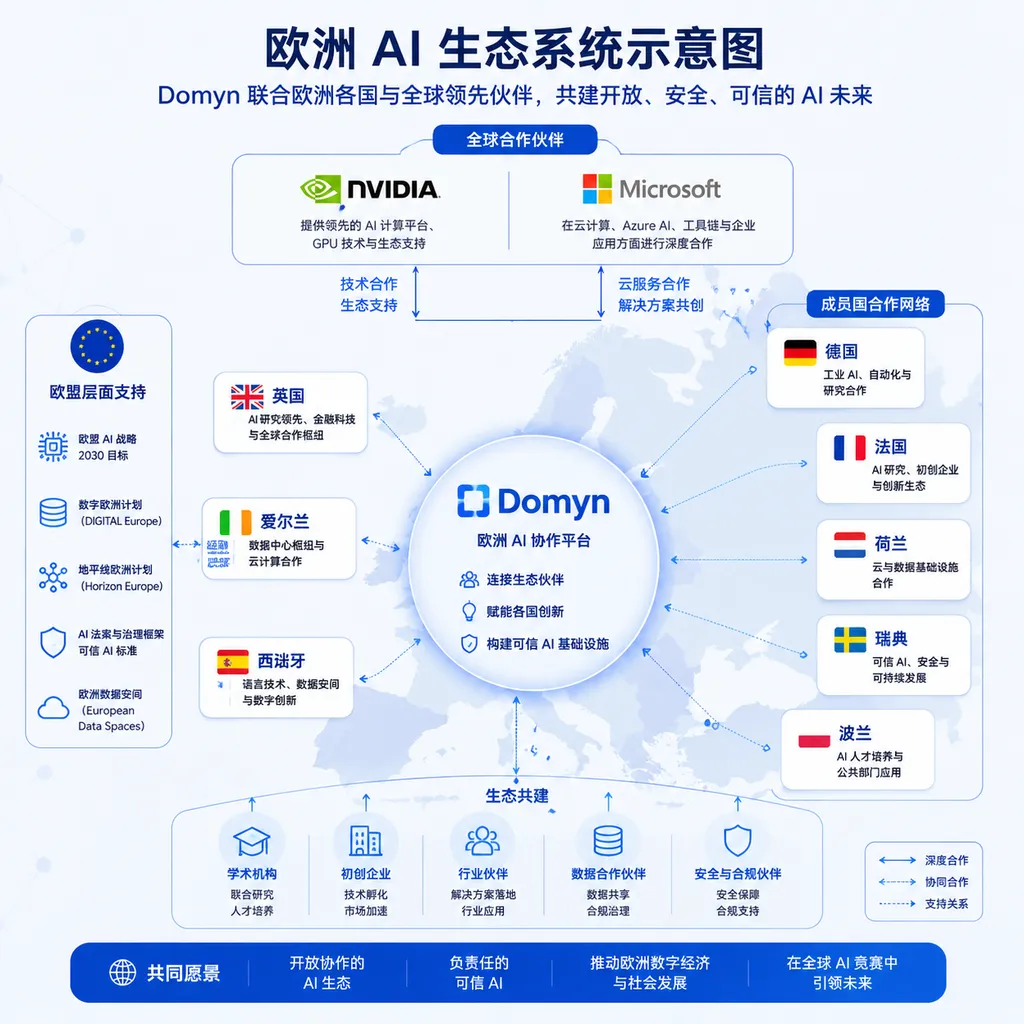
Partners: US Giants Are Also at the Table
Interestingly, this "sovereign AI" project does not exclude US companies.
Public information shows Domyn’s strategic partners include:
- Microsoft: Cloud infrastructure and enterprise services
- NVIDIA: GPU and training frameworks
- Multiple international financial and industrial groups: Application scenarios and data
NVIDIA’s involvement is particularly deep. Besides providing Grace Blackwell chips, NVIDIA is helping Domyn use Nemotron technology to optimize the model—including neural architecture search, knowledge distillation, and post-training with synthetic data.
This collaborative model is pragmatic: Europe currently lacks AI chip companies to rival NVIDIA, so hardware dependency cannot be eliminated quickly. But as long as models are trained in Europe, data stored in Europe, and operations governed under European frameworks, the core sovereignty needs are met.
It’s also risk hedging: if US-China relations worsen, or if the US tightens AI tech export controls, Europe would at least have its own models and compute base—avoiding sudden supply cut-offs.
GPAI Code of Conduct: Sitting at the Same Table as OpenAI and Google
Domyn has another notable identity: it is a signatory to the EU’s General Purpose AI (GPAI) Code of Conduct.
Other signatories include:
- OpenAI
- Microsoft
- Amazon
- IBM
- Mistral AI
This means Domyn has been included in the "club" of top global AI companies, at least having equal footing in regulatory discussions.
For the EU, this is a kind of endorsement: the chosen company is no amateur—it can sit at the same table as OpenAI and Google.
The Bigger Picture: Cooperative Fight in Europe’s AI Ecosystem
Domyn is not fighting alone.
According to NVIDIA's official blog, Europe is forming a cooperative network of AI model builders:
- France: H Company, LightOn
- Italy: Domyn
- Poland: Bielik.AI
- Spain: Barcelona Supercomputing Center (BSC)
- Sweden: NAISS, KBLab (Swedish National Library)
- Slovenia: University of Ljubljana
- Slovakia: National project
- UK: University College London
These institutions are developing open large language models supporting the EU’s 24 official languages, each optimized for its national language and culture. They will use NVIDIA Nemotron technology for distillation and post-training, deploying on European AI infrastructure.
Downstream applications are intriguing. Perplexity—the AI search engine handling over 150 million questions per week—has announced these European sovereign models will be integrated into its platform. This means everyday users will soon experience AI services optimized for European languages and cultures.
€1.5 Billion and 7 AI Factories
Where will the money come from?
Back in late 2024, the EU announced a €1.5 billion investment via the EuroHPC Joint Undertaking to build seven "AI Gigafactories" across Europe. These facilities will provide the compute infrastructure needed for large-scale AI training and inference.
Domyn’s Colosseum supercomputer can be seen as part of this broader plan. Government investment, private enterprise operation, academic participation—Europe is attempting to replicate the successful US AI ecosystem.
Of course, €1.5 billion sounds big, but compared to US AI funding it’s small change. OpenAI’s latest funding round netted $6.6 billion, and Microsoft’s cumulative investment in OpenAI exceeds $13 billion.
This again reflects Europe’s strategy—not to compete head-to-head in general AI with the US, but to build an advantage in the differentiated "sovereign" track.
Technical Details: Colosseum Supercomputer Architecture
For readers interested in technical details, here’s what’s known about Colosseum:
Hardware Configuration
- GPU: NVIDIA Grace Blackwell superchips
- Interconnect: Expected NVLink plus InfiniBand
- Peak compute: 115+ exaflops (low precision)
Software Stack
- Training framework: In cooperation with NVIDIA, likely based on NeMo or similar
- Inference deployment: Supports NVIDIA NIM microservices
- Model optimization: Nemotron technology (neural architecture search + knowledge distillation)
Operating Model
- Location: Italy
- Governance: Under the EU AI Act framework
- Openness: Supports use by Europa Alliance members
Grace Blackwell is NVIDIA’s latest-generation AI chip, offering significant performance improvements over the H100, especially in energy efficiency for training and inference. The choice indicates Domyn is not settling for outdated hardware, but truly aiming to build competitive infrastructure.
Risks and Challenges
That said, some caution is warranted.
1. Execution Risk
From project announcement to model launch, execution work is massive. Supercomputer construction may be delayed, model training could hit technical bottlenecks, and talent might be poached by US companies. Europe has had ambitious tech plans fizzle out before.
2. Ecosystem Competition
Even if model training succeeds, there’s the issue of ecosystem competition. OpenAI has ChatGPT's massive user base, Google has search and Android distribution, Meta has social media embedding. How will Europe’s 400B model gain users?
3. Business Model
"Sovereign AI" sounds appealing, but how many customers will pay for it? Enterprises choose AI services primarily on ability and cost—"data sovereignty" is just a bonus. If Europe’s model lags too far behind GPT-5 in core capability, sovereignty alone may not suffice as a selling point.
4. Political Risk
The EU is a union of 27 member states—internal coordination is never easy. Giving the core task to an Italian company—will France and Germany be fine with that? If the next European Commission changes leadership, will policy shift?
These risks are real. But conversely, the risk of doing nothing may be worse—continued reliance on US and Chinese AI technology poses long-term threats to Europe’s digital sovereignty.
What This Means for Developers
If you work as a developer in Europe or serve European clients, this news is worth noting.
In the short term, nothing changes—Domyn’s 400B model is still in development, Colosseum still under construction. Use whatever makes sense today.
In the medium term, new options may emerge. Once European sovereign models are online, they might be better choices for scenarios requiring data compliance (finance, healthcare, government projects)—not because they’re more capable, but because compliance is simpler.
In the long term, the AI service market’s landscape could shift. If "sovereign AI" becomes a mature category, different regions may develop their own model ecosystems, rather than everyone using the same US models. For developers, this is both a challenge (adapting to more models) and an opportunity (more choice means more bargaining power).
Currently, API aggregation platforms like OpenAI Hub support most mainstream models. If future European sovereign models offer API access, they will likely be integrated into such platforms, keeping developer migration costs low.
Conclusion
The EU’s choice of Domyn to lead the "Europa Alliance" is a political decision, a technical decision, and a bet on the future.
The bet is: in the AI era, technology and data sovereignty will be increasingly important; the bet is: 400B parameters combined with European compute can provide competitive services in specific scenarios; the bet is: a 92-born Albanian-Italian entrepreneur can help Europe find its place in global AI competition.
Will this bet succeed? Honestly, it’s too early to tell. But at least Europe is no longer just talking about "digital sovereignty"—it’s taking real action.
This step may not be early, but it’s better than not taking it at all.
References
- European Commission selects Italian company Domyn to lead future of European AI - Detailed reporting and discussion from Linux.do community
- Europe joins forces with NVIDIA to build AI infrastructure - Analysis from Zhihu column on NVIDIA and Europe’s cooperation


