
Yingmou Technology Secures Hundreds of Millions in Financing, 3D Generation Enters the Editable Era
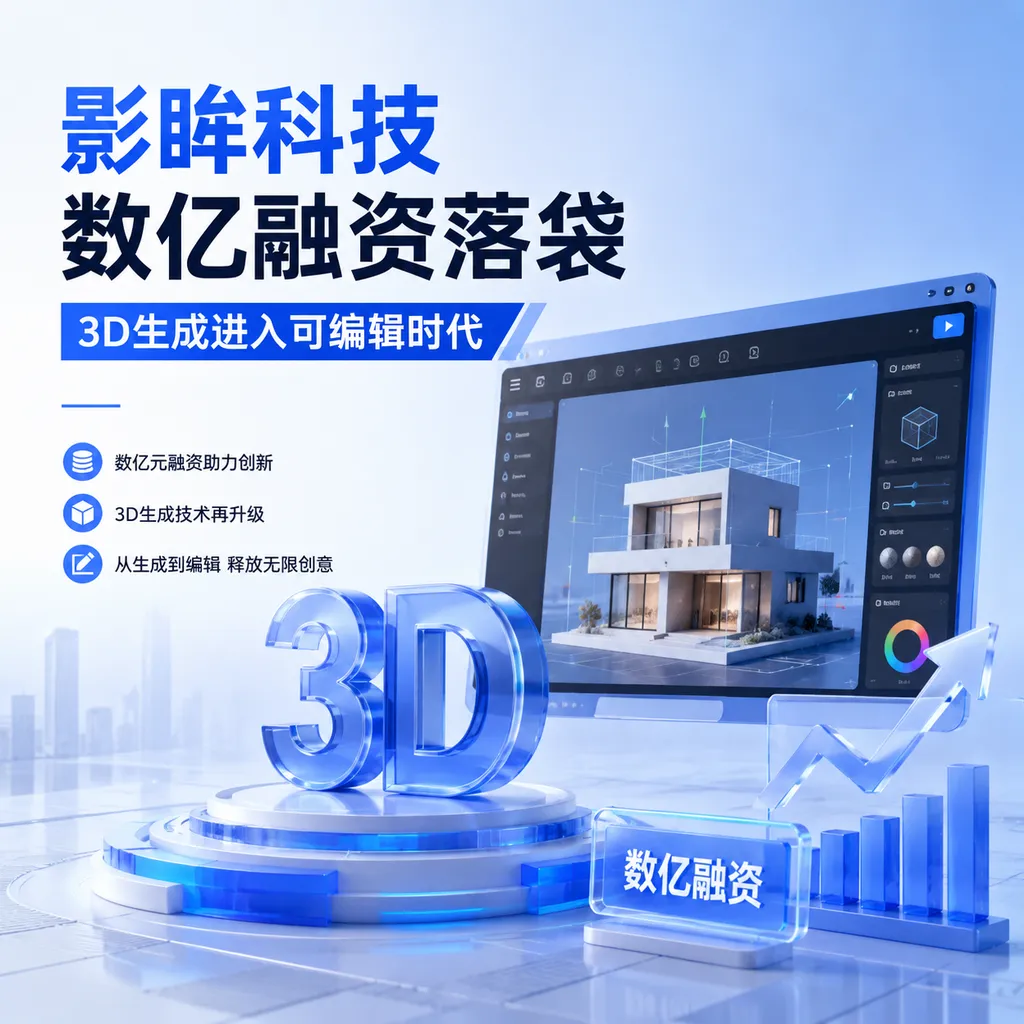
Yingmou Technology has completed a financing round worth hundreds of millions of RMB, led by Cathay Capital and Shanghai Guotou Xiandao, and simultaneously released the Rodin Gen-2.5 3D generation model capable of handling tens of millions of faces. Even more noteworthy is the Rodin Gen-2 Edit released in Q1 this year — marking the industry's first technological breakthrough that makes AI-generated 3D models truly editable.
Yingmou Technology Secures Hundreds of Millions in Financing, Ushering 3D Generation into the Editable Era
Yingmou Technology has just announced the completion of a new round of financing worth hundreds of millions of yuan, led by Cathay Capital and Shanghai State-owned Capital Venture Capital LP, with continued investment from existing shareholders. ByteDance, Meituan DragonBall, Sequoia, and BlueRun have previously bet on this company.
This is not an ordinary financing round. The 3D generation track in 2026 is currently in fierce competition—VAST officially announced new financing in June, and Meshy promptly followed with the so-called “world’s first 3D AI Agent.” Yingmou chose this moment to make its move, bringing a genuine technological leap: generation capabilities at the tens-of-millions polygon level, and Rodin Gen-2 Edit, which makes AI-generated 3D models editable for the very first time.
The “Uneditable” Predicament of 3D Generation
Over the past two years, progress in 3D generation models has been visible to the naked eye. From producing only blurry silhouettes in the earliest days, to now being able to output realistic-looking characters and objects. However, one problem has always stood in the way of commercialization: You can’t modify what’s generated.
That might sound counterintuitive. Didn’t image generation allow for partial redrawing long ago?
The complexity of 3D is on a whole different scale from 2D. An image is a two-dimensional arrangement of pixels; changing an area means modifying those pixels. But a 3D model is a composite of geometric structures, topology relationships, UV mapping, and texture maps. If you want to make a character’s arm thicker, it involves moving mesh vertices, re-dividing polygons, remapping texture coordinates, recalculating normals—tug one thread and the whole structure moves.
Even worse, most 3D generation models output some kind of intermediate representation—NeRF, 3D Gaussian Splatting, or SDF fields. These formats are friendly for rendering but extremely unfriendly for editing. You can’t just select a vertex and drag it like you can in Maya or Blender, because there aren’t any vertices in the traditional sense.
This creates an awkward situation: AI can generate a 3D model in seconds, but if there’s anything unsatisfactory about it, professional artists either have to regenerate and hope for the best, or start modeling from scratch by hand. AI generation becomes a gamble of “accept it all, or scrap it entirely.”
For e-commerce product displays or applications with lower precision requirements, this might still be acceptable. But for high-value markets like gaming, film, and industrial design, uneditable means unusable.
Rodin Gen-2 Edit: The First Natively Editable 3D Generation
In Q1 this year, Yingmou released Rodin Gen-2 Edit, enabling AI-generated 3D models to have true editability for the first time.
This isn’t as simple as tacking an editing module onto an existing model. Yingmou’s approach was to redesign from the ground up—their proposed CLAY architecture is a native 3D solution that defines the mainstream AI 3D generation paradigm in the industry. Simply put, CLAY considers future editing needs during generation, outputting structured, operable 3D assets instead of a lump of implicit representations requiring post-processing.
What exactly can you do?
Local Modifications Without Breaking the Whole
You can select part of a model and use textual descriptions to specify modifications. For example: “Make the backrest of this chair a hollow design” or “Add wings to this character.” The model understands spatial relationships and structural constraints, only modifying the relevant parts while preserving other areas intact.
The technical challenge here lies in the unification of semantic understanding and geometric constraints. The model needs to simultaneously understand what a “backrest” is, what “hollow” means as a geometric operation, and how to apply that operation without destroying the chair’s overall structure.
Style Transfer and Material Editing
After generating a base model, you can specify a style direction for global adjustments—from realistic to cartoonish, from low-poly to finely sculpted. Material-level editing is also supported: change the wood grain, add some weathering effects, adjust the roughness of metallic textures.
Maintaining Production Pipeline Compatibility
Edited models are output in standard formats (FBX, OBJ, GLTF, etc.) and can be directly imported into mainstream DCC software for further work. UV mapping, texture channels, and skeleton binding (if applicable) remain correct. This might seem like a fundamental requirement, but in the 3D generation field, only a handful can achieve this.
Rodin Gen-2.5: Tens-of-Millions Polygon Generation and the “Thinking” Paradigm
Alongside this financing round, Yingmou released Rodin Gen-2.5. If Gen-2 Edit solved the “Can it be modified?” question, Gen-2.5 addresses “How detailed can it be?”
Tens-of-Millions Polygons: A Leap in Precision
Previously, most 3D generation models output precision in the range of tens of thousands to hundreds of thousands of polygons. This suffices for distant objects in games or low-fidelity prototypes, but is far from enough for close-up characters, product-grade rendering, or 3D printing.
Rodin Gen-2.5 is the world’s first tens-of-millions polygon 3D generation model. It can generate a million-polygon model as fast as in 4 seconds, with full precision output requiring longer. Yingmou provides adjustable precision modes, allowing users to choose between speed and quality.
For example: a million-polygon character model can have facial details down to pores, wrinkles in finger joints, and stitching on clothing. This level of precision can be directly used for next-gen game character creation or high-end product marketing renders.
12K Native Textures: Goodbye to Blurry Maps
With geometric precision rising, texture precision must match. Gen-2.5 also introduces the world’s first 12K native 3D texture model.
The word “native” is key. Many 3D generation methods apply 2D super-resolution models to textures in the post-processing stage, which can cause mismatches between textures and geometry—for example, a character’s button is convex geometrically, but the highlight on the texture is misaligned. Native textures mean geometry and textures are coupled during generation, ensuring physical accuracy.
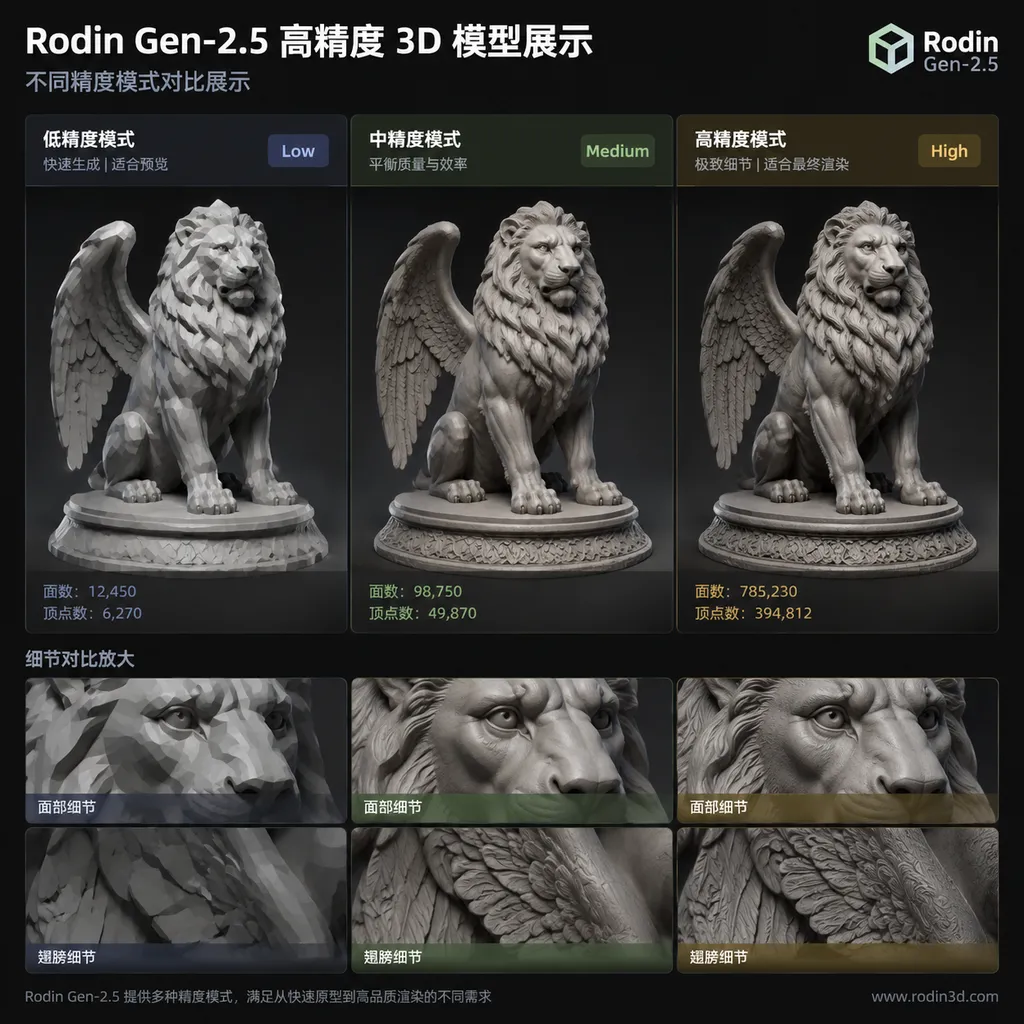
“Think Before You Generate”: The 3D Version of Reasoning-Time Scaling
Yingmou summarizes this generation paradigm as “bringing 3D generation into the thinking era.” This borrows from concepts in the large language model field but has a specific technical meaning in 3D generation.
Traditional 3D generation is a “direct mapping” process: input prompt, run through neural network layers, output 3D representation directly. It’s fast, but also “mindless”—the model doesn’t have explicit reasoning steps, doesn’t weigh multiple possible interpretations, and doesn’t check if its output meets constraints.
Gen-2.5 introduces reasoning-time computation. During generation, the model performs multi-step reasoning: first understanding the semantic input, then planning the geometric structure, refining it step by step, and continuously checking whether the generation matches expectations. This is akin to a human artist’s workflow—sketching first to set overall relationships, then gradually moving into details, rather than completing it in a single pass.
The benefits are stronger controllability and consistency. Understanding of complex prompts is more accurate, multi-view consistency is better, and structural errors (like mesh clipping or breakage) are reduced. The trade-off is longer reasoning time, but Yingmou’s precision modes let users decide.
A “Counter-Convention” AI Startup
Yingmou’s team composition is quite unconventional among AI startups.
Founder & CEO Wu Di, Co-founder & CTO Zhang Qixuan, and co-founders Zhang Longwen and Zeng Chuxiao all hail from ShanghaiTech University. Founded in 2020, the team has around 60 members with an average age under 25. Despite their youth, their academic credentials are impressive:
- Won SIGGRAPH Best Paper awards and nominations for consecutive years (SIGGRAPH is the top conference in computer graphics, and Best Papers are highly prestigious)
- Proposed the CLAY architecture, defining the mainstream AI 3D generation technical paradigm
- In the algorithm team, 1 out of every 2 members has won or been nominated for Best Paper
Can academic achievements translate into commercial success? Yingmou’s figures say yes.
B-Side: Number of Clients and Revenue Leading the Industry
Yingmou’s B-side clients include ByteDance, Unity, Figma, Canva, etc. According to 36Kr, their B-side client count and revenue exceed the sum of all other companies in the industry. Overseas revenue accounts for about 80% of total—this is a company that has been global from the start.
Main B-side scenarios include:
- E-commerce: Product 3D display, AR try-on
- Gaming: Bulk generation of characters and scene assets
- Industrial Design: Rapid prototyping, concept validation
- 3D Printing: High-precision models ready for printing
- Embodied AI: 3D scene synthesis for robot training
Business models include platform subscriptions, API sales, private deployment, and direct delivery of final assets. High flexibility allows them to adapt to clients of different sizes.
C-Side: Surpassing B-Side Revenue After Gen-2.5 Launch
Interestingly, after Rodin Gen-2.5 launched, C-side revenue is surpassing B-side. This shows that professional individual users—independent game developers, freelance 3D artists, design studios—have stronger willingness to pay for high-quality 3D generation than expected.
Yingmou’s C-side positioning is for “professional users” rather than mass consumers. They haven’t gone for “one-click 3D avatar” apps, instead prioritizing tool professionalism and controllability. This strategy fits the current stage—mass adoption of 3D generation still needs time, but professional users can already gain tangible productivity boosts from current capabilities.
Industry Landscape: The Technological Gap Widens
The 3D generation track entered a reshuffle in 2026.
The gap between the first and second tiers is becoming apparent. The judgment criterion is simple: Can what’s generated directly enter the production pipeline?
Companies that can achieve this see clients paying continuously because AI is genuinely lowering costs and raising efficiency. Companies that can’t achieve this remain at the “toy” stage—fun but impractical—and ultimately face the dilemma of customer acquisition costs exceeding LTV.
Yingmou’s editable capability is a critical watershed. It means AI generation can truly embed into professional workflows instead of being a standalone step outside them. Artists can use AI to generate an 80-point draft and then refine it to 100 points using professional software—this is what human-machine collaboration should look like.
Meshy, VAST, and other competitors are also iterating quickly, but current public information shows they still lag in editability and output precision. Naturally, this sector evolves rapidly, and it’s unclear how long any lead can last. Yingmou’s moat lies in the combination of academic accumulation and engineering capability—the CLAY architecture isn’t something that can be replicated overnight.
Technical Details: Why Native 3D Architecture Matters
A bit deeper into the technical layer.
Current mainstream 3D generation routes include:
-
2D Lifting: Generate multi-view images, then reconstruct 3D via MVS or NeRF. The problem is poor multi-view consistency, causing geometric errors during reconstruction.
-
Triplane + Decoder: Represent 3D with three orthogonal feature planes, then decode into a mesh. Efficient, but limited in expressiveness—details are easily lost.
-
3D Gaussian Splatting: Great render quality but outputs point clouds rather than meshes—poor editability and troublesome to export into traditional pipelines.
-
Native 3D Generation (e.g., CLAY): Generate directly in 3D space, outputting structured meshes.
Yingmou took the fourth route. CLAY’s core idea is to make the generation process aware of 3D structure, instead of treating 3D as a byproduct of 2D. Specific implementation involves 3D positional encoding, structured attention mechanisms, and mesh topology-specific loss functions.
This route is harder—scarcity of 3D data, computational complexity, and the discrete nature of mesh representation are all challenges. But the benefits are greater: outputs are directly usable, editability is ensured, and physical accuracy is better.
What to Watch Next
Yingmou hasn’t disclosed the exact amount for this financing round, only calling it “hundreds of millions.” With Cathay Capital and Shanghai State-owned Capital Venture Capital LP leading and existing shareholders following, it’s clear the primary and secondary markets still have confidence in the 3D generation track.
A few key things to watch:
-
Can C-side revenue continue to surpass B-side? If it can, it means the professional individual user market is bigger than expected, and Yingmou may adjust product strategy to increase C-side investment.
-
Deepening of editability capabilities. Gen-2 Edit is the first step, but current public info is limited. Whether it can support more complex edits (like topology modifications, animation binding adjustments) will determine the ceiling of this capability.
-
Landing in embodied AI scenarios. 3D scene synthesis is a necessity for robot training, and this market is booming. Whether Yingmou is laying groundwork in this direction is worth observing.
-
Model openness level. Currently, Yingmou’s models are mainly provided via API and platform, not open-source. If they choose to open some capabilities in the future, it could greatly impact the industry landscape.
3D generation is moving from “can generate” to “can be used.” Yingmou’s financing round and new model releases mark this track entering its second half.
No reference links in this article


