
Qualcomm's $4 Billion Acquisition of Modular: A Software Gamble Targeting Nvidia
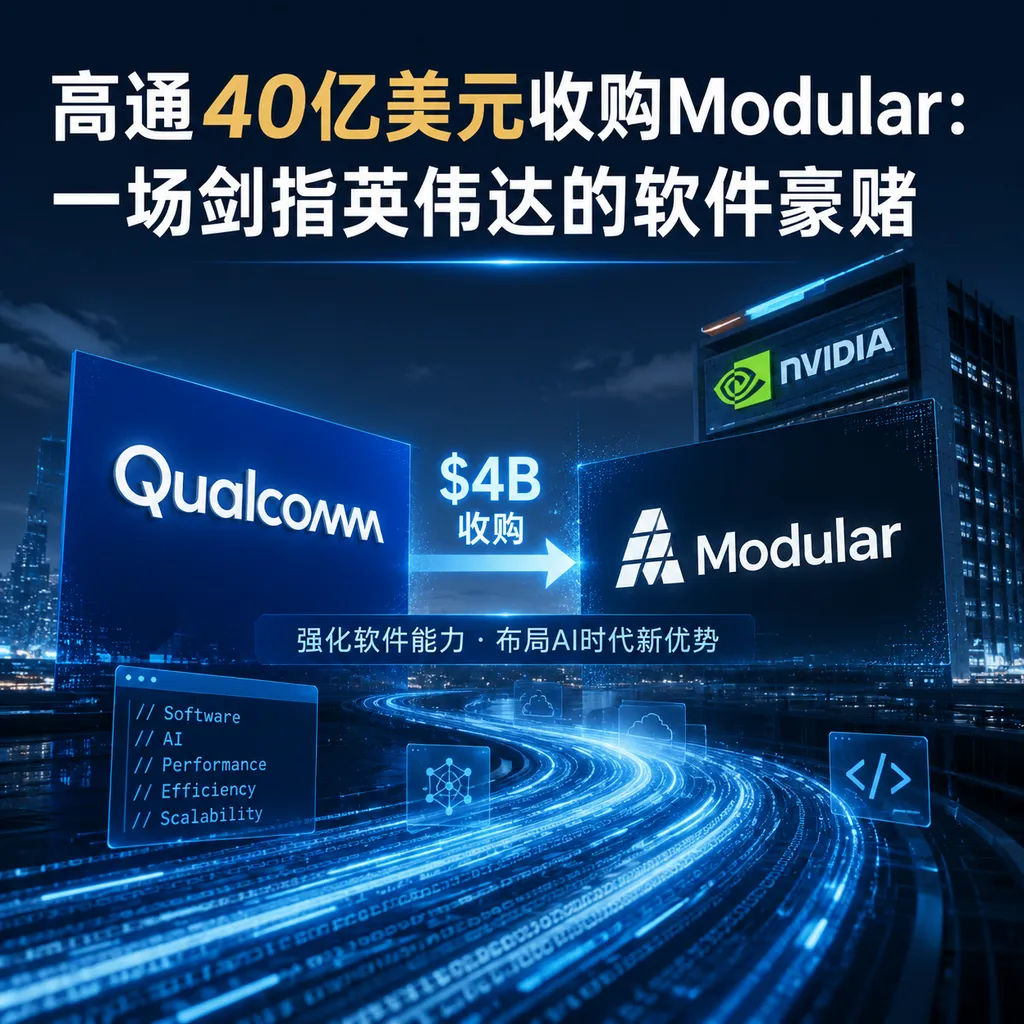
Qualcomm today announced the acquisition of AI software stack company Modular, with a valuation of around $4 billion, representing a 150% premium over its previous funding round. Founded by LLVM creator Chris Lattner, the company’s core value lies in breaking the CUDA monopoly—allowing one set of code to run across all AI chips.
Qualcomm’s $4 Billion Acquisition of Modular: A Software Bet Aimed at Nvidia
Qualcomm officially announced today a major acquisition: about $4 billion to acquire AI software stack company Modular. The deal is expected to close in the second half of 2026.
This is not a chip company. Modular focuses on software infrastructure that enables AI models to run efficiently on any hardware — in plain terms, it aims to break the monopoly of Nvidia’s CUDA ecosystem.
What is the $4 Billion Buying?
Modular was founded in 2022 by two heavyweight founders:
- Chris Lattner: Inventor of the LLVM compiler architecture and the Swift language, former engineering executive at Apple, Tesla, and Google
- Tim Davis: Former core member of Google TensorFlow
The company completed a $250 million funding round last September, valued at $1.6 billion. In less than a year, Qualcomm’s offer bumped the price up by 1.5x.
Paying a 150% premium for a software company — what exactly does Qualcomm see in it?
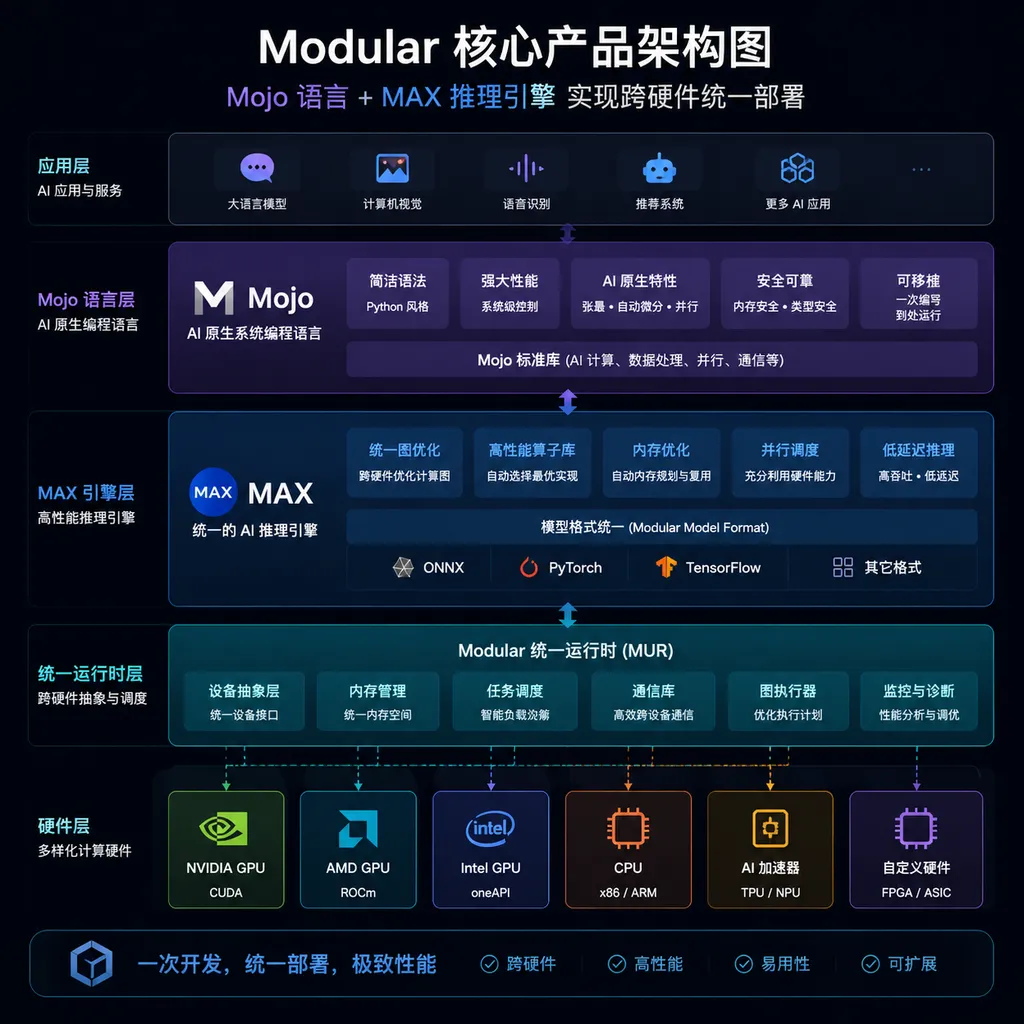
Modular’s Core Weapons: Mojo + MAX
Anyone doing AI development knows this pain point: A model runs perfectly on Nvidia GPUs, but when switched to AMD or other accelerators, performance can drop by half. The reason is simple — CUDA is Nvidia’s proprietary ecosystem, and other vendors can only watch from the sidelines.
Modular’s solution rebuilds from the ground up:
Mojo Language
A programming language purpose-built for AI, with Python-compatible syntax (virtually zero learning cost) but tens of thousands of times faster than pure Python. It doesn’t compile to any specific hardware, but generates intermediate code that can run efficiently on any AI accelerator.
MAX Inference Engine
A complete model deployment platform. Developers only need to build once to deploy models to Nvidia GPUs, AMD GPUs, Qualcomm AI accelerators, and even regular CPUs — without rewriting optimization code for each hardware type.
The value of this combo is that it decouples the AI software stack from hardware.
Think of it like this: If Nvidia’s CUDA is iOS — closed but with top-notch experience — Modular wants to be Android — open, cross-platform, giving hardware vendors a fighting chance.
Qualcomm’s Strategy: Filling the Last Missing Piece
Qualcomm has been aggressively expanding in AI over the past two years.
On devices, the Snapdragon platform’s NPU is already established in smartphones and PCs, capable of running local large models. In the cloud, the AI200 and AI250 data center inference chips to be released in 2025 are on the way, expected to be commercially deployed in 2026 and 2027 respectively.
But there’s a fatal shortcoming: software ecosystem.
No matter how powerful the hardware, if developers don’t want to adapt to it, it’s just scrap metal. Nvidia’s moat has never been about chip performance alone — it’s about the CUDA ecosystem built up over more than a decade. Global AI developers use its toolchain, and all mainstream frameworks are deeply optimized for it.
If Qualcomm wants to grab a share of the data center market, building its software ecosystem from scratch would take at least five to ten years. Acquiring Modular provides a shortcut.
Bernstein analyst Stacy Rasgon summed it up well: “Acquiring Modular will accelerate Qualcomm’s AI roadmap by several years.”
Specifically, this deal offers Qualcomm three distinct benefits:
1. A Ready-Made Cross-Platform Inference Software Stack
The MAX engine can be directly paired with Qualcomm’s self-developed AI accelerator hardware. Cloud providers and enterprise clients won’t have to worry about being locked into one chip vendor, greatly reducing deployment costs.
2. Differentiated Competitive Capability
Nvidia sells an integrated “chip + CUDA” package, while AMD has been chasing ROCm with a noticeable gap. Qualcomm now has a new card to play: an open, cross-hardware AI deployment platform. For clients who don’t want to be locked in by Nvidia, this is an attractive option.
3. Synergy With Potential Acquisition Targets
Earlier this month, market rumors suggested Qualcomm is negotiating to acquire Tenstorrent, a company founded by chip legend Jim Keller, making AI training and inference chips based on RISC-V architecture.
If both deals happen, Qualcomm would own:
- Tenstorrent’s high-performance AI chip hardware
- Modular’s cross-platform software stack
- Its own Snapdragon device-side AI capabilities
From milliwatt-level wearable devices to kilowatt-level data center servers — full scenario coverage. This combination could be serious enough for Nvidia to take notice.
Industry View: The Software War in the Era of Heterogeneous Computing
The backdrop to this acquisition is a structural shift sweeping the AI industry: hardware is diversifying, and software’s value is rising.
Two years ago, Nvidia almost completely dominated the AI compute market. But now:
- AMD’s MI300 series is securing orders from cloud providers
- Google’s TPU keeps iterating
- Amazon has its own Trainium chips
- AI accelerator startups are popping up everywhere
- Even Intel is struggling to survive with its Gaudi series
More hardware choices lead to an explosion in software fragmentation. Every chip vendor has its own toolchain and optimization stack, forcing developers to either pick sides or spend a lot of effort on multi-platform adaptation.
Modular is targeting precisely this pain point. Its vision: regardless of what chips are underneath, developers write just one set of code on top.
This vision sounds great, but whether it can be realized depends on several key factors:
Can performance compete?
Cross-platform often means performance compromises. Modular claims the MAX engine has “industry-leading performance,” but how it actually compares to Nvidia’s native TensorRT still needs more real-world data. If the performance gap exceeds 20%, most customers will stick with CUDA.
Can the ecosystem grow?
Even though Mojo’s syntax is compatible with Python, it’s still a new language. Whether developers are willing to migrate, and if frameworks and libraries can catch up, remain open questions.
Can the business model work?
Modular’s previous clients were mainly companies wanting to ditch CUDA dependency. After being acquired by Qualcomm, will other chip vendors still want to use Modular’s products? This touches on subtle coopetition dynamics.
What Developers Should Watch
If you’re an AI developer, this deal won’t affect your daily work in the short term. But in the medium-to-long term, several trends are worth noting:
Multi-Hardware Deployment Will Become More Common
As AI applications spread from the cloud to the edge, scenarios where the same model must run on different hardware will become increasingly common. Getting familiar with cross-platform deployment tools (not just Modular — also ONNX Runtime, Apache TVM, etc.) will be a plus.
Edge-Side Inference is Rising in Importance
Qualcomm stressed this acquisition helps customers “migrate AI from edge to cloud.” Notice the phrasing — from edge to cloud, not cloud to edge. This implies Qualcomm believes the starting point for AI computation will be in edge devices, with the cloud serving more for coordination and expansion.
The Software Stack May Reshuffle
If Modular scales seriously under Qualcomm’s backing, the AI software toolchain landscape could change. One possible scenario: Mojo becomes the de facto standard for cross-platform AI development, like JavaScript in web development. Of course, this will require time to verify.
A Bigger Game Plan
Zooming out, Qualcomm’s moves (acquiring Modular, possibly acquiring Tenstorrent) reflect a broader strategic transformation: from a mobile chip company to a full-stack AI computing company.
Growth in the smartphone market is slowing — a fact. Over half of Qualcomm’s revenue still comes from phones, but the ceiling is clear. Data centers, automotive, IoT, PCs — Qualcomm is expanding in all these areas, with AI as the key capability running across them.
Success in this transformation hinges on whether Qualcomm can crack the software ecosystem. Hardware alone is useless if no one uses it.
Acquiring Modular is an important step in this chess game. Is paying $4 billion for a shot at breaking CUDA’s monopoly expensive? Opinions vary. But at the very least, Qualcomm now has a compelling story to tell.
Some Numbers About the Deal
| Item | Data | |------|------| | Acquisition Price | About $4 billion | | Modular’s Last Valuation | $1.6 billion (September 2025) | | Valuation Premium | About 150% | | Modular Total Funding | $380 million | | Estimated Closing Time | Second half of 2026 | | Conditions to Close | Regulatory approval and customary closing conditions |
Follow-Up Events to Watch
- June 30, Keysight World Tech Day 2026: Qualcomm executives may further explain their AI infrastructure strategy at the event
- Second half of 2026: Deal closes — watch for integration progress between Modular’s products and Qualcomm’s chips
- Tenstorrent acquisition talks: If both deals close, Qualcomm’s full-stack AI layout will be basically complete
For developers concerned with AI model deployment, whether or not you end up using Modular’s tools, cross-hardware deployment capabilities are becoming increasingly important. The era of CUDA’s dominance may be loosening — and that’s a good thing for the entire industry.
References
- ITHome - Qualcomm Announces Acquisition of AI Software Stack Company Modular: First report of Qualcomm’s official acquisition announcement, including transaction timeline and statements from both sides


