
OpenAI Launches Self-Developed Chip "Jalapeño" to Take Back Computing Power Pricing from NVIDIA
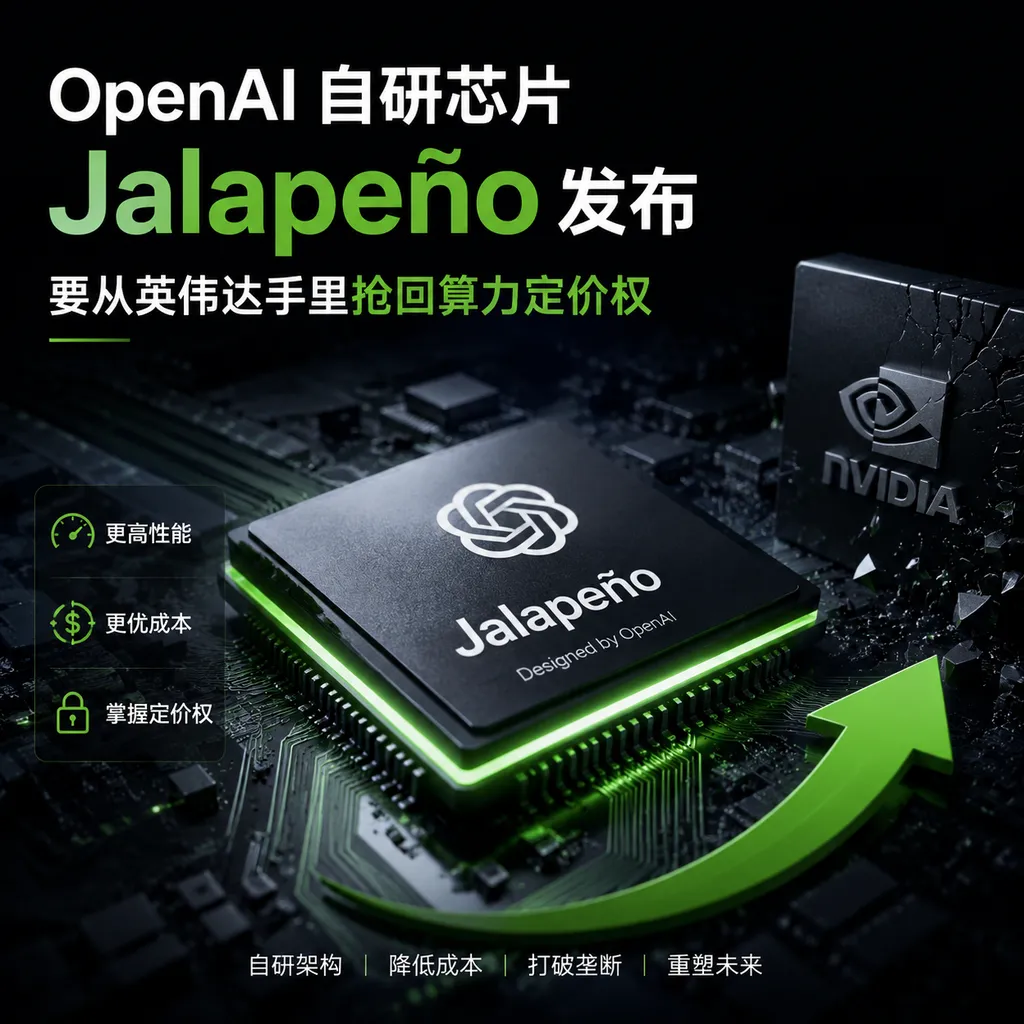
OpenAI has released its first self-developed AI inference chip, Jalapeño, designed in collaboration with Broadcom and optimized specifically for LLM inference. It took only 9 months from design to tape-out, and deployment is planned for the end of 2026, aiming to break NVIDIA’s monopoly on AI computing power.
OpenAI Releases Self-Developed Chip Jalapeño to Take Back Compute Pricing Power from Nvidia
Today, OpenAI officially announced its first chip: Jalapeño.
This chip is designed solely for inference—not training—which means it powers the computations for ChatGPT answering your questions, Codex writing your code, and the API responding to developer requests. According to OpenAI, Jalapeño was designed from scratch, not simply by tweaking parameters on a general-purpose AI accelerator, but by building an architecture entirely around the inference needs of modern LLMs.
Its partner is Broadcom, one of Silicon Valley’s oldest and most established chip manufacturing giants. Judging by the official timeline, it took only nine months from initiating the design to tape-out. OpenAI specifically pointed out that part of the design process was accelerated using its own models.
Engineering samples are already running in the lab, with test workloads including GPT-5.3-Codex-Spark. Preliminary data shows Jalapeño’s performance per watt is significantly better than the current state-of-the-art solution—OpenAI did not name names, but everyone knows this refers to Nvidia’s H100/H200.
Deployment is planned for the end of 2026, at a “gigawatt-scale.”
Why Does OpenAI Want to Make Its Own Chips?
The answer is simple: money.
Inference cost is the crux of OpenAI’s commercialization. Training a large model is a one-time investment, but inference is a continuous expense—every conversation from every user, every API request, every Codex task burns compute. ChatGPT’s daily active users surpassed 100 million long ago, and peak concurrency is astronomical.
Nvidia has more than 80% market share in AI chips, with full control over pricing. A single H100 card sells for $30,000 and is often out of stock. OpenAI, Microsoft, Google, and Meta—the big customers—are essentially working for Nvidia.
The logic of self-developing chips is simple: keep compute costs under your own control.
And OpenAI isn’t alone. Google has TPU, Amazon has Trainium and Inferentia, and Meta is developing its own MTIA. But OpenAI’s situation is unique—it has no cloud business to offset hardware costs, so compute expenses hit the profit sheet directly.
Moreover, OpenAI understands its model architectures best. General-purpose GPUs are designed for many workloads; in the specific scenario of LLM inference, there’s room for optimization. Jalapeño’s design is meant to capture that opportunity.
What Exactly Has Jalapeño Optimized?
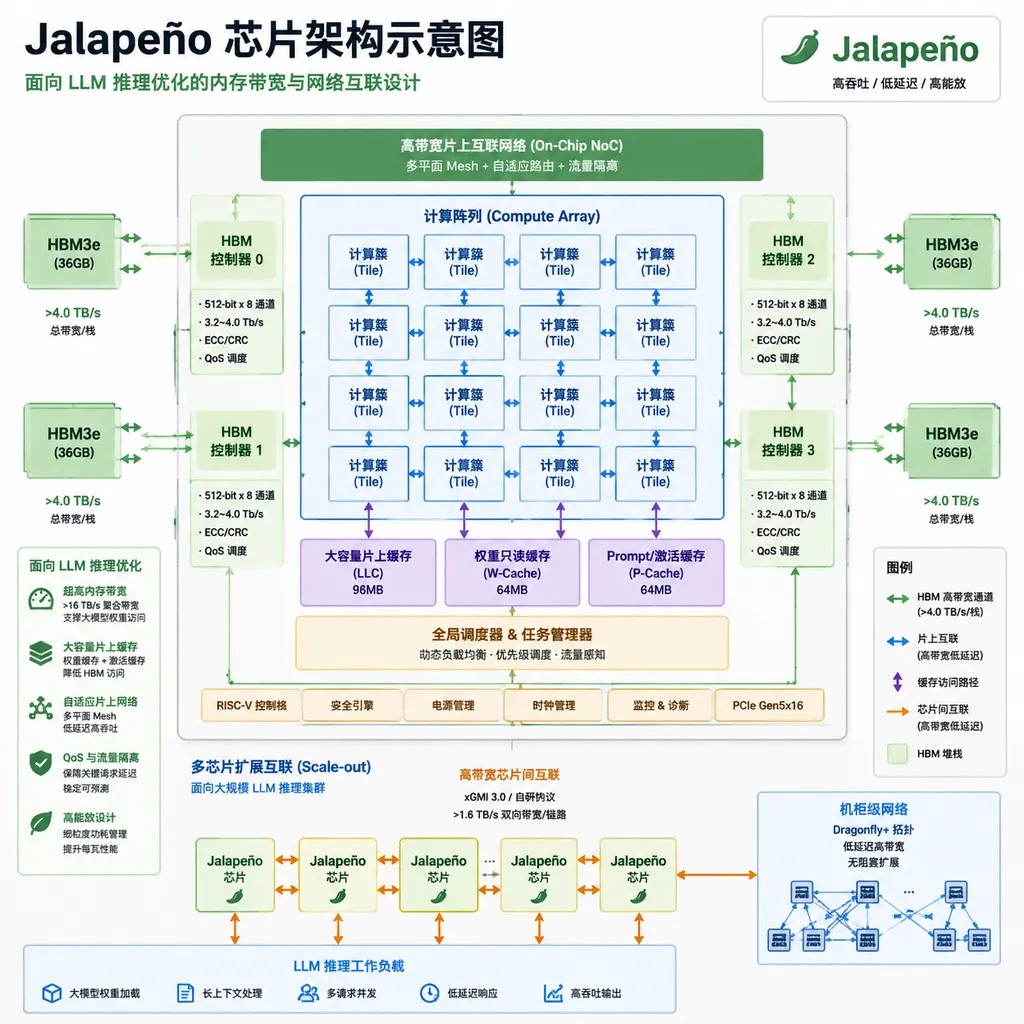
Official details are limited, but from public technical descriptions, Jalapeño focuses mainly on the following directions:
1. Memory Bandwidth
LLM inference is a classic memory bandwidth-limited task. For each generated token, the model must read huge weight matrices from memory. For a GPT-4-level model, parameters number in the hundreds of billions, and each forward pass moves massive amounts of data. GPU compute units often sit idle waiting for data, leading to low utilization.
Solutions typically go two ways: either stack larger memory bandwidth (expensive) or optimize memory access patterns for more efficient data movement (difficult). Jalapeño likely tackles both.
2. Sparse Computation
Modern LLMs increasingly adopt Mixture of Experts (MoE) architectures—GPT-4 is widely speculated to be MoE-based. The key feature of MoE is activating only some expert networks per inference, making computation sparse. General-purpose GPUs don’t handle sparse computation well, leaving many compute units underutilized.
A dedicated chip can optimize for this sparse pattern at the hardware level, making idle transistors productive.
3. Long Context Support
128K or even longer context windows are now mainstream. Long context means KV Cache grows large, greatly increasing memory pressure. Efficiently managing KV Cache and distributing long sequences across multiple cards is an engineering challenge.
The general approach is using frameworks like vLLM for PagedAttention, but if hardware natively supports such access patterns, efficiency is higher.
4. Network Interconnect
Large-scale inference clusters require multi-card or even multi-machine cooperation. Inter-card and inter-machine bandwidth and latency directly affect overall throughput. Broadcom has deep expertise in high-speed networking chips, and Jalapeño integrates closely with Broadcom network tech.
The official announcement also mentioned Celestica’s board and rack systems. This means OpenAI isn’t just building a chip—it’s building complete inference infrastructure.
Nine Months from Design to Tape-Out—How Did They Do It?
Traditionally, the chip industry moves at a 2–3 year per-generation pace. Nine months to tape-out is indeed fast.
OpenAI says part of the process was accelerated using its own models. This is not an empty boast—many steps in the EDA (Electronic Design Automation) toolchain can be AI-optimized:
- Layout and routing: Deciding how billions of transistors are placed and connected is a combinatorial optimization problem. Traditionally, heuristic algorithms are used; AI can learn from past designs to speed up search.
- Timing analysis: Ensuring signals meet clock constraints during chip transmission. AI can predict potential timing violations, reducing iterations.
- Power optimization: AI can predict power hotspots early in design, guiding architecture adjustments.
Google published a paper in 2021 showing reinforcement learning outperforming human engineers for chip layout. With OpenAI’s powerful LLMs, it’s unsurprising they gained advantages in EDA.
However, nine months is only tape-out; mass production is still far off. Chips must be tested and verified after returning from fabrication, and revisions may be needed. Targeting end-of-2026 deployment makes the timeline quite tight.
How Big an Impact on Nvidia?
In the short term, limited.
Jalapeño is an inference chip, not a training chip. Large model training still relies on Nvidia’s H100/H200/B100. Moreover, Jalapeño is for OpenAI’s own use, not for sale. Nvidia’s other customers—cloud providers, enterprises, research institutions—will still need its cards.
But long term, it’s a signal.
The trend toward AI companies self-developing chips is clear. Google’s TPU is already in its fifth generation and runs well on Google Cloud. Amazon’s Trainium 2 is rolling out at scale. Meta’s MTIA is still early, but the direction is obvious.
These players share one trait: they are the designers of AI models and know their workloads best. General-purpose GPUs must cater to gaming, scientific computing, AI training, AI inference, and more. They can’t be optimal for every scenario. Self-developed chips can allocate all transistor budgets to where they matter most.
Nvidia’s moat is its CUDA ecosystem. Over the past decade, all AI frameworks, operator libraries, and optimization tools have been built around CUDA. Switching platforms is costly.
But companies like OpenAI, Google, Meta can write their own low-level software stack. They don’t need CUDA, or even general PyTorch/TensorFlow. They can build dedicated inference engines for their models, potentially achieving higher efficiency.
Jensen Huang clearly sees this trend. Nvidia recently has been emphasizing software, cloud services, and full-stack AI capability. Purely selling hardware is becoming less defensible.
What Does This Mean for Developers?
If you’re a developer calling GPT or Codex via the OpenAI API, Jalapeño’s deployment could bring several changes:
1. Faster Response
Inference chip efficiency improvements could reduce Time to First Token and increase generation speed. Peak queue times might shorten.
2. Potentially Lower Costs
If OpenAI’s compute costs drop, they could lower prices—though this depends on their business strategy. They might instead keep prices stable but improve service quality.
3. Longer Contexts, More Complex Tasks
With better hardware, model capability ceilings rise—support for longer context windows and more complex agent tasks, larger code execution, and analysis of bigger codebases in Codex could be possible.
4. More Stable API Availability
Self-developed chips give OpenAI better control over supply chains—no worries about Nvidia shortages or fighting for capacity. Service stability is better assured.
Of course, these changes would be post-2026. Jalapeño just taped out; mass deployment is still ahead. For now, developers can stick to using the current API while OpenAI upgrades infrastructure.
The Ambition of a Full-Stack AI Company
Looking back at OpenAI’s past two years:
- Model layer: Continuous iterations of GPT-4, GPT-4o, and GPT-5 series
- Product layer: ChatGPT, Codex, Sora, various Agent products
- Platform layer: API, plugin ecosystem, GPT Store
- Infrastructure layer: Self-built data centers, self-developed chips
This is the blueprint of a full-stack AI company.
It’s very different from early OpenAI’s “research institute” positioning. Sam Altman’s ambition is to make OpenAI an infrastructure provider for the AI era—owning models, products, and compute.
The path resembles Apple’s—starting with software (macOS, iOS), then building hardware (iPhone, Mac), then self-developing chips (M series, A series). Full-stack integration lets each layer optimize the others for maximum efficiency.
But this also means heavier assets, larger capital investment, and longer return cycles. OpenAI’s latest funding rounds have valued it at over $300 billion—a valuation supported by sustained revenue growth and expanding market share.
Self-developed chips are an important part of this growth story. Controlling compute cost helps control gross margin; controlling gross margin supports high valuation.
In Closing
The name Jalapeño is interesting—a small but spicy Mexican chili. OpenAI’s meaning seems to be: although this is a first-generation chip, it can bring a “spicy” boost to inference performance.
I’m curious what future generations will be called. Following this style—Ghost Pepper? Carolina Reaper?
Jokes aside, Jalapeño’s launch is indeed a significant milestone in the AI industry. It marks leading AI companies moving from a “model arms race” to an “infrastructure arms race.”
Model capability competition is plateauing. GPT-4-level models are achievable by mainstream players. The next competitive focus is: who can deliver models of equal capability at lower cost, faster speed, and more stable service to users.
This requires effort in chips, networks, and data centers. Jalapeño is OpenAI’s first step in that direction.
For developers using the OpenAI API, the good news is OpenAI Hub will continue to track these changes. Regardless of the chips underlying OpenAI, API interfaces remain stable—your code doesn’t need changes, and you automatically benefit from performance boosts.
References
- OpenAI releases first self-developed AI chip Jalapeño for ChatGPT, Codex, and API inference - Linux.do community summary of OpenAI’s official announcement, including key technical specs and deployment timeline.
- OpenAI releases first self-developed LLM inference chip Jalapeño?? - Linux.do community discussion with analysis of OpenAI’s “full-stack AI company” strategy.


