
Jensen Huang: The Era of AI Factories Has Arrived
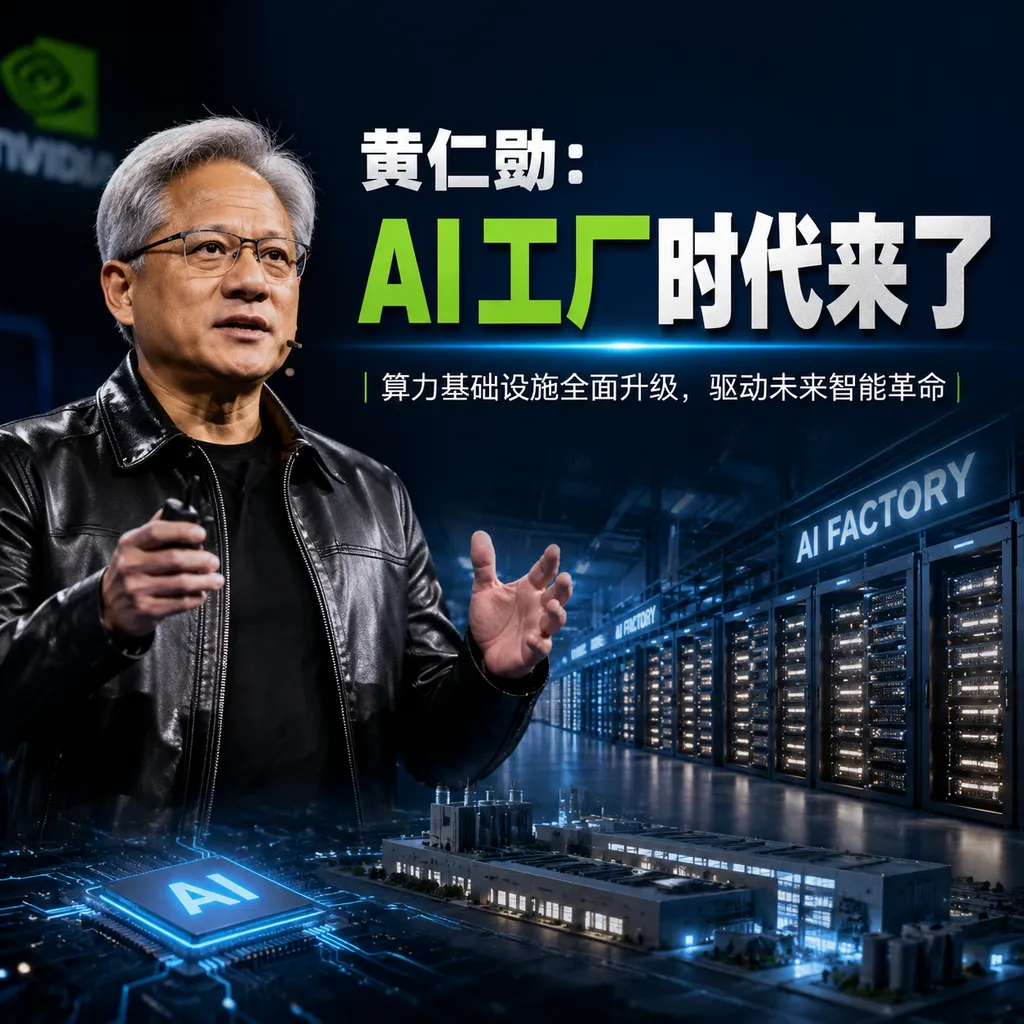
NVIDIA CEO Jensen Huang announced at the shareholders' meeting that the era of intelligent agents has officially arrived, defining it as the greatest computing paradigm shift in 60 years. Data centers are shifting from storing files to producing tokens, and NVIDIA has launched the Vera CPU specifically designed for intelligent agents, warning that smuggling chips to cobble together data centers is "a dead end."
Jensen Huang: The Era of AI Factories Has Arrived
At yesterday’s NVIDIA annual shareholders meeting, Jensen Huang made a bold statement: the era of intelligent agents has officially begun — the largest industry reset in 60 years.
This is not empty talk. He backed it up with data — GitHub pull requests rose from 400 million in 2024 to 500 million in 2025, and in the first few months of this year nearly tripled again. Code is being produced at unprecedented speed, and those behind it are no longer just human programmers.
Data Centers Have Changed: No Longer Storing Files, Now Producing Tokens
Huang put forth a core idea: the era of traditional data centers storing and transmitting files is over; the core function of new data centers is to produce tokens.
This transformation merits deeper discussion.
In the past two decades, the business model for data centers was straightforward — you paid based on how much data you stored, the bandwidth you used, and the cabinets you rented. But the logic of the AI era is completely different. Businesses purchase compute power not to store things, but to make machines “think” things. Every token generated is value creation — it could be a piece of code, a report, a design, or an intelligent agent capable of executing tasks autonomously.
Huang has named this new type of data center the “AI Factory.” The factory’s key metrics are no longer storage capacity or network bandwidth, but how many tokens can be produced per watt, and how low the cost per token is.
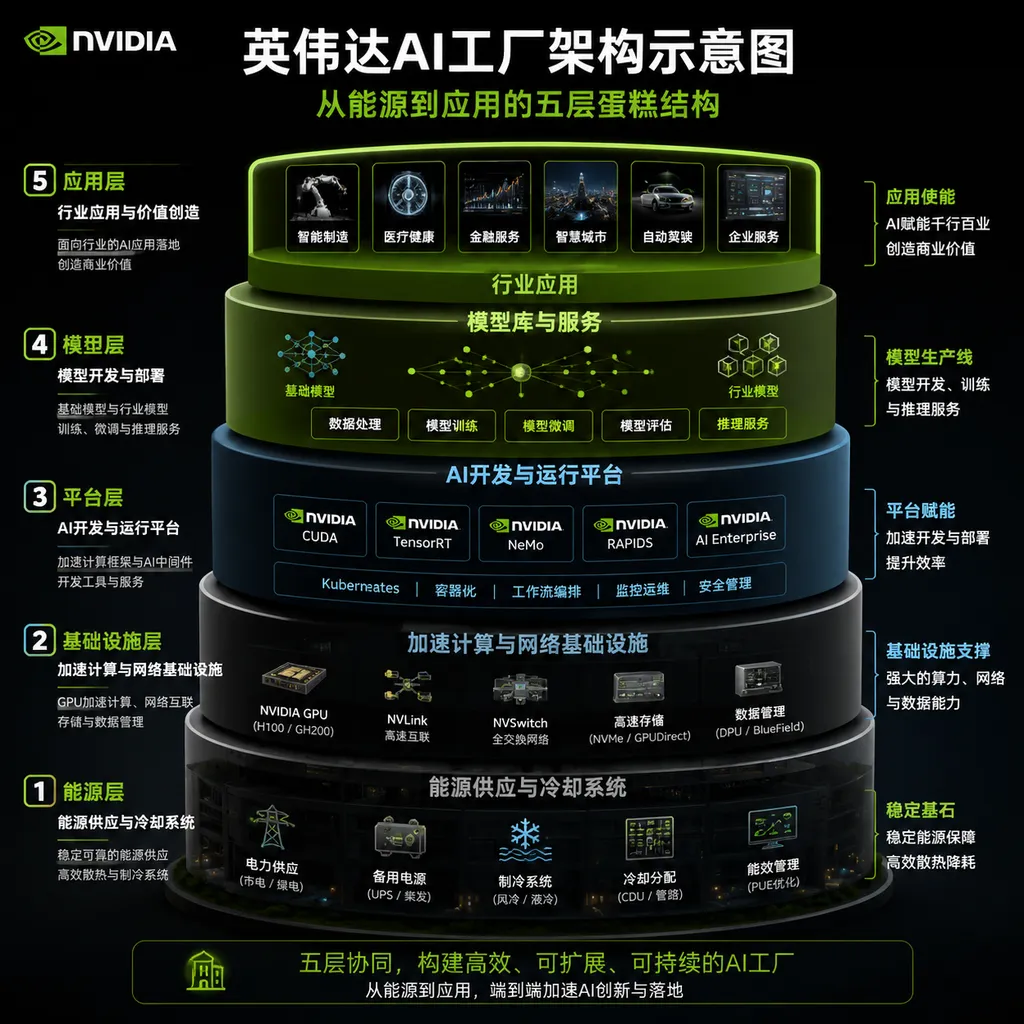
He used a “five-layer cake” to describe the AI industry ecosystem:
- Bottom layer: Energy — AI factories are heavy consumers of power, and electricity costs directly determine operational efficiency
- Second layer: Chips & systems — Coordination between GPU, CPU, and networking equipment
- Third layer: Infrastructure — Overall architecture and operations of the data center
- Fourth layer: Models — Foundational large models and vertical domain models
- Top layer: Applications — Intelligent agents and AI services that directly create business value
This framework reveals NVIDIA’s ambition: it doesn’t just want to sell chips, it aims to capture the entire AI production chain.
Blackwell’s Strength: 30× Higher Inference Throughput Than Second Place
At the shareholders meeting, Huang cited Semi Analysis Inference X benchmark results: the Blackwell platform was dubbed “Inference King,” with token throughput 30 times higher than the next-best platform.
What does 30× mean?
Imagine running an intelligent agent application on a competitor’s chip that can handle 100 concurrent requests per second; with Blackwell, in theory, you could handle 3,000. For AI service providers charging by token, this directly translates into an orders-of-magnitude difference in revenue capacity.
More importantly, the client roster is changing. Huang named companies including Capital One (finance), Hyundai Motor (manufacturing), Jane Street (quantitative trading), and Eli Lilly (pharmaceuticals). This means AI factory customers have expanded beyond hyperscale cloud providers like AWS, Azure, and Google Cloud to include traditional industry giants.
Banks want AI for risk control and customer service, automakers want AI for autonomous driving and smart cabins, and pharma companies want AI to accelerate drug discovery — these needs have shifted from “nice to have” to “existential.”
Vera CPU: A Processor Designed Specifically for Intelligent Agents
One of the most interesting parts of the shareholders meeting was Huang’s positioning of the Vera Rubin platform. He called it “one of the most important product launches in NVIDIA’s history.”
Why? Because the Vera CPU is not designed for humans, but specifically for intelligent agents.
This distinction matters.
All past CPU designs were based on the assumption that the user is human. Human reaction times are measured in milliseconds, so CPUs can be partitioned by core count for rental, with multitasking handled in parallel. Intelligent agents are different — they “live” in a nanosecond-level computational world.
When an intelligent agent needs to call tools, access databases, execute code, and iteratively refine tasks, any delay in the chain causes ripple effects. If the CPU becomes the bottleneck, expensive GPUs sit idle. Every second of idle time means lost revenue for the AI factory.
Huang’s words: intelligent agents do not demand core quantity, but have an extreme requirement for ultra-low-latency response.
This explains why NVIDIA had to build a CPU from scratch. Market x86 and Arm processors are tuned for humans; no one had designed an architecture for the working patterns of intelligent agents. Vera CPU fills this gap — according to Huang, it is 1.8× faster than x86 processors.
The bigger picture: with global intelligent agent numbers reaching into the billions, this is an entirely new CPU market. NVIDIA doesn’t want to leave this pie to Intel or AMD.
CUDA Ecosystem: NVIDIA’s “Crown Jewel”
Huang called the CUDA X library ecosystem NVIDIA’s “crown jewel.”
This is not an exaggeration.
There’s a harsh truth in the chip industry: no matter how powerful the hardware, without a software ecosystem it’s scrap metal. AMD’s GPUs match NVIDIA in many scenarios, but market share disparity remains vast — the core reason being CUDA’s ecosystem moat.
Huang explained NVIDIA’s flywheel effect:
- Unified architecture builds a massive installed base
- Installed base attracts developers
- Developers create breakthrough applications
- Applications open new markets
- New markets further expand the installed base
This loop has been running for over a decade, and CUDA now supports over 7,000 applications. For NVIDIA’s challengers, the barrier is not any single chip’s performance, but the network effect of the entire ecosystem.
More noteworthy is CUDA’s direction of evolution. Huang announced BioNeMo — a digital biology and drug discovery toolkit designed specifically for intelligent agents. This marks CUDA X’s shift from tools for human developers to a toolbox for intelligent agents.
In other words, the future coder may not be a human calling CUDA, but an intelligent agent calling it. NVIDIA is preparing for that scenario.
Smuggling Chips? “A Dead End”
Huang unusually addressed chip smuggling publicly at the meeting, with strong wording: trying to cobble together a data center with a small number of smuggled products is “a dead end.”
The context is U.S. export restrictions on chips to China. Some companies tried to obtain restricted chips through gray channels to build their own AI infrastructure. Huang outright dismissed that route’s feasibility.
His logic: advanced AI data centers are not simple pile-ups of scattered hardware. In real-world deployment, you need trusted hardware, software, networking, and continuous support, integrated into large-scale unified systems. NVIDIA provides no support or repair services for restricted products.
Translation: even if you get the chips, without official support the system won’t run; if it runs, no one repairs problems; if repaired, new software versions won’t be compatible. This becomes a bottomless pit of burning money without output.
On China market issues, Huang was cautious. He revealed that the U.S. government had approved export licenses for H200 chips to Chinese customers, but NVIDIA has yet to generate any related revenue, and uncertainty remains over whether products will be smoothly imported.
He reiterated his stance: when there is a conflict between commercial interest and U.S. national security, national security comes first.
Physical AI: The Next Growth Engine
Beyond intelligent agent AI, Huang devoted significant time to Physical AI.
Physical AI refers to AI with a physical form that can perceive and act in the real world — also called Embodied AI. Simply put, robots, autonomous vehicles, and industrial automation systems — AI that can “move.”
Huang stated that more businesses are deploying Physical AI, which will be NVIDIA’s next growth opportunity.
This assessment is backed by data. Since early this year, humanoid robot sector funding has risen, with companies like Tesla Optimus, Figure, and 1X making notable progress. In autonomous driving, although Robotaxi commercialization is slower than expected, technical routes are steadily converging.
For NVIDIA, Physical AI means new chip demand — robots need edge inference chips, autonomous driving needs in-vehicle computing platforms, industrial automation needs edge AI devices. These scenarios have real-time, power, and reliability requirements completely different from cloud data centers, requiring dedicated product lines.
NVIDIA is already positioned. Jetson series targets robotics and edge AI, DRIVE series targets autonomous driving, and Isaac platform offers robotics development frameworks. If Physical AI takes off, NVIDIA will be the most prepared.
Financial Data: $96 Billion in Free Cash Flow
Finally, the numbers.
Huang disclosed that NVIDIA’s revenue grew 65% in the past year, with operating profit up 60%. Fiscal year 2026 free cash flow exceeded $96 billion. He reaffirmed that in coming years the company plans to return 50% of free cash flow to investors via stock buybacks and dividends.
What’s $96 billion? That figure exceeds the market capitalization of most tech companies. NVIDIA is not just making money, it is accumulating cash at an almost insane pace.
But stock performance has been less stellar. Boosted by AI demand, NVIDIA stock soared over 240% in 2024, rose more than 50% in 2025, but so far this year has only gained 6.7%, underperforming the S&P 500’s 7.5% rise.
What is the market worrying about?
The focus has shifted from short-term results to how long the AI infrastructure investment cycle can last. Cloud giants and enterprise clients have already poured massive funds into AI — will these investments translate into tangible returns? If AI application commercialization falls short, could compute demand plateau?
Huang’s answer: the question of AI investment returns “already has an answer.” When AI output can directly create value, running NVIDIA systems to generate tokens is inherently profitable. The explosive rise in GitHub pull requests is proof AI is already creating real value.
What This Means for Developers
From the meeting’s information, several trends are worth developers’ attention:
Intelligent agent development will become mainstream. Huang repeatedly emphasized the arrival of the intelligent agent era, signaling the paradigm shift from “calling an API for an answer” to “building systems that execute tasks autonomously.” Mastering intelligent agent frameworks (LangChain, AutoGen, CrewAI, etc.) will be increasingly important.
Inference optimization matters more than training. When the AI factory’s core metric is token production efficiency, optimizing inference becomes critical. Techniques like quantization, pruning, KV Cache optimization, and speculative decoding will grow in demand.
Edge–cloud synergy is the future. NVIDIA’s RTX Spark entry into the PC market, and Microsoft’s Build showcase of a unified intelligent agent stack from Windows devices to Azure cloud, point to the same direction: AI won’t only run in the cloud — edge compute will handle more tasks.
Ecosystem lock-in will deepen. CUDA’s moat is already deep, and as CUDA X migrates to intelligent agent scenarios, lock-in will tighten. Starting over outside NVIDIA’s ecosystem will become increasingly costly.
For developers using multi-model APIs, paying attention to inference efficiency differences across models will become more valuable. The same function implemented with a lower-token-cost model will be more competitive commercially. Platforms like OpenAI Hub, supporting one key to call GPT, Claude, Gemini, DeepSeek, and others, make comparing and switching models easier.
Huang characterizes this computing paradigm shift as the largest industry reset in 60 years. Sixty years ago marked the start of the mainframe era, followed by the PC revolution, internet revolution, and mobile internet revolution. Each shift birthed new giants and eliminated players who couldn’t keep pace.
This time, the game has only just begun.
References:
- NVIDIA’s Jensen Huang: AI Factory Era Arrives, Intelligent Agents Reshape Computing Landscape – IT Home — coverage of core content from the shareholders meeting
- Jensen Huang GTC2026 Taipei Keynote: Computing Revolution of the Intelligent Agent Era & AI – Zhihu — technical details analysis of the GTC Taipei keynote


