
Baidu Wenxin website undergoes major integration, but the question is why users would want to come.
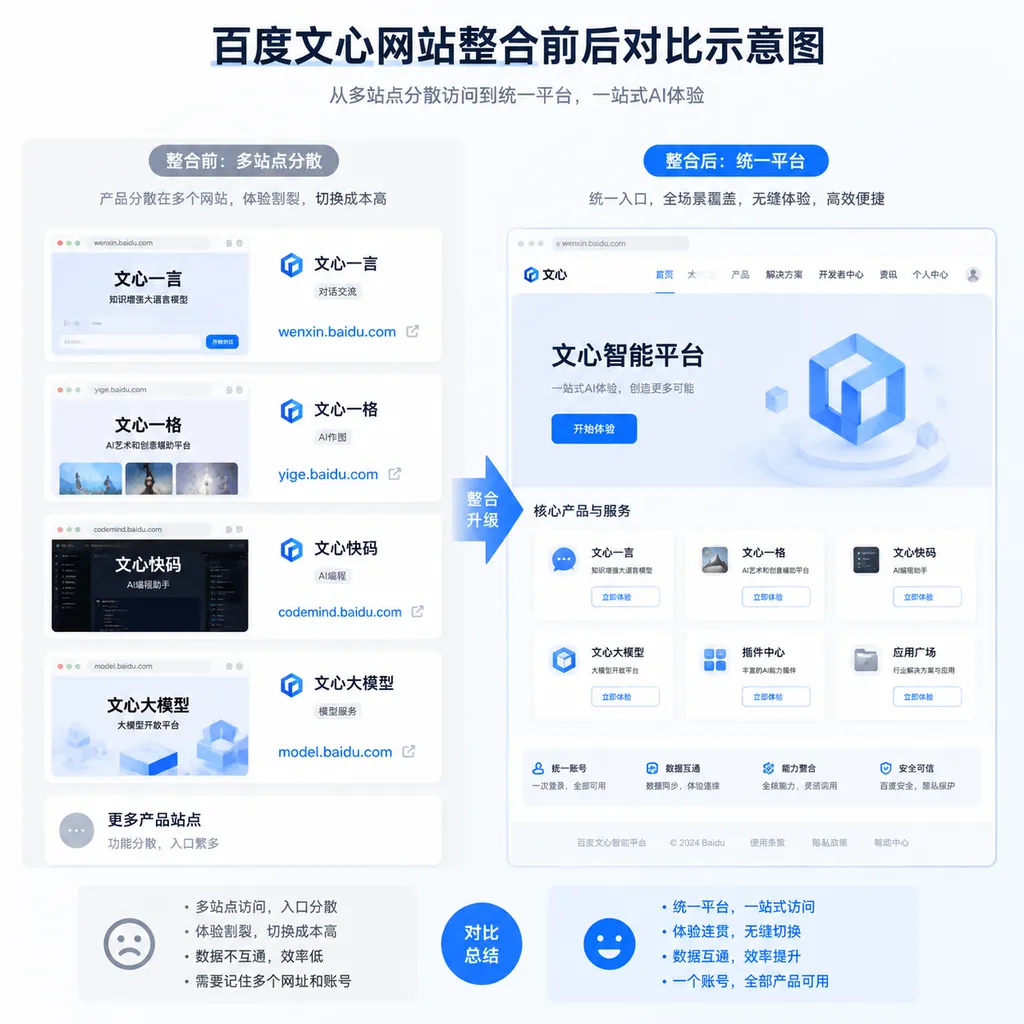
Baidu today announced the merger of multiple websites, including Ernie Bot and Ernie Agents, into a unified Baidu Ernie portal. The integration itself is not hard to understand, but at a time when products like DeepSeek, Kimi, and Doubao have already made the user experience smooth enough, the question Baidu needs to answer is: what real problem can a unified portal solve?
Major Integration of Baidu Wenxin Website, But Why Should Users Come?
Baidu announced today that it will merge and upgrade its Wenxin-related websites, integrating previously scattered entry points such as Wenxin Yiyan (yiyan.baidu.com), Wenxin Agent Platform (agents.baidu.com), and Baidu AI Open Platform (ai.baidu.com) into a new unified Baidu Wenxin website (wenxin.baidu.com), creating a one-stop AI service portal.
According to the official statement, the core purpose of this upgrade is to "lower the usage threshold and improve interaction efficiency"—users no longer need to jump between multiple websites and can use all AI functions from one platform. Sounds reasonable, but this move may expose more issues than it solves.
The logic of integration is clear, but the timing is awkward
Baidu's logic for this integration is easy to understand. Over the past year, Baidu's AI product lineup has indeed been somewhat scattered: Wenxin Yiyan is a conversational assistant, the Wenxin Agent Platform is a tool for Agent development, and the AI Open Platform was aimed at B-end developers, providing traditional AI capabilities such as OCR, speech, and image recognition. Each product had its own domain name and account system, and fragmented user experience was a real problem.
From the product form perspective, the unified entry point approach aligns with the current development direction of AI applications. OpenAI's ChatGPT website is both a conversation tool and an entry point for DALL-E, the code interpreter, and the plugin marketplace; Anthropic's Claude website similarly integrates conversation, document analysis, and workspaces. Users are now accustomed to completing the entire process—from conversation to creation, from search to generation—within a single interface. Baidu following this trend is fine.
The issue lies in the timing. As of mid-2026, the domestic AI application market structure is already relatively clear:
- DeepSeek has established itself with the R1 model’s reasoning capabilities, with a highly active developer community
- Moonshot’s Kimi offers smooth experiences in long-text processing and internet-enabled search, with good user reputation
- ByteDance's Doubao continues investing in multimodal capabilities and mobile user experience, with impressive DAU figures
- Alibaba's Qianwen enjoys rapid penetration into enterprise scenarios, strongly supported by the DingTalk ecosystem
These products had already adopted a "one-stop" format more than a year ago. Baidu's current integration looks more like catching up than leading.
What problem does a one-stop entry point solve?
Returning to the product itself, we have to ask: what problem is Baidu Wenxin’s integration actually solving?
For C-end users
The core demand of ordinary users for AI products is: quickly finding tools that solve their problems, with smooth experience.
From this perspective, Baidu Wenxin’s pre-integration product line did have pain points. For example, if a user wanted to chat with Wenxin Yiyan and then decided to try out the Agent feature, they had to switch to another site, log in again or reauthorize, resulting in a fragmented experience. This problem could theoretically be alleviated with the integration.
But in reality, this pain point isn’t high priority. Most users are not frequently switching between a “conversation assistant” and “Agent development.” The user bases for these functions hardly overlap: the former is a daily-use tool, while the latter leans toward developers or advanced users. Placing them under one entry point is more about platform management efficiency than addressing genuine user needs.
More importantly, C-end users choose AI products based on: whichever is better, they use. If Wenxin Yiyan’s conversational experience, response speed, and knowledge updates are inferior to competitors, a unified entry point won’t make users stay. The integration only reduces jumping cost between Baidu's own products, not the cost of switching to competitors.
For developers
Developers’ needs are more pragmatic: API stability, clear documentation, reasonable pricing, and adequate model capability.
Previously, Baidu AI Open Platform mainly offered traditional AI services like OCR, speech, and image recognition, which still have markets in vertical scenarios (e.g., invoice recognition, call centers). With the advent of the large model era, developers care more about: How is Wenxin’s large model API call experience? How does the cost-performance compare with GPT-4, Claude 3.5, DeepSeek-V3?
Integrating the AI Open Platform into Wenxin’s website—if it’s just a different domain name and navigation bar—has limited value for developers. Real value lies in:
- API compatibility: Can Wenxin’s large model be called directly using OpenAI SDK format? This is key to migration cost.
- Model lineup: What are the positioning and differences between Wenxin 4.0, 3.5, and lite versions? Which scenario fits which model?
- Pricing transparency: Are the token billing rules clear? Any hidden costs?
- Ecosystem tools: Are there supporting Prompt management tools, debugging tools, monitoring dashboards?
If these issues aren’t resolved, a unified entry point is superficial. Developers won’t change their tech stack just because of a website redesign; they vote with their feet.
Three questions Baidu needs to answer
Post-integration, Baidu Wenxin still faces unchanged core questions:
1. What is the actual capability level of the model?
The real performance of Wenxin’s large model is unclear to outsiders. Unlike GPT-5, Claude 3.5, or DeepSeek R1, which have public benchmarks and widespread community testing, Wenxin’s capability boundaries are fuzzy.
Baidu claims Wenxin 4.0 meets internationally advanced standards in multiple tasks, but feedback from the developer community is lukewarm. Partly because Baidu discloses little technical detail, and partly because actual experience falls short of the marketing.
In reasoning, DeepSeek R1 has proven that a Chinese team can achieve world-class levels in math, code, and logical reasoning. In long text processing, Kimi's 2 million token context window sets the benchmark. In multimodal capabilities, GPT-5 and Gemini’s video understanding and image generation are rapidly iterating. Wenxin must find its differentiated positioning, not settle for “good enough” in every aspect.
2. How to build the ecosystem?
The Wenxin Agent Platform has been around for a while, but its presence in the developer community is far less than ByteDance’s Coze or OpenAI’s GPTs. Reasons may include:
- Creation threshold: Despite “no-code” claims, is the actual experience smooth enough?
- Distribution channels: Can developers’ Agents be discovered and used by users? Baidu has search and information streams—are they directing traffic to Agents?
- Monetization path: Can developers make money from Agents? Is there a clear revenue-sharing mechanism?
OpenAI’s GPT Store has issues, but at least attempts to establish a “creator economy.” If Baidu treats the Agent Platform merely as a display cabinet rather than a real ecosystem, it’s just decoration.
3. Can the To B scenarios be fully penetrated?
Previously, Baidu AI Open Platform had many B-end customers in OCR and speech recognition, such as Taikang Insurance’s medical claims, J&T Express’s order processing, and Chongqing Court’s smart case handling. These form the core of Baidu's AI business.
But the question is, how receptive are these customers to large models? Will they upgrade their existing services to solutions based on Wenxin’s large model? If Baidu merely hosts large model and traditional AI services on one site without integrating their tech stacks and business logic, the integration means little.
The real To B value lies in: reconstructing traditional AI services with large models. For example, replacing traditional OCR + NLP pipelines with multimodal large models, rule engines with Agents, and complex backend configurations with conversational interfaces. This requires product reengineering, not just website integration.
Impact on developers
From a developer's perspective, this integration has little short-term impact, but there are a few long-term points worth watching:
API migration and compatibility
If Baidu changes API endpoints, authentication methods, or pricing rules during integration, developers should watch migration costs. Ideally, Baidu should maintain backward compatibility and provide a sufficient migration window.
For new developers, the key question is: Can Wenxin’s large model API be called using OpenAI SDK format? If yes, migration costs drop dramatically. Currently, most domestic large model APIs (including Alibaba’s Qianwen, ByteDance’s Doubao, Moonshot’s Kimi) support OpenAI-compatible format. If Baidu doesn’t follow suit, it will be disadvantaged in the developer ecosystem.
Documentation and toolchain
Post-integration, unifying and optimizing the documentation system is critical. Previously, Baidu AI Open Platform’s docs were detailed, but Wenxin Yiyan and Agent Platform docs were more fragmented. If integration makes docs clearer, examples richer, and debugging tools better, that benefits developers.
But if it’s just stacking the three sites’ docs together, the user experience may worsen.
Pricing and costs
Pricing for large model APIs is highly sensitive for developers. How does Wenxin’s pricing compare with GPT-4 and Claude 3.5? How about compared with domestic DeepSeek, Qianwen, and Kimi?
DeepSeek’s extreme cost efficiency in training and inference has pressured others greatly. If Baidu cannot strike a balance between performance and cost, developers will vote with their feet.
A bigger question: What is Baidu’s AI strategy?
Zooming out, this integration is just a small adjustment in Baidu’s AI strategy. The bigger question is: What is Baidu’s position in the AI era?
In early 2023, Baidu was among the first in China to release large model products. Wenxin Yiyan’s launch conference was a debacle, but it still seized a time window. Over the past two years, however, Baidu's presence in the large model race has gradually diluted.
- Technology: Wenxin’s technical details are scarce, developer community buzz is low, and it hasn’t sparked widespread attention like DeepSeek
- Product: Wenxin Yiyan’s experience lacks obvious advantages over competitors; the Agent Platform hasn’t spawned hit apps
- Ecosystem: Baidu has search, maps, and cloud storage, but their integration with Wenxin large model is shallow, lacking a strong moat
Compare with Alibaba, ByteDance, and Moonshot, whose strategies are clearer:
- Alibaba bets on the enterprise market, penetrating To B scenarios via DingTalk and Alibaba Cloud
- ByteDance builds Doubao into a content creation tool, leveraging Douyin and Toutiao ecosystems
- Moonshot focuses on long texts and knowledge management, targeting a deep vertical niche
Baidu’s problem is: It wants to do everything, but hasn’t done anything thoroughly. Search is a ready traffic entry point, but integration with Wenxin is shallow; maps and cloud storage are high-frequency apps, but AI functions are an add-on rather than core experience; To B market has potential, but Baidu lacks strong B-end tools like DingTalk or WeCom.
Website integration is a technical move, but without solving strategic issues, it’s superficial.
One-stop entry point is not the end, but the beginning
Returning to this integration, unifying the Wenxin website can indeed address some fragmented user experience problems, but it’s the most basic step. The real challenge is:
- Can model capabilities match the top tier? If Wenxin’s large model lacks differentiation in reasoning, long text, and multimodal capabilities, the unified entry point’s significance is limited.
- Can the developer ecosystem be built? A platform’s value lies not in how many functions it has, but in how many people are willing to build apps on it.
- Can the commercialization path succeed? Baidu needs to prove Wenxin isn’t just a demo, but a core product that generates revenue and supports business growth.
From this angle, the Wenxin website integration isn’t the end—it’s a new starting point. In the next few months, we’ll see Baidu’s real moves in model capabilities, product experiences, and ecosystem building. If it just stays at a website redesign level, this integration will be merely a mediocre product optimization.
But if Baidu uses this chance to restructure its AI strategy, truly integrate Wenxin’s large model, Agent Platform, and developer ecosystem, and find its differentiated positioning, this integration could be a turning point.
It’s just too early to draw conclusions now. The market will give the answer, and users and developers will vote with their feet.
References
No external links to cite (reference materials are Baidu’s official website and 36Kr news).


