
The Ministry of Transport Bets on End-to-End Large Models, Autonomous Driving Enters the AI-Native Era
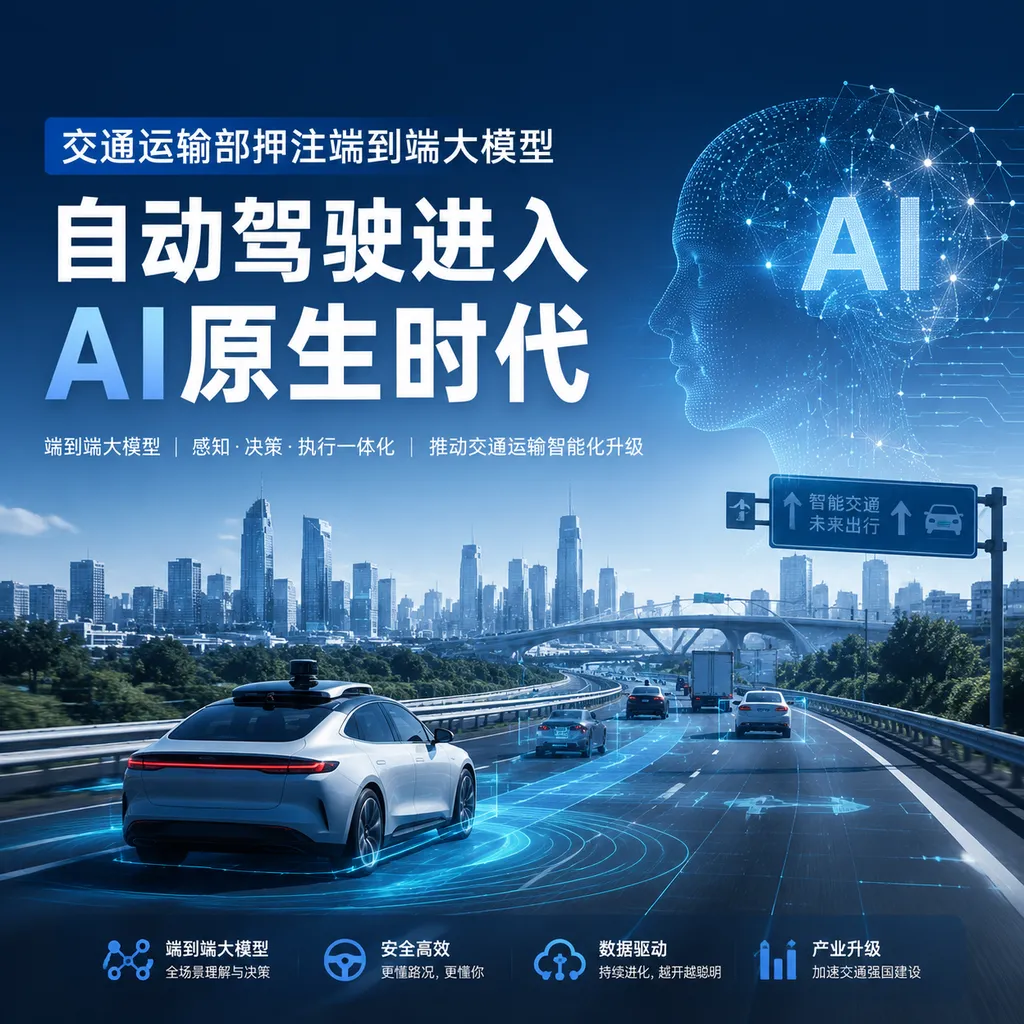
The Ministry of Transport and four other departments jointly issued a document, clearly defining end-to-end large models as the core technical route for intelligent driving. This marks a paradigm shift in autonomous driving from rule-driven to data-driven, with breakthroughs expected first in scenarios such as freight transport and industrial parks.
Ministry of Transport Bets on End-to-End Large Models, Autonomous Driving Enters the AI-Native Era
Today, the Ministry of Transport and four other departments jointly issued the “Artificial Intelligence + Transportation” Typical Application Scenarios Innovation Action Plan, which, for the first time at the national level, clearly identifies “end-to-end large models” as the core technical route for intelligent driving. This is not just a simple policy statement, but a systemic restructuring of the autonomous driving technical route from the past decade.
From Rule Chains to Neural Networks — One Model Replaces the Entire System
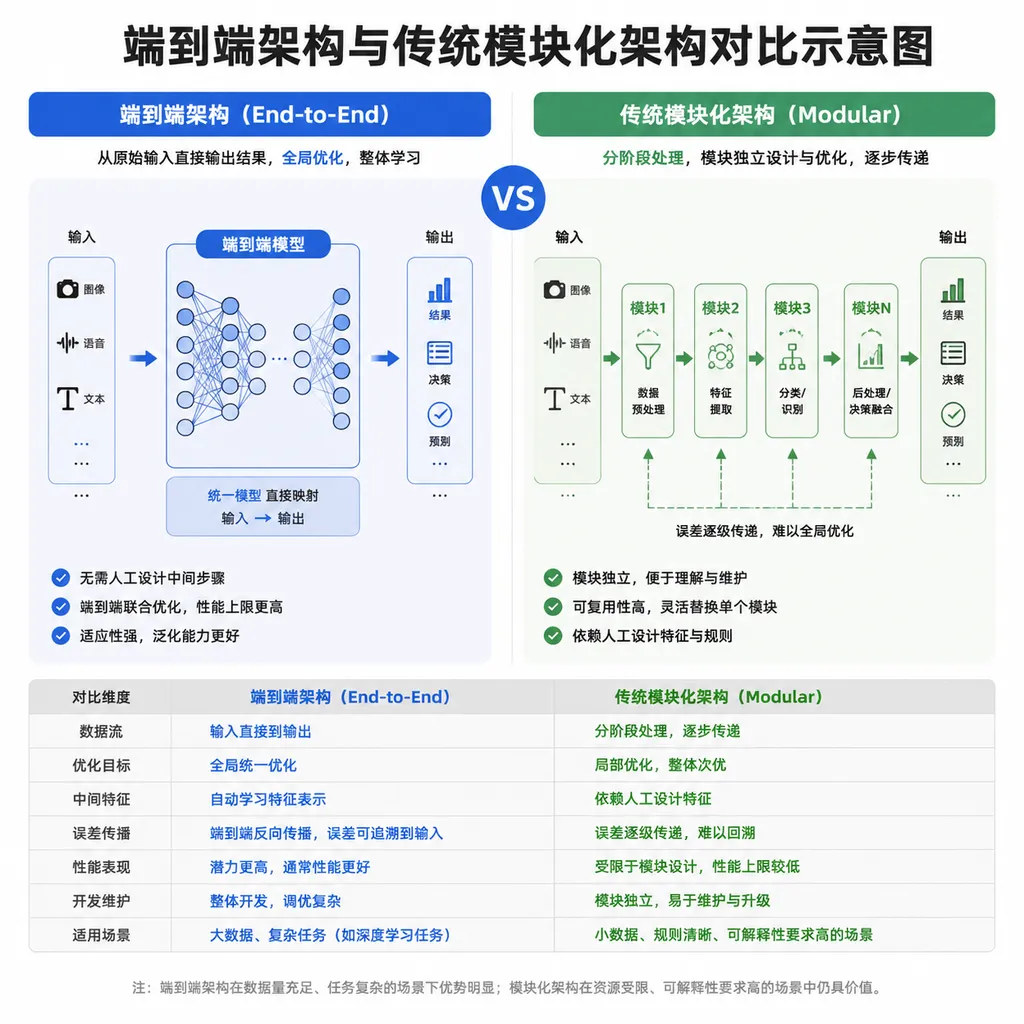
Traditional autonomous driving systems are like assembly lines: the perception module identifies obstacles, the decision module determines actions, the planning module computes trajectories, and the control module executes them. Each step has manually written rules, with standardized interfaces passing information between modules. This architecture is clear and comprehensible, but the problem is — humans can’t write all the rules.
End-to-end compresses the entire chain into a single neural network. Raw data from cameras and radars goes straight in, and the model outputs steering angles and throttle/brake depth. There’s no intermediate step like “first identify the vehicle, then judge the distance,” but rather it operates like a human driver — seeing the scene and knowing how to drive.
This isn’t just an optimization of technical details, but a fundamental change in problem-solving. In Tesla FSD V12’s road tests in North America, when faced with police traffic gestures in a construction zone, traditional systems would freeze, having never seen such a “non-standard scenario.” The end-to-end model simply learned how to “read gestures” from its training data. The industry generally sees this as a key step toward L4-level autonomous driving.
The Policy Target is Not Passenger Cars, but Cost Reduction and Efficiency Gains in Commercial Scenarios
The plan clearly states three areas of focus: highway freight, campus/industrial park transport, and short-haul shuttle services. These share common traits — relatively fixed routes, controllable regulatory environments, and favorable economics.
Mining sites are the most typical testing ground. In the open-pit mines of Inner Mongolia and Shanxi, unmanned mining trucks have already run millions of kilometers. But early systems relied on centimeter-level high-definition maps and LiDAR, with intelligent driving hardware per vehicle costing over 500,000 RMB. The end-to-end solution can be achieved with pure vision + millimeter-wave radar, pushing hardware costs below 100,000 RMB — and crucially, algorithm iterations no longer require re-labeling maps.
Port container transport is also moving quickly. At Shanghai’s Yangshan Port, intelligent heavy trucks still use rule-based V2X collaborative systems that require roadside equipment cooperation. Switching to end-to-end allows vehicles to “drive by sight” like human drivers, cutting infrastructure renovation costs by at least 60%.
The plan also contains a detail: it calls for building “intelligent test fields integrating virtual and real environments.” This matches the core challenge of training end-to-end models — the data loop. Models require massive corner cases to learn, but real-world data collection is too slow. Simulation platforms can generate batches of “rainy night + pedestrian sudden entry + front car hard brake” extreme combinations, letting models experience many “real-world situations” before hitting the road.
Highways and Railways are Using Large Models to Restructure Perception Systems
The description of smart highways in the plan is worth noting: “Using multimodal large model technology to enhance comprehensive perception across infrastructure, traffic operations, and road network environment.” In plain terms, roadside cameras will no longer just record video, but understand road conditions in real time.
Currently, 90% of highway monitoring footage is stored for post-event investigation. With AI intervention, systems can automatically identify “a tilted cone in a construction area,” “debris in the emergency lane,” or “three large trucks side-by-side at low speed in the right lane.” This information is pushed to autonomous vehicles in real time, essentially giving each car a “global vision plugin.”
In rail transport, the proposed “intelligent trains and operational control systems” are essentially an end-to-end approach. Traditional train control tells trains “red signal ahead in 3 km” via ground beacons, and onboard ATP (Automatic Train Protection) brakes based on preset curves. The new plan aims for trains to “read” signal lights, recognize track conditions, and even predict the slowing intentions of the train ahead.
Huawei’s fully autonomous driving system pilot on the Qinghai–Tibet Railway already uses vision-based large models for turnout recognition and obstacle detection. Previously, rail cracks and overhead line wear relied on manual inspections — now onboard cameras scan, and AI marks them.
Three Hurdles for Large Models in Vehicles: Computing Power, Data, Safety
End-to-end sounds promising, but mass adoption still faces major challenges.
Computing power is the first hurdle. Tesla’s FSD V12 model has over 100 billion parameters, requiring hundreds of TOPS for inference. NVIDIA’s Thor chip offers 2000 TOPS, but consumes 200W — posing cooling and cost issues. Domestic brands like Jidu and Xpeng use Horizon’s Journey 6 chip with 560 TOPS, requiring pruning optimizations to run full end-to-end models.
The data loop is even more critical. Baidu Apollo has accumulated over 35 million km of road tests, but truly valuable corner cases may account for less than 0.1%. Extracting “representative extreme scenarios” from masses of video, and ensuring training data doesn’t bias (e.g., too much sunny weather leading to rain failures), requires dedicated data engineering teams.
Safety is the baseline. End-to-end models are “black boxes,” and it’s hard to explain decisions after accidents. Li Auto’s solution is dual systems — end-to-end handles regular driving, traditional rule-based systems serve as safety fallback. Xpeng adds a “safety brain” to its model, simulating human instinct to avoid harm. But these are experimental, and regulatory acceptance remains uncertain.
2026 Will Be a Watershed
According to the timetable, 2025 will be the first year of end-to-end perception in production vehicles, and 2026–2027 will see true “One Model” systems. This is based on two observations:
First, the maturity cycle of computing platforms — NVIDIA Thor and Qualcomm Snapdragon Ride Flex will only mass-produce in the latter half of this year, and automakers need at least a year for adaptation and testing. Second, regulation progress — the UN WP.29 forum plans to finalize L4 autonomous driving global technical regulations by January 2026, and China’s Intelligent Connected Vehicle Pilot Access & Road Operation is advancing in parallel.
Another overlooked signal in the plan: it calls for “intelligent simulation of traffic flow and congestion mechanism analysis, automatic generation of alleviation strategies.” This implies end-to-end will not only be in vehicles but also used to optimize the entire road network. Imagine: a city’s traffic brain analyzes all intersections in real time, uses reinforcement learning to calculate optimal traffic signal durations, and pushes them via V2X to autonomous vehicles. Vehicles and roads form a massive neural network — the ultimate “vehicle-road-cloud integration” form.
The Technical Route Debate is Over — but Business Models Have Yet to Begin
Domestic players are all-in on end-to-end. Xpeng’s XNGP 5.0 uses dual large models XNet + XPlanner; NIO has spun off a dedicated large model department; Li Auto has “fast thinking + slow thinking” dual systems; Huawei ADS 3.0 uses GOD perception + PDP decision on a unified network. Their architecture details differ, but the direction is highly aligned.
The real divergence is commercialization paths. Tesla sells FSD subscriptions at $199/month; domestic automakers mostly opt for standard or optional packages. Autonomous driving’s cost structure has changed — traditional approaches have high hardware costs and low marginal software costs, whereas end-to-end lowers hardware costs but spikes compute and data costs. Who pays for the cloud GPU clusters for training? How to price so that ongoing OTA updates are covered? These are harder questions than the technology itself.
Policy gives direction, but not answers. The plan’s statement to “promote cost reduction, quality improvement, and efficiency gains in freight transport” hints that commercial scenarios must first be economically viable. Passenger vehicle adoption may have to wait until after 2027, to see who can first develop a sustainable business model.
Is the end-to-end large model the iPhone moment for autonomous driving, or another tech bubble? We’ll find out in two years. But at least now, the industry no longer debates “whether to do it” — it’s competing on “how fast and how well.” That in itself is great progress.
References
- Ministry of Transport et al.: Launch R&D and Testing of Intelligent Driving 'End-to-End' Large Models - IT Home — Original policy text and key task interpretation
- Is 'End-to-End' the Dawn of Autonomous Driving? - iNABR — Analysis of end-to-end technical principles, industry practice, and commercialization challenges


