
Google Gemini core team collapses in succession
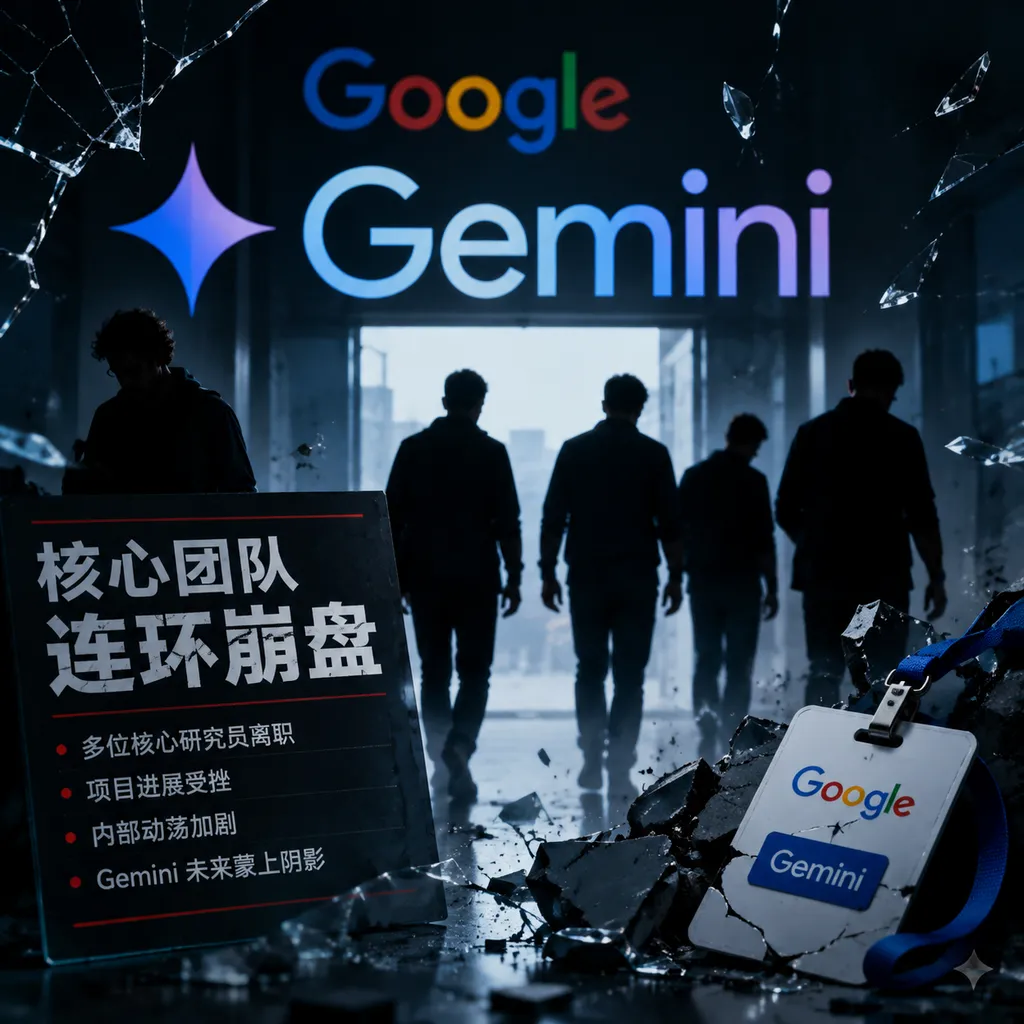
Gemini's two key R&D personnel, Jonas Adler and Alexander Pritzel, are about to move to Anthropic. Following Nobel Prize winner John Jumper and star researcher Noam Shazeer, Google's AI team is experiencing its most severe wave of talent loss.
Google Gemini Core Team Collapses in Succession
Two of Gemini’s core architects, Jonas Adler and Alexander Pritzel, are about to jump ship to Anthropic. This marks the third major talent loss in Google’s AI team within a week—just days ago, Nobel Prize winner John Jumper announced he was joining Anthropic, and star researcher Noam Shazeer defected to OpenAI.
After the news broke, Alphabet’s stock fell as much as 1.2% intraday on Wednesday. This is not just simple personnel turnover, but a direct loss of core R&D capability. Adler was responsible for Google’s AI programming projects, and Pritzel was involved in AI system training; both are key contributors to the Gemini large model. Losing them is tantamount to handing the ongoing development roadmap directly to a competitor.
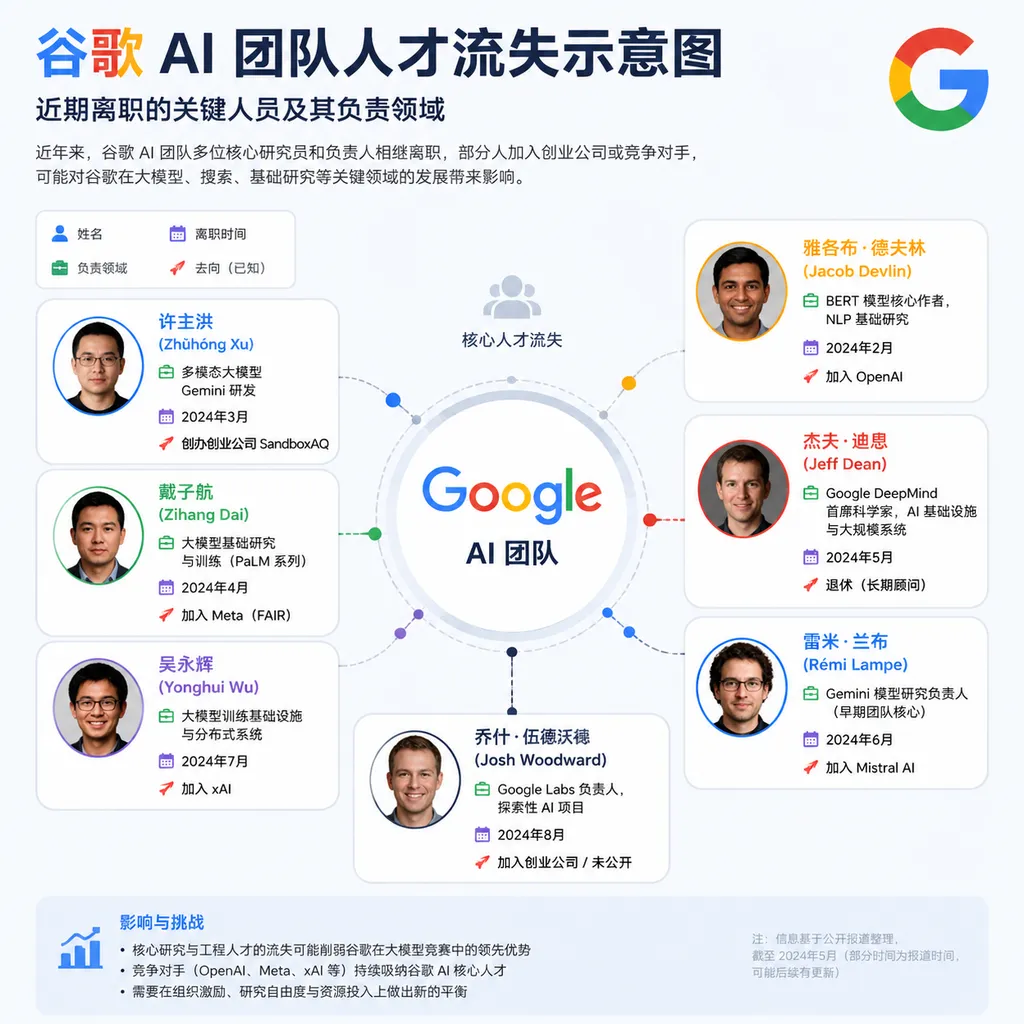
It’s Not Just the People Leaving — Compute Resources Are Being Redirected
A more notable detail is that shortly before Shazeer’s departure, the compute resources for his project were reallocated to the DeepMind London team. According to insiders, this was to “strengthen team collaboration and optimize pre-training,” but the timing is suspicious. A project’s compute resources are pulled back and the project lead immediately leaves—clearly signaling that Google’s internal support for certain research directions is shrinking.
The "pre-training optimization" these reassigned resources target is itself an interesting direction. Pre-training is the initial stage of AI development, where models learn basic capabilities from vast amounts of data. Google’s pivot of resources toward this stage may indicate they’ve found inefficiencies in Gemini’s current pre-training process and need to adjust from the ground up. However, the trade-off is sacrificing Shazeer’s exploration of new architecture directions.
Two insiders revealed that Shazeer had been developing a new type of AI architecture before leaving. This architecture was still based on Transformer, but had already shown “encouraging results.” Now this technical path will either be shelved or continue without the person who best understands it. Either way, it’s a loss for Google.
Google’s AI Dilemma: Starting Early but Falling Behind
Google’s awkward position in AI is that—they were the earliest pioneer, yet in this current wave of competition they’ve long been playing catch-up. Google proposed the Transformer architecture in 2017, but the GPT series made it famous. Google has its self-developed TPU chips, the largest research team in the world, huge amounts of data and compute power—but it was only late last year that Gemini truly caught up to the first tier.
This “technology leading but product lagging” situation is essentially an organizational problem. Google’s AI research is spread across Google Research, Google Brain, DeepMind, and other teams, making coordination costly and decision chains long. In comparison, OpenAI and Anthropic have much flatter organizational structures, shortening the path from research to product.
DeepMind CEO Demis Hassabis responded to the talent loss at an event in Cannes: “There is a lot of talent movement between all leading labs, and we have also attracted a substantial proportion of top talent. We have the largest and most wide-reaching research team in the industry.” He’s not wrong—but large scale doesn’t equal high efficiency. When Anthropic can produce Claude 3.5 Sonnet with a smaller team, and OpenAI’s o1 shows stronger reasoning ability, Google’s “scale advantage” becomes far less convincing.
Why Can Anthropic Attract Talent?
The list of talent jumping from Google to Anthropic is now quite impressive: Nobel Prize winner John Jumper, core researchers Jonas Adler and Alexander Pritzel. This is no coincidence—Anthropic truly has unique appeal.
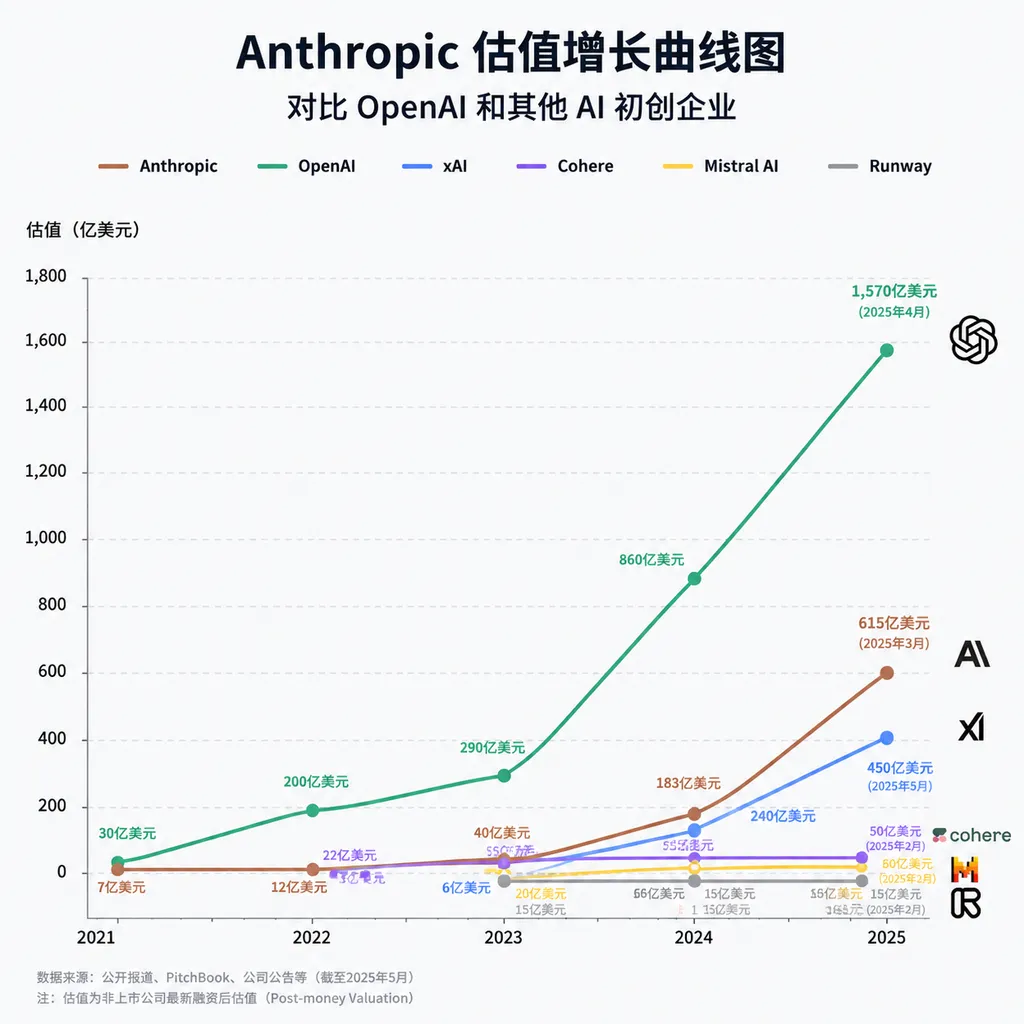
First is valuation and IPO expectations. Anthropic’s latest valuation has reached $965 billion, surpassing OpenAI to become the highest-valued AI startup globally, with the IPO process accelerating. For researchers, joining now means getting pre-IPO equity, which is far more enticing than a stable salary at Google.
Second is research freedom and influence. Anthropic’s research team is small, with core researchers having greater impact on technical directions. At Google, a research project might require coordination across multiple teams, plus facing OKR assessments and productization pressure. At Anthropic, researchers can focus more on exploring cutting-edge directions without worrying too much about short-term commercialization needs.
Third is differences in technical approach. Anthropic’s exploration in Constitutional AI and safety alignment represents thinking different from mainstream routes. For researchers wanting to try new directions, this differentiation itself is attractive.
How Will Talent Loss Affect Gemini?
In the short term, the impact is mainly in three aspects:
Slower technical iterations. Adler and Pritzel are core contributors to Gemini. Their departure means ongoing features and optimizations may be delayed. Even if other researchers take over, they will need time to familiarize themselves with the code and design concepts.
Competitors gain intelligence. Once they join Anthropic, they’ll inevitably bring deep knowledge of Gemini’s architecture, training processes, and data handling methods. Although non-compete agreements exist, such tacit knowledge transfer is unavoidable. Anthropic can better understand Gemini’s strengths and weaknesses, and adjust its strategy accordingly.
Impact on team morale. Continuous senior departures can shake remaining researchers’ confidence. If core members are leaving, does it mean the project’s prospects are dim? If compute resources are being redirected, does it mean the company no longer values this direction? Such doubts affect team cohesion and execution.
In the long term, the bigger issue is Google’s competitiveness in the AI talent market dropping. If “jumping from Google to Anthropic” becomes a trend, it creates a negative cycle: the more people leave, the more outsiders question Google’s AI strategy, making it harder to attract and retain top talent.
What Should Google Do?
Hassabis’s response strategy is to emphasize that “talent movement is normal in the industry.” This is fine for PR, but doesn’t solve the actual problem. Google needs to:
Accelerate organizational restructuring. Integrate scattered AI teams into a unified decision-making system to reduce coordination costs and improve responsiveness. This isn’t just a reporting-line adjustment, but a complete reworking of research-engineering-product collaboration processes.
Give core researchers greater autonomy. Not all projects need immediate commercialization. Allow some long-term exploratory research to exist, giving researchers enough room for trial and error. Allocation of compute resources needs more transparency to avoid making researchers feel their projects could be cut at any time.
Use equity and long-term incentives to retain people. Google’s compensation system is relatively conservative. For top researchers, stable high pay is less appealing than explosive equity incentives. They could consider setting up dedicated equity pools for key projects so core members share in the rewards of project success.
Accelerate Gemini’s productization and ecosystem building. Researchers are more willing to stay if they believe what they’re working on will have impact. If Gemini can prove its value in real-world applications and build a developer ecosystem, researchers’ sense of achievement will grow, reducing motivation to leave.
Large Model Competition Enters the Second Half
From a broader perspective, this talent movement reflects changes in the large model competition landscape. 2023 was about “model capability”—whoever had the more powerful model won. 2024 began shifting toward “engineering and ecosystem” competition, with capability gaps narrowing. The key became who could more quickly turn capabilities into products and build a developer ecosystem.
From 2025 to now, the competition has entered a new stage: “organizational efficiency and talent density.” When model capabilities converge and engineering capabilities catch up, the decider is organizational execution and talent quality. Whoever can use a smaller team to produce better products, and allow top researchers to maximize their value, will lead this marathon.
From this angle, Google’s challenge isn’t just about keeping a few people—it’s about how the entire organization adapts to this new competitive stage. Anthropic and OpenAI’s organizational structures are inherently suited to this phase, while Google needs to find a balance between big-company stability and agility/execution.
For developers, the results of this talent war will directly affect model quality and API stability available to them. If Google’s talent loss slows Gemini’s iteration speed, developers may lean toward Claude or GPT. If Anthropic, by absorbing many Google talents, makes a technical breakthrough, Claude’s capability ceiling may rise further.
Ultimately, the losers in this talent movement aren’t just specific companies, but any organizations with poor efficiency that can’t fully leverage talent value. The winners are those teams that let researchers focus on exploration, quickly turn ideas into products, and provide fair rewards. Google has resources and technical accumulation, but if it can’t make organizational changes, these advantages will be gradually eroded.
References
- Two key Google AI researchers plan to jump to Anthropic - Linux.do – The earliest community discussion revealing this talent movement, including analysis of Google’s AI strategy.


