
RoboScience Releases Visics Large Model: VLOA Architecture Revealed for the First Time
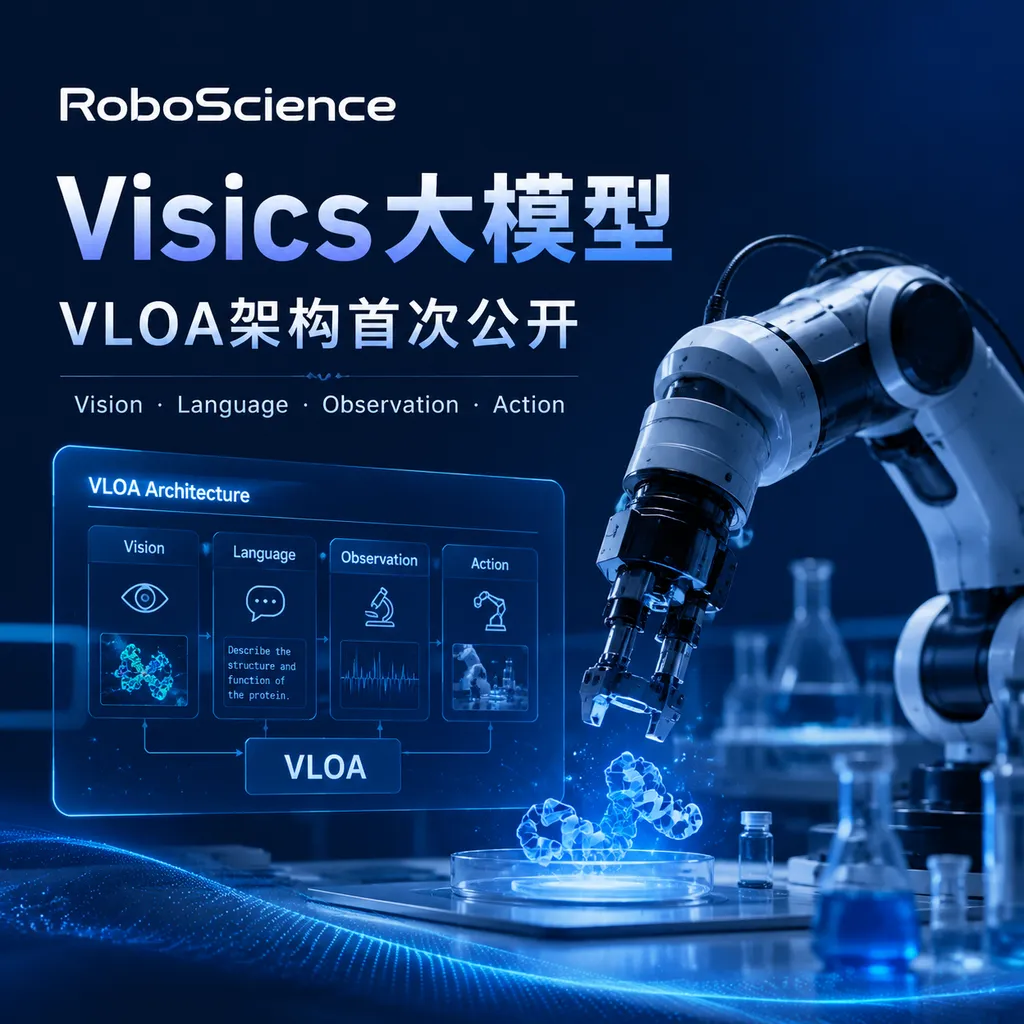
Former Apple AI head Ye Tian's RoboScience released the universal embodied large model **Visics** yesterday, fully unveiling the **VLOA** architecture for the first time. By replacing joint coordinates with object trajectories, a single model can perform operational tasks across different robot bodies and object types.
RoboScience Unveils Visics Large Model: VLOA Architecture Publicly Released for the First Time
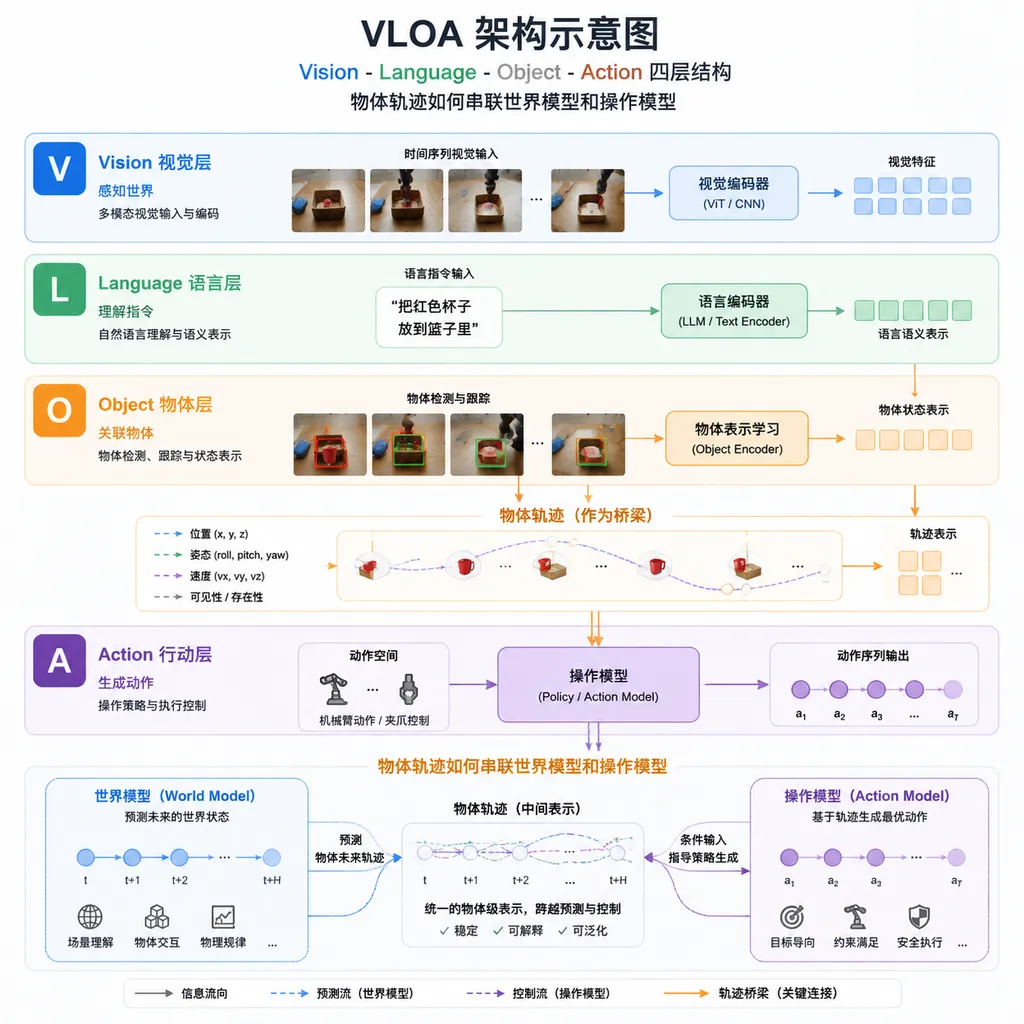
Yesterday (June 24), RoboScience, founded by former Apple AI Platform technical lead Tian Ye, released the general-purpose embodied large model Visics and, for the first time, fully disclosed its VLOA (Vision-Language-Object-Action) architecture. This architecture tackles the most fundamental challenge in the embodied intelligence field: enabling robots to reuse learned skills across different environments and hardware platforms.
At the launch event, practical applications were demonstrated, including furniture assembly, dexterous grasping, and dynamic assembly lines. But what’s more notable is the architecture itself—RoboScience proposes using Object Trajectory (3D point cloud trajectory of objects) as a unified intermediate representation, instead of directly learning robotic joint motion data as existing solutions do.
Why Existing Solutions Aren’t Enough
Large language models have tokens, autonomous driving uses point clouds—these standardized data formats allow models to transfer across scenarios. Embodied intelligence has long lacked such a standard.
In the past two years, the mainstream approach has been to have models directly learn robot joint trajectories—for instance, recording each joint’s angle changes as a gripper moves from point A to point B. The flaw here is obvious: change the robot, the object, or the environment, and the learned patterns no longer apply. The model learns “how this specific gripper grabs a cup,” rather than understanding the essence of the action “grasp”—how much force is needed, how an object reacts to force, where to choose contact points.
At the launch, Tian Ye summarized three bottlenecks: poor generalization, difficulty with fine operations, and error accumulation in long tasks. Solving these requires redesigning data representation from the ground up.
The Core Logic of VLOA: Modeling Around Objects
The key to the VLOA architecture is the Object Trajectory intermediate representation. It uses a time-stamped sequence of 3D point clouds to describe an object’s future position, pose, deformation, and changes in the surrounding environment.
Tian noted, “The term ‘Object’ encompasses both ‘physical object’ and ‘goal,’ precisely defining the robot–object interaction and the motion changes the object should undergo after operation.” This is not wordplay—modeling around the object instead of the robot means learning physical laws themselves, rather than a specific hardware’s movement pattern.
VLOA adopts a dual-engine design, with world and operation models independent from each other:
Embodied World Model
Responsible for "pre-enacting" how objects will move. Pre-trained on massive internet video data—RoboScience has accumulated over 1 million hours of video (tens of millions of clips), growing at hundreds of thousands of hours per week, aiming for a 10-million-hour dataset by 2026.
The model learns object states, 3D trajectories, contact forces, and physical causality. Given the current scene and task description, it outputs an object’s future movement trajectory—such as how a cup will be lifted, tilted, and moved during grasping.
General Operation Model
Responsible for converting “object motion trajectory” into “robot actions.” It receives the world model’s 3D point cloud trajectory output and generates specific contact points, force-control parameters, and joint commands.
This model is trained on simulation data from RoboScience’s self-developed multi-modal physics engine, having accumulated 10B (10 billion) operation samples with a goal of 1T (1 trillion) by 2026. It can manipulate rigid bodies, hinged bodies, 1D/2D/3D deformables, supports cross-platform deployment, and is compatible with visual, tactile, and force feedback inputs.
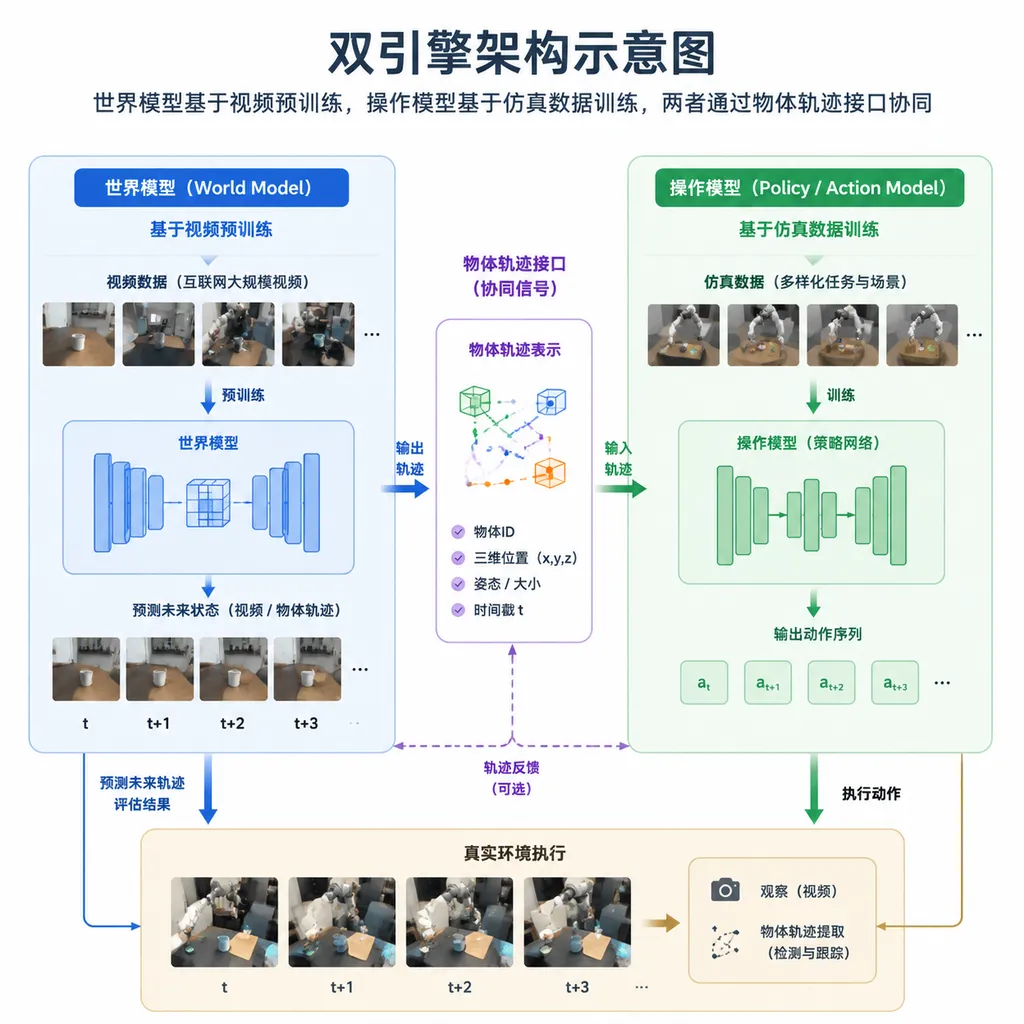
The key is that the two models are separately pre-trained and independently iterated. The world model focuses on understanding physical laws, the operation model on executing actions, without interfering with each other. They are connected via the Object Trajectory standard interface—similar to tokens in large models.
How Does It Perform?
Demonstrations covered key capabilities:
Cross-object generalization: For irregular deer toys, ketchup bottles, and crowded snack boxes, the model detects each object’s geometry and physical properties, automatically choosing optimal contact points and gripping force. For the deer toy, it chooses the torso rather than antlers to avoid damage; for the ketchup bottle, it grips mid-body to keep balance.
Cross-platform deployment: The same strategy transfers seamlessly to different dexterous hands—2-finger, 3-finger, or 5-finger—without retraining. X-hand and LEAP Hand differ greatly in mechanism (gear-driven 12 DoF vs tendon-driven 16–20 DoF), yet the model operates both stably.
Precision force control: Tasks like cutting open envelopes require millinewton cutting force, standing coins needs dynamic balance control, grasping chips must avoid crushing, and injecting liquid via syringe requires precise plunger speed control. Demonstrations also included grasping fragile items like seaweed, eggshells, ice cream cones, and assembling furniture with dual arms.
Long-horizon execution: For dynamic conveyor grabs, the model detects object speed and pose in real time, adjusting grasp points in closed-loop fashion. In furniture assembly, even if disassembled mid-process, it automatically recovers and continues—enabled by continuous visual feedback and real-time decision adjustment.
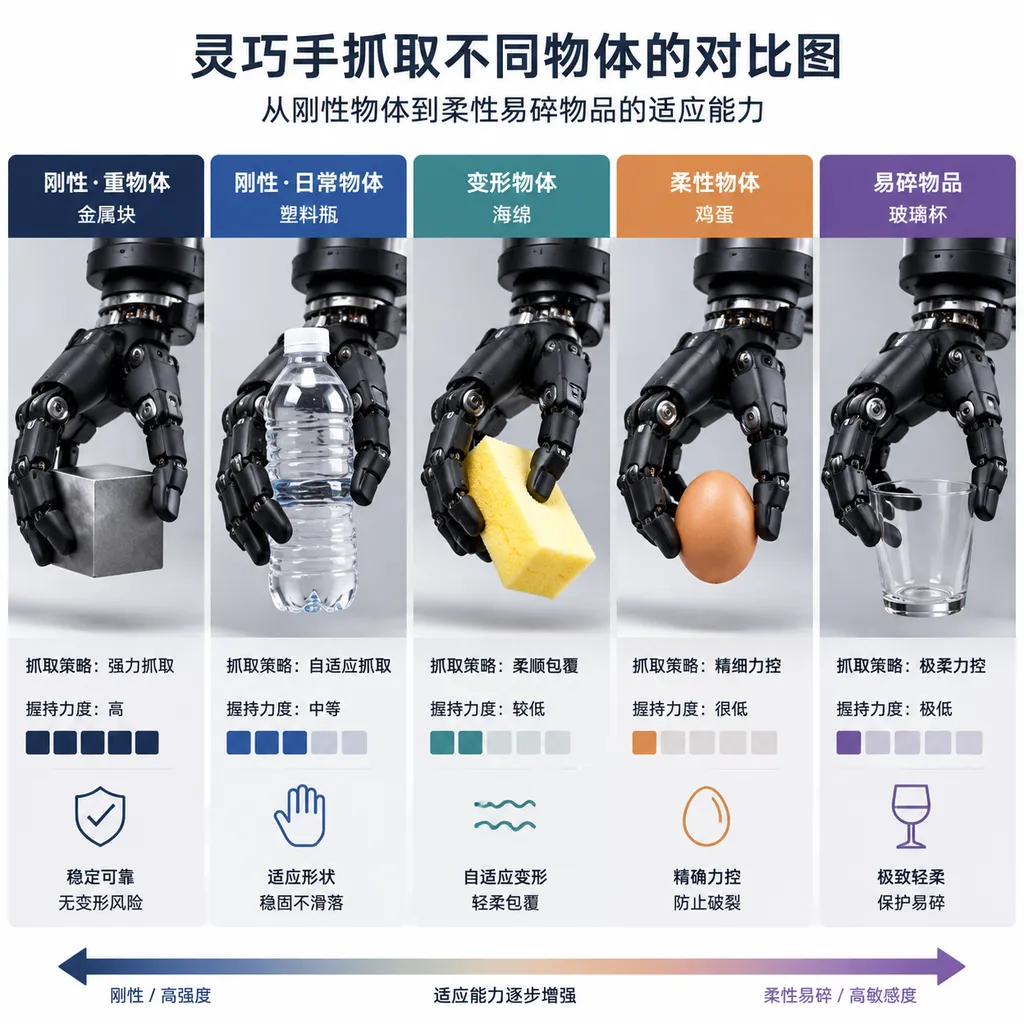
Inference runs at over 3 fps, enabling closed-loop control based on point cloud inputs of objects and environment. Unlike traditional methods needing paired action datasets, Visics is trajectory-conditioned—it doesn’t need to relearn “where to go,” only “how to get there.”
Differentiation in Technical Approach
Existing operation models often use an “atomic skill library,” breaking tasks into discrete skills (grasp, place, etc.), each with its own dedicated model. These fragmented approaches scale poorly and require retraining for new tasks.
Visics’ general operation model is a large model with over 1 billion parameters, jointly trained on all skills to form a unified operation representation. No need to train separate sub-models for new objects or actions—shared physical common sense and trajectory priors enable generalization.
Experimental data shows that as the model scales, success rates and grasp diversity (variance in successful grasp joint angles) predictably improve via power-law scaling. This reflects Scaling Law in embodied intelligence—with standardized data formats and sufficient data scale, model capabilities evolve continuously.
Data sourcing is split: the world model uses internet videos, the operation model uses physics-simulation-generated data. The “video + simulation” combo is much more efficient than pure teleoperation collection. RoboScience’s self-developed multi-modal physics engine generates high-quality force, tactile, and deformation-rich data, supporting manipulation of rigid, hinged, deformable objects across full spatial domains.
Team Background & Deployment Plans
Founder Tian Ye holds a physics bachelor’s from USTC and a master’s from Stanford AI Lab under Andrew Ng, and served as Apple AI Platform technical lead. At Apple, he led multiple milestone projects: the core infrastructure platform dubbed “Apple’s PyTorch and CUDA,” the world’s first cloud–edge collaborative large model inference system (Apple Intelligence), the first on-device inference system, and multi-computation-unit collaborative computing system. His work served over 1 billion users and 2 billion devices, with extensive experience in large-scale on-device AI deployment.
Chief scientist Shao Lin is an assistant professor in the NUS Computer Department, with a PhD from Stanford AI Lab. His UniGrasp deep neural network architecture is now a benchmark method for data-driven dexterous grasping, while his cross-entity dexterous grasp method D(R,O) won ICRA 2025 Best Paper in Robotic Manipulation and Motion—the first such award for an Asian institution in five years. His latest work Bi-Adapt is nominated for ICRA 2026 Best Paper.
Co-founder Liu Penghai was VP at Ecovacs Group, with 20+ years in new product development and supply chain management, building Ecovacs’ product development process from scratch, enabling mass production for 50+ robot products. Co-founder Wang Tao previously led fundraising for large-scale industrial funds at SenseTime Guoxiang Capital.
Founded in December 2024, RoboScience has completed multiple financing rounds, with investors including JD Group, SenseTime Technology, Fortune Capital, CM Capital, Zero One Ventures, and Puhua Capital. The latest round was a nine-digit RMB Pre-A completed in February, led by Puhua Capital. The company has R&D and production centers in Beijing, Shenzhen, Suzhou, and Hangzhou.
On deployment, RoboScience is piloting collaborations with retail, logistics, eldercare service companies, as well as robot body and dexterous hand manufacturers, aiming to mass-produce standardized robot body products for industrial and commercial scenarios this year.
Industry Significance
The biggest challenge in embodied intelligence over the past two years has been the absence of standardized data formats. Each company and research team collects data and trains models in its own way, making results hard to reuse and scale.
RoboScience’s Object Trajectory as a unified intermediate representation, if adopted industry-wide, could have significance on par with Transformer’s impact on NLP. It defines a clear interface: the world model outputs object trajectories, the operation model consumes them. Both sides can evolve independently without interference.
More practically, it reduces skill transfer costs. Previously, a grasping model could only be used on specific hardware; now, in theory, it can deploy across platforms. Robot companies can focus on hardware design without retraining operation models for each product.
Of course, many engineering issues remain—force control precision, real-time responsiveness, safety, and cost control. But at the architectural level, VLOA offers a scalable framework. As data scales and models iterate, capabilities will continue to improve—making it more promising than fragmented skill library approaches.
References
- 36Kr: RoboScience Releases Visics General-purpose Embodied Large Model, Achieves Cross-platform, Cross-object, Cross-task – Official launch coverage including technical details and application cases
- RoboScience Official Website: VLOA Large Model Series Explained – Technical deep dive into the general operation model
- Zhidx: Former Apple Technical Lead Builds Embodied Large Model – Team background and financing information


