
OpenAI halves the Pro subscription price; Codex is the real battlefield.

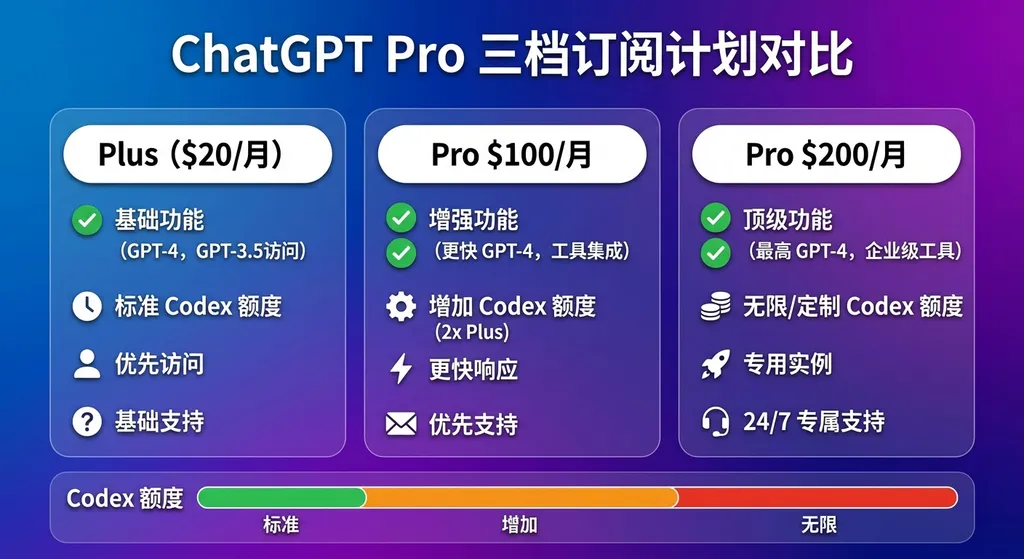
OpenAI has launched a new $100/month Pro plan. The ChatGPT features are identical to the $200 tier, with the main difference in the Codex quota: 5x vs. 20x. During the limited-time promotion, the $100 tier offers a 10x quota — a clear example of precise pricing aimed directly at developers’ budgets.
OpenAI just changed its own pricing structure.
On April 9, OpenAI announced the launch of a new $100/month Pro plan, positioned between the original $20 Plus and $200 Pro tiers. On the surface, it looks like just another pricing level—but a closer look reveals the core logic isn’t about ChatGPT chatting itself—it’s about Codex.
First, the conclusion: No difference in ChatGPT, the real divide lies in Codex
The new $100 Pro and the original $200 Pro plans are completely identical on the ChatGPT side. Exactly the same, including:
- Access to the exclusive Pro model (GPT-5.4 Pro)
- Unlimited use of Instant and Thinking modes
- Deep research capabilities
- All Pro-level features
In other words, if you only use ChatGPT for chatting, research, or writing documents, you’ll experience no difference between the $100 and $200 tiers.
The real difference lies in how much Codex usage you get:
| Plan | Monthly Fee | Codex Quota (relative to Plus) | Promotional Quota (until 5/31) | |------|--------------|-------------------------------|-------------------------------| | Plus | $20 | 1x | 2x | | Pro (new) | $100 | 5x | 10x | | Pro (original) | $200 | 20x | 40x |
Note the 2x promotional multiplier—all Pro plans enjoy double quota until May 31. That means the $100 tier offers 10 times the Codex usage of Plus during the promotion.
What’s the logic behind this pricing?
Looking back at the past few weeks makes the move easier to understand.
On April 2, OpenAI reduced the Business plan price from $30 to $25, but also quietly cut Business users’ Codex quota—shrinking it by about 60%. This triggered notable backlash in the developer community. While the price cut was welcomed, the quota reduction felt like a betrayal to heavy users.
Meanwhile, on Reddit’s r/codex forum, requests for a “$100 tier” have been persistent for weeks. The core demand was simple: the $20 Plus isn’t enough, and the $200 Pro is too expensive. Many developers only need 2–3x usage, but were forced to choose between “too little” and “way too much.”
OpenAI clearly heard them.
But this move is more than just “listening to user feedback.” Codex, OpenAI’s AI coding agent, is becoming one of the company’s key commercial engines. By anchoring pricing around Codex usage rather than ChatGPT chat functionality, OpenAI is effectively saying: we can be generous with chatting, but computing-intensive code generation must be priced by consumption.
This mirrors Anthropic’s strategy for Claude Code. AI coding tools have a completely different cost structure than chat—one Codex task can involve multiple cycles of reasoning, code generation, testing, and bug fixing, consuming dozens of times more tokens than an ordinary conversation.
Is the quota enough? Let’s do the math
According to a detailed quota analysis on Juejin, we can better understand what these multipliers mean.
Plus users have a 5-hour Codex quota baseline (1x). In real use, a moderately complex coding task—such as having Codex refactor a React component, write tests, and fix bugs—can consume 15–25% of that quota. In other words, a full day of intensive use leaves Plus users nearly at their limit.
What does 5x mean? Roughly that you can run 4–5 hours of intensive Codex sessions without worrying about hitting a cap. For most full-time developers, that’s enough to cover an entire day of AI-assisted programming.
The 20x quota represents a whole other level, suitable for heavy users relying on Codex as their main development environment, generating almost all their code via AI.
Here’s a detail worth noting: if you use Codex via a client app (instead of the web), the quota is doubled; but if you enable Fast mode for responsiveness, your quota is consumed twice as fast. These two mechanisms combined make actual usage less straightforward.
The core trick to saving quota is simple: describe your problem clearly. A well-written prompt saves far more resources than three vague attempts. Instead of making Codex guess your intent, spend two minutes clarifying your requirements, constraints, and expected output.
How does this pricing compare to competitors?
Here’s the general landscape of AI coding tool subscriptions:
- GitHub Copilot: $10/month personal, $19/month enterprise
- Cursor Pro: $20/month (500 fast requests)
- Claude Pro (includes Claude Code): $20/month
- ChatGPT Plus (includes Codex): $20/month
- ChatGPT Pro (new tier): $100/month
- ChatGPT Pro (original): $200/month
At $100/month, this new tier sits on the premium end for individual developers. But compare it to enterprise-level API call costs—then it looks quite reasonable. A mid-sized project using GPT-4-level models for code generation via API can easily exceed $100 monthly. From that angle, a fixed $100 plan is a more predictable expense.
However, there’s an interesting competitive dynamic. Claude’s $20 Pro plan already includes Claude Code usage; although it has limits, the entry barrier is much lower. Many developers on community forums are saying: “Finally, we can have Claude and GPT premium at once”—meaning $100 GPT Pro + $20 Claude Pro = $120 for two top-tier AI coding assistants. That’s more appealing than paying $200 for GPT Pro alone.
OpenAI likely noticed this. Better to keep users in the ecosystem at $100 than lose them to competitors at $200.
Real impact on developer workflows
If you’re wondering whether to upgrade, here are a few practical scenarios:
Scenario 1: Daily assistant coding. You mainly use AI to complete code, explain errors, or write unit tests. Plus at $20 is more than enough—no need to upgrade.
Scenario 2: Project-level code generation. You use Codex to build modules, perform large-scale refactoring, or generate entire CRUD interfaces. The $100 plan’s 5x quota saves you from constantly monitoring usage.
Scenario 3: Codex as your main development environment. You generate nearly all your code through Codex, including debugging, testing, and deployment scripts. The $200 tier’s 20x quota is designed for this.
For most indie developers and small teams, the $100 tier may be the current sweet spot—especially before May 31, when the 10x promotional quota nearly matches the regular $200 plan’s day-to-day experience.
If you use OpenAI models via API
It’s worth noting that Codex subscription quotas and API calls are separate systems. If your workflow integrates OpenAI models via API into your development chain, these subscription changes don’t affect you much.
For developers integrating multiple model APIs, platforms like OpenAI Hub (openai-hub.com) streamline access—one key to switch among GPT, Claude, Gemini, DeepSeek, etc., with OpenAI-compatible interfaces that even connect directly within China.
For example, calling GPT-5.4 in your coding assistant tool might look like this:
import openai

client = openai.OpenAI(
    api_key="your-openai-hub-key",
    base_url="https://api.openai-hub.net/v1"
)

response = client.chat.completions.create(
    model="gpt-4o",
    messages=[
        {"role": "system", "content": "You are an experienced code review assistant."},
        {"role": "user", "content": "Please review the following Python function for performance issues and suggest optimizations:\n\ndef find_duplicates(lst):\n    duplicates = []\n    for i in range(len(lst)):\n        for j in range(i+1, len(lst)):\n            if lst[i] == lst[j] and lst[i] not in duplicates:\n                duplicates.append(lst[i])\n    return duplicates"}
    ],
    temperature=0.3
)

print(response.choices[0].message.content)
This method’s advantage: if you find another model performs better for specific tasks (e.g., Claude sometimes outshines GPT in code refactoring), you only need to change the model parameter—nothing else in your code.
The bigger picture: The AI coding tool pricing war is only beginning
Stepping back, OpenAI’s pricing adjustment reflects that the AI coding tool market is entering a refined operations phase.
In the early days, every provider followed a “one price fits all” model—$20/month, use all you want. But as user bases grew and usage deepened, the cost pressure increased. AI code generation is not just text completion—each Codex task burns serious computing resources.
Hence, tiered pricing has emerged:
- Cursor differentiates between fast and slow request quotas
- Claude limits Claude Code usage
- OpenAI now ties pricing to Codex quota
This trend will likely continue. We may soon see even more granular pricing—by task complexity, by codebase size, or even by the quality score of generated code.
For developers, this means the era of the “free lunch” is ending. But from another perspective, those willing to pay for tools are often the ones who get the most out of them. $100/month might sound steep, but if it saves you two hours of coding time daily, it easily pays for itself.
The key is finding the tier that matches your usage intensity—don’t overpay for unused quota, and don’t underpay to the point of getting throttled when you need it most.
References:
- ChatGPT $100 Pro Launch - Linux.do — Community discussion with Codex quota comparisons
- Deep Dive into Codex Quota Changes: How to Check ChatGPT Pro, Plus, and Business Codex 5-hour usage & save quota - Juejin — Detailed quota calculation and checking guide


