
SenseTime bets on the design track, U1 Pro targets GPT-Image 2
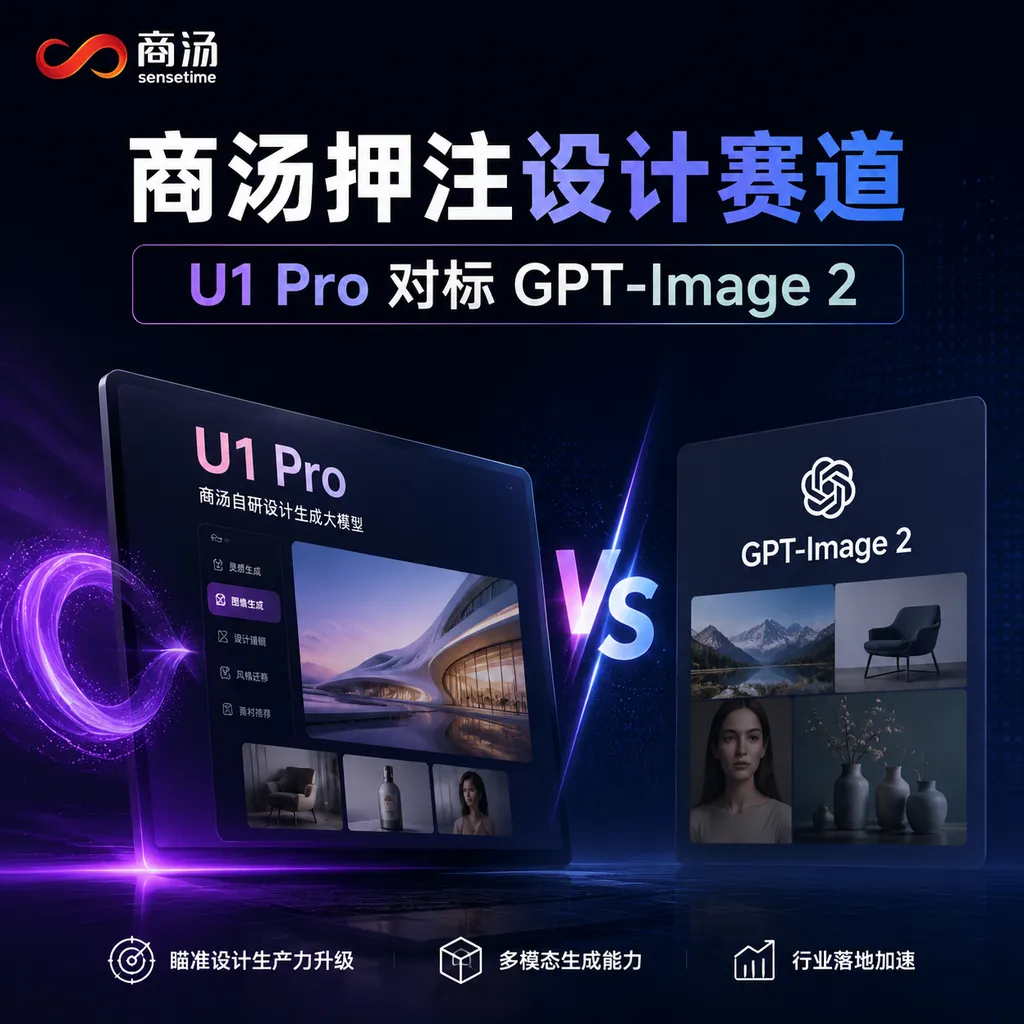
SenseTime has been secretly developing a multimodal design model, U1 Pro, led by Lin Dahua, aiming to compete with OpenAI's GPT-Image 2. Internal testing began in July, supporting 8K resolution, with internal evaluations claiming its performance is close to or even surpasses GPT-Image 2.
SenseTime Bets on the Design Track, U1 Pro Targets GPT-Image 2
SenseTime Technology is secretly developing a multimodal design generation model codenamed "U1 Pro," led by co-founder and chief scientist Lin Dahua, aimed at competing with OpenAI’s GPT-Image 2. This is the latest member of the SenseTime SenseNova model family, expected to launch internal invitation-only testing in July and offer services to customers.
According to insiders, in numerous internal evaluations, U1 Pro’s generated images using the same prompts are highly similar to GPT-Image 2’s results, and even have advantages in certain scenarios. The message here is clear: while top AI companies like Anthropic and Zhipu are leading the programming track, design is becoming the next main battlefield for multimodal models.
Not Just Image Generation — Building a "Thinking Designer"
U1 Pro is not positioned as just another text-to-image tool. SenseTime defines it as an "intelligent" image generation model, primarily tailored for design scenarios.
This positioning is interesting. Over the past two years, competition in text-to-image models has focused on generation quality — the realism of the output, and the precision of details. But after GPT-Image 2 appeared, the rules changed. In LMSYS Chatbot Arena’s text-to-image ratings, GPT-Image 2 significantly outperformed Google’s Nano Banana 2 in image quality, text rendering, and instruction fidelity, triggering a wave of enthusiasm in the design industry.
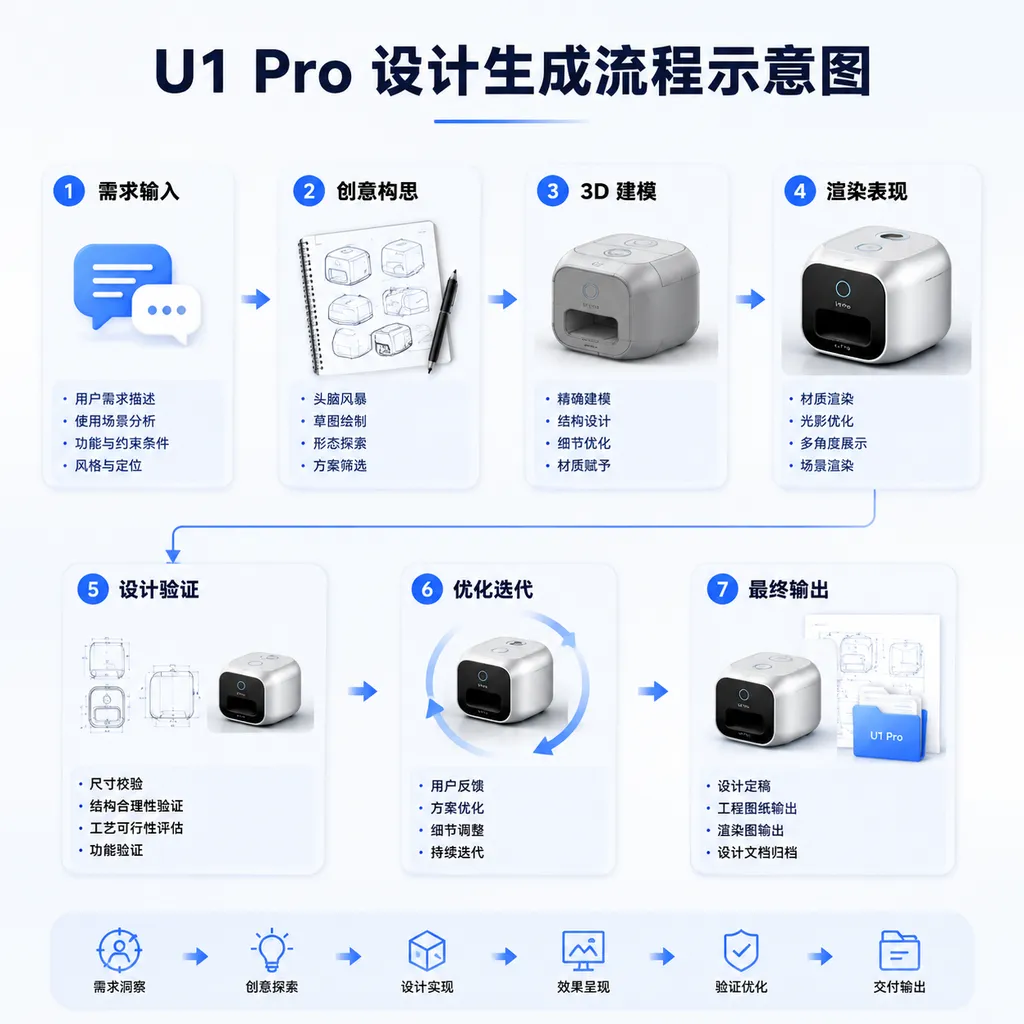
GPT-Image 2’s core advantage is not just the beauty of a single image, but its ability to understand complex design requirements and translate abstract intentions into concrete visual renderings. SenseTime clearly saw this direction, too. According to insiders, U1 Pro can, like a "thinking designer," achieve a long-term cycle of design, generation, and review. This means the model is not merely executing instructions, but also has design decision-making capabilities — understanding design goals, evaluating generated results, and iterating solutions.
Support for 8K resolution output is another key capability. In design scenarios, resolution requirements are much higher than in ordinary content creation. Whether it’s a poster, UI interface, or product image, low-resolution output is essentially useless.
SenseTime’s Multimodal Path: From Native Architecture to Image-Text Reasoning Chains
To understand U1 Pro, we need to look back at SenseTime’s technical accumulation in the multimodal direction.
From the outset, SenseTime chose the native multimodal path instead of adapting a language model. This decision was set in early 2023, when they were pondering a question: what happens when vision models and language models meet on the scaling laws curve?
Native training consumes far more resources than adaptation training, but SenseTime ran two key experiments to verify its value. First, under suitable data ratio conditions, fusion-trained models outperformed single-modality models in their respective tasks, particularly in scenarios handling images with text, screenshots, and professional charts, far surpassing the image-text Q&A models of that time. Second, the fusion of language and vision modalities should begin in the mid-phase of pretraining — starting too early or too late fails to achieve optimal results.
An even more important breakthrough is the image-text interleaved reasoning chain. Traditional Chain-of-Thought reasoning is purely textual; SenseTime extended this mechanism to multimodal. In the interleaved chain, the model can generate and reference images during reasoning — for example, drawing auxiliary diagrams in math problems, or generating sketches for UI design before iterating.
This capability needs reinforcement learning to amplify its effect. In training, SenseTime solved three key challenges: defining the action space (how to insert images into the reasoning chain), designing mixed reward signals (different tasks use different validators and reward models), and optimizing an Agentic RL system (handling GPU-CPU image transmission costs).
After multiple rounds of reinforcement learning, the model exhibited significant gains in mathematics, coding, GUI operations, chart analysis, and advanced tasks. This technical foundation is precisely what underpins U1 Pro.
SenseTime Has Open-Sourced U1, but U1 Pro Is Another Story
To clarify: SenseTime has already open-sourced a lightweight version of SenseNova U1 — U1 Lite — including the 8B parameter U1-8B-MoT and the 38B total parameter but only 3B active U1-A3B-MoT. These versions are available on GitHub and Hugging Face, dubbed the "open-source GPT-Image 2."
U1 Lite’s performance is indeed impressive. It can generate text and images in coherence, with tight logical alignment, achieving open-source SOTA in scenarios such as infographics and sequential image-text outputs. For example, when asked to draw a diagram illustrating the working principles of a large AI model from training to inference, it can visualize the complex process in a lighthearted style suitable for non-technical audiences.
But U1 Pro is completely different in positioning. The open-source U1 Lite takes the local deployment, low-cost inference route, aimed at developers and cost-sensitive scenarios. U1 Pro, however, is a closed-source commercial-grade model targeting GPT-Image 2, aimed at enterprise customers and professional design contexts, with model scale, capability boundaries, and generation quality at another level.
The naming hints at this distinction. Both U1 Lite versions use the MoT (Mixture of Thoughts) architecture, emphasizing efficiency and deployability. The "Pro" suffix in U1 Pro signals it’s a flagship product and will not take the open-source route.
The Design Track Competition Has Just Begun
The viral success of GPT-Image 2 proves design is a valuable direction. But the competitive landscape of this track is far from settled.
OpenAI’s advantages in design are clear. GPT-Image 2’s high generation quality is coupled with deep integration with the GPT series language models, enabling understanding of design intent, accepting feedback, and iterative optimization in complex multi-turn conversations. This end-to-end design capability is something simple text-to-image models cannot achieve. Industry predicts OpenAI will soon release a new AI image generation model with design as a focus.
SenseTime’s advantage lies in multimodal technical accumulation and deep understanding of design scenarios. Judging from U1 Lite’s open-source performance, SenseTime already has solid technical foundations in image-text interleaved generation and information visualization. If U1 Pro can elevate these capabilities to GPT-Image 2’s level, combined with understanding China’s design industry needs — such as handling Chinese fonts, layout habits, and cultural elements — it has a chance to secure a foothold in the domestic market.
Challenges are also evident. First is computing power. Lin Dahua admitted in his essay "Towards Multimodal General Intelligence: SenseTime’s Thoughts" that native multimodal training consumes huge resources, and as model scale grows, costs will rise further. The pricing of GPT-4.5 and Grok 4 already reflects this issue. Sustained investment in this direction requires strong resource support.
Second is data. Design scenarios need large volumes of high-quality professional data, especially design reasoning chains — not only final outcomes, but also decision logic during the process, iteration trajectories, and review feedback. Such data is hard to acquire at scale and varies greatly in quality. While SenseTime has built a complex multimodal data production system capable of producing 5T tokens daily, building specialized high-level datasets remains a long-term challenge.
Third is ecosystem. OpenAI’s advantage isn’t just the model itself, but also the developer ecosystem built around ChatGPT and its API. SenseTime needs to catch up here. The good news is that U1 Lite’s open-source version has gained attention on GitHub and Hugging Face. SenseTime has also open-sourced the SenseNova-Skills AIGC skill library for Agent runtimes, allowing developers to integrate U1’s capabilities into agent workflows. This is the right direction, but it will take more time to create true ecosystem effects.
OpenAI May Also Be Holding Back a Big Move
It’s been some time since GPT-Image 2 was released, and by OpenAI’s rhythm, the next image generation model is not far off. Industry widely predicts OpenAI will make design a major focus, possibly releasing a version specifically optimized for design scenarios, or integrating image generation more deeply into the GPT series.
If this prediction proves correct, competition will intensify. OpenAI has the advantages of abundant resources, deep technical accumulation, and a complete ecosystem. But this also leaves a time window for challengers like SenseTime. Before OpenAI releases a new model, if U1 Pro can successfully complete internal testing and enter the market, building a certain customer base and reputation, it could occupy a place in China’s design market.
In the long run, the design track may fragment. The high-end market will be dominated by top players like OpenAI and Anthropic, offering end-to-end design solutions — expensive but comprehensive in capability. The mid-tier market will be the battlefield for top domestic teams like SenseTime and Zhipu, who must work on cost-effectiveness and localized demand. The low-end market will be split among open-source models and various startups.
SenseTime’s simultaneous pursuit of U1 Lite (open-source) and U1 Pro (closed-source) is essentially a risk-hedging strategy. The open-source version can quickly expand influence, attract developers, and gather feedback; the closed-source version targets high-value clients to pursue commercial returns. This strategy is rational in the current market environment.
From Language Models to Multimodal, to Agents
Lin Dahua mentioned in his essay that multimodal is the inevitable path from LLM to AGI. The basis for this judgment is that information in the world exists in multiple forms, and artificial intelligence must handle multimodal information to achieve generality.
But multimodal alone is not enough. Lin also spoke about the multi-agent path. To surpass human level in a specific direction, there are two possibilities: build a "superhuman" (single super model) or build a "team" (multiple agents collaborating). The former consumes enormous resources, has long development cycles, and is costly; the latter is more pragmatic and has already shown great potential in multiple professional fields. Google DeepMind’s Deep Think, which won a gold medal in the International Mathematical Olympiad, is based on a multi-agent architecture, and SenseTime’s Little Raccoon is also backed by multi-agent.
This approach points to the next stage of AI applications: not a single model covering everything, but multiple specialized models collaborating on complex tasks. In design scenarios, you might need one model to understand requirements, another to generate drafts, another to review feedback, and another to iterate optimizations. If U1 Pro truly aims to be a "thinking designer," it may eventually move in this direction.
SenseTime is already preparing for this in its architectural design. They are rethinking the functional positioning of the vision encoder and MLLM backbone, believing the design of "eyes" and "brain" should differ fundamentally. This modular thinking lays the groundwork for future multi-agent collaboration.
Conclusion
While U1 Pro news remains confidential, the trend it reflects is clear: competition in multimodal models is shifting from general capabilities to vertical scenarios, with design as the first major focus.
Whether SenseTime can secure a foothold in this track depends on three things: first, whether U1 Pro’s actual performance matches internal evaluation; second, whether it can capture the market before OpenAI releases a new model; third, whether it can create differentiation in cost, localization, and ecosystem building.
July’s internal test will be the first key milestone. If U1 Pro can genuinely match or surpass GPT-Image 2 in design scenarios, SenseTime will have earned its ticket to compete. But to truly win in this track will require much longer-term validation.
References
- Report: SenseTime Technology Developing New Image Model, Codename U1 Pro, Internally Striving to Match OpenAI — Exclusive IT Home report revealing U1 Pro development details
- Open-source GPT-Image 2 Alternative: Infographics, Sequential Image-Text Outputs, Local Deployment All Achieved|SenseNova U1 Hands-On Test — iFanr’s detailed review of the open-source U1 Lite


