
$320 million — This company plans to use game data to train a general-purpose AI
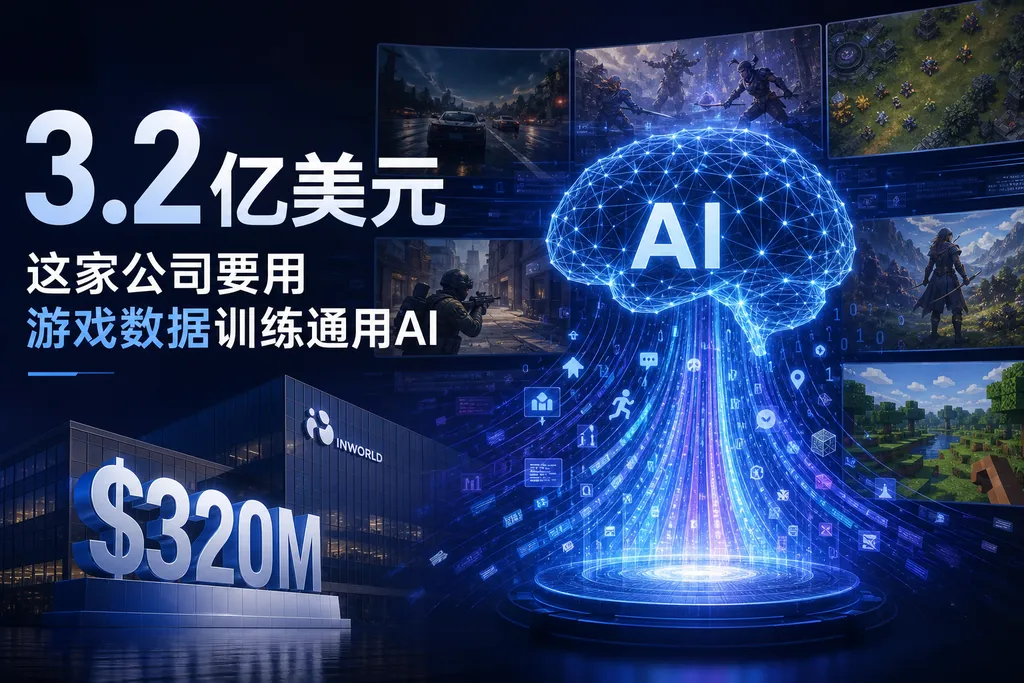
General Intuition completes $320 million financing, valued at $2.3 billion. This AI lab, spun off from the gaming video platform Medal, is betting on training embodied AI with billions of gaming videos, attempting to teach machines human “physical intuition.”
$320 Million: This Company Plans to Train General AI Using Game Data
General Intuition announced today that it has completed a $320 million funding round, with a valuation of $2.3 billion. Both Bezos and Schmidt invested.
This is quite an aggressive bet: using gameplay videos to train AI agents that can act in the real world. Not training AI to play games, but training AI to understand the physical world.
Core Logic: Why Game Data?
Current large language models have a fundamental limitation—they learn about the world from text.
GPT-4, Claude, Gemini—these models can write flawless instructions on “how to ride a bike,” but have no intuition about “keeping balance.” They know “apples fall to the ground” because they’ve read the story of Newton, not because they’ve “felt” gravity.
The founding team at General Intuition believes this is a key bottleneck on the path to general intelligence. They state it bluntly on their official website:
Machines trained primarily on human language archives inherit both the brilliance and the limitations of language: flat abstractions without embodied experience, predictions without participation.
In plain language: reading books without practice means you’ll never learn to swim.
That’s exactly where game data shows its value.
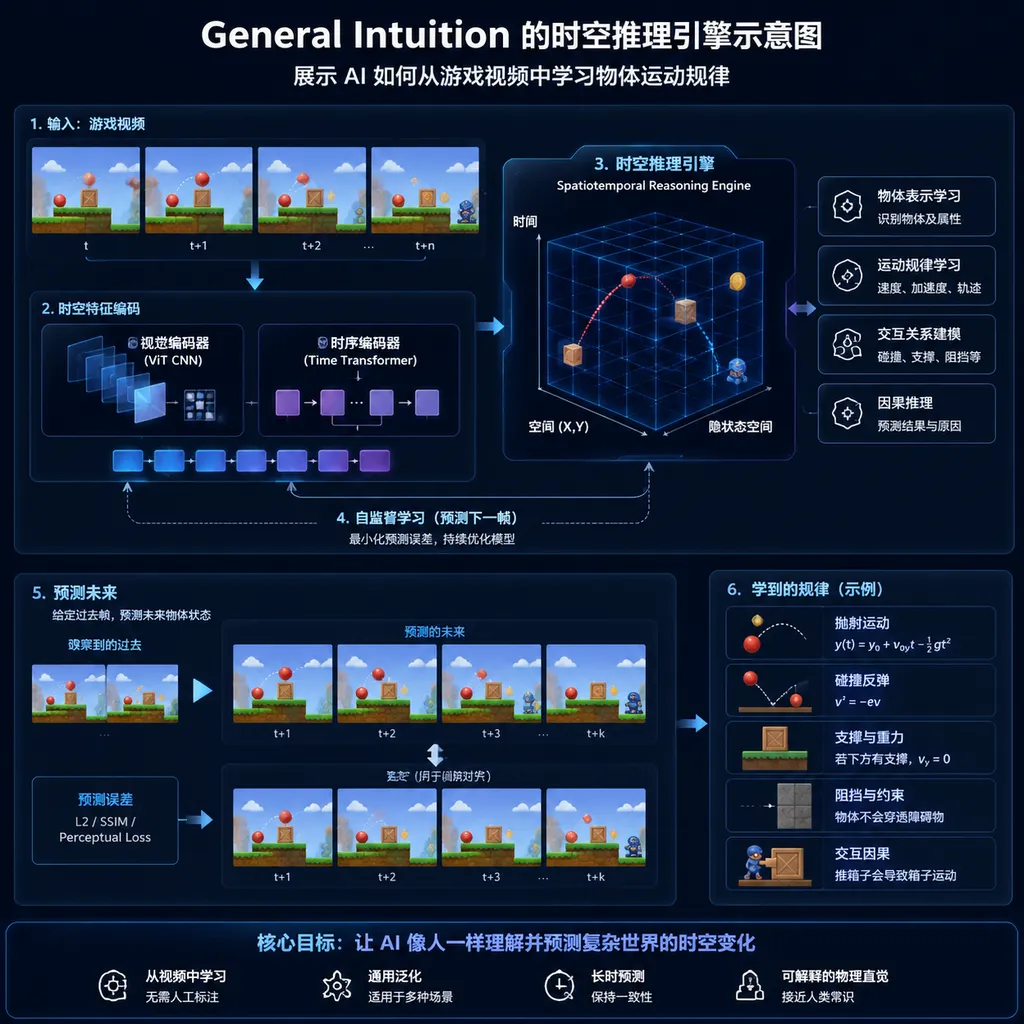
Every gameplay video is a miniature physics lab. Players control characters to jump, and AI can observe: starting posture of the jump, parabolic trajectory in the air, landing buffer actions. Players drive cars into walls, and AI can observe: speed before collision, shape deformation on impact, direction of movement after rebound.
This information is almost absent from traditional datasets. ImageNet is static pictures, YouTube videos are mostly fixed shots, autonomous driving datasets have single-perspective views. Only gameplay videos combine three features:
- First-person perspective: player actions directly correspond to visual changes
- Dense physical interactions: collisions, movements, and deformations happen every second
- Extremely high scene diversity: from realistic racing to sci-fi shooting, with countless variations of physical rules
And most importantly, there’s the sheer quantity. General Intuition’s parent company, Medal, is a game short-video platform producing more than 2 billion gameplay clips annually. This scale surpasses any existing embodied AI dataset.
Technical Path: Spatiotemporal Prediction Engine
General Intuition’s goal is not to create a “game AI,” but to build what they call a “spatiotemporal prediction engine.”
Simply put, it’s teaching AI to answer questions like:
- Where will this object be in the next second?
- If I push it, what will happen?
- Can this shaped object fit through that hole?
This capability, known academically as “spatial-temporal reasoning,” is the core ability of embodied intelligence. Human infants start developing it at 3–4 months of age, but for AI, it remains a challenge.
The traditional approach is to use reinforcement learning to train from scratch in simulators, but this is highly inefficient. OpenAI trained a Dota 2 AI with the equivalent of 45,000 years of gameplay; DeepMind’s AlphaStar trained with 200 years of StarCraft. This works for a single task but is non-transferable. An AI good at Dota is useless for making coffee.
General Intuition takes a different route: first pre-train a general physical intuition using massive gameplay videos, then fine-tune for specific tasks.
This mirrors the LLM paradigm. GPT first reads the entire internet to learn “how language works,” then can be fine-tuned to write code, do customer service, or assist lawyers. General Intuition wants AI to first “watch” tens of billions of hours of gameplay videos to learn “how the physical world works,” then be fine-tuned for controlling robotic arms, driving cars, or doing household chores.
The team has deep experience in this direction. Their research achievements include:
| Project | Published | Core Contribution | |----------|------------------|-------------------| | IRIS | ICLR 2023 Oral | Sample-efficient world models using Transformers | | Δ-IRIS | ICML 2024 | Context-aware efficient tokenization | | DIAMOND | NeurIPS 2024 Spotlight | Using diffusion models for world modeling |
The common theme of these papers is “World Models”—letting AI simulate the physical world in its mind instead of relying on brute-force trial and error.
Competitive Landscape: Why Did OpenAI Offer $500 Million?
Earlier this year, The Information reported that OpenAI had offered $500 million to acquire General Intuition, which was rejected.
This price reveals several things:
First, the data moat is real. OpenAI has money, compute power, and talent, but it doesn’t have 2 billion gameplay clips. Medal spent nearly a decade building this dataset, and it’s not something money can quickly replicate.
Second, the big players acknowledge this path. OpenAI itself is working on Sora and embodied intelligence projects, DeepMind has a robotics team, Meta is building the Habitat simulator. Everyone is looking for breakthroughs in embodied intelligence, and gameplay data is recognized as an important option.
Third, the valuation logic has changed. Last October, General Intuition’s seed round after spinning off from Medal valued it at $133.7 million. Eight months later, the valuation doubled. Capital market confidence in “pre-training physical intuition” is rising rapidly.
Of course, rejecting OpenAI has its risks.
Competition in the embodied intelligence track is increasing. Robotics companies like Figure, 1X, and Agility are raising huge sums. Wayve (co-founded by alumni of the General Intuition team) just raised $1 billion for end-to-end autonomous driving. Google DeepMind’s Gemini team is also exploring multimodal physical reasoning.
General Intuition’s unique advantage is its data assets, but how long the moat can hold is uncertain. If Google decides to do something similar using YouTube Gaming videos, the data volume gap would quickly narrow.
Application Scenarios: From Games to Reality
General Intuition’s disclosed partners span multiple fields:
Gaming is the obvious first deployment scenario. Riot Games, Ubisoft, Epic Games are all on their partner list. Using AI to create smarter NPCs, more realistic physics effects, and more efficient game testing—these needs are real, and willingness to pay is strong.
Robotics and autonomous driving are longer-term goals. The team has ties with Wayve, which uses end-to-end learning for autonomous driving. If General Intuition’s world model technology is sufficiently general, it could theoretically allow robots to train in virtual environments and then transfer to the real world (sim-to-real).
Research institutions are also on the partner list, including Cambridge University, Stanford Business School, CERN, and others. Academia has long been interested in the fundamental question of “how to make AI understand physics.”
But frankly, there are few publicly disclosed actual products so far. The company is more like a basic research outfit; its commercialization path is unclear. This is the risk in its $2.3 billion valuation—if no killer application emerges within two or three years, investors’ patience will wear thin.
Technical Challenges: Bridging the Gap From Games to Reality
The idea of training AI with game data is tempting, but there are a few hardcore challenges:
1. Game physics ≠ real-world physics
Game engines simplify physics simulations for performance and gameplay. Car crashes in GTA are completely different from real crashes; construction in Fortnite doesn’t follow structural mechanics. If AI learns “game physics,” it could make absurd judgments in the real world.
General Intuition’s possible solution: teach AI “abstract patterns of physical intuition” rather than “specific physical parameters.” Just as humans can understand “heavy things fall faster” from watching cartoons, even if the cartoon physics isn’t accurate.
2. Differences in perspective and control
In games, players use keyboard and mouse to control characters, getting visual feedback on screen. Robots use motors to control joints, receiving sensor data. These “control-feedback” loops are vastly different.
This may be why General Intuition emphasizes the importance of “first-person perspective.” Visual input from first-person games is closer to robot camera input, making it easier to transfer than third-person perspectives.
3. Coverage of long-tail scenarios
Game scenes, however rich, are designed by humans. The real world’s chaos far exceeds any game. An AI trained in Cyberpunk, when seeing a real cat dart out from under a car, might not know what to do.
This is a common challenge for all sim-to-real methods, with no perfect solution—only mitigation through larger datasets and more domain randomization.
Industry Impact: An Undervalued Technical Route?
Over the past two years, the AI industry’s attention has been almost entirely on language models and image generation. Embodied intelligence has always been discussed but with slow progress and relatively little investment.
General Intuition’s funding may mark a turning point.
A $2.3 billion valuation means top investors are starting to take “physical intelligence” seriously. Bezos has invested in Amazon’s robotics business and knows the demand for logistics automation. Schmidt has long focused on cutting-edge AI, having invested in companies like Anthropic and Aleph Alpha. Their endorsements will attract more capital to this track.
From a technical route perspective, General Intuition represents a “data-driven” path to embodied intelligence, contrasting with the traditional “physics simulation” path:
| Path | Representative Methods | Advantages | Disadvantages | |----------------|-------------------------|---------------------|----------------------| | Physics Simulation | Isaac Gym, MuJoCo | Physically accurate | Low scene diversity | | Data-driven | General Intuition | Rich, diverse data | Physically inaccurate |
In the long run, the two paths may merge: learning coarse-grained physical intuition from real gameplay data, then fine-tuning specific tasks with precise simulators. This hybrid approach could be the practical route to general embodied intelligence.
Investor List: Who Is Betting on This Track?
This $320 million funding round’s investor lineup is impressive:
- Jeff Bezos (Amazon founder, personal investment)
- Eric Schmidt (former Google CEO, via Schmidt Ventures)
- Khosla Ventures (lead investor, top Silicon Valley VC)
- General Catalyst (existing investor, follow-on)
- Raine Group (existing investor, follow-on)
A few observations:
Khosla Ventures’ involvement carries strong signal value. This VC is renowned for betting on early deep tech, having invested early in OpenAI, Impossible Foods, Oklo, and others. Leading General Intuition means they endorse the team and direction.
Bezos and Schmidt appearing together is noteworthy. Neither is a scattergun investor—they act when they have clear conviction. Both believing in the game-data-to-AI path suggests at least some consensus in the industry.
Valuation jump is extremely fast. Last October’s seed round was $133.7 million; eight months later, Series A is $320 million with a $2.3 billion valuation. Even accounting for AI industry bubbles, such growth shows capital is quickly buying into the “physical intuition” story.
Founding Team Background
General Intuition spun off from Medal, and its core team has several key traits:
Strong academic credentials. Team members have published in top conferences such as ICLR Oral, ICML, NeurIPS Spotlight, with ongoing research output in world models and reinforcement learning. This is a plus for AI startups, though not decisive.
Unique data assets. Medal’s 2 billion gameplay video clips form a genuine moat. The scale and quality of this dataset are unmatched in the industry.
Small, elite team. As a recently spun-off research lab, General Intuition’s headcount is likely still in double digits. This suggests efficiency but also that they’ll need rapid team expansion for large-scale engineering.
Conclusion: A New Direction Worth Watching
Bullish reasons:
- Unique data asset, hard to replicate in the short term
- Technical direction endorsed by top investors
- Embodied intelligence is a key direction for the next phase of AI
- Deep academic accumulation in the team
Bearish reasons:
- Difficulty of transferring from games to reality may be underestimated
- Commercialization path unclear
- Valuation is high, expectations already maxed out
- If big players act seriously, the data advantage may be caught up
For developers, General Intuition’s work is worth watching but doesn’t require immediate action. If you’re working on robotics, autonomous driving, or game AI projects, you can follow their open-source papers and code (IRIS, DIAMOND, etc. have GitHub repositories). If you’re doing standard app development, this direction currently may not be relevant.
Breakthroughs in embodied intelligence won’t happen overnight. But General Intuition’s funding shows capital is already laying out bets in this direction. This could be an early signal for the next wave of AI.
References:
- IRIS paper code repository – Open-source implementation of ICLR 2023 world model research
- Δ-IRIS project – ICML 2024 efficient world model code repository


