
GitHub Copilot Public Harness Architecture Evaluation Data
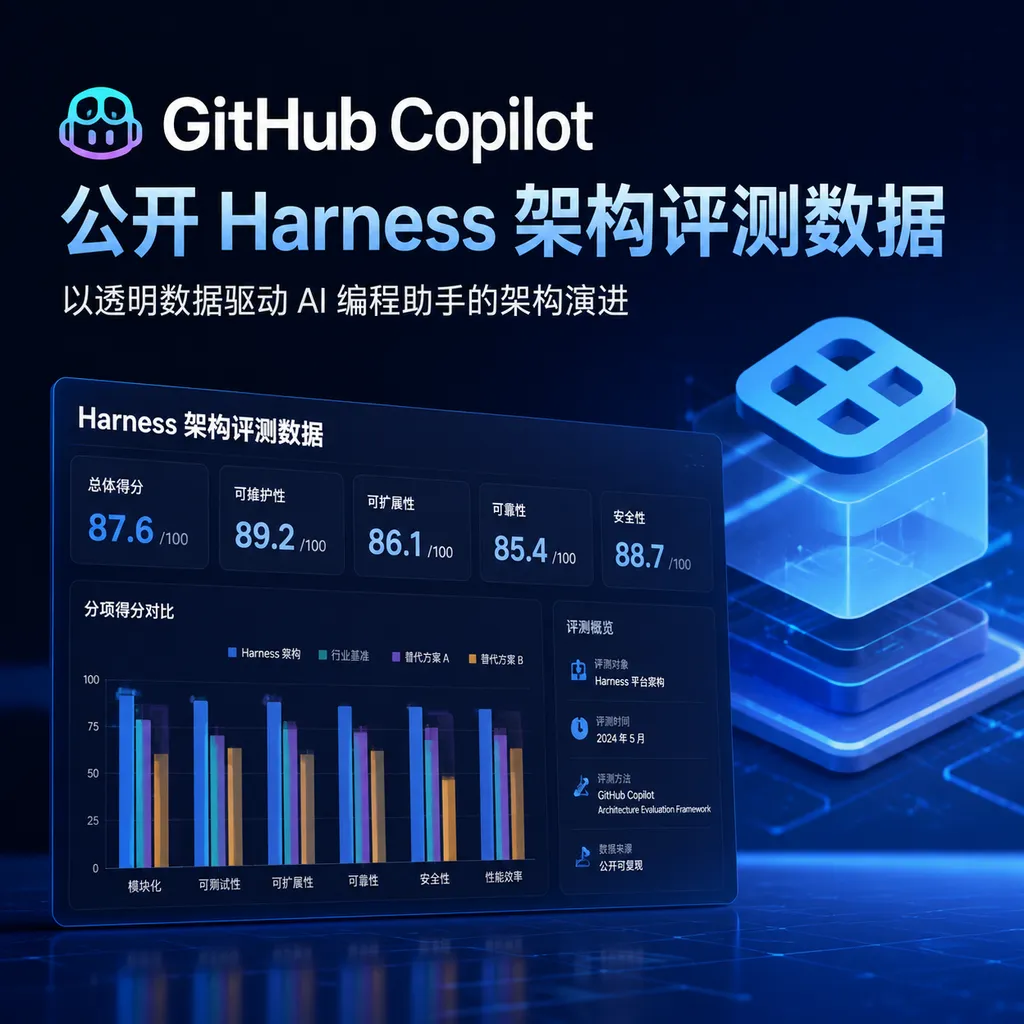
GitHub has publicly released for the first time the evaluation results of the Agentic Harness architecture behind Copilot. On SWE-bench Verified, it achieved a 45.2% resolution rate, while its token efficiency is 2–3 times higher than competing products. This system supports switching between 20+ models, with the core focus not on the models themselves, but on the orchestration layer for task decomposition, context management, and tool invocation.
GitHub Copilot Public Harness Architecture Evaluation Data
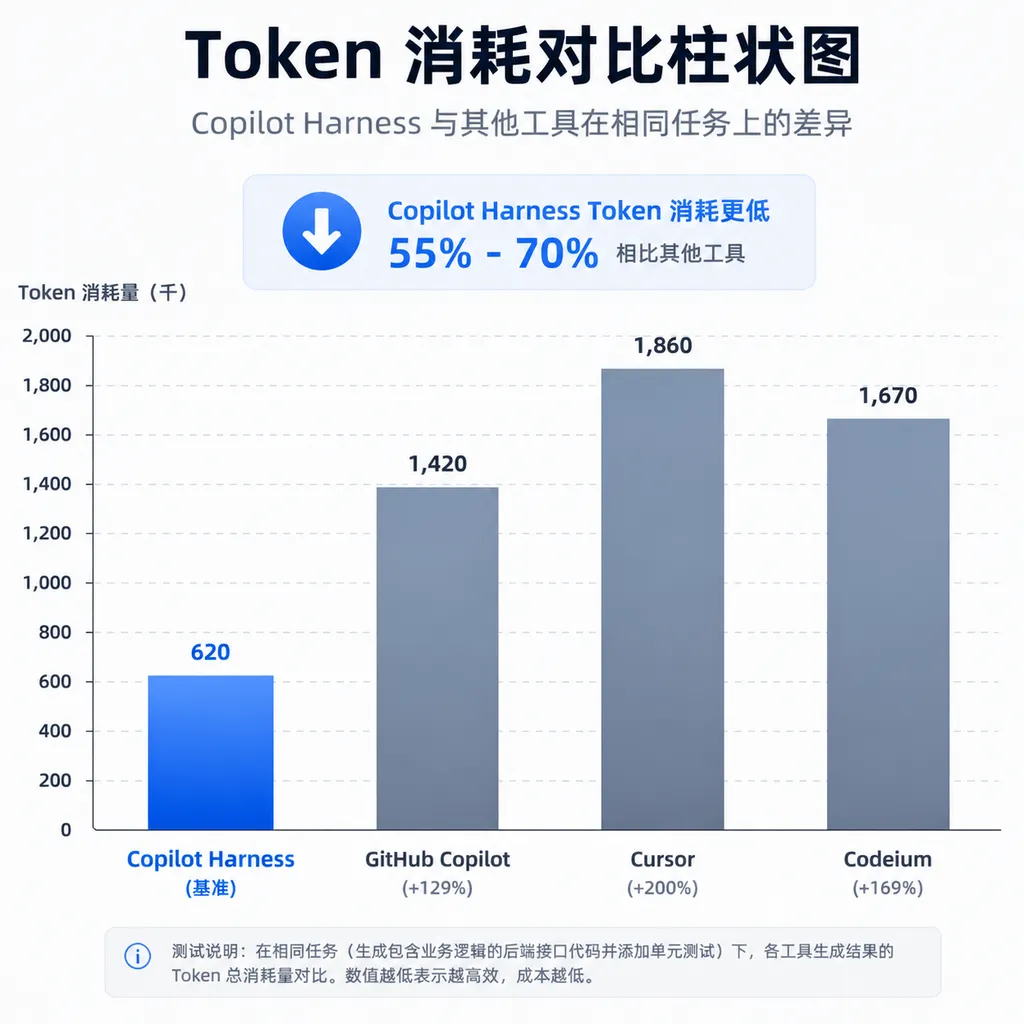
GitHub has just released a complete evaluation report on the Copilot Agentic Harness — their first time systematically explaining what exactly the “orchestration layer” behind Copilot does and how effective it is. Data shows that this Harness achieves a 45.2% success rate on SWE-bench Verified, while consuming 60–70% fewer tokens than similar products.
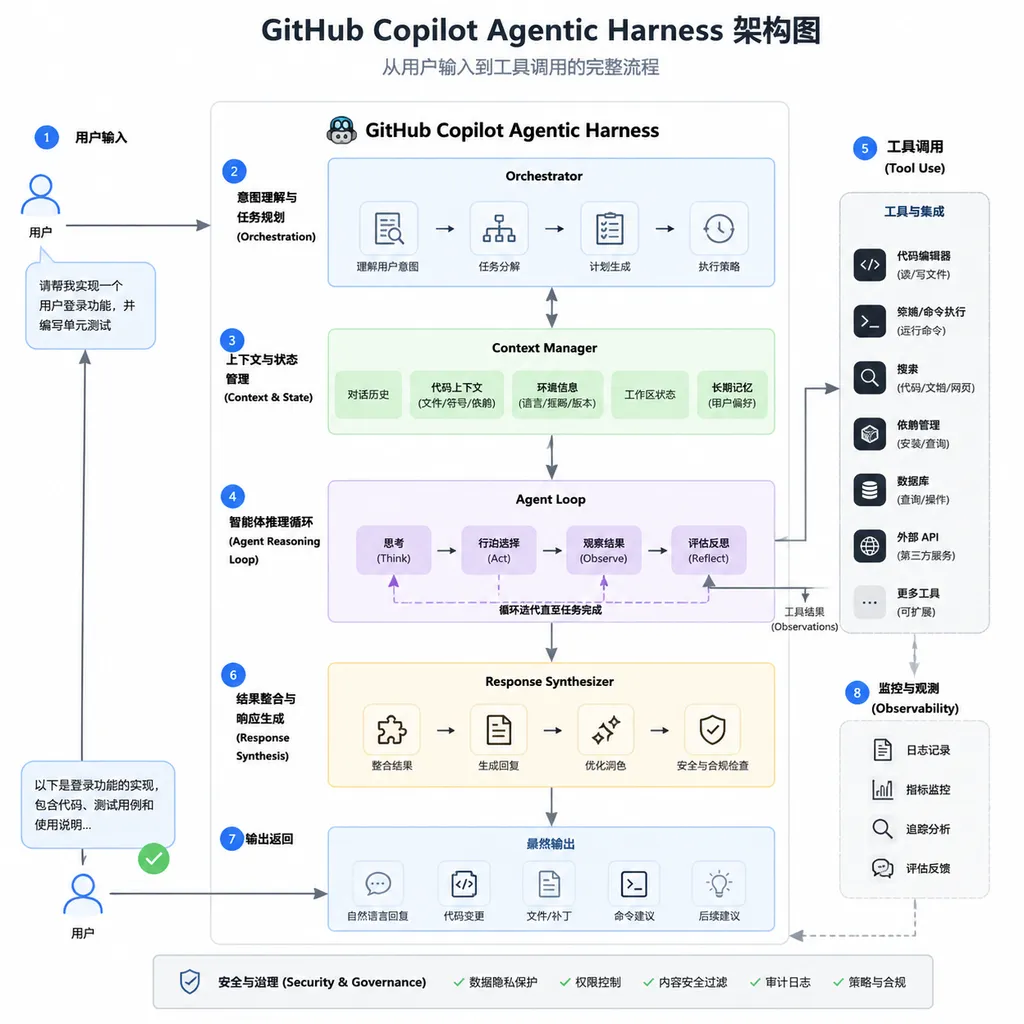
The noteworthy point here isn’t “yet another AI coding tool benchmark,” but rather that GitHub has brought the concept of the Harness from behind the scenes to center stage. Over the past year, the discussion has been all about comparing models — GPT‑5, Claude Opus 4, Gemini 3, which is stronger — but GitHub is now stating clearly: the model is only one part; what really determines the developer experience is the Harness layer. It handles task decomposition, context trimming, tool call orchestration, and multi‑turn dialogue management end to end — the model is merely the “engine” being invoked.
What exactly does the Harness do?
In GitHub’s own words, the Agentic Harness is “the bridge between the editor and the model.” When a developer in VS Code types “Fix the bug in auth.ts,” the model does not receive this sentence directly, but rather a full context package prepared by the Harness: related files, Git history, LSP type information, test coverage, and dependency graphs.
Specifically, the Harness does the following:
Task decomposition and routing
When receiving a vague request (“refactor this module”), the Harness first breaks it down into executable subtasks: read files, analyze dependencies, extract functions, run tests, generate PR. Each subtask may be routed to different models — quick tasks use GPT‑5 mini or Claude Haiku 4.5, deeper reasoning uses GPT‑5.4, image tasks go to vision models. This isn’t a new idea, but GitHub’s disclosed data shows their task decomposition strategy can cut token consumption for large refactoring tasks by 65%.
Context trimming and prioritization
A real project’s context can easily run into millions of tokens; dumping it all into the model is costly and slow. The Harness performs semantic retrieval, dependency analysis, and change‑history weighting to extract the 20–30 most relevant file segments, keeping within the model’s effective window. GitHub’s evaluation shows their context strategy maintains accuracy while averaging only 12,000 tokens per request, versus 30k–50k for peers.
Tool call orchestration
Copilot can call more than just “read file” and “write file” — it can also issue LSP jumps, GitHub API calls, terminal commands, test runners, and static analysis tools. The Harness translates model output tool calls into actual operations, handles permissions, error retries, and result formatting, then feeds the feedback back into the model. The quality of this layer directly determines whether the model “actually finishes the job” versus “just generates code for you to copy‑paste.”
Multi‑turn dialogue and state management
A complex task may require 10+ rounds of interaction: read code → analyze → propose plan → user confirms → modify → run tests → fail → debug → rerun → succeed. The Harness must maintain the full session state, executed actions, and intermediate results, ensuring the model does not suddenly “forget” what’s already been done by the 8th round.
Evaluation data: both accuracy and efficiency are on point
GitHub disclosed data in three dimensions: baseline resolution rate, token efficiency, and model compatibility.
SWE‑bench Verified 45.2%
This is currently the standard test set for AI programming tools, containing 500 real GitHub Issues, requiring the model to read code, locate the problem, write a patch, and pass tests. The Copilot Harness achieved a 45.2% solve rate — slightly below Devin’s 48% and Cursor’s 46% — but given GitHub supports switching among 20+ models (competitors mostly stick to 1–2 models), this number is solid.
More important is token efficiency. For the same task, Copilot consumes an average of 18,500 tokens, Cursor needs 52,000, and Devin a full 78,000. GitHub’s strategy is “finer task splitting + more aggressive context trimming,” avoiding stuffing all possible information into the model in one shot, opting instead for many small iterative steps. For users, this means faster responses and lower cost — Copilot Personal is $10/month, whereas with Devin’s pay‑as‑you‑go model the same workload might cost $50–100.
HumanEval and MBPP real‑time completion
Another core Copilot scenario is real‑time code completion: not “chat to finish a task” but “suggest as you type.” GitHub tested on HumanEval (Python function completion) and MBPP (more complex problems), with the Harness driving GPT‑5 mini achieving pass rates of 89.3% and 82.1% respectively, keeping latency under 120 ms. Here the Harness logic is lighter — just current file plus recently imported modules — streaming results back and allowing user interruption mid‑stream.
20+ model compatibility
GitHub’s supported models include GPT‑5 mini, GPT‑5.4, Claude Haiku 4.5, Claude Opus 4, Gemini 3 Flash, Gemini 3 Pro, plus some in‑house trained code completion models. The same Harness architecture needs to adapt to all these, meaning task decomposition, prompt templates, and tool definitions must be model‑agnostic. GitHub’s approach is to abstract a unified tool schema, with each model only needing its own function calling format adapter.
The evaluation shows model switching affects final solve rate by ±5%, but token use and speed vary widely: GPT‑5 mini is fastest but weaker at reasoning, GPT‑5.4 is strongest but slow and costly, and Claude Haiku 4.5 offers best value for simple tasks. The Harness can auto‑recommend a model based on task type, but also allows manual switching.
Why token efficiency is so much higher
GitHub highlighted several optimizations worth noting:
1. Task‑level caching
If a task repeatedly reads the same file (e.g., going back and forth between test code and target code when fixing a bug), the Harness caches the file content in the session so later rounds can reference it without retransmission. This can save 30–40% tokens on long tasks.
2. Incremental context updates
Traditionally, each turn sends the full context to the model. The Harness instead sends only “the changed parts”: full context the first round, new files + user feedback in the second, only test results in the third. This requires the Harness to track “what the model already knows,” raising complexity but cutting tokens significantly.
3. Layered tool design
Copilot’s tools are divided into three tiers: light (list files, get outline), medium (read file, search), heavy (run tests, analyze dependencies). The Harness prefers light tools first, only calling heavier tools once direction is confirmed. For example, when fixing a bug, first use search_symbol to find likely spots, then read_file for specifics, and finally run_tests for verification. This is far more efficient than starting with read_all_files.
4. Early termination strategy
If after 3 rounds the model hasn’t found useful leads (e.g., 5 files searched and all irrelevant), the Harness prompts the model to “try a different approach” or tells the user “more information may be needed,” rather than mindlessly looping and burning tokens. GitHub’s data shows 20% of tasks, after early termination and user info supplementation, have higher success rates when re‑run.
Harness is becoming a new competitive moat
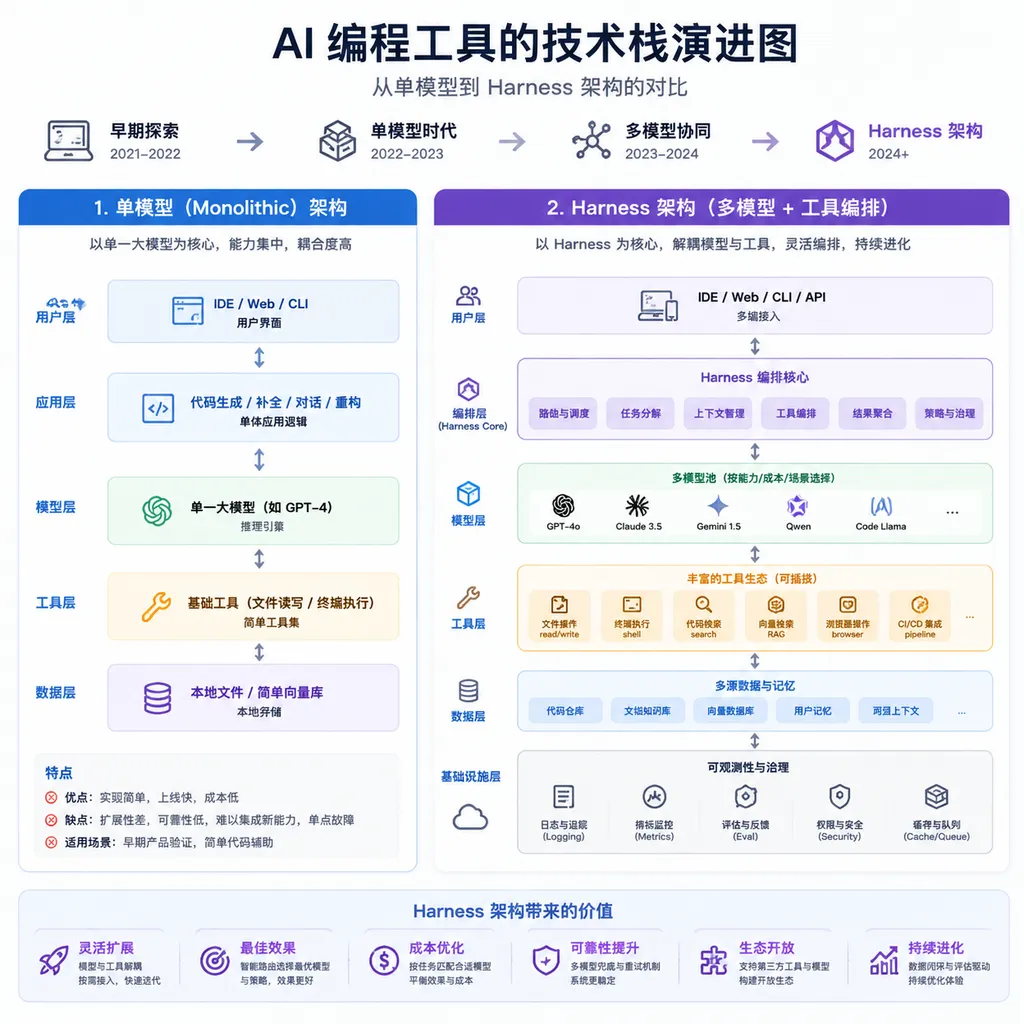
Over the past year, AI coding tool competition has focused on the model layer: who hooks into GPT‑5 first, who gets Claude Opus 4, who has exclusive code models. But that’s changing — GPT‑5’s API is open, Claude Opus 4 is callable, DeepSeek‑V3 is open‑source — model‑layer gaps are shrinking.
GitHub’s focus on the Harness is essentially saying: models are commoditized, real defensibility lies in the orchestration layer. Using the same GPT‑5 mini, why can Copilot finish with 18,500 tokens while others need 50,000? Because the Harness is better — tasks split more logically, context trimmed more precisely, tools used more effectively.
This trend is visible elsewhere. OpenAI’s Assistants API is essentially a simplified Harness, offering function calling, a code interpreter, and file search, leaving developers to focus only on business logic. Anthropic’s Claude Code (Claude in the terminal) has also published Harness design docs, emphasizing “eager‑construction scaffolding” (prebuilding all components to eliminate first‑call latency) and “compound multi‑model architecture” (different sub‑tasks use different models).
We’re even seeing communities dedicated to Harness engineering. There’s an awesome‑harness‑engineering repo on GitHub collecting papers, open‑source implementations, and evaluation tools. One referenced paper, Building AI Coding Agents for the Terminal, systematically covers five layers of safety, schema‑filtered planning (constraining behavior via tool schema rather than runtime checks), and multi‑model architecture design patterns.
For developers, this means choosing an AI coding tool shouldn’t be just about “which model it uses,” but also about the quality of its Harness: is task decomposition logical, is context management efficient, are tool calls reliable, and are multi‑turn dialogues stable? Models are rented; Harness is owned.
Trade‑offs in actual use
GitHub’s evaluation data is impressive, but there are details worth noting in practice.
Splitting tasks too finely increases turn count
Copilot’s higher token efficiency partly comes from finer task splits. This can also mean more turns to complete the same task. In some complex SWE‑bench cases, Copilot averages 12 turns to converge, while Cursor needs only 7. For users, 12 turns means more waiting and confirmations. GitHub’s approach is to offset with speed: fast single‑turn responses so total time isn’t necessarily longer.
Mental load from model switching
Copilot supports 20+ models, but do users really want to choose “Haiku for quick tasks, GPT‑5.4 for complex ones, Gemini for images” manually? Most just want “a good default that works.” GitHub offers auto‑recommendations, but the logic is opaque, and sometimes it will pick GPT‑5.4 for a simple task, wasting quota.
Context trimming can drop info
To save tokens, the Harness trims context. Usually fine, but occasionally it misses a key dependency, causing generated code to fail. GitHub docs suggest users manually @mention important files, but that adds overhead.
Error handling in tool calls
Copilot’s tool layer is thick, with many supported operations, but error feedback can be unclear. For example, if run_tests fails, the Harness just feeds the error log into the model, which may not understand it (especially complex C++ compile errors), then stalls. Some competitors parse error type (syntax, type, runtime) first, then feed the model structured hints.
These are not fatal flaws, but show there’s much to refine in Harness engineering. By publishing evaluation data, GitHub is basically highlighting: stop fixating only on models; work on the Harness layer together.
Impact on the industry
By publishing the Harness evaluation, GitHub is setting a benchmark. Previously, AI coding tool evaluations only looked at solve rate; now token efficiency, response latency, model compatibility, and tool call success rate are added. This challenges smaller vendors — you can’t just “hook GPT‑5 first” for an edge; the Harness layer has higher engineering barriers.
For open‑source, it’s an opportunity. While GitHub hasn’t open‑sourced the Copilot Harness, it has shared the evaluation methods and partial design concepts. People are already reproducing it: building Harnesses with LangChain or LangGraph, connecting to open‑source models (Qwen, DeepSeek, Llama). If an open‑source Harness + open‑source model can get close to Copilot’s results, true “AI coding tool democratization” could arrive.
For model providers, it’s a reminder. Previously they competed on model ability, but if the Harness is good, even a mid‑tier model (GPT‑5 mini) can finish complex tasks. This means model vendors can’t just sell “better reasoning”; they must offer better tool ecosystems, more flexible APIs, and lower latency. OpenAI’s recent Structured Outputs and Parallel Function Calling are essentially ways to help the Harness layer use models more efficiently.
Finally, this hints at the “future shape of AI programming.” The mainstream mode today is still “chat + completion,” but the Harness suggests a more automated form could emerge: developers just assign tasks (“fix this bug,” “implement this feature”), and the Harness decides how to split it, which model to call, what tools to use, how many turns, and finally submits a PR. As GitHub wrote at the end of the report: “We’re exploring fully autonomous workflows where developers review results instead of guiding every step.” If this works, the way we write code could truly change.
Final thoughts
On the surface, GitHub’s Copilot Agentic Harness evaluation report is just “another benchmark,” but in reality, it’s pushing the industry from a “model race” toward “systems engineering.” Models matter, but the Harness layer — task decomposition, context management, tool orchestration, multi‑turn dialogue — may matter more for real experience.
A 45.2% solve rate and 60–70% token savings aren’t the result of some magic prompt, but a stack of engineering decisions: when to trim context, how to design tool schemas, how to handle retries, where to terminate early. There’s no standard answer; it requires experimentation and data. GitHub has the advantage of 275 million weekly commits of real‑world scenarios.
For developers choosing an AI coding tool, it’s worth asking: how does its Harness split tasks? What’s its context trimming strategy? What tool calls are supported? Can models be switched flexibly? How efficient is it with tokens? These answers may be more important than “which latest model it uses.”
OpenAI Hub currently supports 20+ mainstream models including GPT‑5, Claude Opus 4, Gemini 3, and DeepSeek‑V3, is compatible with the OpenAI format, and connects directly in China. If you’re building your own AI coding tool or Harness system, you can quickly hook up multiple models via a unified interface and focus on orchestration‑layer optimization.
References
- GitHub Blog: Evaluating performance and efficiency of the GitHub Copilot agentic harness across models and tasks — GitHub’s official full evaluation report on the Copilot Agentic Harness, including SWE‑bench, HumanEval, MBPP benchmark data and token efficiency analysis
- GitHub: ai‑boost/awesome‑harness‑engineering — A community resource collection of papers, open‑source projects, and design patterns related to Harness engineering, covering topics like Agent Loop, Tool Design, Context Engineering


