
Token Finally Has a “National Standard”? CAICT, Together with 22 Industry Giants, Forms a Token Service Working Group
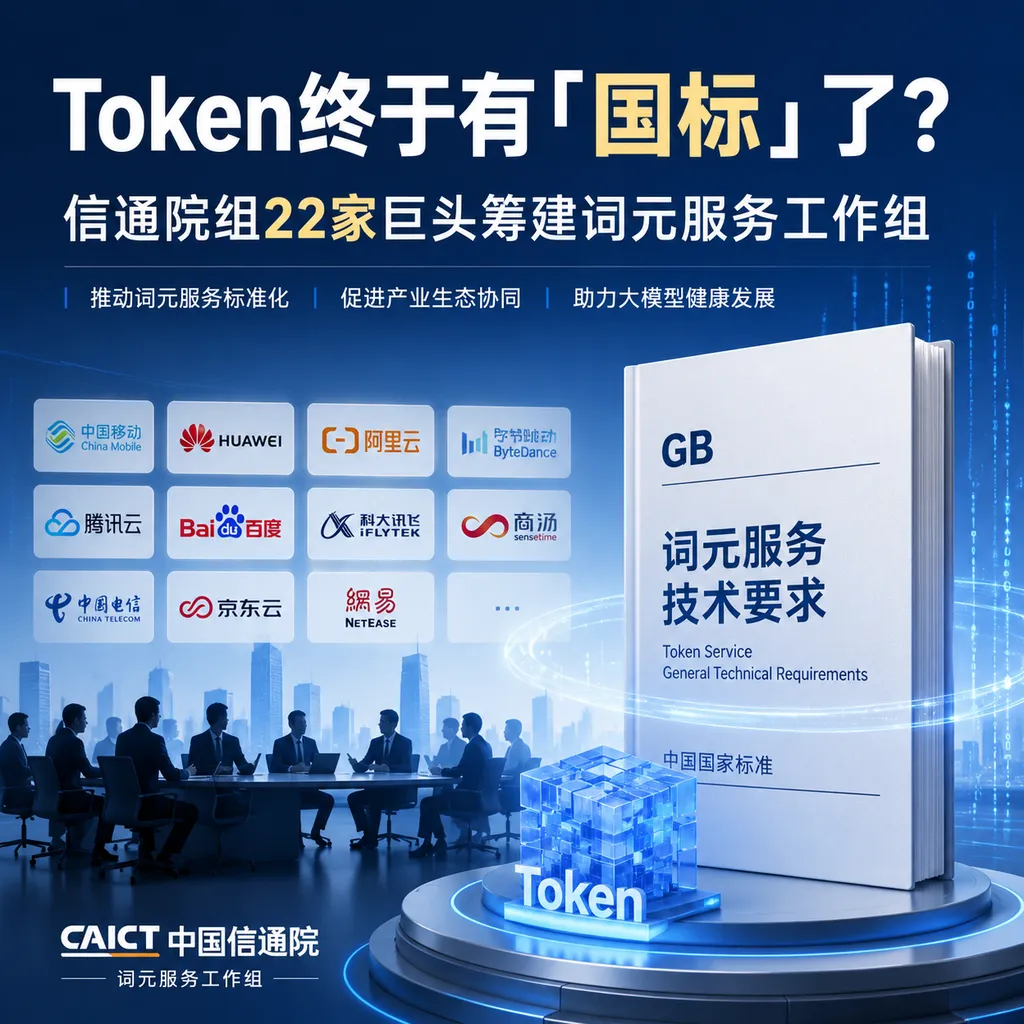
The China Academy of Information and Communications Technology, together with Huawei Cloud, Baidu Intelligent Cloud, the three major telecom operators, and 22 other organizations, has officially launched the preparatory work for the AIIA Token Service Working Group. This is the first domestic attempt to establish a unified standard system for AI large model token services, covering key aspects such as measurement and billing, service quality, and cross-border flow.
Token Finally Has a “National Standard”? CAICT Leads 22 Giants to Prepare Token Service Working Group
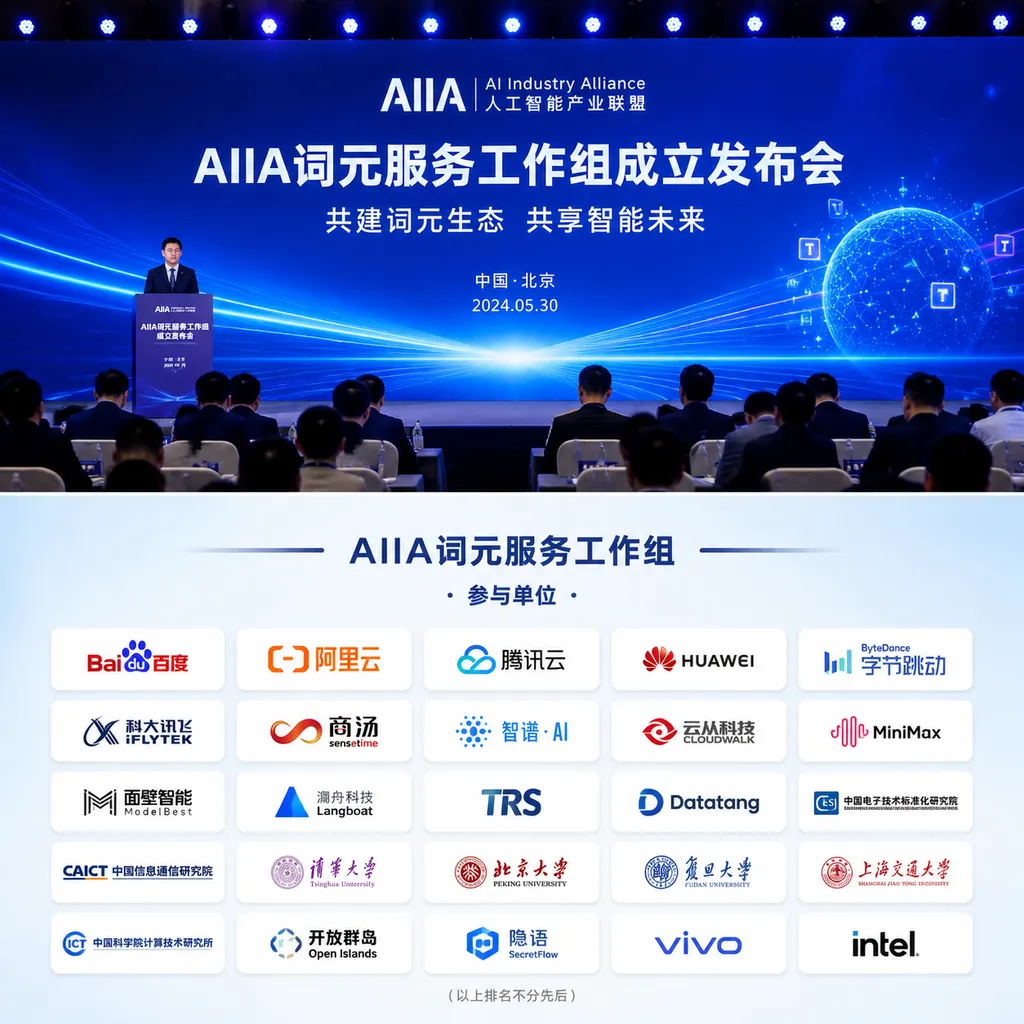
On June 25, the Artificial Intelligence Industry Alliance of China (AIIA) officially launched preparations for a Token Service Working Group. The leading party is the China Academy of Information and Communications Technology (CAICT), with participation from Huawei Cloud, Baidu Intelligent Cloud, China Mobile, China Telecom, China Unicom, and 22 upstream and downstream enterprises in the industry chain.
Simply put, this is the first domestic attempt to set rules for Token services in large models.
Why Now?
Anyone who has developed large models knows that the Token is the “currency unit” of AI services — each time you call an API, you consume a certain number of Tokens, and you pay accordingly. But the problem is, this “currency” currently has no unified standard of measurement.
Different vendors calculate Tokens differently. The same piece of Chinese text might be counted as 500 Tokens by Vendor A, but 800 Tokens by Vendor B. Even worse, pricing strategies, service quality commitments, and response latency standards differ, with each vendor setting their own rules.
This causes several real issues:
First, cost transparency is lacking. When enterprises purchase large model services, they can hardly make horizontal comparisons between vendors. One says 15 yuan per million Tokens, another says 20 yuan per million Tokens, but the Tokens themselves aren’t the same.
Second, service quality varies. Some vendors’ response latency spikes during peak hours, some impose traffic limits or throttling, but contracts often lack clear SLA terms. When problems arise, resolving disputes is costly.
Third, security and compliance are questionable. Token services involve data transmission and processing, especially in sensitive industries like finance, healthcare, and government. Without a unified security baseline, compliance departments cannot rest assured.
CAICT’s leadership this time is essentially aimed at fixing these “infrastructure-level” confusions.
What Will the Working Group Do?
From public information, the AIIA Token Service Working Group has a broad scope, covering the full life cycle of Token services. I’ve broken it into core directions:
1. Establish Token Service Standards
This is the most fundamental part. The Working Group plans to develop standards covering the whole process — from Token production, circulation, application, operation, measurement, to billing.
Specifically, this may include:
- Token Measurement Norms: Unify Token calculation methods for different content types (Chinese, English, code, etc.)
- Billing Basis: Clarify pricing logic for input Tokens and output Tokens
- Service Level Definitions: Quantify what “high availability” and “low latency” mean
For developers, this means price comparisons could be easier in the future — at least everyone uses the same ruler.
2. Build Token Service Monitoring Platform
The Working Group mentions promoting construction of a “Token Service Capability Monitoring Platform”, conducting continuous monitoring, and periodically publishing monitoring and research reports.
In plain terms: this is like a “third-party evaluation” of large model vendors’ API services. Response speed, stability, outage frequency — all with official backed data.
For enterprise procurement decision-makers, this is far more trustworthy than vendors’ own promotion materials.
3. Industry-Specific Scenarios
Finance, healthcare, and government are explicitly listed as priority industries. The Working Group plans to set “scenario-based Token service capability baselines” for these industries.
This is practical: different industries have different requirements for Token services.
- Finance: Highly latency-sensitive, extreme data security requirements, possibly needing private deployment or dedicated access lines
- Healthcare: Involves patient privacy, must comply with the Personal Information Protection Law and healthcare data regulations
- Government: Hard requirements for domestic, independently controllable tech
Unified industry baselines can help vendors avoid detours and help clients avoid pitfalls.
4. Build Security and Trust Systems
The Working Group plans to launch “Token service-related security commitments”, develop basic requirements for Token security and trustworthiness, and conduct evaluation and testing.
This is key. Currently, security capabilities disclosure for large model API services is not transparent. Is data transmitted encrypted? Will it be used for model training? Who is responsible for security incidents? Many vendors keep it vague.
With official-backed standards and evaluation, at least vendors will be forced to clarify these issues.
5. Cross-Border Token Flow Mechanism
This is often overlooked but very important.
The Working Group proposes to “promote construction of cross-border Token flow mechanisms”, focusing on bottlenecks in data compliance and transmission latency across countries, and to produce research reports, along with supporting technical and compliance standards.
Background: More and more Chinese enterprises are going global, needing AI services abroad; likewise, multinational enterprises in China need to call domestic large models. Tokens, as data carriers, face complex compliance issues when crossing borders.
Currently, regulations on cross-border AI data are still forming globally. If China can establish its own rules early, it can gain more international influence.
6. Domestic Independent Control
The final direction is promoting “domestic Token independent control capabilities”, building a complete chain around domestic large models, domestic computing power, and domestic development frameworks.
This is a policy-driven necessity. In key information infrastructure, domestic substitution is a trend. Token services, as the underlying support for AI applications, naturally fall within scope.
Analysis of the 22 Participants
From public info, participants cover several key types:
Cloud Vendors: Huawei Cloud, Baidu Intelligent Cloud — main Token service suppliers, holding computing and model resources.
Telecom Operators: China Mobile, China Telecom, China Unicom — the three major operators have been entering AI business and have natural advantages in network infrastructure. Low-latency Token service transmission relies on network support.
Other participants are still open for recruitment, but this looks like a practical working group — Huawei Cloud and Baidu Intelligent Cloud are top players in Token services, and the three major operators represent national interests.
What Does This Mean for Developers?
On a practical note: If you’re a large model app developer, this Working Group may bring changes in the medium to long term.
More Transparent Costs
Once Token measurement has a unified standard, vendor pricing can be compared directly. Good for smaller developers — less chance of being trapped by differing “measurement methods”.
More Reliable Service Commitments
If the Token Service Monitoring Platform materializes, SLAs will have third-party verification. Claims of “99.9% availability” can be validated by data.
Clearer Compliance Paths
For finance, healthcare, and government developers, having industry-level Token service baselines makes client discussions easier. Clear compliance requirements eliminate repetitive disputes.
Potential Entry Barriers
Standardization can also have downsides — once mandatory standards or conventions form, smaller vendors’ compliance costs rise. For low-cost, small Token service vendors, this may be bad news.
Issues to Watch
Whether this Working Group can truly work depends on execution. Questions to watch:
How enforceable are the standards?
For now, outputs may be industry or group standards, not mandatory national standards — vendors can choose not to adopt. Implementation depends on top vendors’ willingness and market acceptance.
Will monitoring data be public?
They plan regular reports. Key: Will they be public? Will specific vendors be named? If only anonymized aggregated data is released, its value is limited.
Balancing interests
Participants include both cloud vendors and telecom operators, large enterprises and SMEs. Needs differ — large vendors might want higher thresholds to cement advantage, small vendors lower ones to survive. Balancing will test coordination.
Can cross-border rules be implemented?
This involves international cooperation and multilateral coordination — progress may be slow.
Bigger Picture
Viewed in the AI industry development context, this reflects a trend: Large model services are moving from “wild growth” to “regulated operation”.
In the past two years, domestic competition focused on model capabilities — parameter counts, benchmark scores, inference costs. As capabilities become similar, competition is shifting to service quality: stability, availability, security, compliance.
This is where standards shine. Without them, vendors speak their own language; with them, you can compare, evaluate, and trust.
Internationally, there are no unified standards for Token services among OpenAI, Anthropic, Google, etc. If China can establish such a system early, it could gain a first-mover advantage in competition — at least with exportable rules when services go global.
Final Thoughts
CAICT leading Token service standardization is unsurprising — standardization is inevitable at a certain stage of AI industry development.
Success depends on key factors: whether top vendors truly participate, whether standards meet real needs, and whether there’s strong enforcement.
The group is still in preparation, with public recruitment for interested participants. If your company is related to Token services, watch developments.
For ordinary developers, short-term impact is minimal. But if the standards are implemented in the next year or two, calling large model APIs should become more transparent and predictable.
That’s good news.
References
- CAICT teams with Huawei Cloud and 22 units to prepare founding of AIIA Token Service Working Group - IT Home: Original report with detailed description of the seven directions of the Working Group.


