
Qualcomm Teams Up with Hugging Face: A New Edge-to-Cloud AI Battlefield for 16 Million Developers

Qualcomm and Hugging Face announced an expanded partnership to integrate millions of open-source models with Qualcomm’s full range of chips, covering everything from smartphones and IoT to data centers, in an attempt to carve out a share of the AI computing market dominated by NVIDIA.
Qualcomm has finally made up its mind to go head-to-head with NVIDIA in the AI developer ecosystem.
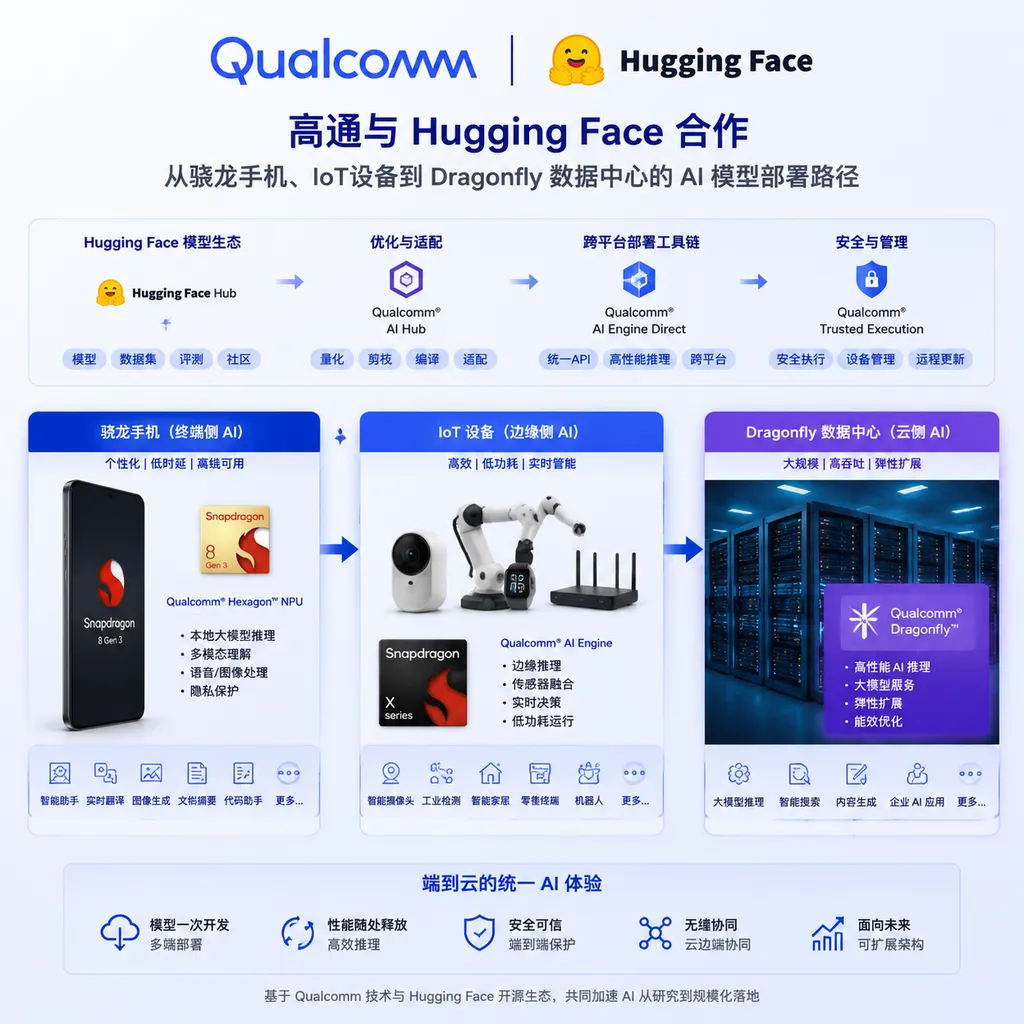
On June 25, Qualcomm announced an expanded cooperation with Hugging Face. This isn’t their first collaboration, but this time the ambition is clearly bigger—they plan to integrate over a million AI models on Hugging Face with Qualcomm’s full product line, from mobile chips to data centers, enabling developers to seamlessly deploy AI applications across Snapdragon smartphones, IoT devices, and Dragonfly servers.
Simply put: Qualcomm wants to turn Hugging Face’s 16 million developers into its “off-the-books employees.”
What exactly is this cooperation about
Let’s break down the three core directions announced:
First, deep integration at the data center level. Hugging Face’s AI storage and inference services will be adapted to Qualcomm’s Dragonfly data center solutions. This means enterprise customers can directly run Hugging Face-hosted models on Qualcomm’s data center chips without worrying about environment configuration.
Second, accelerated deployment on devices. Models in the Hugging Face ecosystem will be integrated with Qualcomm platforms via agents—Snapdragon (mobile/PC), Leap Dragon (IoT/automotive), Dragonfly (data center). Previously, developers wanting to run an open-source model on a Snapdragon chip had to do their own quantization, optimization, and adaptation; now Qualcomm and Hugging Face will handle that grunt work.
Third, a distributed AI framework. This is the most interesting part. The two plan to support a framework allowing AI agents to “flow flexibly” between devices and cloud. Translation: An AI assistant can handle simple tasks on your phone, and when faced with complex problems, switch seamlessly to the cloud for computation, then pass the result back—without the user noticing the switch.
Why now
It’s pretty clear why Qualcomm chose this moment to expand cooperation.
Over the past two years, the AI compute market has been dominated by NVIDIA. The training side is obvious—H100/H200 are in short supply; on the inference side, although there are more players, CUDA’s ecosystem moat makes most developers reluctant to switch—if your code runs once, why bother changing platforms?
Qualcomm’s dilemma: It has good AI chips, but not a large enough developer ecosystem to feed them.
The Snapdragon 8 series NPU has increased compute power with each generation, the Hexagon processor’s energy efficiency is impressive, and last year’s Dragonfly data center solution targeted the inference market. But the question is: Why would developers optimize models for Qualcomm specifically? Who bears the adaptation cost?
Hugging Face just happens to fill this gap.
As the world’s largest open-source AI community, Hugging Face hosts over a million models covering NLP, CV, and multimodal fields. More importantly, it has 16 million registered developers and a mature set of infrastructure for model distribution, hosting, and inference.
For Qualcomm, deeply binding with Hugging Face means instantly gaining:
- A massive library of pre-trained models: No need to build their own
- An active developer community: No need to run developer outreach themselves
- Standardized deployment processes: No need to define their own toolchain
This deal makes sense no matter how you calculate it.
What Hugging Face gets
Cooperation is a two-way relationship; Hugging Face isn’t doing charity.
From a business perspective, Hugging Face has been working to transform from an “open-source community” into an “AI infrastructure service provider” over the past two years. Its Inference Endpoints, Spaces hosting, and PRO subscriptions all head in that direction. But the cloud inference market is competitive—AWS, GCP, Azure all fight for it—so Hugging Face needs differentiation.
On-device AI is a differentiated entry point.
Think about it: If models on Hugging Face can be deployed with one click to billions of Snapdragon devices, its value proposition shifts from “hosting your model” to “running your model anywhere.” For enterprise customers, this is a completely different level of appeal.
More pragmatically, Qualcomm has promised to offer Hugging Face PRO access to customers using its chips. This means Qualcomm is pushing Hugging Face locally—buy my chips, get PRO membership—for mutual benefit.
Technical details: How models go from cloud to devices
After talking about the business logic, let’s see how this works technically.
The biggest challenge in on-device AI deployment is that models are too big, and device compute power is too small. A 7B parameter LLM in FP16 precision needs about 14GB of VRAM—ordinary phones can’t run that. So the core work for on-device deployment is model compression and inference optimization.
Quantization is the first step
Quantization essentially lowers numerical precision to reduce model size and boost computation speed. Common methods include:
- INT8 quantization: Compress FP16 weights to 8-bit integers, halving model size, with usually acceptable precision loss
- INT4 quantization: Further compress to 4-bit, again halving size, but requires more precise calibration
- Mixed precision: Keep key layers at high precision, aggressively quantize non-critical layers
Qualcomm’s AI engine has specific optimizations for quantized models; Hexagon NPU is highly efficient at low-precision integer operations. A key aspect of this cooperation will likely be that Hugging Face provides pre-quantized models optimized for Qualcomm hardware—developers just download and use.
Operator optimization is the second step
Deep learning models are essentially combinations of mathematical operations—matrix multiplications, convolutions, attention computations, etc. Different hardware supports different operations to varying degrees.
For example, the self-attention mechanism in Transformer models involves lots of matrix multiplications, which can be highly parallelized on GPU but might need rewriting to suit vector processing units in NPU. Such low-level operator optimization usually requires close collaboration between chip makers and framework developers.
Qualcomm already has an AI Engine Direct SDK supporting models exported from mainstream frameworks (PyTorch, TensorFlow, ONNX). This Hugging Face cooperation likely means deeper integration into the transformers library, making it easier for developers to export Qualcomm-optimized models.
Distributed inference—longer-term goal
The “distributed AI framework” mentioned in the announcement is where imagination runs wild.
One possible implementation is model partitioning: break a large model into smaller modules, with simple modules running locally and complex modules in the cloud. For example, a chatbot could handle casual conversation locally but go to the cloud when needing to research.
Another possibility is dynamic scheduling: decide in real time where tasks execute based on device status (battery, network, compute load). This requires a well-designed orchestration system—technically challenging.
But whatever the approach, the core value is blurring the boundary between devices and cloud. For developers, you just write one codebase and the runtime decides where to execute; for users, the experience is smoother and privacy more controllable.
Comparing with competitors—how strong is Qualcomm’s hand
To assess this cooperation’s significance, you have to see Qualcomm in the competitive landscape.
On-device AI chips: Qualcomm, Apple, MediaTek in a three-way contest
In mobile SoCs, Qualcomm’s AI capability is definitely first-tier. Snapdragon 8 Gen3’s Hexagon NPU reaches 73 TOPS, able to run models with tens of billions of parameters. Apple’s Neural Engine is also strong but only serves its own ecosystem. MediaTek’s Dimensity 9300 is close behind, offering better cost efficiency.
Qualcomm’s advantage is open ecosystem. Apple’s Core ML is only available for iOS developers; Qualcomm’s chips are in hundreds of brands’ phones, giving it a much larger potential developer base. This Hugging Face partnership further amplifies that advantage.
Data center inference: No match for NVIDIA, but room for differentiation
Honestly, in the data center market, Qualcomm’s Dragonfly isn’t on the same level as NVIDIA’s H100/H200—not in compute power and especially not in ecosystem lock-in, since almost all AI frameworks and training code are written for CUDA.
But inference market logic differs from training. Training demands peak performance; inference seeks cost efficiency. If Qualcomm can deliver similar inference performance at lower chip cost and energy consumption, cost-sensitive enterprises will be interested.
By partnering with Hugging Face, Qualcomm is effectively saying: “You don’t need to adapt your models to my chips—Hugging Face has done it for you.” That lowers migration costs—a smart strategy.
Developer ecosystem: This is the real battlefield
Chip performance can be chased; ecosystem barriers are the hardest to overcome.
NVIDIA’s moat isn’t GPU performance—it’s the CUDA ecosystem built over more than a decade, with millions of developers, thousands of optimized libraries, countless tutorials and code samples. These create developer path dependency.
Qualcomm can’t break this dependency by just making SDKs and tutorials. It must leverage existing developer communities. Hugging Face is the largest AI developer community, with 16 million users; even if only 10% try Qualcomm solutions, that’s 1.6 million potential developers.
Qualcomm has calculated this clearly.
What this means for developers
After all this strategic talk, let’s look at what this means for ordinary developers in practice.
Short term: Wait for toolchains to mature
The announcement is just the first step; tools and SDKs will take time to materialize. Based on past experience, it usually takes 6–12 months from announcing a partnership to developers getting mature tools.
Suggestions for now:
- Follow Qualcomm’s section on Hugging Face: There will likely be a dedicated model hub page listing all models optimized for Qualcomm
- Familiarize yourself with Qualcomm AI Engine SDK: Learn the basic toolchain so you can get started faster when new features release
- Experiment with on-device inference: If you have a Snapdragon 8 series phone, try current on-device LLM solutions (like MLC-LLM) to understand the on-device AI limits
Medium term: Device-cloud hybrid deployment will become a new paradigm
If the distributed AI framework really lands, device-cloud hybrid deployment could become standard for many applications.
Imagine scenarios:
- Smart assistant: Casual conversation processed locally for privacy; only goes to cloud for internet searches
- Real-time translation: Simple sentences translated locally; complex ones sent to cloud
- Image processing: Basic filters run locally; AI-enhanced edits run in the cloud
This hybrid architecture benefits latency, cost, and privacy, but also adds development complexity. Whoever makes this paradigm work gains a head start in the next wave of AI applications.
Long term: Hardware heterogeneity is the trend
Looking further ahead, hardware heterogeneity in AI inference is irreversible.
The future won’t be “all AI runs on NVIDIA GPUs” but “different hardware for different scenarios”—training on NVIDIA, cloud inference on various accelerators, on-device inference on NPUs, edge computing on specialized chips.
For developers, this means: Don’t tie yourself to one platform. Use higher-abstraction tools (like Hugging Face’s Optimum library) to keep code portable.
Qualcomm and Hugging Face’s cooperation essentially pushes this abstraction—letting developers focus on models and applications without worrying about the underlying chips.
Some cooler thoughts
A few less optimistic points to note:
First, PPT to product distance can be far. Tech companies’ launch visions are always beautiful, but actual engineering can be much harder. Both Qualcomm and Hugging Face have solid technical capabilities, but cross-company cooperation faces coordination costs, priority conflicts, and resource allocation challenges.
Second, ecosystem building takes time. Even with a perfect toolchain, whether developers will migrate is unknown. Path dependency is strong—unless Qualcomm has overwhelming cost or performance advantages, many developers will wait and see.
Third, NVIDIA won’t sit idle. CUDA’s lead is still growing, and NVIDIA is also strengthening partnerships with various AI frameworks. This ecosystem war isn’t decided by Qualcomm alone; competitors’ reactions matter.
That said, Qualcomm’s choice to cooperate with Hugging Face is strategically correct. In the AI era, whoever wins developers wins the world. This move was the right one; the rest will depend on execution.
For developers needing to call various AI models in applications, OpenAI Hub already supports unified invocation of mainstream models, including some open-source models deployable via Hugging Face—worth checking out.
References
- Qualcomm and Hugging Face expand cooperation to build end-to-cloud AI development ecosystem - IT Home: Detailed report on the cooperation announcement, including explanations of its three core directions


