
Agents Have ID Cards: 7 National Standards Break the AI Isolation Dilemma
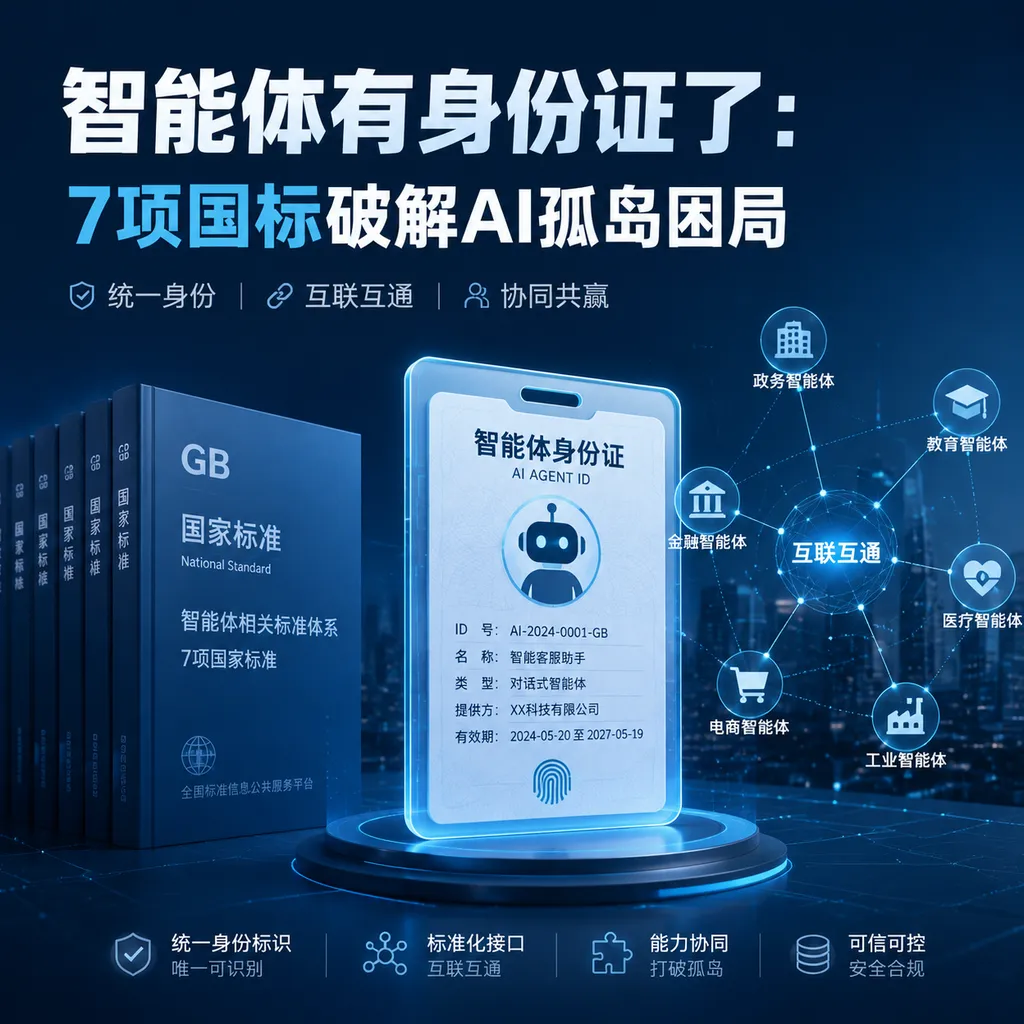
The State Administration for Market Regulation has released a series of seven national standards titled *Artificial Intelligence – Agent Interconnection*, issuing each intelligent agent a "digital ID," standardizing identity authentication and interaction protocols, and addressing the "information island" problem caused by fragmented communication interfaces and chaotic collaborative interactions in the current intelligent agent industry.
Intelligent Agents Get ID Cards: 7 National Standards Break the AI Island Dilemma
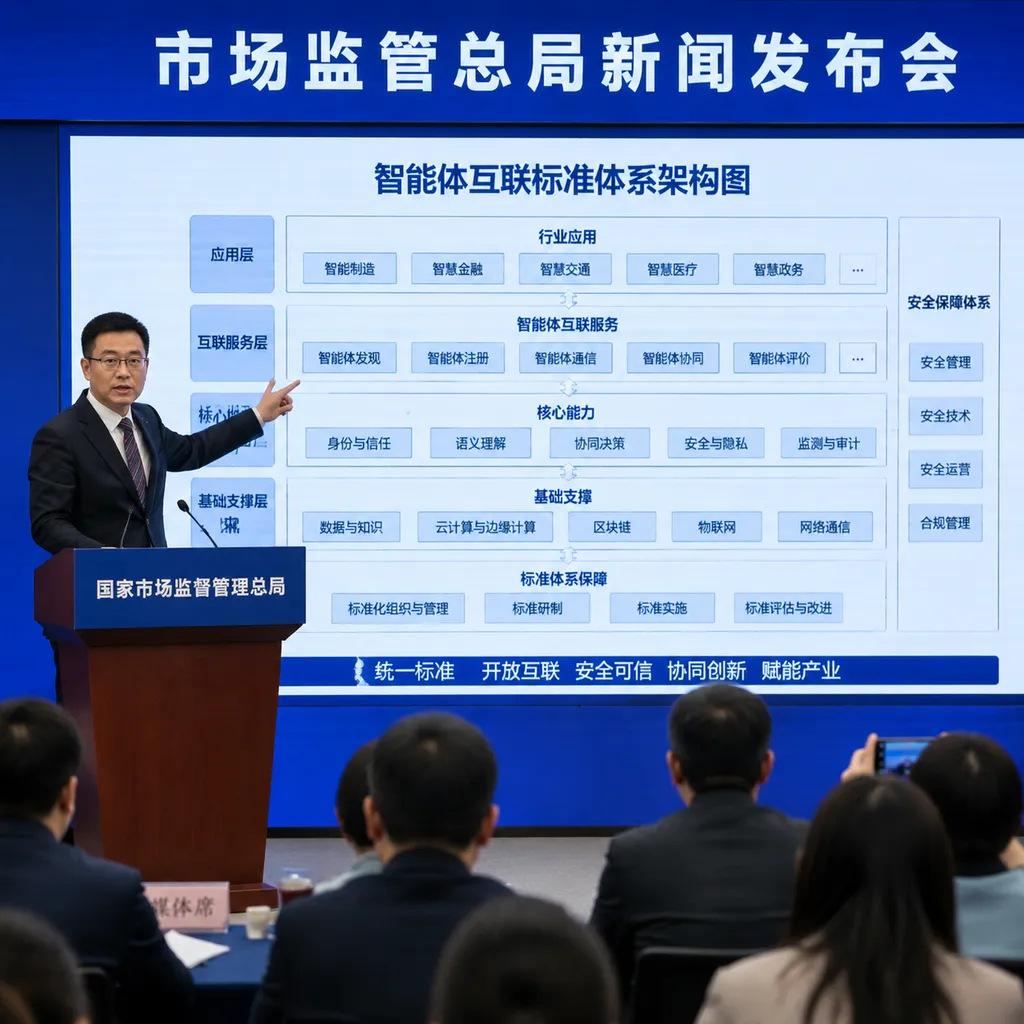
This morning, the State Administration for Market Regulation announced in Beijing that the series of 7 national standards titled “Artificial Intelligence — Intelligent Agent Interconnection” has been officially approved and released.
This is the first time in China that a systematic interoperability standard has been established for intelligent agents (AI Agents). Simply put, from now on, every intelligent agent will have its own “digital ID card,” and intelligent agents from different platforms and different manufacturers will finally be able to communicate using the same protocol.
Over 100 companies including Xiaomi and Lenovo have already participated in pilot projects.
Where’s the problem: Many intelligent agents, but they don’t know each other
Let’s start with the background.
Over the past year, the intelligent agent sector has grown explosively. From internal corporate automation assistants, to consumer-facing intelligent customer service, intelligent driving decision-making systems, and even approval agents in government services — almost every vertical field is building its own agent.
But problems have followed: these intelligent agents don’t know each other.
A typical example: In a smart city project, a traffic agent needs to call weather agent data to optimize traffic light timing. But the two agents are from different manufacturers with completely different interface protocols. The result? Either spend a lot of money on custom integration, or simply give up on cooperation and work separately.
This “information island” phenomenon has become a recognized pain point in industry:
- Fragmented interface protocols: Manufacturer A uses REST, Manufacturer B uses gRPC, Manufacturer C develops its own proprietary protocol
- Lack of identity authentication: Agents can’t verify each other’s identity, so security and trust are impossible to guarantee
- Non-uniform capability descriptions: You say you can do “document processing,” but can you handle PDFs or Word? Support OCR? Without standardized capability profiles, supply-demand matching is guesswork
- Chaotic tool invocation rules: When calling external tools (APIs, databases, other services), each implementation varies widely
Zhu Meina, Deputy Director of the Standards Technology Department of SAMR, stated at the press conference: with the demand for massive cross-platform and cross-scenario agent cooperation surging, these problems have seriously restricted industry development.
7 Standards: From “ID cards” to “social etiquette” — complete coverage
The design of these 7 standards is clear — break down the whole process of agent interconnection into 7 steps, with one standard for each step.
Fan Kefeng, Deputy Director of the China Electronics Standardization Institute, provided a systematic explanation at the press conference. Here’s a simplified version:
Part 1: Overall Architecture
This is the top-level design that defines the overall technical framework for agent interconnection. Think of it as a “city master plan” telling all participants what kind of ecosystem we want to build and how each module relates.
Parts 2–3: Identity Codes and Identity Management
This is the core of the whole system.
Issue a “digital ID card” to each agent. The identity code is a unique identifier; identity management defines how to register, verify, update, and revoke these identities.
Why is this crucial?
Imagine you encounter an agent online claiming to be “a bank’s customer service agent” — how do you know it’s real and not phishing? With a unified authentication system, agents can verify each other, and users/regulators can trace each agent’s origin and behavior.
Zhu Meina revealed that identity code-related standards will later be promoted to mandatory national standards, meaning in the future an agent may need “real name verification” before going online, similar to an app launch.
Part 4: Agent Description
This is the agent’s “resume” or “capability profile.”
The standard defines a unified format to describe what an agent can do, its strengths, and its limitations. For example:
- Supported input/output formats
- Types of tasks it can process
- Response time and concurrency capabilities
- Required permissions
With standardized capability descriptions, agents can collaborate effectively — I know what you can do, you know what I need.
Part 5: Agent Discovery
Once the “capability profile” exists, how do you find the right partner?
This part defines the “supply-demand matching mechanism.” Think of it as an agent “job board” or “service marketplace”: when you need a certain capability, you can find matching agents via a standardized discovery mechanism.
Part 6: Agent Interaction
Once you’ve found the other party, how do you communicate?
This part standardizes the interaction protocol between agents — message format, communication process, state synchronization, exception handling, etc. Essentially, this defines the “social etiquette” of the agent world.
Part 7: Agent Tool Invocation
Agents don’t just talk to each other — they also need to invoke external tools like databases, APIs, computing resources, and other software services.
This part specifies standard interfaces and processes for tool invocation. Developers familiar with agent development know “Function Calling / Tool Use” is a key extension of agent capabilities. Standardizing this part is highly important.
One diagram to understand the logic
Fan Kefeng summed up the internal logic of these 7 standards in one sentence:
“Identity marking — capability description — supply-demand discovery — collaborative interaction — tool invocation” covering all steps in a closed-loop standard system.
Translated into developer language:
Register identity (Parts 2–3)
    ↓
Declare capabilities (Part 4)
    ↓
Be discovered/discover others (Part 5)
    ↓
Establish communication (Part 6)
    ↓
Collaboratively execute tasks, invoke tools (Part 7)
Only when the entire chain is connected can agents truly achieve “orderly and trustworthy cooperation.”
Why choose “guidance technical documents” rather than mandatory standards?
It’s worth noting these are national standardization guidance technical documents rather than mandatory national standards.
This is a pragmatic choice.
Zhu Meina explained: the agent industry is still evolving rapidly, and technology paths have not yet fully converged. If we start with mandatory standards, we may stifle innovation. Guidance documents have these benefits:
- Maximum compatibility with multiple technical paths: Different manufacturer implementations can differ, as long as they fit the standard framework
- Rapidly build industry consensus: Get everyone moving in the same direction, then refine through practice
- Leave room for trial and error: Standards can be iterated based on industry development
In other words, this is an agile “run first, optimize later” standardization strategy.
But don’t think this is soft enforcement — identity code standards will gradually become mandatory, and standards for auditing, transactions, and other areas are being accelerated. The regulatory tightening is progressive.
What does this mean for developers?
Let’s get practical.
Short-term: Focus on identity access specifications
If you’re developing agents, identity codes and identity management are the primary areas to watch as they may become future “entry requirements.” Suggestions:
- Monitor technical details after official publication
- Assess compatibility of your current agent architecture with the standards
- Reserve interfaces for identity authentication modules
Mid-term: Interface protocol adaptation
If your agent needs to cooperate with other systems, interaction protocols and tool invocation standards will directly impact integration costs. After standardization:
- Integration costs will fall (no more custom adapters for each partner)
- But you’ll need to modify your existing implementations accordingly
Long-term: Position in the ecosystem
After standards take effect, tools, middleware, testing, and certification services based on them will become new opportunities. Teams that master the standards early and produce compliant solutions will have first-mover advantages in the ecosystem.
Over 100 companies piloting: Who’s involved?
The press conference revealed that Xiaomi, Lenovo, and more than 100 companies have participated in pilot applications.
This isn’t surprising.
Xiaomi has large-scale device interconnection needs in the smart home space — coordinating agents behind different device types has been a challenge. Lenovo has layouts in enterprise services and smart manufacturing — cross-system agent collaboration is also a necessity.
Their participation helps validate feasibility and secures influence — the deeper you participate in standard-setting, the lower your future adaptation cost and the greater your ability to steer standards toward your technology path.
However, the public information hasn’t disclosed pilot technical details or performance data — worth following up later.
Relationship with international standards
A natural question is: How does this relate to international intelligent agent interconnection efforts?
The press conference didn’t elaborate, but we can make reasonable guesses:
Currently there are no mature international standards for agent interconnection. Anthropic’s MCP (Model Context Protocol) has attracted attention, but it’s more about large model–tool interaction, not exactly the same as today’s “agent interconnection” topic.
China launching national standards first offers a chance to take the lead in international standard competition. Whether it becomes a reference template for international standards will depend on industry adoption and international coordination.
Some sober observations
Standards release is positive, but there are realities to consider:
1. Implementation takes time
From release to broad adoption is a long journey. Supporting testing/certification systems, development tools, best practice guides, and leading enterprises’ demonstration efforts are needed.
2. Compatibility challenges
Existing agent systems adapting to new standards face significant overhaul costs — especially for large-scale established systems, migration is a major project.
3. Can the standards evolve quickly enough?
Agent technology is still rapidly advancing, with new paradigms like multi-agent cooperation and swarm intelligence emerging. The agility of the standard update mechanism will determine if we avoid “standards outdated upon release.”
4. Boundaries of mandatory standards
Identity code moving toward mandatory standards is clear, but how far they will extend, which scenarios they will cover, and balancing safety with innovation require deeper discussion.
Summary
The 7 national standards released today aim to solve one core problem: allow intelligent agents to know, understand, and cooperate with each other.
Technically, this is the infrastructure enabling the shift from single-agent applications to multi-agent collaboration. Industrially, it breaks “information islands,” lowers integration costs, and accelerates large-scale deployment.
The value of the standards will ultimately be proven in practice. But at least the direction is right — for the agent industry to truly take off, interconnection is an unavoidable foundational issue.
First, issue the “digital ID card,” and then everything else can follow.
References
- IT Home: “Artificial Intelligence — Intelligent Agent Interconnection” series of 7 national standards released — Detailed press conference coverage including standard system interpretation and official statements


