
Rokid Releases AIOS: Has the Android Moment for Smart Glasses Arrived?
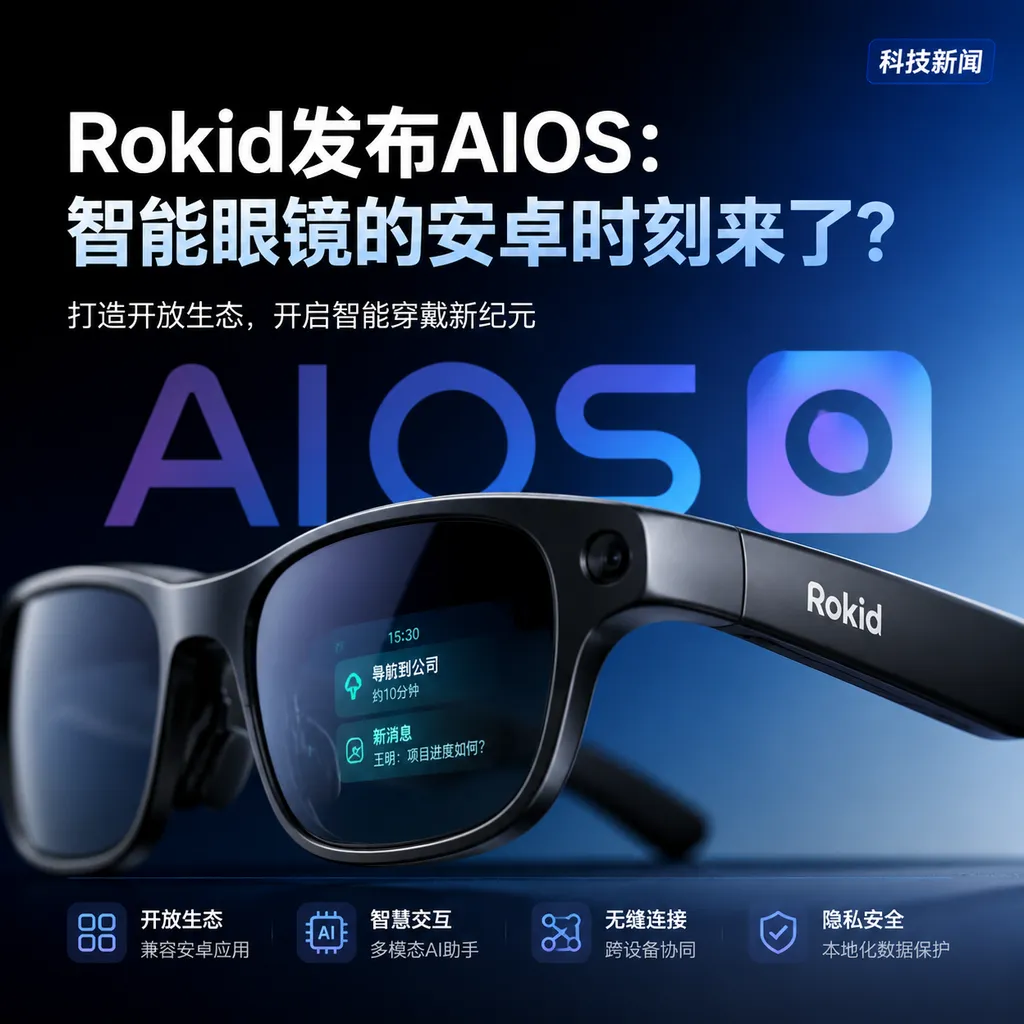
At Open Day 2026, Rokid unveiled the world’s first smart glasses operating system, YodaOS, integrating platforms such as Alipay, WeChat, and Amap, in an attempt to carve out a path in the AI glasses market surrounded by industry giants through an open ecosystem.
Rokid Releases AIOS: Has the Android Moment for Smart Glasses Arrived?
On June 26, during the Rokid Open Day 2026 in Hangzhou, Rokid unveiled a major product: the world’s first smart glasses operating system, YodaOS.
This is not another case of piling up hardware specs, but rather Rokid’s ambitious declaration to define smart glasses on the software level. Glasses for scan-and-pay, one-click ride-hailing, real-time navigation projection — behind these features lies YodaOS’s deep integration with national applications like Alipay, WeChat, and AutoNavi.
At a time when Meta holds 85% of the global market share and Apple Glasses is slated for release later this year, Rokid has chosen to counter the overwhelming advantage of the giants with the “open ecosystem” card. How far this strategy can go is worth close scrutiny.
Why AIOS?
The smart glasses industry faces an awkward reality: hardware has gone through several iterations, but software has largely stayed in the “extension of a mobile app” stage.
Most AI glasses follow this interaction logic — glasses collect information (photos, audio, location), leaving processing and presentation to the phone. This turns glasses into a “plug-in sensor” for smartphones rather than an independent computing terminal.
Zhu Mingming clearly wants to break this pattern. YodaOS is positioned as an “AIOS” — AI-native Operating System — emphasizing that AI capabilities are a native part of the system, not a bolted-on feature.
Specifically, YodaOS has done three things:
First, integrating platform services. Cooperation with Alipay enables “look-and-pay” — users scan with glasses to pay, skipping the phone; integration with AutoNavi provides real-time navigation directly projected into the field of view; and collaboration with WeChat enables notifications and quick replies.
Second, opening full-stack AI development capabilities. YodaOS offers developers three layers of capabilities: system hardware (API access to camera, microphone, display module), AI infrastructure (APIs for multimodal perception, speech recognition, visual understanding), and a complete development toolchain. Developers can carry out the full process from development to deployment via open.rokid.com.
Third, building an application ecosystem. Rokid currently has over 20,000 active developers, and plans to incentivize third-party development through revenue sharing. This is similar to Android’s rise — first open the platform’s capabilities, then let developers grow the ecosystem.
Open Ecosystem: Rokid’s Differentiation Chip
The smart glasses industry is showing an interesting structural divergence.
Meta follows a vertically integrated route. The success of Ray-Ban Meta largely depends on Meta’s control over hardware design, AI models, and social applications. Photos taken by users can be sent directly to Instagram and WhatsApp — Meta’s moat of native social pathways that others can’t replicate.
Apple will most likely also choose a closed route. If Apple Glasses are positioned like Apple Watch, their core value will be as an “extension of the iPhone,” tightly binding to Apple’s ecosystem, excluding non-iPhone users.
Huawei’s HarmonyOS glasses also follow a closed logic, with their main selling point being seamless coordination with Huawei phones, tablets, and in-car systems.
Google intends to be open — the Android XR platform aims to replicate Android’s success in the mobile era. But Google’s challenge is slow execution; whether Project Aura will actually ship within the year is still uncertain.
This gives Rokid a window: to be the pioneer of an open ecosystem in the Chinese market.
Here, “open” is not an empty slogan. Zhu Mingming once said in an interview: “A true ecosystem is where all participants can make money.” YodaOS’s open strategy is supported by business logic:
- For Alipay, glasses-based payment is a new use case worth investing resources in.
- For AutoNavi, glasses navigation is a natural extension of driving scenarios, providing high user value.
- For developers, revenue sharing offers a chance to make money on a new platform.
Of course, “open” also carries risks. If core apps don’t want to integrate, or if integrated experiences are poor, openness becomes an empty shell. The YodaOS application ecosystem is still in its early stage; whether a killer app emerges will be the key factor in determining the viability of this route.
The Real Battleground Rokid Faces
To understand the significance of Rokid releasing AIOS, one must first see the actual state of the AI glasses industry in 2026.
It’s a “one superpower, many contenders” market.
Meta is the clear leader. In 2025, global AI glasses shipments reached 8.7 million units; Meta alone shipped 7.4 million, holding 85.2% market share. Meta plans to ramp up its annual production capacity to over 20 million units in 2026, upgrading optics comfort, battery life, and AI interaction.
Apple is the biggest variable. Apple Glasses are scheduled for release at the end of 2026. The first-generation product will reportedly forego complex AR displays and adopt an “iPhone accessory” positioning, focusing on Siri and AI experiences. Once Apple enters, it will impact user expectations and product standards industry-wide.
Google is returning to the battlefield. Its three-step plan: launch audio smart glasses early in the year, release monocular display products by year’s end, and collaborate with XREAL on Project Aura. Google’s ambition is to promote the Android XR ecosystem, but execution has been its weak point.
The domestic market is fierce hand-to-hand combat. Huawei launched AI glasses early this year, powered by HarmonyOS for cross-device coordination; Xiaomi secured a 30% domestic share in 2025; Alibaba’s Quark S1 connected e-commerce and local living scenarios; newcomers like Thunderbird, XREAL, and Shanji are also ramping up.
IDC predicts that global AI glasses shipments in 2026 will reach 22.67 million units, with 4.51 million in China. The market is expanding rapidly, but competition is heating up sharply.
Rokid holds the position of global No. 2 in all categories, No. 1 among Chinese brands, and No. 1 globally in the segment of AI glasses with display. It’s a good starting point, but the gap with Meta remains huge.
More critically, Rokid faces not only market share competition but structural challenges:
1. Supply Chain Shortcomings
When Rokid Glasses exploded in popularity in 2025, production capacity lagged badly — many orders had to be pushed to 2026. As Zhu Mingming said, “the whole industry chain wasn’t ready.”
The 2026 supply chain situation hasn’t improved. Global memory chip shortages are pushing DRAM prices up an expected 88% and NAND flash 74%. Data centers consume over 70% of high-end memory capacity, squeezing consumer chips. For players with weak supply chain leverage, this means higher costs and more uncertain deliveries.
Rokid’s response is to bring in Lens Technology as a strategic investor and exclusive manufacturing partner. Lens is a core supplier for Apple and Huawei, with deep expertise in precision manufacturing. How much this will relieve capacity pressure remains to be seen.
2. Funding Strength Gap
Meta invests over $10 billion annually into XR R&D; Apple and Huawei have full-stack capabilities, including in-house chips and OS. Rokid has raised over RMB 3 billion but is still far from the giants’ scale.
Early this year, Rokid raised four rounds in quick succession, bringing in industrial investors like Lens Technology and SenseTime; the founding team’s stake diluted to 42%. Next, it initiated a Hong Kong IPO process. These moves show that Rokid needs more capital to support expansion — IPO is inevitable.
3. Sustainability of Technical Moat
Over 12 years, Rokid has accumulated full-stack capabilities from optical design and chip adaptation to AI algorithms and hardware manufacturing. But first-mover advantages are easily erased when giants invest heavily.
Core technologies in the industry are rapidly advancing: full-color Micro-LED displays, waveguide optics, low-power AI chips are continually being broken through. Rokid plans to launch full-color display smart glasses in 2026 — a high-tech product line. Whether this translates into a true technology moat is a key market focus.
Technical Details of YodaOS
Back to YodaOS itself — what does it actually do?
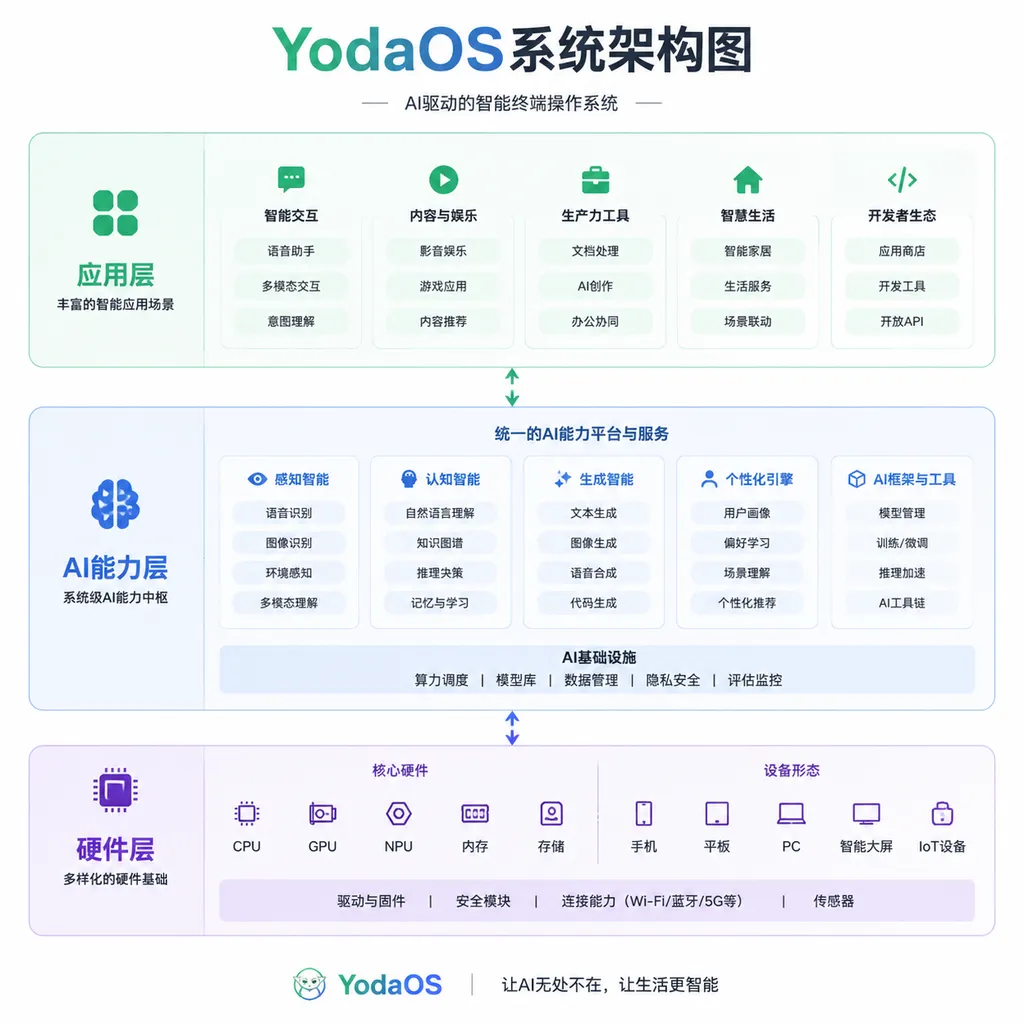
Architecturally, YodaOS is a lightweight OS optimized for smart glasses scenarios. It aims to provide smooth AI interactions within limited hardware resources (compute, memory, battery).
Multimodal perception is the core capability. YodaOS integrates visual understanding, speech recognition, and environmental awareness, enabling it to comprehend what users see and hear, and to act accordingly. For example, when you look at a restaurant, the system can display ratings and recommended dishes; while driving, navigation adjusts in real time to traffic conditions.
On-device AI is the technical direction. Constraints on compute power and battery mean not all tasks can be offloaded to the cloud. YodaOS deploys lightweight AI models on-device for high real-time tasks (like voice wake-up and simple image recognition), while complex tasks are handled via cloud-based large models.
Rokid deeply collaborates with top domestic large model companies, developing proprietary multimodal on-device models. A key selling point for next-gen AI glasses will likely be stronger on-device AI capability.
Developer toolchain is the foundation of the ecosystem. YodaOS provides a complete SDK and documentation so developers can access hardware capabilities (camera, microphone, display module, sensors) and AI capabilities (speech recognition, image understanding, translation, etc.) to build apps.
The maturity of this toolchain and smoothness of development experience will directly affect third-party developer participation. From current info, Rokid has devoted significant resources to its developer ecosystem — but its 20,000 developers are still orders of magnitude fewer than Android or iOS.
Industry Insight: Does the “Impossible Triangle” Still Exist?
The smart glasses industry has long had an “Impossible Triangle”: performance, lightness, and battery life — you can only achieve two at once.
In 2026, tech progress is loosening this triangle, but hasn’t broken it entirely.
In weight, Rokid Glasses manages 49g, and Rokid AI Glasses Style 38.5g, approaching regular glasses’ comfort. But full-color AR glasses are still usually 60–90g, making long wear uncomfortable.
In battery life, mainstream products with all features on rarely exceed 4 hours — meaning at least one recharge during a full day’s use. For a face-worn device, this is far from ideal.
In compute, dedicated chips like Qualcomm’s AR1 series make complex AI algorithms possible at ultra-low power. The current mainstream is a tri-core heterogeneous architecture (MCU+ISP+NPU) to balance power and performance.
Another notable stat is return rates: reports indicate AI glasses returns are 30%–50%, primarily because “most functions can be done better on a phone.”
This shows AI glasses haven’t nailed strong “irreplaceability.” Features like payment, navigation, translation have value, but whether they justify buying a pair of glasses remains questionable for many users.
Where is the killer app? The whole industry is looking for the answer.
Rokid’s in-vehicle AI glasses with GAC is an interesting attempt. By voice control for remote driving and automatic parking, glasses in this context bring clear value — freeing hands and making driving safer. But such scenarios remain niche.
Rokid’s Next Steps
Zhu Mingming’s targets for Rokid: 1 million units shipped in 2026, 2–3 million in 2027, and over 10 million in 2028.
This is aggressive. In 2025, Rokid shipped about 340,000 units (based on Omdia’s estimate of 3.9% of 8.7 million units globally). Achieving 1 million in 2026 means nearly tripling growth.
Actions supporting this goal include:
- Capacity expansion: partnering with Lens Technology to reach monthly output over 500,000 units.
- Product line expansion: planned upgrades to Glasses, launch of full-color display smart glasses.
- Ecosystem building: release of YodaOS and opening of developer platform.
- Channel expansion: deployed in 115 countries worldwide.
A Hong Kong IPO is another critical milestone. Listing means opening funding channels and facing public market scrutiny. Long-term investors (IDG, Yuanjing, Fosun, etc.) after 12 years need an exit path.
But IPO also brings pressure: quarterly reports, performance guidance, investor relations. For a fast-growing startup, these short-term pressures may affect execution of long-term strategies.
In Closing
From 2014 to 2026, Rokid has run 12 years in the AR race.
Over these 12 years, mobile internet matured, O2O rose and fell, the metaverse spiked then cooled, and generative AI moved from lab to countless industries. Many companies took off in a boom and crashed, but Zhu Mingming and his team persisted in this track.
The release of YodaOS signals Rokid’s attempt to transform from “hardware maker” to “platform company.” In a market surrounded by giants, relying on hardware alone makes lasting advantage hard — supply chain, funding, brand, and channels all favor the giants. But if they can establish footholds in software ecosystems, building a developer community and applications, the story changes.
Of course, the “China’s Android” narrative sounds sweet but is hard to realize. Android’s success relied on Google’s massive investments, global developer community buy-in, and structural opportunities in mobile. Whether these conditions apply to smart glasses is still uncertain.
For developers, is YodaOS worth investing time in? Perhaps watch and see. Observe first batch app experiences, check if Rokid’s developer policies are truly friendly, and see whether user growth can sustain an active app market.
For consumers, are AI glasses worth buying? It depends on your scenarios — if you often need to free your hands (driving, sports, outdoor work) or have frequent translation/navigation needs, current products can offer real value. If just for novelty, better to wait — products next year will likely be much better.
Zhu Mingming once said there are no shortcuts in AR — you must take it step by step, falling into and learning from pitfalls. After 12 years, most pitfalls are behind them, and the boom is here. The next question is how far and wide this road can go — and whether they can truly become a core player for the next generation of smart terminals.
We’ll need a few more years to find the answer.
References:
(Based on publicly available reports from 36Kr, TMTPost, Lei Technology, and China National Radio; specific links omitted due to domain restrictions)


