
Sakana AI Releases Fugu: Competing on Scheduling, Not Parameters
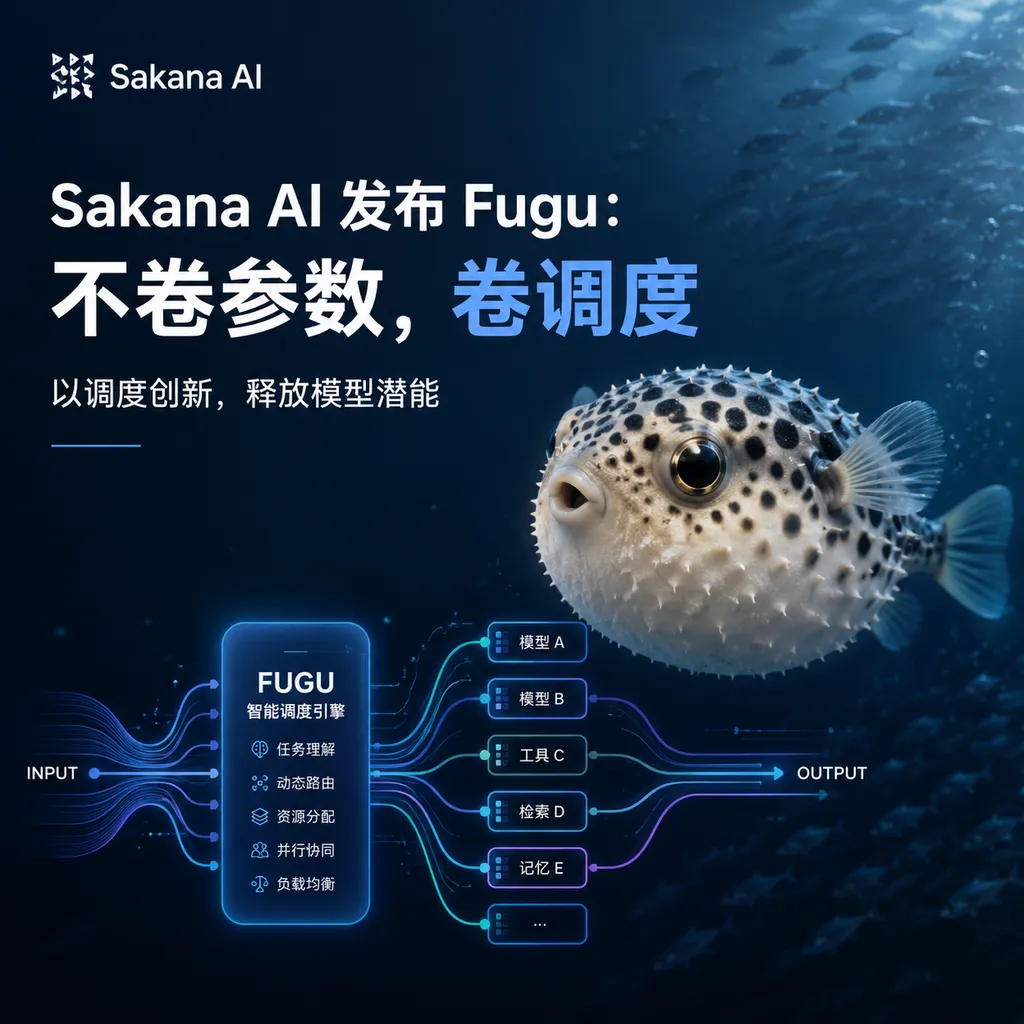
Japanese AI unicorn Sakana AI has released Fugu, a multi-agent orchestration model that uses a single API to coordinate multiple models to collaboratively complete tasks. It surpasses Opus 4.8 and GPT-5.5 in multiple benchmark tests, while costing only one-third of the former’s price.
Sakana AI Releases Fugu: Competing on Orchestration, Not Parameters
On June 22, Japanese AI startup Sakana AI released a new product called Fugu (pufferfish). It’s not yet another “bigger and stronger” monolithic model, but an orchestration system trained specifically to “direct other models.”
Simply put, you call an API, and behind it is a complete system that can select models, assign tasks, verify results, and integrate the final answer — all automatically. For developers, the complexity is hidden away; for results, a combination of models often outperforms a single one.
What Is an “Orchestration Model”?
In recent years, the main theme of the large model arms race has been “competing on parameters” — whoever has the largest model, the most training data, and the highest scores dominates the food chain. But this path is hitting bottlenecks: the larger the model, the higher the training cost, the longer the inference latency, while performance differences between models on various tasks are shrinking.
Sakana AI has chosen a different path: instead of building an omnipotent god, build a commander who knows how to deploy the troops.
Fugu itself is a large language model, but its job isn’t to directly answer your question — it’s to decide who should answer it. When a request comes in, Fugu dynamically determines:
- Which model is best suited?
- How many steps are needed to complete the task?
- Should intermediate results be verified?
- Should it recursively call itself to handle subtasks?
These capabilities come from two ICLR 2026 papers. TRINITY uses a lightweight coordinator to dynamically assign “thinker,” “executor,” and “validator” roles to different models; Conductor uses reinforcement learning to let the system learn its own natural-language strategies for coordinating agents.
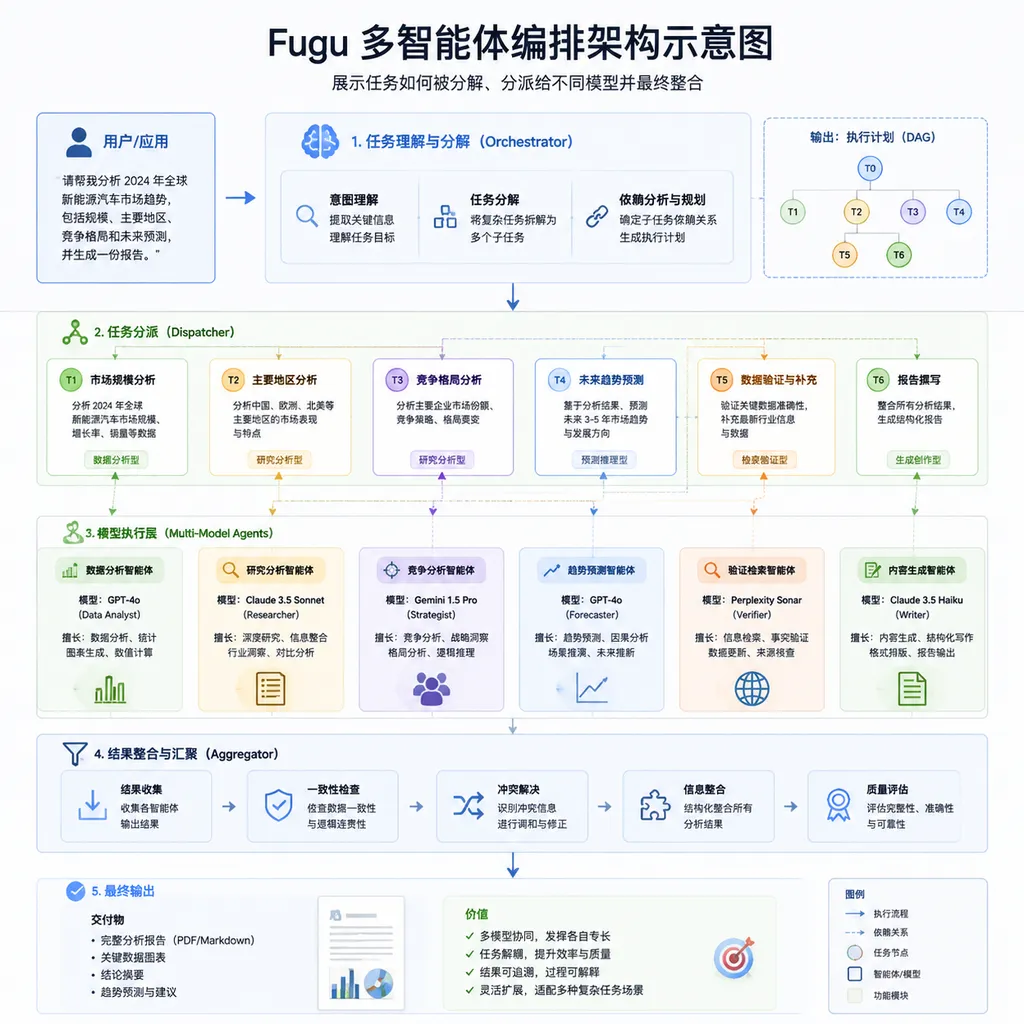
An analogy: traditional model calls are like visiting a general practitioner for all ailments; Fugu is more like a consultation system — you book an appointment, and the system automatically schedules cardiology, neurology, and radiology experts, each providing reports, before giving you a comprehensive diagnosis.
Two Versions, Two Positions
Fugu comes in two versions:
Standard Fugu
Balances performance and low latency, suitable for everyday scenarios:
- Chatbots
- Code assistance and review
- Routine business automation
Fugu Ultra
Targets maximum accuracy, tackling hard problems that “ordinary” models can’t handle:
- Kaggle competition-level data science problems
- Paper reproduction and academic research
- Cybersecurity analysis
- Patent search and legal document processing
Both provide OpenAI-compatible API endpoints, making migration almost costless.
Benchmarks: Going Toe-to-Toe with the Top Models
Sakana AI provided a series of benchmark results. Fugu Ultra directly benchmarks against current frontier models in multiple hardcore tests:
| Test | Fugu Ultra | Opus 4.8 | GPT-5.5 | Gemini 3.1 Pro | |------|------------|----------|---------|----------------| | SWE Bench Pro (Programming) | 73.7 | 69.2 | 58.6 | - | | LiveCodeBench Pro | 90.8 | - | 88.4 | - | | GPQA-D (Graduate-level Scientific Reasoning) | 95.5 | - | - | 94.3 | | Humanity's Last Exam | 50.0 | - | - | - |
Notable points:
SWE Bench Pro — 73.7: This is an industry-recognized hardcore programming test that requires locating and fixing bugs in real GitHub repos. Fugu Ultra outright beats Opus 4.8’s 69.2.
GPQA-D — 95.5: Tests graduate-level scientific reasoning ability — the highest score among publicly available models.
LiveCodeBench Pro — 90.8: Outperforms GPT-5.5’s 88.4.
Crucially, Sakana AI stresses that these were achieved without including Claude Fable 5 and Mythos Preview in its model pool — in other words, Fugu didn’t “cheat” by calling the strongest models, but achieved frontier-level performance by orchestrating mid-tier models.
Real-World Use: More Than Just Leaderboards
Good benchmarks are one thing; real usability is another. Sakana AI gave some interesting examples:
Automated ML Research
In AutoResearch tasks, Fugu Ultra ran 123 experiments autonomously and achieved the top BPB score (0.9774 ± 0.0019). This means it can behave like a junior researcher — designing experiments, running data, tuning parameters, and iteratively optimizing.
Japanese Historical Text Recognition
When restoring reading order in Japanese historical documents, Fugu hit NED 0.80 versus other models’ 0.24 or outright failures. Not surprising, as Sakana AI has specific optimizations for Japanese language and culture.
CAD Mechanical Design
In designing an iris mechanism, Fugu produced a working design, whereas other models’ designs had gaps or were incomplete.
Financial Forecasting
In a 50-week stock trading backtest, Fugu delivered an average +19.43% return, compared to others’ under-15% results. Of course, backtests differ from live trading, but it shows orchestration’s advantage in multi-step decision-making tasks.
Pricing: One-Third of Opus
Under pay-as-you-go pricing, Fugu Ultra costs:
- Input: $5 / million tokens (over 272k tokens: $10)
- Output: $30 / million tokens (over 272k tokens: $45)
By comparison, Opus 4.8 costs $15 input and $75 output. Fugu Ultra’s input cost is one-third of Opus’s, and output less than half.
Billing is also friendly: charges are based only on the highest-tier model used at the time, not additive for each invoked model — alleviating fears that “multi-model calls will be insanely expensive.”
Timing Is Everything
The release date is worth noting.
On June 12, Anthropic, in response to U.S. export control requirements, withdrew Claude Fable 5 and Mythos Preview from public API access. Developers outside the U.S. woke up to find their models gone.
Sakana AI CEO David Ha (former Google Brain researcher) said plainly at the launch: “Our Fugu Ultra has reached the performance level of Fable and Mythos, and is not affected by U.S. export controls.”
The intended audience is obvious.
As geopolitical risk in the AI supply chain grows, “not relying on a single vendor” shifts from a technical choice to a business continuity concern. Fugu’s orchestration architecture naturally has this advantage — if a particular model becomes inaccessible, the system automatically switches to other available models without serious business impact.
Who Is Sakana AI?
If you haven’t heard of Sakana AI, it’s worth a look.
Founded in Tokyo in 2023, its three founders are heavyweights:
- Llion Jones: Co-author of the 2017 Transformer paper Attention Is All You Need, one of the pioneers of modern large language models
- David Ha: Former Google Brain researcher known for “World Models,” later Head of Research at Stability AI
- Ren Ito: Leads operations and business
The company follows a bionic philosophy: “Sakana” means “fish” in Japanese, inspired by collective intelligence in fish schools and evolution. Fugu (pufferfish) continues this naming style.
In Japan, Sakana is near “national team” level. In its Series B round (Nov 2025), it raised $135M at a $2.65B valuation, making it Japan’s most valuable AI startup. Investors include Japan’s largest financial group MUFG, the CIA’s venture arm In-Q-Tel, plus Silicon Valley firms Khosla, NEA, and Lux.
Dubbed the “Japanese OpenAI,” Sakana has taken a completely different path — focusing on making multiple models collaborate better rather than endlessly scaling a single one.
How Does It Differ from OpenRouter Fusion?
In March this year, OpenRouter launched Fusion, which also hides multiple models behind one API. Many ask: what’s the difference?
Simply put:
- Fusion leans towards a “voting” approach — send the same question to multiple models in parallel, then have an evaluator model merge them into a final answer.
- Fugu leans towards a “division of labor” approach — training a commander model to break down tasks, assign roles, and verify iteratively.
The former excels when answers have clear correctness criteria (e.g., math, code bugs), while the latter shines in complex, multi-step tasks (e.g., research, design, analysis).
Model orchestration is evolving from a tool into a product in itself.
What Does This Mean for Developers?
Some practical implications:
1. Lower cognitive load in model selection
Before, you had to know “which model is good at what” and “use Claude or GPT for this task”; now you can hand that decision to the orchestration system. Of course, you lose some control.
2. Potentially more favorable cost structure
For complex tasks, rather than always using the most expensive model, let orchestration assign simple subtasks to cheaper models. Fugu’s pricing also encourages this.
3. Diversified supply chain risk
If you were all-in on one API provider, you may want to rethink. Orchestration systems have built-in fallback capability.
4. Debugging may be harder
When results are subpar, you need to determine if it’s the orchestration logic or the underlying models at fault — the black-box factor is higher.
Final Thoughts
As leading models grow closer in capability, “directing a group of models more effectively” may be more advantageous than “training an even bigger one.”
Sakana AI has sidestepped the compute arms race, focusing instead on model orchestration rather than parameter piling. Whether this is the right move — the market will decide.
At the very least, when your Claude API suddenly fails due to export controls, you might seriously consider: maybe you shouldn’t put all your eggs in one basket.
References
(Note: Below are sources accessible domestically in China)
- None available


