
Apple Vision Pro leader jumps to OpenAI, hardware war officially begins
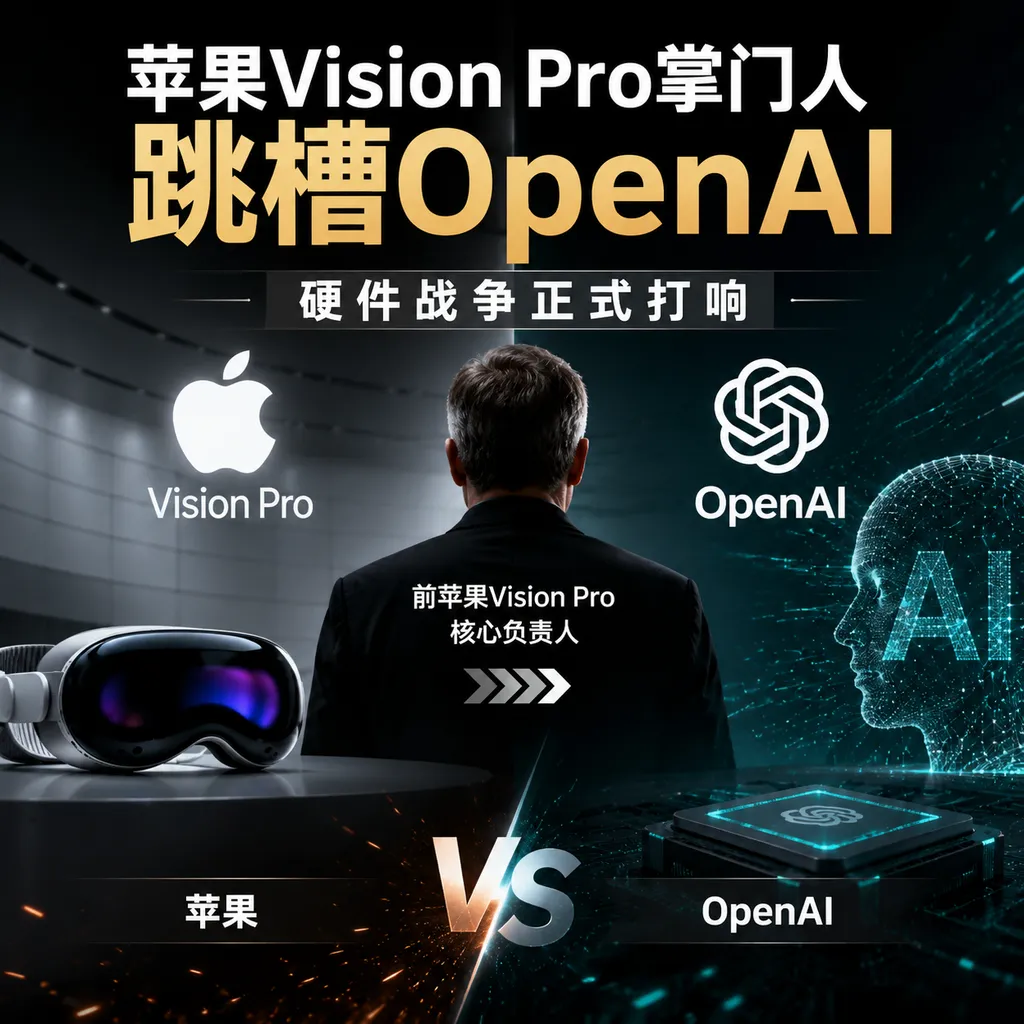
Paul Meade, head of hardware engineering for Apple Vision Pro, is about to join OpenAI—another heavyweight talent poached from Apple by OpenAI. Together with former Apple executives such as Jony Ive who have already joined, OpenAI is building a high-profile hardware team, aiming for the AI-native device market.
Apple Vision Pro Leader Joins OpenAI, Hardware War Officially Begins
Paul Meade is leaving.
The veteran who spent 15 years at Apple and built the Vision Pro hardware engineering team from scratch will report to OpenAI next week. The news comes from a Bloomberg report today, which Apple has internally confirmed.
This is not an ordinary job change.
Who is Meade? What is he taking with him?
When Meade joined Apple in 2010, he was just an engineer on the iPhone and iPad team. But he arrived at the perfect time — that was the year the iPhone 4 launched, the beginning of the golden era for Apple’s mobile devices.
Seven years later, he moved to the visual products team. At the time, that decision seemed a bit risky: In 2017, the AR/VR market was still barren — Magic Leap had burned through billions without producing a decent product, and Meta’s Oculus was gathering dust in living rooms.
But Meade bet right.
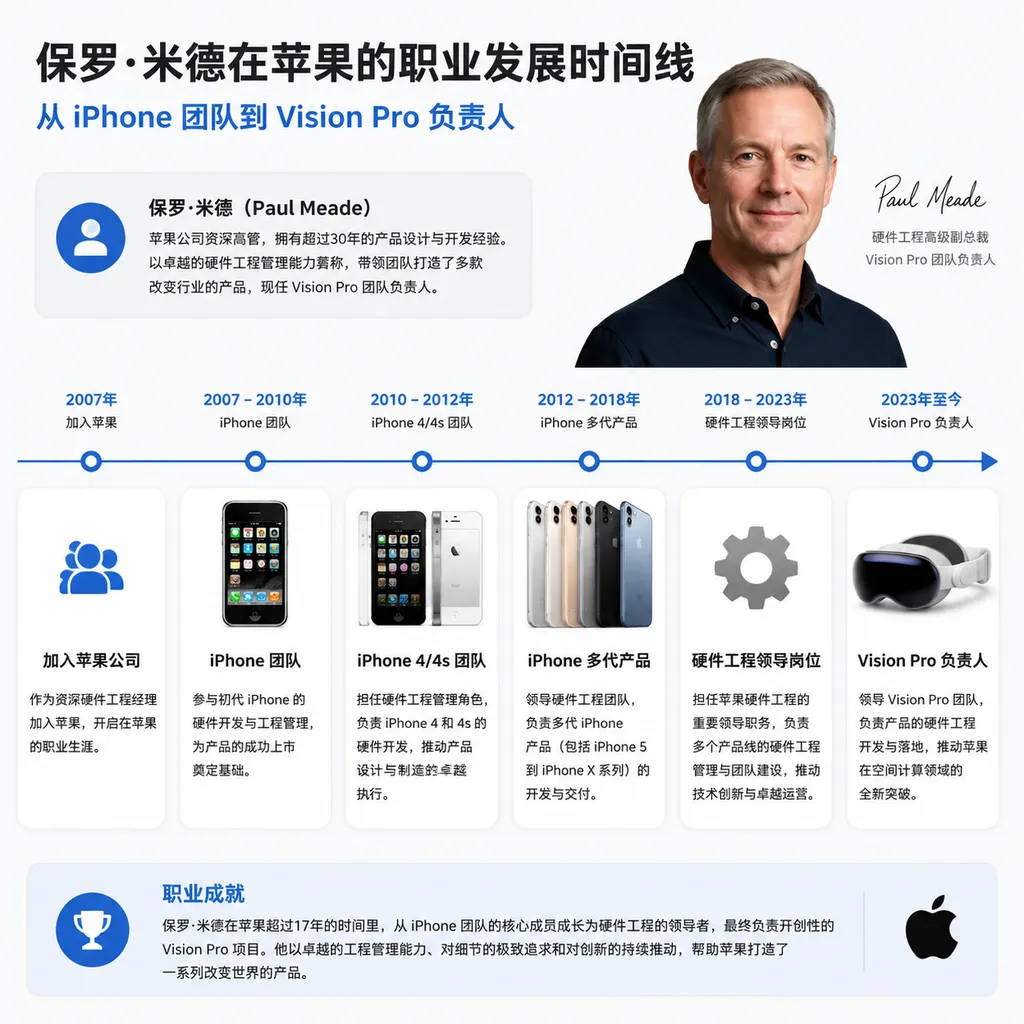
From 2017 to 2024, he led the team to build Vision Pro’s hardware architecture from scratch. This wasn’t simply “making a headset” — Vision Pro’s display system, eye-tracking, gesture recognition, spatial audio — every module had to redefine consumer electronics engineering standards.
The $3,499 pricing made many complain, but industry insiders knew: that price might already be selling at a loss. The sheer amount of cutting-edge components Apple piled into Vision Pro was far beyond Meta Quest Pro’s reach.
Even more crucial was the past year. According to internal sources, Meade had been leading Apple’s AI smart glasses project — lighter, cheaper, and more suited for daily wear than Vision Pro. This project was seen as Apple’s next big bet in wearable devices.
Now, the soul of that project is going to OpenAI.
OpenAI’s “Former Apple All-Star Team”
Meade is not the first.
Over the past year, OpenAI’s poaching from Apple has become so aggressive that Cupertino headquarters can no longer sit still. Just look at this list:
Jony Ive
Needs no introduction. iMac, iPod, iPhone, iPad, Apple Watch, AirPods — virtually all of Apple’s iconic products over the past 25 years owe their design language to him. After leaving Apple in 2019 to found LoveFrom, last year he was revealed to be working with OpenAI to develop AI hardware.
Tang Tan
Former Apple designer and longtime subordinate of Ive. After a stint at LoveFrom, he has reportedly joined OpenAI for the joint project with Ive.
Evans Hankey
After Ive’s departure in 2019, she succeeded him as Apple’s VP of Industrial Design. She left in 2023 and is now also in OpenAI’s camp.
And beyond those in headlines:
In just the past month, more than 40 Apple employees have jumped to OpenAI, covering nearly all hardware divisions including cameras, chips, iPhone, Mac, Vision Pro.
This figure came from a report last November. Half a year later, the actual number is surely higher.
Why now?
The timing of Meade’s departure is subtle.
Bloomberg’s report mentions that his exit is related to Apple’s recent leadership changes. John Ternus is preparing to succeed Tim Cook as CEO, and chip chief Johny Srouji will take over Ternus’ role as head of hardware.
This reshuffle has stirred notable waves inside Apple. For executives like Meade who have been deeply entrenched in a specific field for years, a new boss often means a reset in priorities — not everyone is willing to start anew to prove themselves.
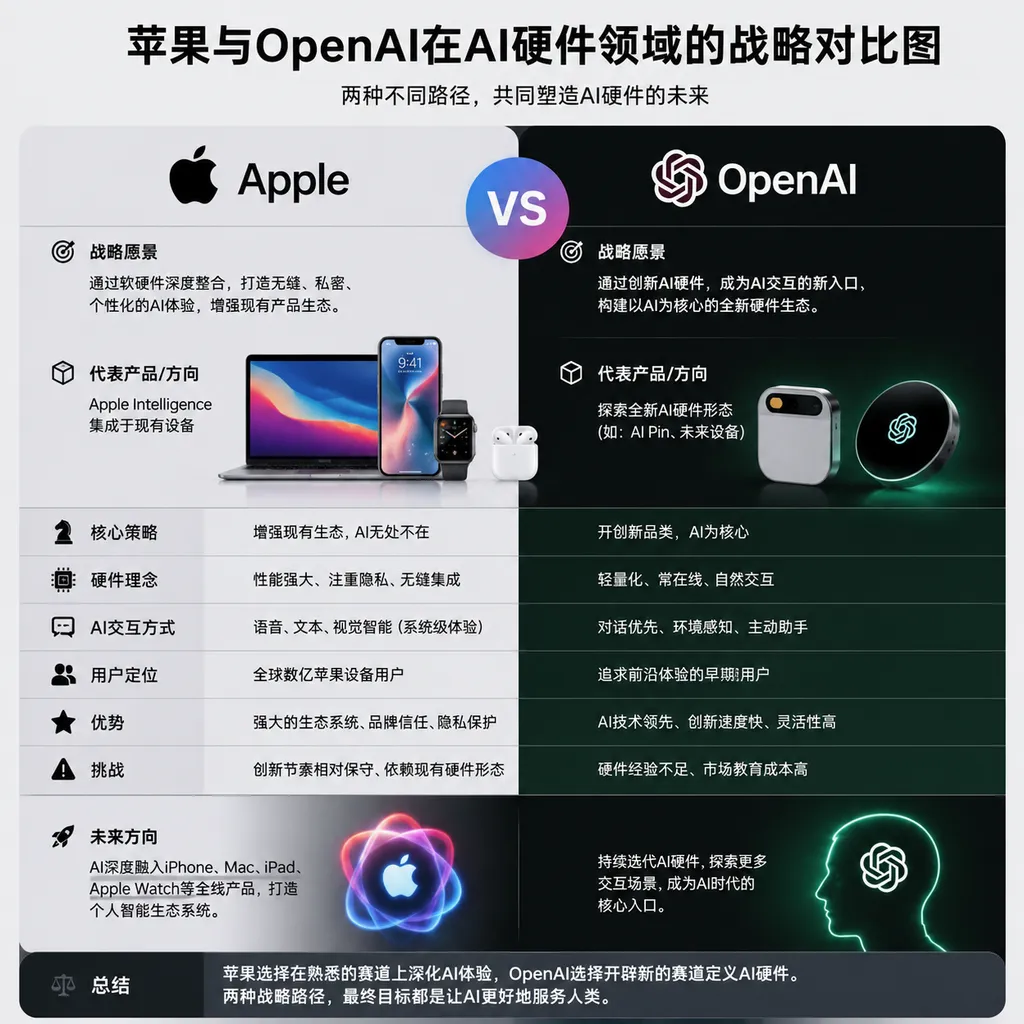
A deeper reason could be Apple’s strategic quandary in the AI era.
Look at what happened in the past year:
- WWDC 2024, Apple loudly announced “Apple Intelligence,” only for features to be delayed and user experience to disappoint
- Vision Pro sales far below expectations, with some SKUs already discounted
- Siri still unable to compete head-to-head with ChatGPT or Claude
- Smart glasses project progressing slowly, while Meta’s Ray-Ban smart glasses are selling like crazy
Apple’s issue isn’t lack of technology, money, or talent. The problem is its DNA— that “wait for the technology to mature before delivering perfection” culture, which in the AI era has become a liability.
OpenAI’s approach is the opposite: throw a product out there, let users find the bugs, iterate quickly. When ChatGPT launched it could say nonsense with a straight face, but that didn’t stop it from gaining 100 million users in two months.
For engineers accustomed to Apple’s pace, this “changing the wheels while running” model could be the real draw.
What hardware does OpenAI want to make?
This is a billion-dollar question.
Here’s what can be confirmed externally:
- Ive’s design studio LoveFrom is collaborating with OpenAI, project codename unknown, but direction is “AI-native devices”
- SoftBank’s Masayoshi Son discussed potential investment with Altman, possibly worth several billion dollars
- OpenAI has recruited over 20 Apple consumer hardware experts, spanning UI, wearables, cameras, and audio engineering
Piecing these clues together, the picture gets clearer:
It’s very likely a wearable device, possibly glasses or glasses-like, with deep integration with GPT as its core selling point.
Imagine:
- You wear a pair of glasses with a normal appearance
- They can see everything you see
- You can converse with GPT anytime, and it can give suggestions based on your visual input
- No need to pull out your phone, no need to type
This isn’t science fiction. Meta’s Ray-Ban glasses already do the first three, just with relatively weak AI capabilities. Replace the backend with GPT-4o or even stronger multimodal models, and the experience changes entirely.
Meade’s joining makes this speculation more credible. He had recently been working on AI smart glasses at Apple — now he’s joining the company with the world’s most powerful AI, to do the same thing.
What does this mean for the industry?
Three points:
1. The battlefield for AI hardware has officially opened
For the past two years, AI companies and hardware companies existed in parallel worlds. OpenAI made models, Apple made devices, with little overlap.
But products like smart glasses, AI Pin, and Rabbit R1 show that the trend is now irreversible: AI needs its own hardware carrier, not just living inside smartphones.
Smartphones were the core gateway of the mobile internet era. But their interaction mode — take out, unlock, open app, type or speak — is inherently unsuitable for AI Agent scenarios.
You wouldn’t pull out your phone while crossing the street to ask ChatGPT “Can I cross here?” But if it’s on your glasses, you would.
2. Apple’s moat is being dug into
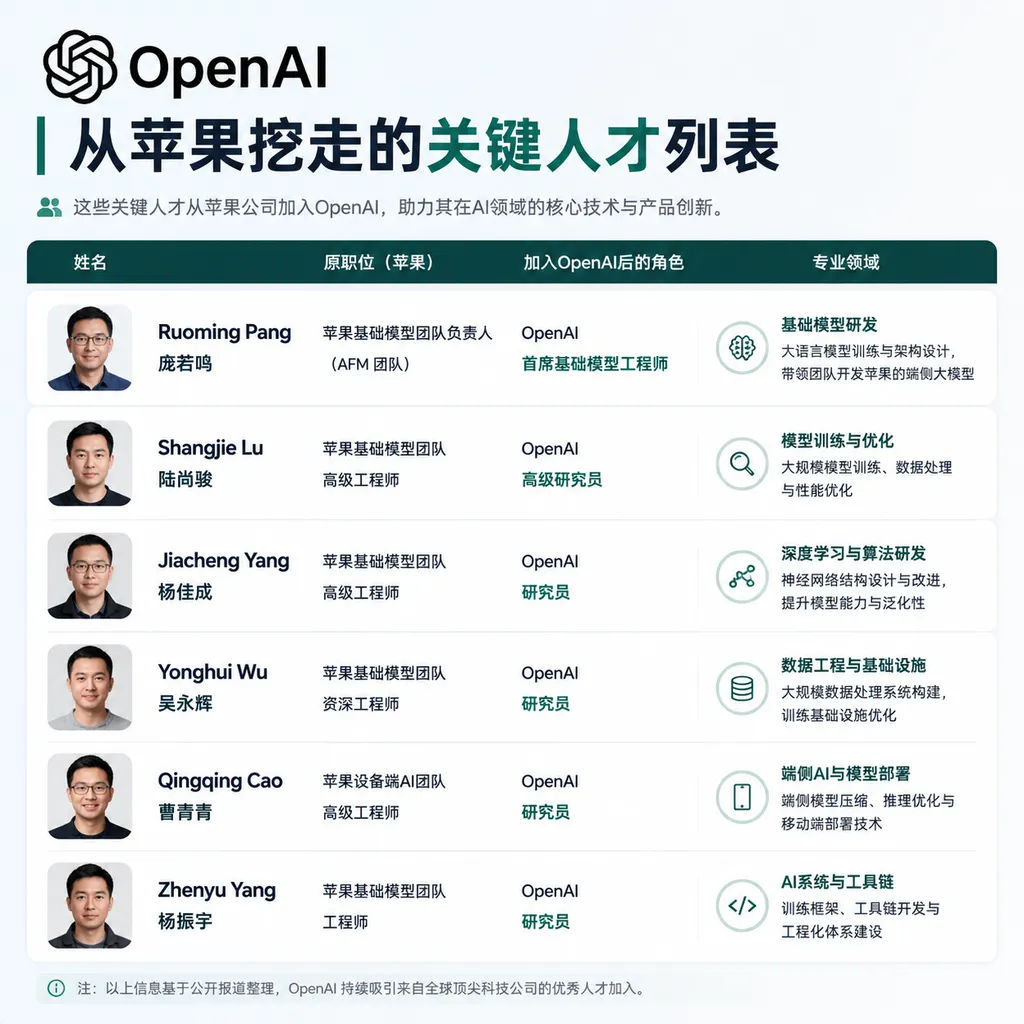
Apple’s strongest moat isn’t its ecosystem, it’s its people.
For 30 years, Cupertino has gathered the world’s top consumer hardware talent. These people don’t just understand technology — they know how to turn technology into products ordinary people are willing to pay for. This capability is hard to replicate, typically requiring over a decade at Apple to truly internalize.
Now, OpenAI is acquiring this capability in bulk.
Over 40 engineers and several executives — this isn’t simply poaching a few people, it’s systematically replicating Apple’s hardware expertise.
Worse, these departures often aren’t about money — OpenAI’s salaries aren’t much higher than Apple’s. They leave because they want to make something new.
That’s what Apple should fear most: it may be losing the magic that keeps the best people staying.
3. 2025–2026 will be the first years of AI hardware
Based on all reports, OpenAI’s hardware products may debut next year.
If so, we’ll see an interesting showdown:
| Player | Strengths | Weaknesses | |--------|-----------|------------| | OpenAI | Strongest AI models, top design team | No hardware mass production experience, supply chain starting from scratch | | Apple | Mature hardware system, huge user base | Lagging AI capabilities, slow decision pace | | Meta | Products already on the market, deep VR/AR expertise | AI models weaker than OpenAI’s, lower brand trust | | Google | Strong AI capabilities, Android ecosystem | Poor hardware track record, lacks consumer product DNA |
No one has absolute advantage.
But if asked to bet, OpenAI’s combination has the most potential: strongest AI + designers who best understand consumer products + a group of ex-Apple engineers eager to prove themselves.
Whether they can make a great product is uncertain, but it will at least be an interesting one.
Who comes after Meade?
Fletcher Rothkopf will take Meade’s place. He’s currently head of product design for Vision Pro and smart glasses, effectively the successor.
But the question is: how many more will leave?
Apple is in a sensitive transition period. Cook’s succession, AI strategy adjustments, hardware business restructuring — any one variable could trigger another wave of talent loss.
And OpenAI’s appetite clearly isn’t satisfied. They don’t just need a few executives, but the know-how across the entire production line:
- Supply chain management (who to contract manufacturing to, how to cut costs)
- Quality control (how to achieve million-unit mass production without failures)
- User research (what features to keep, what features to drop)
- Retail channels (how to get products into consumers’ hands)
Every link requires experienced people. Apple happens to have the highest density of such talent in the world.
Poaching will surely continue.
Final words
Meade’s move on the surface is an executive’s career choice, but it reveals a bigger trend:
AI is infiltrating from the software layer into the hardware layer — and this process might be faster than we think.
Three years ago, ChatGPT didn’t exist. Two years ago, people debated whether AI was a bubble. One year ago, AI hardware was still considered niche.
Now, the world’s smartest consumer hardware minds are moving en masse to AI companies.
What they’re building might, like the iPhone redefined the phone, redefine how we interact with AI.
Maybe it won't. But at least, this is the most noteworthy AI hardware story of 2024.
References
- ITHome: Report — Apple Vision Pro executive Paul Meade to resign and join OpenAI’s hardware team — First Chinese report on Bloomberg news, includes Meade’s career background and Apple leadership changes
- ITHome: Gurman — OpenAI aggressively poaching from Apple’s hardware engineering team — Prior report on systematic poaching by OpenAI
- Zhihu: OpenAI poached more than 20 ex-Apple staff for hardware development — Analysis of OpenAI hardware team recruitment details


