
Codex can finally adjust Claude: Open-source tool enables multi-model routing
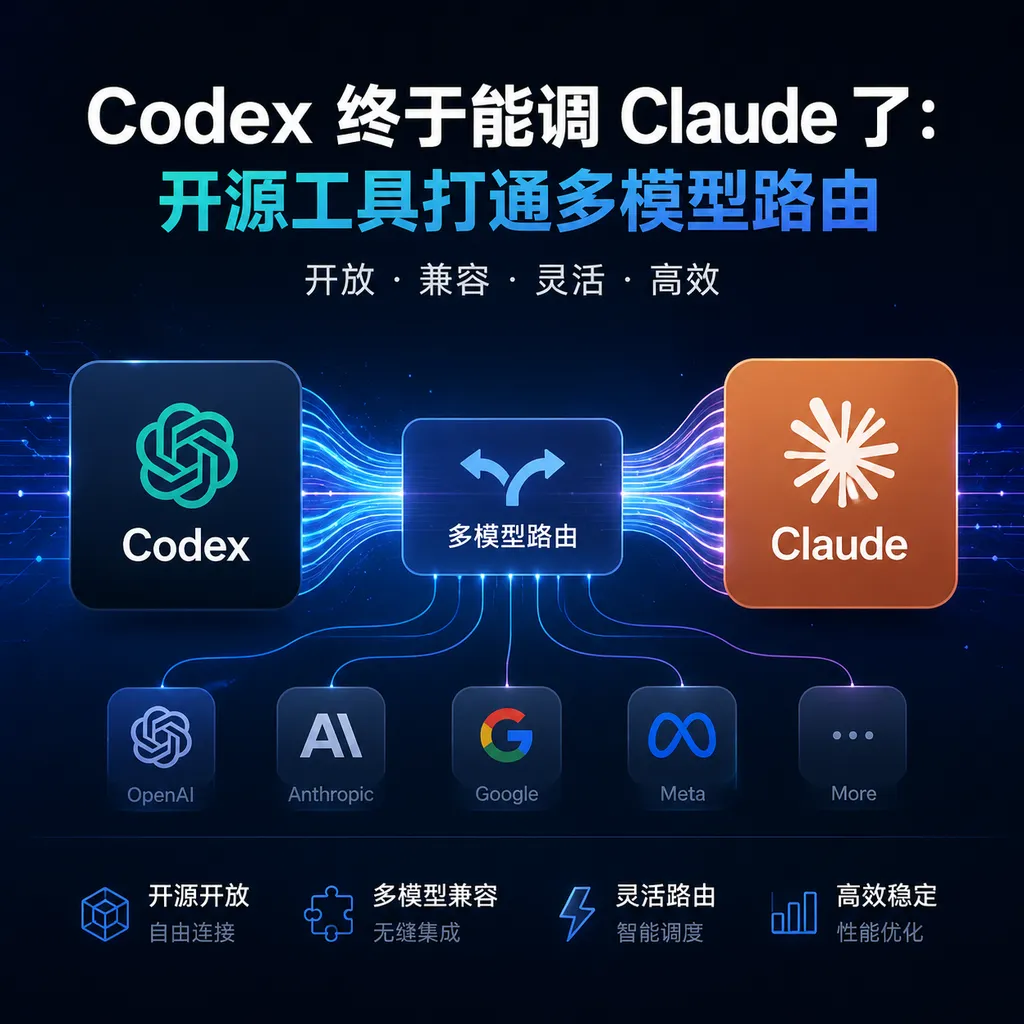
Developer open-sources the Neko Route tool, enabling OpenAI Codex to natively support integration with Claude, domestic models, and other providers, achieving shared 1M context window and seamless switching between models, thus resolving the AI programming assistant’s model lock-in dilemma.
Codex Can Finally Call Claude: Open-Source Tool Enables Multi-Model Routing
Want to switch to Claude for handling complex logic while coding with Codex? Previously, you could only use two separate windows, each with its own context. Now someone has solved that pain point.
Developer zoefix recently open-sourced Neko Route on GitHub — a multi-model routing layer specifically designed for Codex. Simply put, it turns Codex into a unified entry point — you decide which models it connects to underneath. OpenAI, Claude, domestic models — all can be used while sharing the same context window.
Why This Is Needed
Current AI programming tools have an awkward limitation: each vendor is building its own closed ecosystem. Codex is tied to OpenAI models, Claude Code is tied to Anthropic — if you want to mix use, you have to switch clients back and forth, losing all context.
In real development, different models indeed have their strengths. Some developers have tested this: GPT-5.4 works quickly with Codex but is worse than Claude Opus when it comes to writing and complex logic review; Claude Code is more nuanced in task comprehension, but frequent context compression slows down the workflow. Ideally, they should work together instead of being mutually exclusive.
Neko Route aims to solve this. It doesn’t alter Codex’s core architecture, but adds a routing layer outside — you specify the models in Codex’s config, and the tool forwards requests to the corresponding provider, then returns responses in a unified format to Codex.
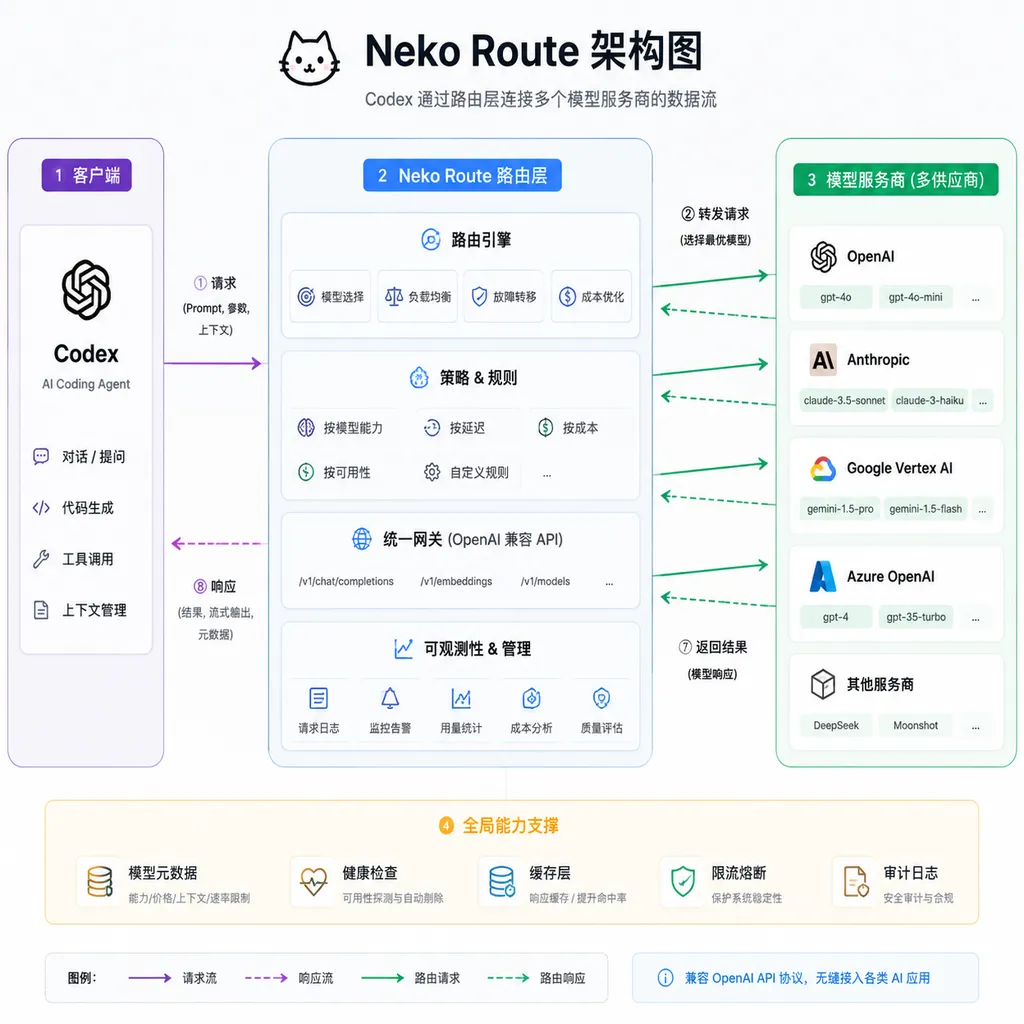
A Few Notable Capabilities
Unified Access Across Providers
Supports OpenAI protocol and Claude protocol, meaning almost all mainstream models can be integrated. Domestic models only need to be OpenAI-compatible (which most now are) — then with a simple configuration they can be used. For developers needing to switch between models for testing, this saves a lot of environment setup time.
1M Context Window Support
A practical feature. Many models now support million-token contexts, but clients often lag behind. Neko Route adapts at the routing layer so Codex can use these long-context models normally. Implementation-wise, it requires simulating scheduling semantics on the client side while ensuring the server instance has the correct parameter configuration enabled — not simply changing the model name.
Protocol Conversion
Interestingly, it supports protocol conversion calls from GPT-5.5 to gpt-image2. This means some special capabilities of new models can be adapted into Codex’s workflow via the routing layer.
Usage Statistics and Cost Tracking
Each call has complete logs, allowing precise cost calculation. This is highly useful in team use or cost-accounting scenarios.
Model Sharing
A slightly unusual feature — you can share locally configured models (including Claude protocol) with others. Supports concurrency limits, request limits, quota limits, implemented via TLS reverse tunnel. The example given by the author is “too much Codex quota and want to give some to friends,” but more realistic use cases include internal team resource sharing or small-scale service operation.
Trade-Offs in Implementation
Looking at the project’s design approach, the author chose a “don’t modify Codex core” route. This is pragmatic — Codex itself iterates quickly, and deep modifications would require changes after every official update, pushing up maintenance costs.
The routing layer approach is relatively decoupled, but adds network overhead, which might affect latency-sensitive scenarios. For most development tasks, the delay is negligible.
Protocol adaptation is another challenge. Claude’s API protocol and OpenAI differ significantly, especially in streaming response formats and token counting logic. Based on the project description, Neko Route handles these, but real-world compatibility still needs verification.
Comparison with Other Approaches
Similar needs have been tackled before. For example, some developers shared a method of directly having Codex call Claude Code via conversation: “When encountering writing tasks, call a Claude Code Opus 4.6 High Reasoning to write; after it finishes, continue.” This is flexible but not automated — each time you need to manually specify.
Others have tried adapting Claude Code to other models like Qwen3.6-Plus, but Claude Code’s protocol stack is heavily customized for Anthropic API, and hard adaptation requires “protocol parsing, streaming response alignment, token buffer rescheduling, model capability declaration spoofing” — a full set of system-level modifications, with a high barrier.
Neko Route’s approach is different: it keeps the client unchanged while adding a layer in between. For users, this reduces configuration costs and more easily keeps up with model updates.
Real Usage Scenarios
Imagine this workflow:
You start a code refactoring task in Codex. For initial code analysis and structural understanding, use GPT-5.4 for a quick pass; when faced with complex business logic that requires careful reasoning, switch to Claude Opus for deep thinking; for final code generation and formatting, switch back to GPT for speed. All done in the same window with context preserved.
Or another scenario: you need to handle an extremely long codebase document — hundreds of thousands of tokens. Previously you’d have to manually chunk it or give up. Now connect to a model that supports a 1M context and feed it directly.
Such flexibility is impossible with single-model tools.
Points to Watch
The project has just been open-sourced, so several aspects still need time for verification:
Stability — Will the routing layer itself become a new failure point? How does it perform under high concurrency or long-running scenarios?
Compatibility — Model APIs update frequently; can the routing layer keep up? Especially with protocols like Claude that change more often.
Community Activity — The vitality of open-source projects depends heavily on the community. From GitHub’s initial response, interest looks good, but ongoing maintenance cadence remains to be seen.
Also, since such tools involve API key management and forwarding, security is a sensitive topic. Before use, read the code carefully to ensure there’s no suspicious data reporting behavior.
Final Thoughts
Multi-model collaboration is a real need. Currently, major LLM vendors are busy building their own IDE integrations and agent capabilities, but users want to flexibly call whichever model is most suitable — not be locked into any one ecosystem.
Neko Route offers an approach: keep the client unchanged and manage multiple models via a routing layer. It’s not perfect, but it’s practical.
For developers who heavily use Codex, it’s worth a try. If you use multiple model APIs at once, combining platforms like OpenAI Hub with Neko Route can further simplify configuration — one key to access all models, eliminating the hassle of managing multiple provider accounts.
The project is already open-sourced, so if interested, you can check out the code and leave suggestions for the author.
References
- Neko Route GitHub Repository — project source code and documentation
- LINUX DO community discussion thread — author’s project introduction and community feedback


