
Codex Python SDK Released: AI Coding Can Finally Be Written Directly into Code
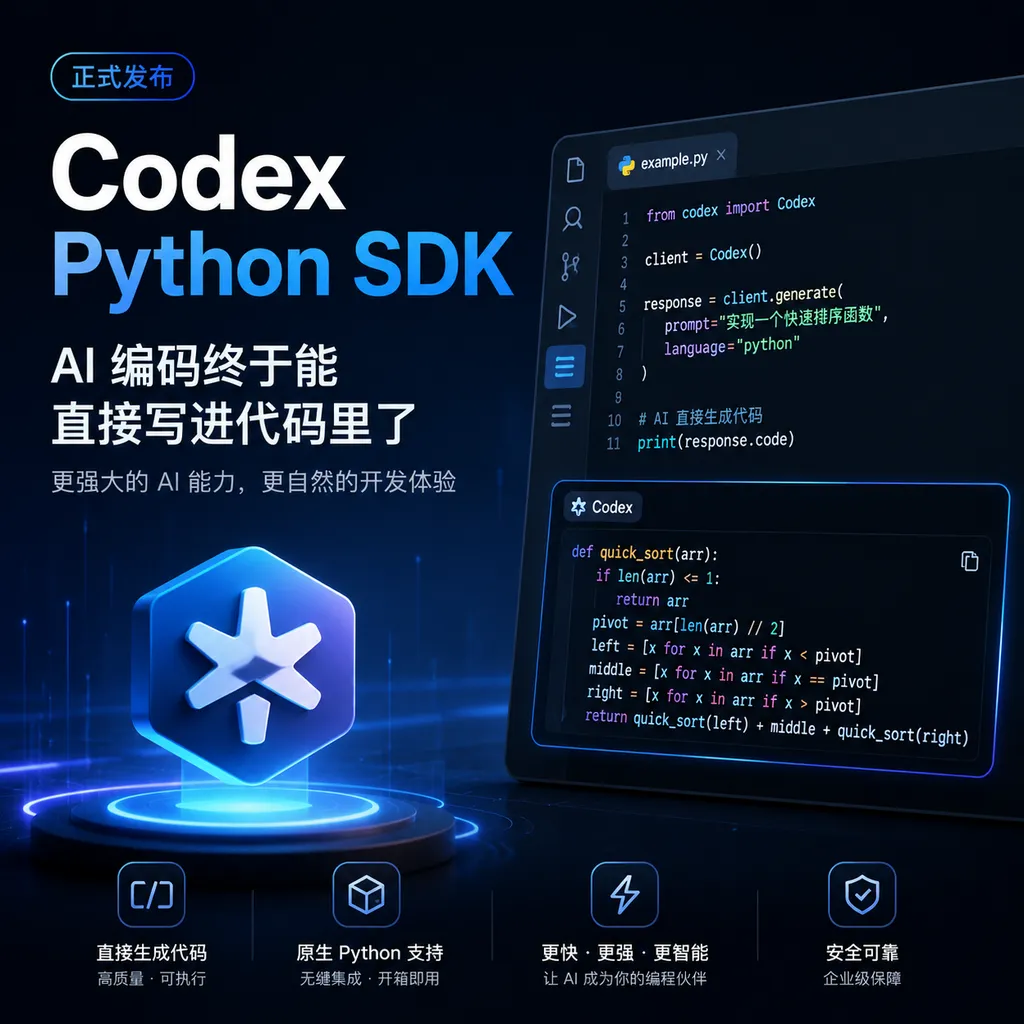
OpenAI has released the official Codex Python SDK, allowing developers to embed AI coding capabilities directly into applications with a single `pip install` command. It supports thread management, real-time streaming output, and sandbox permission control. This is not just an API wrapper, but a transformation of agentic programming capabilities into programmable infrastructure.
Codex Python SDK Release: AI Coding Can Finally Be Written Directly Into Your Code
OpenAI has just released the official Python SDK for Codex. With a single pip install openai-codex, Codex’s AI coding capabilities can be embedded directly into your Python applications.
This is a much bigger deal than it sounds.
From "Using Codex" to "Embedding Codex Into Code"
Over the past year, Codex has been a standalone product—you’ve used it in ChatGPT, invoked it from the CLI, or ran tasks in the Codex app. It’s powerful, but it’s a tool, not part of your codebase.
Now, that changes.
With this SDK, Codex becomes an object you can programmatically control. You can start a coding thread in Python, let it run a task, stream real-time progress, resume after interruptions, and even send images for it to examine. This isn’t just a simple API wrapper—it turns an agentic programming engine into composable infrastructure.
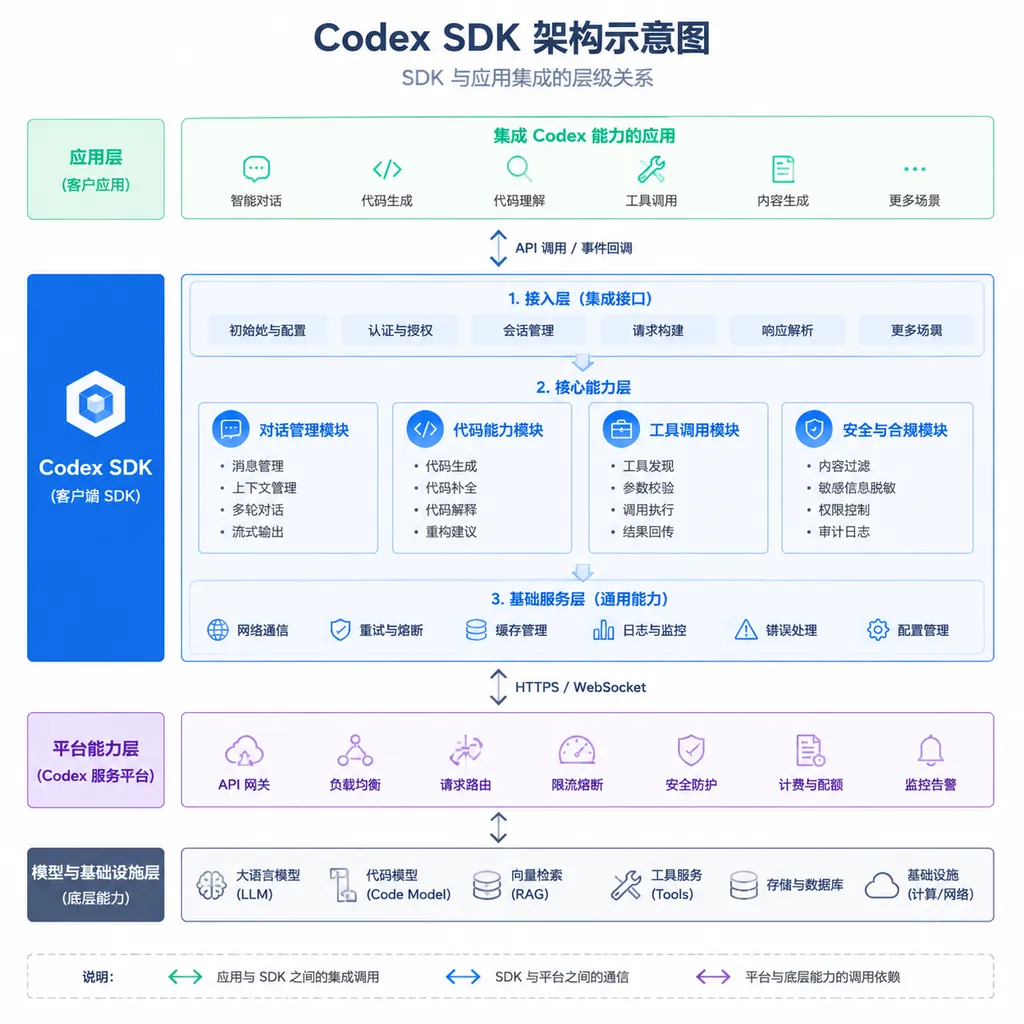
For example: let’s say you’re building an internal tool that generates data processing scripts from user descriptions. Previously, you might call the GPT-4 API to return a code string, then parse it, execute it, and handle errors yourself. Now, you can start a Codex thread that runs the code in a sandbox, executes tests, and returns results—you just handle the final output.
This is a leap from "AI helps me write code" to "AI helps me get the code running".
SDK Core Capabilities: More Than Just an API Call
Thread Management & State Persistence
Traditional LLM API calls are stateless—you send a request, get a response, and maintain all context yourself. The Codex SDK introduces the Thread concept, similar to the Assistants API, but optimized specifically for coding workflows.
A thread can:
- Maintain complete conversation history and code context
- Resume after a task interruption
- Preserve environment state across multiple turns
This means you can build truly long-running tasks. For example, you can have Codex spend 10 minutes refactoring a module, during which it may try multiple approaches and run several test cycles—your application just listens for status changes and doesn't have to manage the intermediate states.
Real-Time Streaming Output
Waiting for Codex to finish a long, complex task before getting results? Too slow. The SDK supports real-time streaming so you can see what Codex is thinking, which file it’s editing, and whether tests pass as they run.
This is especially useful for building developer tools. Imagine an IDE plugin where the user enters a request and can watch Codex’s thought process and code changes in real time—much better than waiting for a black-box result.
Sandbox Permission Control
This is a standout feature. The SDK allows fine-grained control over Codex’s sandbox permissions: which files it can read, which it can write, whether it can access the network, and whether it can execute shell commands.
Why is this important? Security.
When embedding AI coding in a production application, the big worry is whether it might break things—delete the wrong file? Send outbound requests? Granular permission controls let you confine Codex to a strict boundary so it can work without overstepping.
Multi-Modal Input
You can now send images.
It sounds small, but the scenarios are many:
- Send a UI screenshot to generate the corresponding component code
- Send an architecture diagram for system design understanding
- Send an error screenshot for debugging
This is far more efficient than pure text descriptions, especially in frontend development scenarios.
Technical Details: How to Use It
Installation is simple:
pip install openai-codex
The basic usage looks like this (pseudocode—use the official docs for exact APIs):
from openai_codex import Codex

# Initialize client
codex = Codex(api_key="your-key")

# Create a coding thread
thread = codex.threads.create(
    repo_url="https://github.com/your/repo",
    branch="feature-x"
)

# Send a task
run = thread.runs.create(
    instruction="Implement user login functionality including email verification",
    permissions={
        "file_write": ["src/auth/*"],
        "file_read": ["src/**"],
        "shell": False,
        "network": False
    }
)

# Stream progress
for event in run.stream():
    if event.type == "thinking":
        print(f"Codex is thinking: {event.content}")
    elif event.type == "file_change":
        print(f"File modified: {event.file_path}")
    elif event.type == "test_result":
        print(f"Test results: {event.passed}/{event.total} passed")

# Get final result
result = run.wait()
print(f"Task complete, {len(result.changes)} file changes generated")
Key points:
- Thread bound to a repository: A thread is tied to a specific branch of a code repo and Codex operates within that context
- Declarative permission settings: Limit exactly what Codex can and can’t do via the permissions parameter
- Event-driven streaming output: Different event types let you track task progress precisely
- Sync and async modes: Stream live updates or just wait for completion
What This Means: Typical Use Cases
Scenario 1: Automated Code Review
Integrate the SDK into your CI/CD pipeline to start a Codex thread whenever a new PR appears:
- Review the PR changes
- Analyze potential issues
- Run relevant tests
- Generate improvement suggestions
More context-aware than static analysis tools and faster than human review.
Scenario 2: Built-in Product Coding Capability
If you build low-code platforms, data analysis tools, or BI systems—you can now provide “natural language to code” as a built-in feature.
A user says “Write me a script to split this Excel file into multiple files by month.” The backend launches a Codex thread, generates the code in a sandbox, executes it, and returns results. The user may not even realize code was running behind the scenes.
Scenario 3: Bulk Code Migration
Need to migrate a large project from Python 2 to Python 3, or from JavaScript to TypeScript? Previously, this was labor-intensive. Now you could:
- Write a script to traverse all files needing migration
- Launch a Codex thread for each file
- Process in parallel, stream progress
- Auto-merge results and run regression tests
While AI won’t hit 100% completion, it might cut weeks of work down to days.
Scenario 4: Education & Training
Online coding education platforms can build intelligent teaching assistants:
- Offer real-time suggestions while students code
- Detect common mistakes and explain the reasons
- Adjust hint detail based on student skill level
Much smarter than pre-written hints.
How It Stacks Up Against Competitors
To be clear: this is the first officially provided SDK from a major model vendor designed for agentic coding.
Claude has Artifacts, but that’s more of a presentation layer; Cursor and Windsurf are IDE products, not SDKs; GitHub Copilot has an API, but mostly for completions, not as an agent.
Codex SDK’s positioning is: You build the product, I provide the coding intelligence infrastructure.
It’s a smart position. OpenAI can’t build products for every use case, but it can provide the capability layer for developers to build upon—like AWS provides compute and storage, OpenAI is starting to provide intelligence infrastructure.
Of course, there are concerns:
- Cost: Codex isn’t cheap—complex tasks may consume many tokens, making bulk use costly
- Latency: Even with streaming, a moderately complex task may still take tens of seconds to minutes—unsuitable for instant-response use cases
- Reliability: AI-generated code still requires review; full automation in production is risky
- Vendor lock-in: Deep integration may make switching costly
These aren’t unsolvable, but they must be weighed before adoption.
My Take: This Is the Direction, Not the Final Stop
As someone who has reported on AI for years, I see Codex SDK’s release as a milestone: AI coding is moving from “standalone tool” to “programmable infrastructure.”
This matters.
Previously, no matter how capable AI coding tools were, they sat alongside your workflow—you used them, then incorporated the results. Now, they can be part of your workflow—not just tools you call, but components in your code.
That said, some caution:
This SDK is best for scenarios where imperfection is tolerable—internal tools, prototypes, bulk processing. In high-reliability production environments, you still need human review and testing. AI coding is not yet infallible.
Also, the SDK’s design clearly favors “task-based” workflows—give it a well-defined assignment, and it executes. For exploratory coding—thinking on the go, adjusting direction—current experiences may not match IDE plugins.
But the direction is right. When AI coding becomes programmable infrastructure, developer tools will fundamentally change. Today’s IDEs, CI/CD, and low-code platforms will be reimagined.
The Codex SDK is the starting point for this transformation.
What Developers Should Do
A few suggestions:
- Start in non-critical use cases: Internal tools, personal projects, prototypes—first map out capability limits
- Design strict permission boundaries: Use SDK permission controls to limit Codex’s scope from the start
- Establish review processes: Even SDK-generated code must be verified by humans or automated testing
- Monitor costs: Track token usage to avoid unexpected bills
- Maintain portability: Avoid deeply coupling core logic with Codex SDK—keep the option to switch
OpenAI Hub already supports invoking Codex-related models. If you want to test before official integration, you can use OpenAI Hub’s API aggregation to call Codex and other major models with one key—making it easy to compare performance and cost.
The next chapter of AI coding is moving from “using tools” to “embedding into code.” This change has only just begun.
References
- “From Hauling to Pulling” 2026 AI Programming Tools Panorama - Zhihu Column: Analysis on Codex’s positioning as an agentic programming platform


