
Musk stated: SpaceX will release a brand-new LLM every month, with Grok 4.5 rivaling Opus.
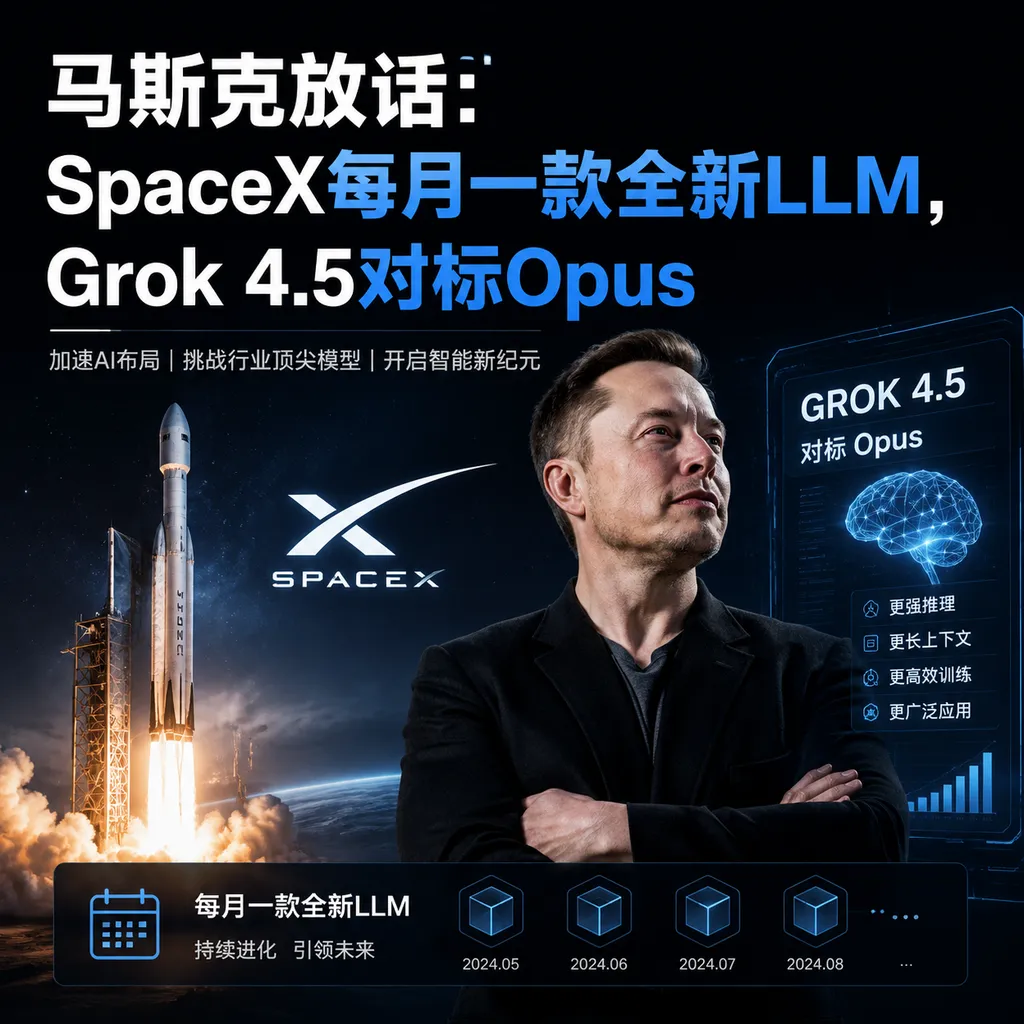
Musk announced that SpaceX will release a newly trained-from-scratch model every month this year. The first release, Grok 4.5, is based on the 1.5T-parameter V9 base model, and in private testing its performance is close to Claude Opus. However, against the backdrop of a large-scale departure of the pre-training team and the Colossus 1 computing power being sold to Anthropic, this pace seems more like a do-or-die battle.
One New Model Every Month — Coming from Musk Himself
At the end of June, Musk dropped a statement on X: “This year, SpaceX will release a newly trained-from-scratch LLM every month.” Alongside it came early info on Grok 4.5 — based on a 1.5T-parameter V9 base model, supplemented with Cursor data during the post-training phase, currently in private testing within SpaceX and Tesla. Early evaluations suggest “performance close to, or possibly surpassing, Opus.”
Sounds fierce. But for anyone familiar with this company's developments over the past two months, the first reaction is likely: Can you sustain this pace?
Let’s Recap the Background
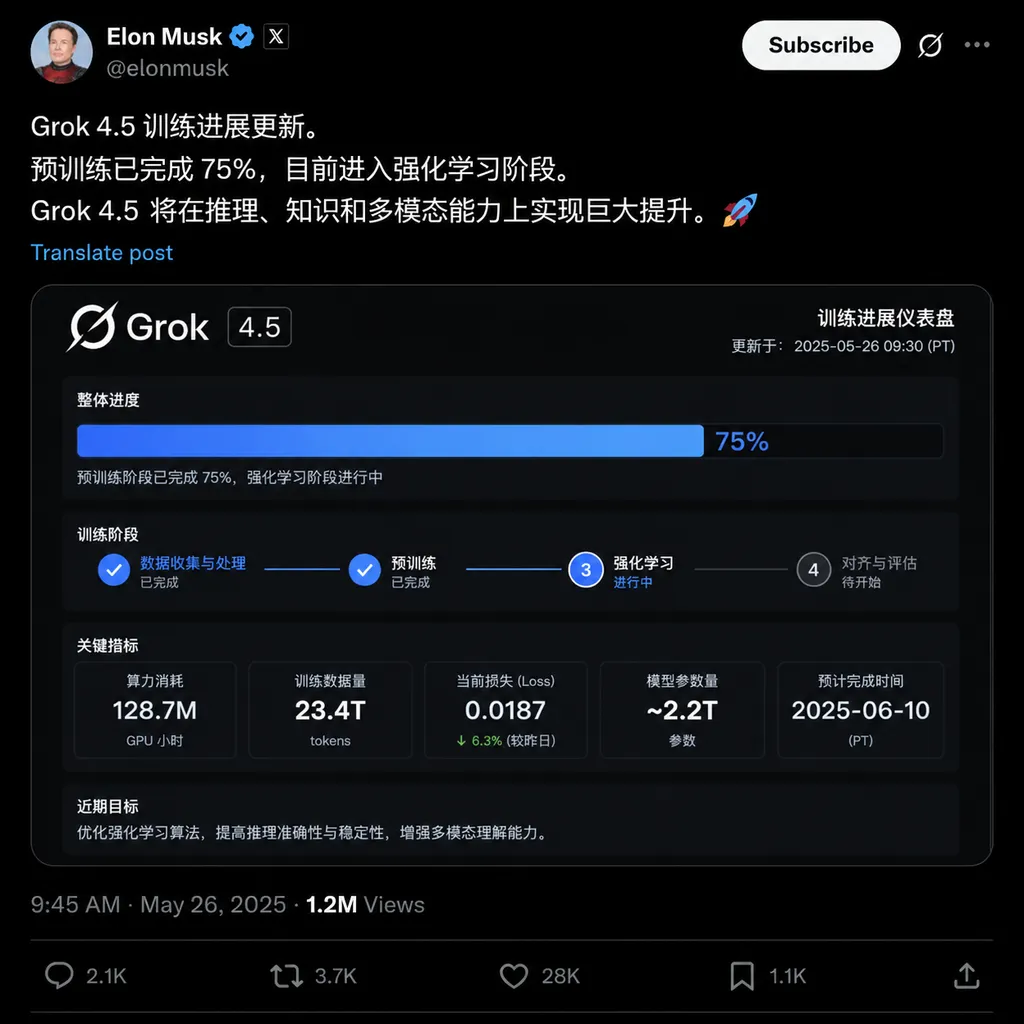
To understand the weight behind “a new model every month,” we need to go back to May.
May 6: xAI was officially merged into SpaceX and renamed SpaceXAI. A sub-three-year-old AI unicorn once valued at up to $200 billion vanished from the org chart.
May 7: Anthropic and SpaceX jointly announced that the entire Colossus 1 compute cluster — Memphis data center, 220,000 GPUs, 300+ megawatts — was rented to Anthropic for training Claude Opus 4.7. This caused an uproar in the community since Colossus 1 was xAI’s lifeline, built over the past two years.
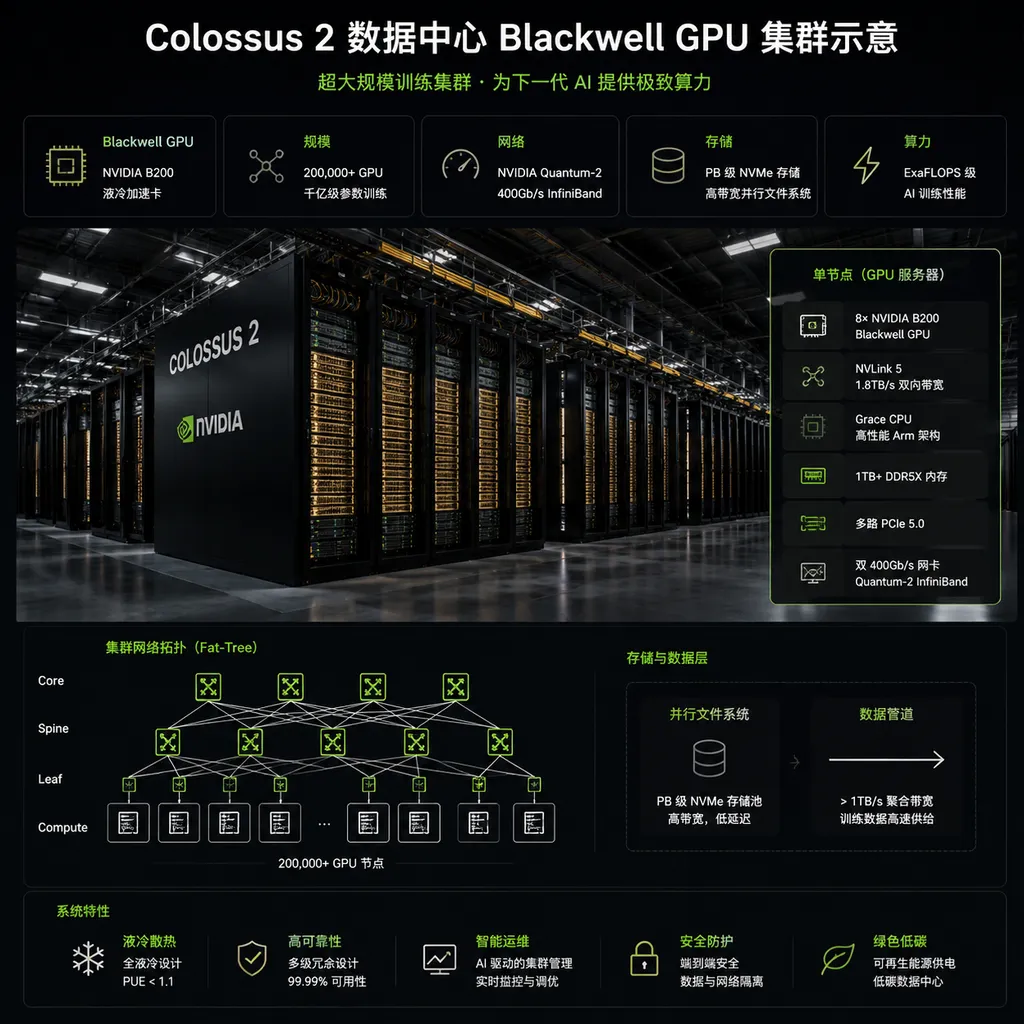
May 8: Musk posted on X refuting “Grok is dead” rumors, emphasizing that Colossus 2 was simultaneously training multiple new Grok models and that “Built harness” development was progressing smoothly. Note: he mentioned Colossus 2, not Colossus 1 — because 1 is no longer under his control.
Mid-May: More painful news emerged — over 50 xAI R&D staff left after the merger, including core members of the pre-training team. No need to explain their importance: they directly determine the upper limit of an LLM’s foundational capabilities. An AI company can lose sales, marketing, even inference optimization, but losing the pre-training team is like removing the engine.
So now, this commitment of “monthly from-scratch models” is made under these conditions:
- Major departure of core pre-training team
- Colossus 1 compute relinquished
- Colossus 2’s Blackwell cluster still ramping up deployment
- Internal MFU (Model FLOPS Utilization) previously reported to have been artificially inflated
At this point in time, saying this either means there’s real backing or it must be said.
Grok 4.5: 1.5T Parameters, V9 Base, Cursor Data
Ignoring the background, the Grok 4.5 details are worth unpacking.
1.5T-parameter V9 base model — In 2026, this scale isn’t outrageous—GPT-5.5, Gemini 3.1 Pro, Opus 4.7 are all in the trillion-parameter range. But the V9 designation means xAI/SpaceXAI’s pre-training pipeline never stopped. From Grok 1 to Grok 4, public version numbers were 1–4, but internally, base models have iterated to V9, meaning the foundational layer kept running, though mostly unreleased.
Post-training using Cursor data — This is notable. Cursor is one of the most popular AI coding tools for developers today, heavily using Claude and GPT series models behind the scenes. Feeding Cursor usage data into post-training has a clear purpose — boost coding ability.
Historically, Grok’s weakest spot has been the developer market. Claude Opus scored 80.8% on SWE-bench Verified, powering tools like Cursor, Windsurf, and Claude Code; Gemini 3.1 Pro scored 94.3% on GPQA. Grok has tried to catch up but never secured a foothold in enterprise and developer scenarios. Using Cursor data for post-training directly targets Opus’s stronghold.
“Close to, or possibly surpassing Opus” — In Musk’s lingo, this should be taken with caution. Even discounted, benchmarking internally against Opus during private testing suggests the internal numbers aren’t bad.
What “Every Month” Means Technically
This is the most worth discussing.
A 1.5T-parameter model trained from scratch typically takes 2–4 months in the industry, assuming mature data pipelines, training frameworks, and scheduling systems. GPT-4 training took ~3 months, Claude Opus 4 allegedly took more than 4 months.
Achieving “new from-scratch model every month” suggests:
- Greatly reduce parameter count — e.g. base to 300–500B range, paired with high-quality data and MoE architecture, can finish in a month.
- Run multiple training pipelines in parallel — Train several models on Colossus 2 simultaneously, releasing one per month. This demands extreme scheduling efficiency.
- Loosen definition of ‘from-scratch’ — e.g. reset checkpoint but reuse some data preprocessing, or spin off from a base model for large-scale continued pretraining.
Given Musk’s history, all three are possible; most realistically, the second — once Colossus 2 is large enough, treat it as a multi-model pipeline.
A key issue: MFU
Reports indicated xAI researchers repeated the same training experiment to boost MFU figures artificially. If Colossus 2’s actual utilization still sits at 11–15%, more GPUs won’t help. A 100k card cluster with 45% utilization could outperform a 300k card cluster at 12%.
This bottleneck isn’t solved by hardware — it needs network protocols, scheduling systems, training frameworks, exactly the engineering capabilities hardest to replace after losing the pre-training team.
What Competitors Are Doing
Looking sideways at peers clarifies Grok 4.5’s awkward timing.
- Claude Opus 4.7 — Just acquired Colossus 1 compute for training, rolled out on Cursor in June.
- GPT-5.5 — OpenAI’s training compute entirely transitioned to Blackwell; expect major moves later this year.
- Gemini 3.1 Pro — Scored 94.3% on GPQA; Google’s internal TPU v6 cluster efficiency keeps improving.
- DeepSeek, Qwen series — Open-source camp keeps iterating frequently; domestic developer ecosystems already mature.
For Grok to break out with “monthly updates” in this landscape, there’s one logical route — use release frequency to build presence, then have one or two versions truly dominate a niche (e.g. code or real-time info). This mirrors SpaceX’s early “rapid iteration, tolerate failure” rocket R&D philosophy.
But rockets can explode and be rebuilt; a failed model release tarnishes developer reputation for good. From Grok 1 to Grok 4, benchmarks show progress, but enterprise and developer markets remain untouched — the root cause isn’t too few models, but no “must-use” standout.
Signals Worth Watching
If “monthly model” happens, watch:
- Grok 4.5’s context window and tool-use ability — If benchmark numbers are good but agent performance is mediocre, the post-training data may just be “cramming for tests.”
- Whether Cursor officially integrates Grok — Hard indicator of Grok 4.5’s coding credentials; developers vote with usage.
- Distinct differences in Month 2/3 models — If each release is just fine-tuning the same base, “from-scratch” claim collapses.
- Whether MFU figures are public — Most critical metric, reveals SpaceXAI’s engineering foundation.
- Speed of pre-training team replenishment — After 50+ departures, who takes on V10/V11 base model development?
Final Thoughts
Musk’s promises are always to be discounted — a consensus formed over the last decade-plus. But even at a third of face value, “monthly from-scratch LLM” means SpaceXAI’s investment in compute allocation, training pipelines, and data flow would be among the industry’s highest.
More importantly, it shows: even after the merger, personnel shake-up, and compute handover, Musk isn’t leaving the LLM table. Colossus 1 was monetized for Anthropic to absorb losses; Colossus 2 on Blackwell is a continued bet with real capital.
For developers, the real impact will show in months. If Grok 4.5 matches Opus in some scenarios, it’s good news for the API market — another high-water option, more bargaining power.
OpenAI Hub will keep tracking Grok 4.5’s public release points. Once its API opens, it’ll be aggregated alongside Opus 4.7 and GPT-5.5, letting you directly compare their real-world performance in your business scenarios — far more reliable than benchmarks.
More models aren’t bad, but the key is who can turn “more” into “better.”
References
- Musk says SpaceX will release a new from-scratch model every month this year - linux.do — Original Musk post discussion and early Grok 4.5 details


