
HP Teams Up with OpenAI: Going All-In on the Frontier Agent Platform

On June 28 local time, HP announced that it has reached a strategic cooperation with OpenAI to fully deploy the OpenAI Frontier Agent Platform across its global operations, covering the entire chain of customer experience and internal operations, and accelerating the company’s AI-native transformation.
HP and OpenAI Form Strategic Partnership: Full Deployment of Frontier Agent Platform to Accelerate AI-Native Transformation
Industry News | June 29, 2026
On June 28, 2026 local time, global PC and printing giant HP Inc. officially announced a major strategic partnership with OpenAI: HP will fully deploy the OpenAI Frontier agent platform across its global business, using it as a core driving force to propel a new round of transformation and growth plans. Under the agreement between the two parties, the Frontier platform will be deeply embedded in HP’s various business processes, with the goal of enhancing the customer-facing experience across the board and systematically optimizing internal operational efficiency.
This marks a landmark case where, among the first six flagship customers (HP, Intuit, Oracle, State Farm, Thermo Fisher, and Uber) following OpenAI’s official release of Frontier in February this year, HP is the first to officially announce global, full business-line rollout, and is viewed as an important win for OpenAI in the enterprise AI agent sector.
1. Core of the Partnership: Paradigm Shift from “Tool” to “Coworker”
Unlike most previous “enterprise adopts ChatGPT” type collaborations, HP is implementing a full-stack strategic agreement this time. Based on publicly disclosed information, the scope of this cooperation can be summarized as three layers:
- Customer-facing: HP will introduce Frontier agents into pre-sales consulting, post-sales support, device management, subscription services, etc., for both consumer and enterprise customers, enabling 24/7 high-quality interactions;
- Internal operations: Covering key functions such as supply chain, financial forecasting, R&D collaboration, HR, marketing, and sales operations, where AI “coworkers” directly take over repetitive processes and assist with decision-making;
- Products and platforms: Future HP PCs, printers, workstations, and subscription services (such as HP+, Instant Ink, Workforce Solutions) will natively integrate Frontier capabilities, forming a next-generation “hardware + AI agent” product model.
HP emphasizes this deployment is not a “pilot project” but a global, across-all-business-lines unified integration. This contrasts sharply with common enterprise AI rollouts in recent years, which often start with a PoC in a single department before scaling, and shows HP’s uncommon high-confidence bet on OpenAI's tech stack.
2. What is OpenAI Frontier? An “Enterprise AI Operating System” Worth Not Overlooking
OpenAI Frontier was officially released in February 2026 and is described by the company as “a unified platform to help enterprises build, deploy, and manage AI agents.” Its core goal is to upgrade the ChatGPT-era “chat assistant” into an AI coworker that can operate long-term in production environments.
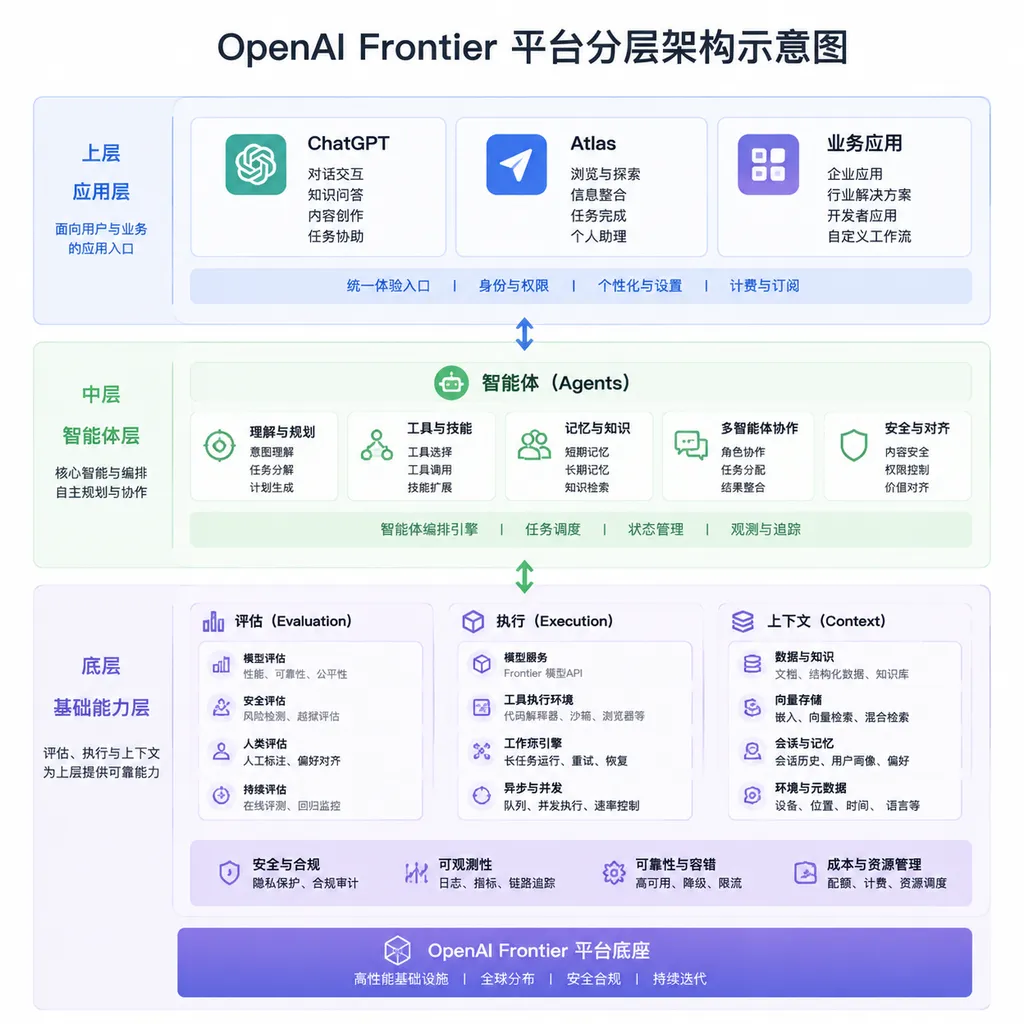
According to OpenAI’s official documentation, Frontier’s capability stack is roughly divided into four layers:
| Layer | Capability | Typical Use | | --- | --- | --- | | Access Layer | ChatGPT Enterprise, OpenAI Atlas, business applications | Multiple entry points for employee-agent collaboration | | Agent Layer | Organization-built agents, official OpenAI agents, third-party agents | Role-based AI “coworkers” | | Platform Layer | Evaluation & optimization, agent execution, business context management | Governance, observability, auditability | | Foundation Layer | Identity & permissions, security compliance, monitoring & auditing | SOC 2 Type II, ISO 27001, etc. |
Compared with traditional LLM API calls, Frontier offers several designs that are highly attractive to enterprises:
- Shared Context: Agents can continuously access enterprise databases, CRM, internal applications, share the same “institutional knowledge” with employees, and accumulate knowledge over time;
- Onboarding & Feedback-based Learning: Each agent has an onboarding process like a new employee, and evolves through feedback from real work;
- Clear Permissions & Boundaries: Integrated into the corporate IAM system to prevent over-authorization;
- Cross-interface Collaboration: Agents are not bound to a single UI and can appear seamlessly in ChatGPT, Atlas browser, or business systems;
- No Need to Start Over: Compatible with existing enterprise data, apps, and deployed agents—no mandatory redeployment.
OpenAI describes this model as enabling enterprises “to become cross-business AI partners rather than remain in isolated use cases.”
3. Why is HP the “First to Take the Leap”?
HP is not naturally known as an AI-centric company, but in recent years, it has been active in areas like “AI PCs,” “AI workstations,” and “AI printing solutions.” Strategically, its choice to deeply bind with OpenAI’s Frontier is notably pragmatic.
1. Transformation Pressure: PC and Printing Businesses Need a New Narrative
Although the global PC market has somewhat recovered under the AI PC wave, overall growth remains limited; the printing business faces structural decline. HP’s recently disclosed “future growth plan” clearly lists “AI-driven servitization and subscription” as key pillars. Deploying Frontier allows HP to:
- Upgrade from “selling hardware” to “selling hardware + AI agent services”;
- Elevate services like device management, consumables subscription, and security protection into an “AI coworker” experience;
- Present enterprise clients with a richer “AI workspace” story than just “selling computers.”
2. Internal Efficiency: Self-Optimization of a Global Giant
HP’s tens of thousands of employees operate across more than a hundred countries and regions. Internal processes have long suffered from silos between ERP, CRM, IT service desk, and other systems. Frontier’s cross-system business context capabilities provide a direct remedy:
- Finance, supply chain, HR, and other functions can use the same agent framework;
- Agents can collaborate across SAP, Oracle, ServiceNow, Microsoft 365;
- Unified evaluation and monitoring allow IT departments for the first time to “manage AI like they manage human employees.”
3. Strategic Security: Betting on OpenAI’s Moat
OpenAI already holds a strong lead in the enterprise AI platform market, and Frontier especially emphasizes SOC 2 Type II, ISO/IEC 27001/27017/27018/27701, CSA STAR and other international compliance certifications. For a multinational listed company like HP, this is a key prerequisite for scaling AI agents while meeting legal, compliance, and audit requirements.
4. Why Frontier’s “No Mandatory Rebuild” Philosophy Matters
One of the biggest reasons enterprise AI projects fail is “tearing down existing systems for AI.” Frontier takes a very clear stance—work with system teams, use without forcing redeployment.
Specifically:
- Preserve existing data formats: No need to rebuild data lakes or re-label data;
- Keep existing agents: In-house, purchased, and third-party agents can coexist within the same framework;
- Preserve existing application entry points: Employees can continue invoking AI coworkers via Salesforce, SAP, Teams, or custom workbenches;
- Unified governance layer: Evaluation, monitoring, permissions, audit centralized at the Frontier layer.
This is a key reason HP could announce “global deployment” so quickly—it didn’t need to pause current IT roadmaps for the system, but allowed Frontier to be embedded rather than replaced.
5. Industry Chain Reactions
HP’s announcement sends several strong signals to the entire enterprise AI industry:
-
PC Giants Moving Towards Agentization is the General Trend
- After fierce competition at the AI PC hardware level, “AI coworkers” are becoming the new differentiation battlefield;
- More hardware manufacturers will likely make platforms like Frontier a standard capability.
-
Competition in the AI Agent Platform Track Intensifies
- OpenAI Frontier, Microsoft Copilot Studio, Google Agentspace, Anthropic enterprise offerings will directly compete;
- Customer criteria for platform selection are shifting from “how strong the model is” to “how complete the governance is and how compatible the ecosystem is.”
-
AI-Native Reshaping of Enterprise IT Architecture
- IAM must incorporate “AI coworkers”;
- Monitoring, auditing, and risk management systems must be upgraded for large-scale agents;
- Data platforms, knowledge bases, and business applications will be redesigned to “serve agents” as a primary goal.
OpenAI’s Frontier product documentation includes a weighty statement: “Over the next decade, enterprises that deeply integrate AI into their infrastructure will continue to accumulate and amplify competitive advantages.” HP clearly does not want to miss this window.
6. Points Worth Watching
Although the announcement has not yet disclosed specific contract values or phased timelines, based on public information there are several points to track:
- When will HP’s consumer products natively integrate Frontier? For example, will next-gen OmniBook and ZBook series have built-in “AI coworker” entry points?;
- Agentization of printing and office subscription services: Will HP+, Instant Ink, Managed Print Services adopt agents as next-gen delivery formats?;
- Coordination and contest with Microsoft ecosystem: HP has long been a core partner for Windows and Microsoft 365. Introducing Frontier means embracing two agent ecosystems simultaneously;
- Data sovereignty and cross-border compliance: Regulations in markets like the EU, Mainland China, and India on enterprise AI data flows will directly impact Frontier’s global rollout within HP.
7. Summary
The June 28 announcement may seem like just another “collaboration between a hardware giant and an AI company,” but at the 2026 timepoint its implications run much deeper:
- For HP, it is a strategic choice to bet the next decade on ‘AI coworkers’;
- For OpenAI, it is a critical endorsement and scalable reference case for Frontier in the enterprise market;
- For the entire enterprise IT industry, it is a real-world exercise in AI no longer being a tool, but being a coworker.
It is predictable that starting in the second half of 2026, “which agent platform to conduct business on” will become as important a strategic question for every CIO and CTO as “which cloud to conduct business on” was over the past decade. HP has given its answer—who will be next?
References
- ITHome: HP and OpenAI Form Strategic Partnership, Fully Deploy AI Agent Platform Frontier to Accelerate Enterprise Transformation — Core coverage of the partnership, detailing Frontier’s capabilities and first-batch client list.


