
China Mobile Sets Up Token Office, Aiming to Become the Utilities Provider of the AI Era
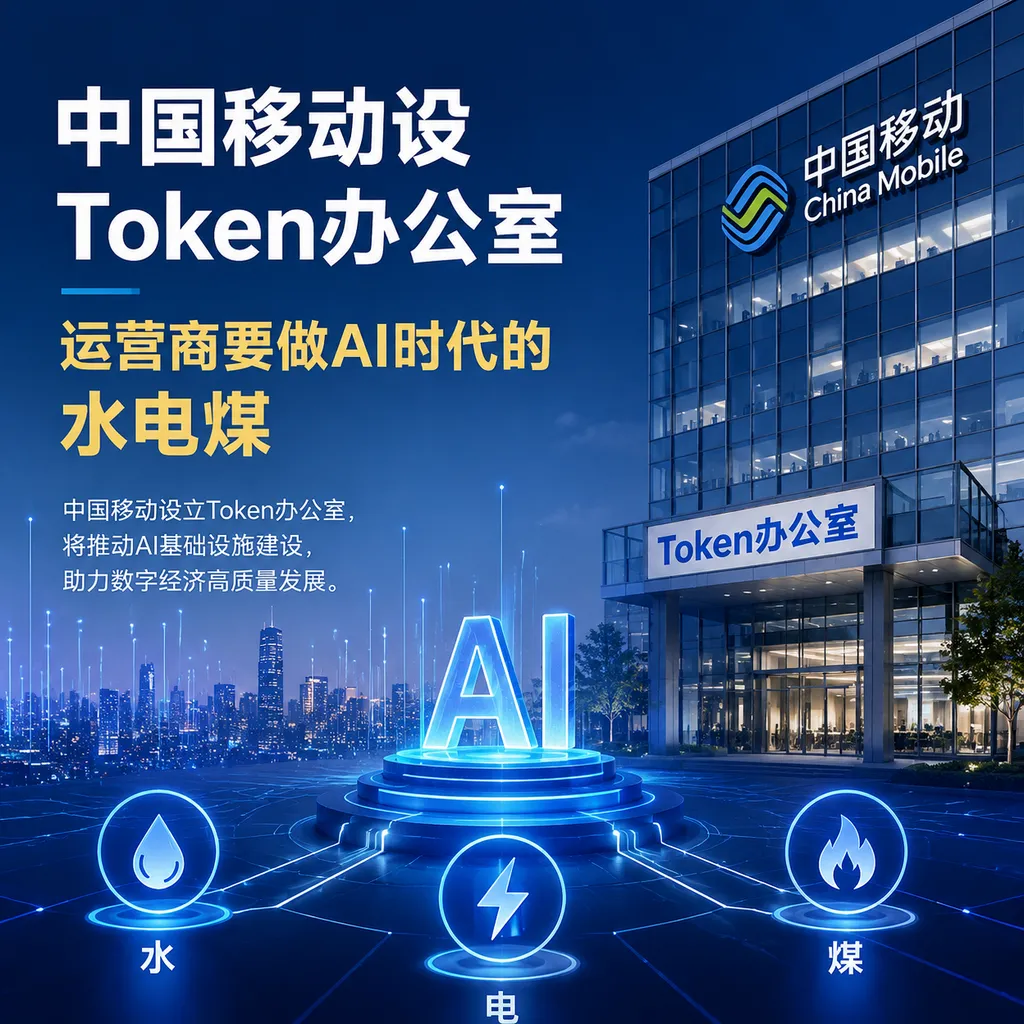
China Mobile has recently set up a new Token Office at the group level, led by core executives, with the General Manager of the Strategic Development Department serving as Executive Deputy Director. The aim is to integrate the entire process of creating, delivering, and applying Tokens, benchmarking against Alibaba's ATH, and bringing together the resources scattered across the Computing Office, Mobile Cloud, and Digital Intelligence Business Unit.
China Mobile Sets Up Token Office, Aiming to Become the Utilities Provider of the AI Era
On June 28, C114 Communications reported that China Mobile has established a new organization at the group level — the Token Office. IT Home followed up the next day to confirm that this organizational adjustment had just been implemented.
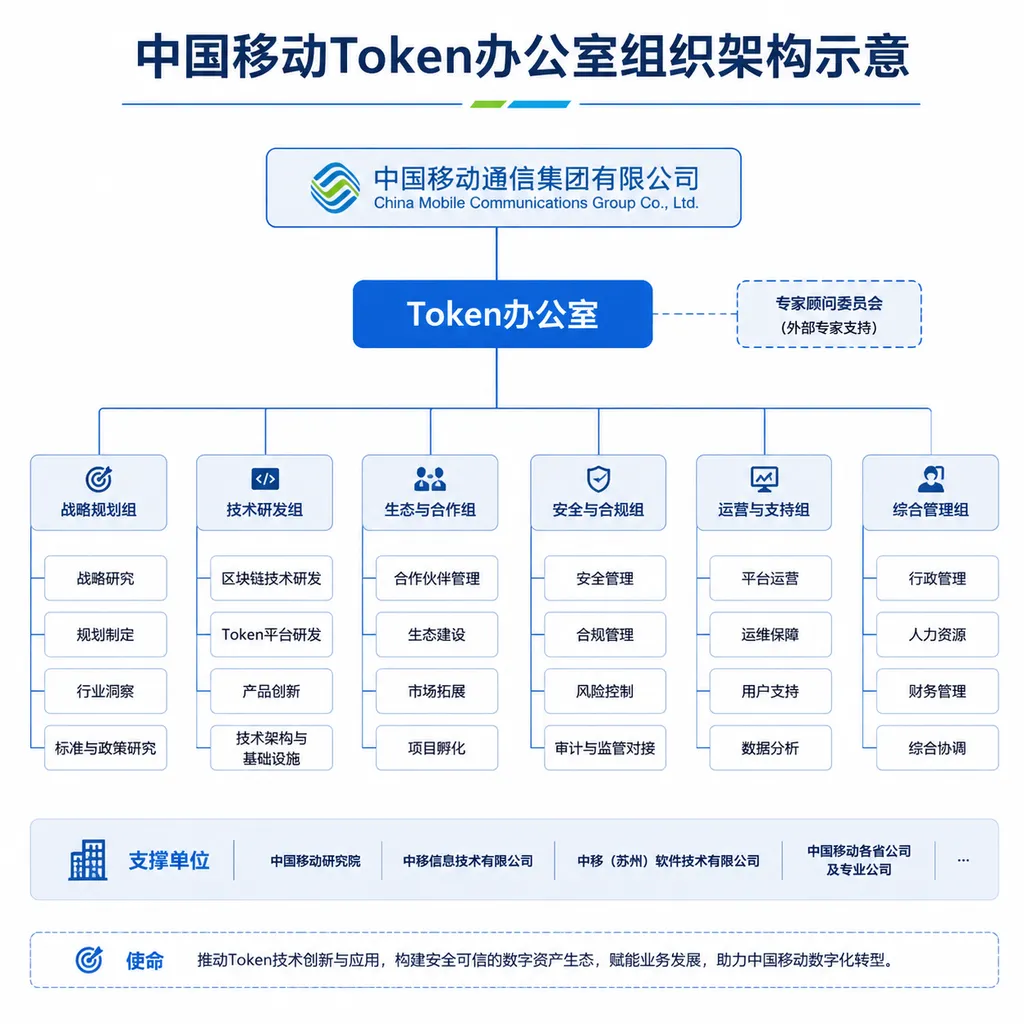
This is not an ordinary departmental reshuffle. Compared with the previous Special Computing Power Office, the Token Office is clearly at a higher level: it is led directly by core group leadership, with the General Manager of the Strategic Development Department serving as Executive Deputy Director. In other words, this is an organization capable of cutting across multiple secondary departments at the group level, not just a small team under a business unit.
I. Why Now?
The timing is delicate. Just days earlier, on June 24 at the opening ceremony of MWC26 Shanghai, China Mobile Chairman Chen Zhongyue delivered a keynote speech titled “Mobile Intelligence Without Boundaries for All”, explicitly expanding the meaning of “Mobile” from Mobile Communication to Mobile Computing and Mobile AI. Three days later, the organizational structure followed suit.
For those in the know, the pace makes sense. Strategic adjustments at telcos are rarely impulsive — they are typically the result of a year or more of deliberation. In January, China Mobile quietly set up a Special Computing Power Office. Less than six months later, the Token Office was launched — a clear sign of rapidly growing urgency about AI business within the group.
More tangible pressure comes from the financials. From January to May this year, the big three Chinese telcos had combined revenue of 735.5 billion yuan, down 1.9% year-on-year. Traditional voice and SMS peaked long ago, and 5G penetration is nearing saturation. Looking ahead, it’s hard to find new growth without touching AI.
II. What Exactly Is the Token Office Meant to Solve?
Industry insiders have a clear benchmark: Alibaba’s Alibaba Token Hub (ATH) business group.
Within China Mobile, AI-related operations were originally scattered across several secondary departments:
- Special Computing Power Office: Oversees computing power strategy and infrastructure deployment
- China Mobile Cloud: Handles cloud and computing power platform operations
- Digital Intelligence Business Unit: Responsible for model development and AI capability building
- Marketing Department: Manages consumer-side (C-end) Token packages and marketing
- Government & Enterprise Business Unit: Manages industry adoption among business and government clients
This structure worked fine for traditional products like voice, broadband, and leased lines, where each product line was relatively independent. But Tokens are inherently cross-cutting: computing power produces Tokens, Tokens travel through the network, and finally some application consumes them. If production, delivery, and consumption are each managed by different departments, the result is siloed operations, internal conflicts, and no unified interface for customers.
According to reports, the Token Office’s core mission is to connect the entire process of “creating Tokens, transmitting Tokens, and applying Tokens”. The analogy here: treat Tokens as the water, electricity, and gas of the new era. The telco’s job is end-to-end operations, from the power plant (computing center) to the grid (network delivery) to the socket (user applications).
III. Reviewing China Mobile’s Token Business Moves
To understand the significance of the Token Office, we need to view China Mobile’s recent actions in sequence:
January: Established the Special Computing Power Office to coordinate computing power strategy group-wide.
May 8: At the 2026 Mobile Cloud Conference, officially launched the Token Operations Ecosystem and initiated the Token Operations Ecosystem Alliance with Tencent, Alibaba, Huawei, ZTE, iFlytek, and others. Vice President Zhang Dong announced four priorities — strengthen the Token user base, promote Token circulation across all domains, activate Token ecosystem vitality, and build full-chain Token synergy.
May: Rolled out token-based subscription plans, starting at 5 yuan/month, packaging Tokens like a mobile data plan for C-end customers. Bundled with cloud PCs and cloud phones, allowing direct Token consumption in AI apps like Tencent WorkBuddy.
June 24: At MWC26 Shanghai, Chen Zhongyue announced the “Mobile AI” strategy.
June 28: Token Office made public.
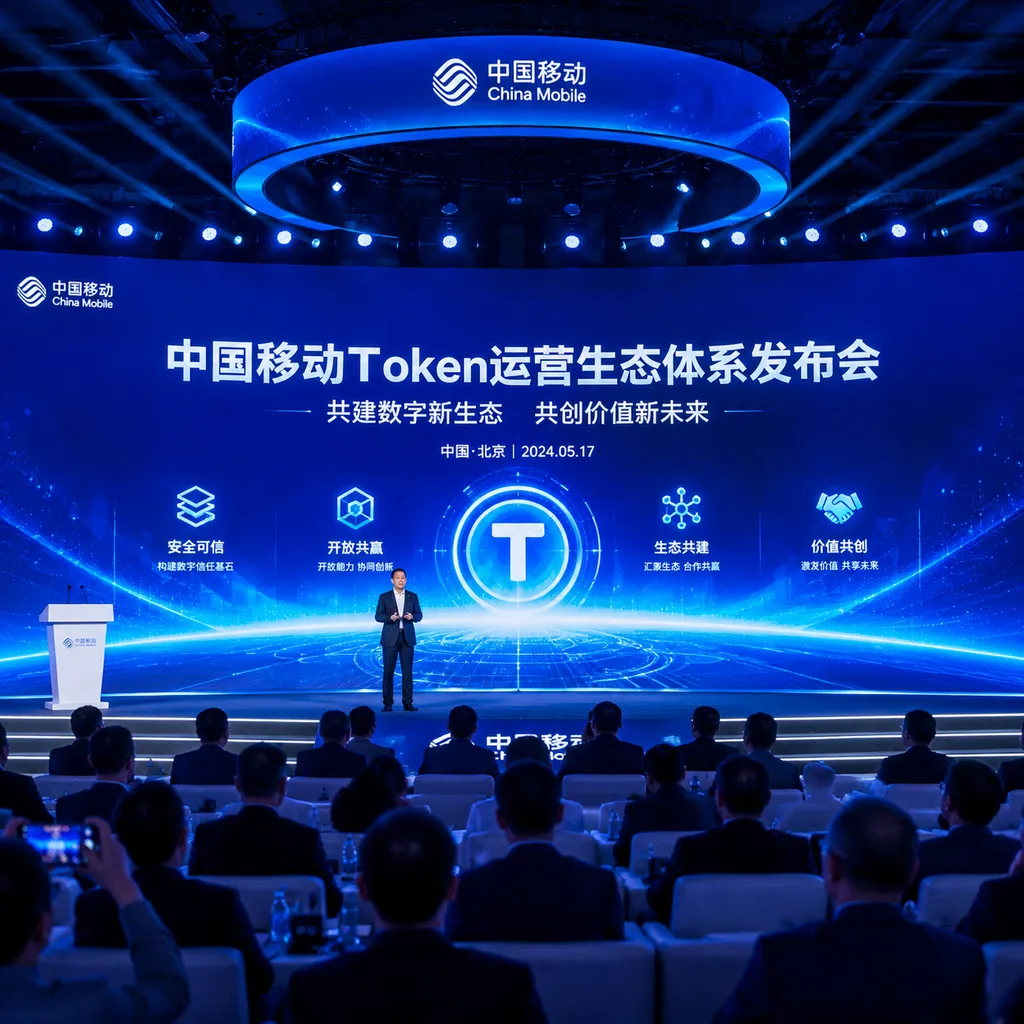
This timeline shows the telco isn’t simply creating a gimmick department on a whim. From strategy release, to ecosystem alliances, to product launch, to organizational backbone, it’s a complete playbook: lay the ecosystem groundwork first, then use organizational restructuring to align internal resources.
IV. Is the Token Package a Good Business?
To be honest, opinions are divided.
Optimists say: the telco already has hundreds of millions of existing users, plus mature billing, authentication, and customer service systems. Adding Token packages to the monthly phone bill comes at virtually zero customer acquisition cost. A 5-yuan/month package is a numbers game for the telco and lowers the trial barrier for users.
Skeptics counter: The Token price war has already hit rock bottom. In 2024, large model API prices have been dropping monthly, with players like DeepSeek, Tongyi, and Doubao in a bitter race to the bottom. For a telco acting as a middleman, either it buys wholesale from big model providers and resells with no price advantage, or it runs its own models and faces both cost and performance challenges.
The deeper issue is user profile. Buyers of the 5-yuan Token plan are likely light trial users, with very low per-user ARPU. Heavy AI users (developers, enterprise customers) are already directly connected to API platforms or major providers — they won’t go through the telco. The Token Office will need an answer for where the incremental demand is supposed to come from.
My view: Running Token operations is a compulsory course for telcos, but unlikely to be a true second growth curve. This is more of a defensive maneuver — to avoid becoming “just the dumb pipe” in the AI era, they must secure a spot somewhere in the value chain. How deep they can embed depends on how much their ecosystem partners are willing to share.
V. Compared with Alibaba ATH, Where Are the Gaps?
Given that Alibaba ATH is the benchmark, let’s compare.
ATH is backed by Tongyi Qianwen, Alibaba Cloud, Quark, DingTalk, and Taobao — a fully-owned model–platform–application stack. Tokens circulate internally at Alibaba, with high closed-loop efficiency and abundant native consumption scenarios.
China Mobile’s hand is different:
- Computing power: Yes, and at scale — the Mobile Cloud intelligence centers are distributed nationwide
- Models: In-house “Jiutian” large model plus agency for third-party models; based on public evaluations, usable but not top-tier
- Application entry points: Lacking — there’s cloud PCs and cloud phones, but daily active use and stickiness are far below consumer internet apps
- Ecosystem reach: Over 1 billion users, but significant education cost between these users and “high-frequency AI consumption”
So, for telcos, going solo in Token operations is hard — they must rely on ecosystem alliances to bring in Tencent, Alibaba, Huawei, etc. But these partners are also in the Token business — why would they hand over traffic to a telco? The likely answer: exchange network and computing power for distribution channels. The telco provides infrastructure and user access, tech giants provide models and applications, and revenue sharing will likely become the key battleground.
VI. What This Means for Developers
For developers, two questions matter: are Tokens cheaper, and is the service more stable?
In the short term, telcos entering Token operations will further drive down market prices — good news for end users. In the longer term, if a telco really can integrate cloud, network, computing power, models, and applications, there could be differentiated low-latency end-to-end Token services — valuable for edge scenarios like AI smartphones, AI glasses, or humanoid robots, where network–computing synergy is critical and telcos have home-field advantage.
However, note that current telco Token plans mainly suit light C-end use cases. For heavy users like developers, factors such as flexibility, model choice, and API stability still make specialized AI API platforms a better fit.
As a side note, if you need to switch flexibly between multiple mainstream models and compare results, platforms like OpenAI Hub (openai-hub.com) can be handy — one key to access GPT, Claude, Gemini, DeepSeek, with direct access in China and OpenAI-compatible format, avoiding the hassle of juggling multiple vendors.
VII. Final Thoughts
The Token Office move is, in essence, an organizational response by a traditional state-owned enterprise to the AI era. From the Special Computing Power Office to the Token Office, from Mobile Communication to Mobile AI, the telco’s transformation is faster than many would expect.
But organizational change is just the beginning. Whether the Token business actually works will hinge on three things: can self-owned applications scale, will ecosystem partners share the pie, and how long can the price war be sustained. None of these will be easy.
At the very least, putting core group leadership in charge shows that China Mobile is serious.
References
- China Mobile Sets Up Token Office, Group Leadership in Charge – IT Home: Original report revealing the Token Office’s organizational rank and leadership
- Token Operations: Can China Mobile Build Another “Mobile Dream Network”? – Zhihu Column: In-depth analysis of China Mobile’s Token operation strategy


